
Skip to Content
  • 오피스

    오피스

    미주
    • Atlanta
    • Austin
    • Bogota
    • Boston
    • Buenos Aires
    • Chicago
    • Dallas
    • Denver
    • Houston
    • Los Angeles
    • Mexico City
    • Minneapolis
    • Monterrey
    • Montreal
    • New York
    • Rio de Janeiro
    • San Francisco
    • Santiago
    • São Paulo
    • Seattle
    • Silicon Valley
    • Toronto
    • Washington, DC
    유럽, 중동, 아프리카
    • Amsterdam
    • Athens
    • Berlin
    • Brussels
    • Copenhagen
    • Doha
    • Dubai
    • Dusseldorf
    • Frankfurt
    • Helsinki
    • Istanbul
    • Johannesburg
    • Kyiv
    • Lisbon
    • London
    • Madrid
    • Milan
    • Munich
    • Oslo
    • Paris
    • Riyadh
    • Rome
    • Stockholm
    • Vienna
    • Warsaw
    • Zurich
    아시아, 호주
    • Bangkok
    • Beijing
    • Bengaluru
    • Brisbane
    • Ho Chi Minh City
    • Hong Kong
    • Jakarta
    • Kuala Lumpur
    • Manila
    • Melbourne
    • Mumbai
    • New Delhi
    • Perth
    • Seoul
    • Shanghai
    • Singapore
    • Sydney
    • Tokyo
    오피스 전체보기
  • 얼럼나이
  • 미디어 센터
  • 구독
  • 연락처
  • Korea | 한국어

    지역 및 언어 선택

    글로벌
    • Global (English)
    미주
    • Brazil (Português)
    • Argentina (Español)
    • Canada (Français)
    • Chile (Español)
    • Colombia (Español)
    유럽, 중동, 아프리카
    • France (Français)
    • DACH Region (Deutsch)
    • Italy (Italiano)
    • Spain (Español)
    • Greece (Elliniká)
    아시아, 호주
    • China (中文版)
    • Korea (한국어)
    • Japan (日本語)
  • Saved items (0)
    Saved items (0)

    You have no saved items.

    관심 있는 내용을 북마크하여 Red 폴더에 저장할 수 있습니다. Red 폴더 에서 저장된 내용을 읽거나 공유해보세요.

    Explore Bain Insights
  • 산업
    메인 메뉴

    산업

    • 우주항공, 방산 및 정부 서비스
    • 농업 관련 산업
    • 화학
    • 인프라, 건설 및 건축 자재
    • 소비재
    • 금융 서비스
    • 헬스케어
    • 산업용 기계 및 장비
    • 미디어 및 엔터테인먼트
    • 금속
    • 광업
    • 석유 및 가스
    • 제지 및 패키징 산업
    • 사모펀드
    • 사회 및 공공 부문
    • 유통
    • 기술
    • 텔레콤
    • 운송
    • 여행·여가
    • 유틸리티 및 재생가능 에너지
  • 컨설팅 서비스
    메인 메뉴

    컨설팅 서비스

    • Customer Experience
    • ESG
    • Innovation
    • M&A
    • 운영
    • 조직
    • 사모펀드
    • 고객 전략 및 마케팅
    • 전략
    • AI, 인사이트 및 솔루션
    • Technology
    • 변화 혁신
  • Digital
  • 인사이트
  • 베인 소개
    메인 메뉴

    베인 소개

    • 업무 소개
    • 베인의 신념
    • 구성원 및 리더십 소개
    • 고객 성과
    • 주요 수상 경력
    • 글로벌 파트너사
    Further: Our global responsibility
    • 다양성과 포용
    • 사회 공헌 활동
    • Sustainability
    • World Economic Forum
    Learn more about Further
  • Careers
    메인 메뉴

    Careers

    • Work with Us
      Careers
      Work with Us
      • Find Your Place
      • Our Work Areas
      • Integrated Teams
      • Students
      • Internships & Programs
      • Recruiting Events
    • Life at Bain
      Careers
      Life at Bain
      • Blog: Inside Bain
      • Career Stories
      • Our People
      • Where We Work
      • Supporting Your Growth
      • Affinity Groups
      • Benefits
    • Impact Stories
    • Hiring Process
      Careers
      Hiring Process
      • What to Expect
      • Interviewing
    FIND JOBS
  • 오피스
    메인 메뉴

    오피스

    • 미주
      오피스
      미주
      • Atlanta
      • Austin
      • Bogota
      • Boston
      • Buenos Aires
      • Chicago
      • Dallas
      • Denver
      • Houston
      • Los Angeles
      • Mexico City
      • Minneapolis
      • Monterrey
      • Montreal
      • New York
      • Rio de Janeiro
      • San Francisco
      • Santiago
      • São Paulo
      • Seattle
      • Silicon Valley
      • Toronto
      • Washington, DC
    • 유럽, 중동, 아프리카
      오피스
      유럽, 중동, 아프리카
      • Amsterdam
      • Athens
      • Berlin
      • Brussels
      • Copenhagen
      • Doha
      • Dubai
      • Dusseldorf
      • Frankfurt
      • Helsinki
      • Istanbul
      • Johannesburg
      • Kyiv
      • Lisbon
      • London
      • Madrid
      • Milan
      • Munich
      • Oslo
      • Paris
      • Riyadh
      • Rome
      • Stockholm
      • Vienna
      • Warsaw
      • Zurich
    • 아시아, 호주
      오피스
      아시아, 호주
      • Bangkok
      • Beijing
      • Bengaluru
      • Brisbane
      • Ho Chi Minh City
      • Hong Kong
      • Jakarta
      • Kuala Lumpur
      • Manila
      • Melbourne
      • Mumbai
      • New Delhi
      • Perth
      • Seoul
      • Shanghai
      • Singapore
      • Sydney
      • Tokyo
    오피스 전체보기
  • 얼럼나이
  • 미디어 센터
  • 구독
  • 연락처
  • Korea | 한국어
    메인 메뉴

    지역 및 언어 선택

    • 글로벌
      지역 및 언어 선택
      글로벌
      • Global (English)
    • 미주
      지역 및 언어 선택
      미주
      • Brazil (Português)
      • Argentina (Español)
      • Canada (Français)
      • Chile (Español)
      • Colombia (Español)
    • 유럽, 중동, 아프리카
      지역 및 언어 선택
      유럽, 중동, 아프리카
      • France (Français)
      • DACH Region (Deutsch)
      • Italy (Italiano)
      • Spain (Español)
      • Greece (Elliniká)
    • 아시아, 호주
      지역 및 언어 선택
      아시아, 호주
      • China (中文版)
      • Korea (한국어)
      • Japan (日本語)
  • Saved items  (0)
    메인 메뉴
    Saved items (0)

    You have no saved items.

    관심 있는 내용을 북마크하여 Red 폴더에 저장할 수 있습니다. Red 폴더 에서 저장된 내용을 읽거나 공유해보세요.

    Explore Bain Insights
  • 산업
    • 산업

      • 우주항공, 방산 및 정부 서비스
      • 농업 관련 산업
      • 화학
      • 인프라, 건설 및 건축 자재
      • 소비재
      • 금융 서비스
      • 헬스케어
      • 산업용 기계 및 장비
      • 미디어 및 엔터테인먼트
      • 금속
      • 광업
      • 석유 및 가스
      • 제지 및 패키징 산업
      • 사모펀드
      • 사회 및 공공 부문
      • 유통
      • 기술
      • 텔레콤
      • 운송
      • 여행·여가
      • 유틸리티 및 재생가능 에너지
  • 컨설팅 서비스
    • 컨설팅 서비스

      • Customer Experience
      • ESG
      • Innovation
      • M&A
      • 운영
      • 조직
      • 사모펀드
      • 고객 전략 및 마케팅
      • 전략
      • AI, 인사이트 및 솔루션
      • Technology
      • 변화 혁신
  • Digital
  • 인사이트
  • 베인 소개
    • 베인 소개

      • 업무 소개
      • 베인의 신념
      • 구성원 및 리더십 소개
      • 고객 성과
      • 주요 수상 경력
      • 글로벌 파트너사
      Further: Our global responsibility
      • 다양성과 포용
      • 사회 공헌 활동
      • Sustainability
      • World Economic Forum
      Learn more about Further
  • Careers
    최근 검색어
      최근 방문 페이지

      Content added to saved items

      Saved items (0)

      Removed from saved items

      Saved items (0)

      M&A Report

      Can Consumer Products Companies Master the Small Deal?

      Can Consumer Products Companies Master the Small Deal?

      As category consolidation gets harder, the better option is more targeted M&A.

      글 Peter Horsley, Maria Kurenova, Sam Rovit, Allison Snider, and Joost Spits

      • 읽기 소요시간
      }

      Report

      Can Consumer Products Companies Master the Small Deal?
      en
      한눈에 보기
      • Consumer products companies have been doing fewer deals, and those they have done look beyond traditional competitors.
      • While M&A remains critical to strategy, large-scale combinations are increasingly too broad, risky, and time consuming.
      • Smaller deals could be the answer, but they are becoming more difficult to find and close given the current economic, regulatory, and geopolitical uncertainty.
      • To be successful, consumer products companies have to rethink their M&A capabilities to be more creative, more flexible, and faster.

      This article is part of Bain's 2024 M&A Report.

      Explore the report

      The year 2023 saw the number of deals in consumer products sink to the lowest level in more than 10 years, while total deal value rose by an estimated 26%, largely boosted by Johnson & Johnson’s Kenvue spin-off (see Figure 1). But in the years ahead, we expect fewer such megadeals in consumer products as the industry shifts away from the typical scale deals between close competitors that generate cost synergies to invest back into growth. Instead, we will see an escalation of the current trend in which companies are willing to look more broadly and buy smaller businesses before private equity or venture capital buyers get there first.

      Figure 1
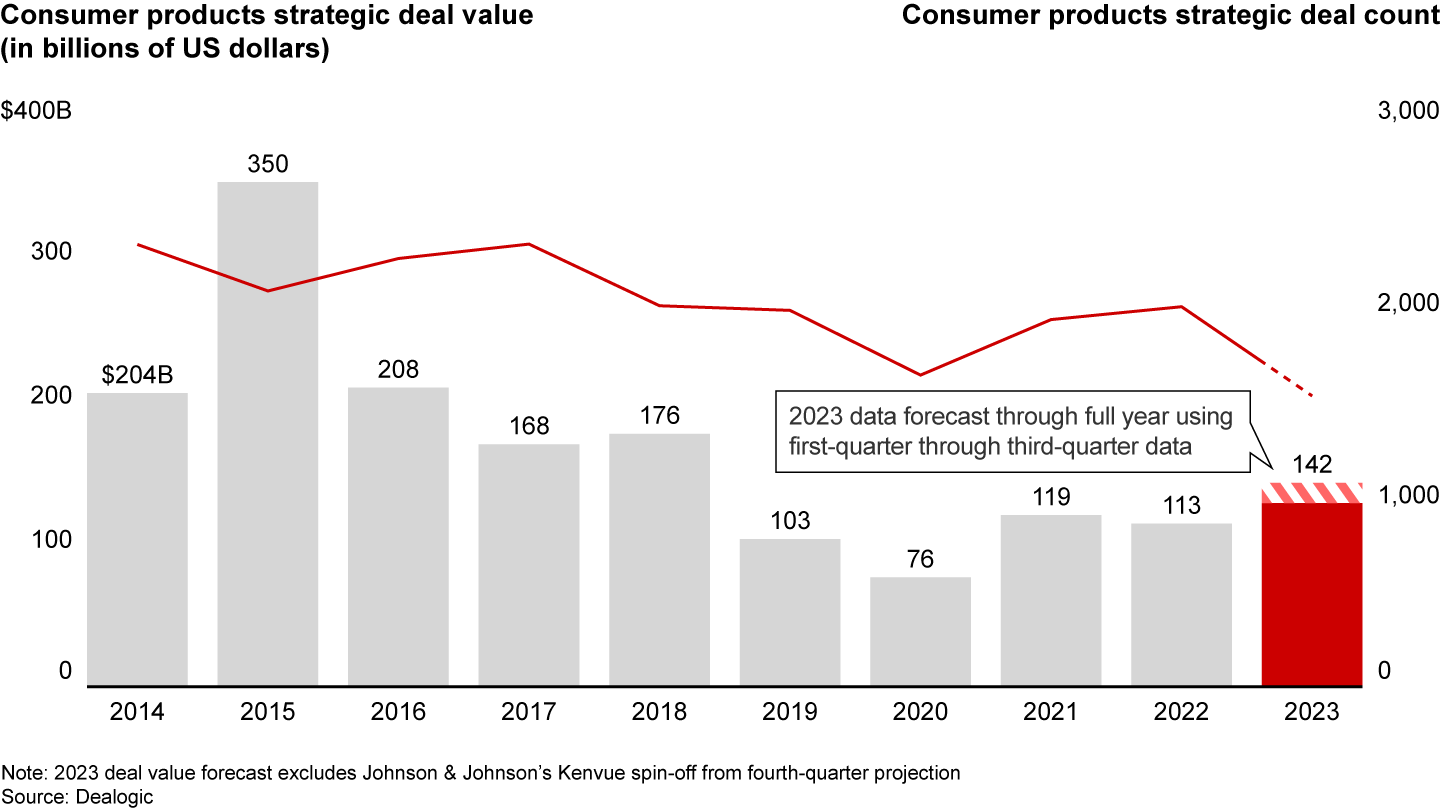
      The strategic deal count for 2023 dropped to the lowest level in 10 years, even as total deal value grew

      Much of the industry’s recent sales growth has been the result of price inflation. As inflation eases, companies are under pressure to return to a profitable volume-led growth model. Also, margins have been squeezed by shifts across the value chain, and many companies have struggled to deliver for shareholders. All of this is happening while structural rules are challenged: Companies need to invest in digitization, they need to address the impact of generative AI, and they need to consider their prospects in markets such as Russia and China, for example.

      Against this backdrop, consumer products companies are plotting ways to align their portfolios against growing profitable segments and to ensure that they offer the right goods and services to meet increasingly fragmented consumer needs. They’re figuring out how to simplify the portfolio to allow for greater profitability. For many, this level of change can’t be achieved organically. They need to acquire assets to reinforce focus segments. And they need disciplined divestments, with roughly 50% of consumer products M&A practitioners telling us that they expect more divestitures in the industry in 2024 if the right buyers can be found (see Figure 2).

      Figure 2
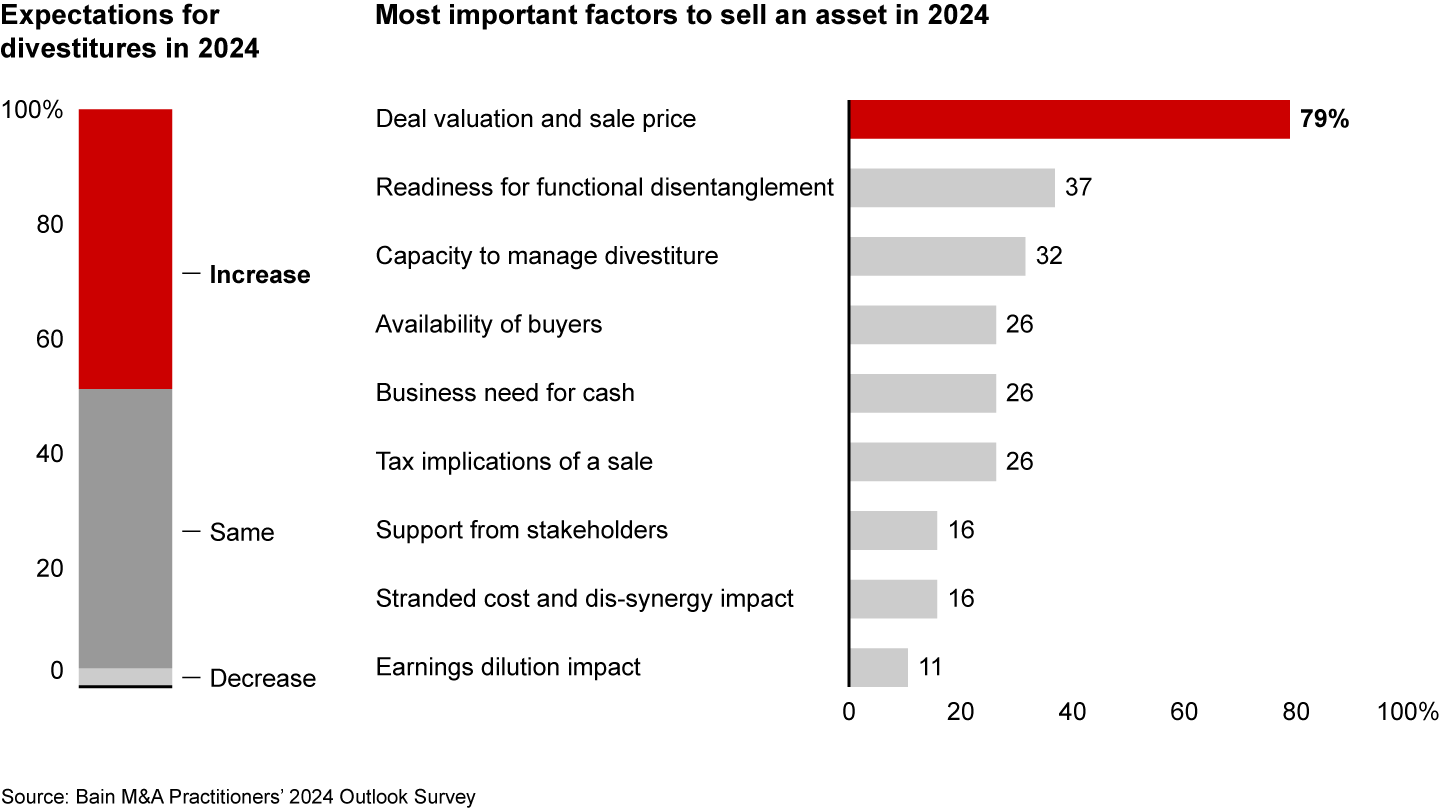
      Consumer products practitioners expect divestiture activity to increase in 2024—that is, provided the price is right
      Consumer products practitioners expect divestiture activity to increase in 2024—that is, provided the price is right
      Consumer products practitioners expect divestiture activity to increase in 2024—that is, provided the price is right

      While M&A remains critical for profitable growth, large deals with traditional competitors have become more expensive, protracted, and risky. Many product categories have become concentrated among the leading players, with most new innovation and growth at the smaller end of the spectrum. For example, in beer and lager, the top 10 firms now make up about 65% of the market (up from about 55% in 2009). Nonalcoholic hot beverages, personal care, household care, and consumer health follow similar patterns of increasing concentration. The bottom line is that any scale moves by those companies are likely to come under scrutiny in a regulatory environment that has become more proactive, fulsome, and time consuming. Witness the delay and further review by the US Federal Trade Commission of Campbell’s pending acquisition of insurgent Sovos Brands.

      Also, larger deals are increasingly viewed as blunt tools when consumer products companies need something sharper to pursue targeted opportunities in specific growth vectors—everything from food service to home delivery to products aligned with health and wellness, convenience, and sustainability. So, the hunt for attractive smaller deals is on. But while they may minimize the risk of any one large deal, it takes patience and discipline to create value across a portfolio of acquisitions. Indeed, smaller deals come with a series of opportunities and caveats.

      Opportunity: Insurgent brands can offer exciting growth, alignment with consumer trends, and attractive purpose-led strategies.

      Caveat: Acquisition success has been mixed. While winners have gotten better at not damaging the assets through overintegration, the jury is still out on how best to scale capabilities across the insurgent and core portfolio.

      Opportunity: Orphan underinvested businesses or brands hiding within the portfolios of larger consumer products companies can offer attractive divestiture opportunities, such as the spin-offs of Upfield and Lipton by Unilever.

      Caveat: Managing the carve-out can be challenging enough while also juggling the reintegration with another business.

      Opportunity: With Russia out of scope, and dealmakers wary of commitments in China, many companies see opportunities to acquire in India and Southeast Asia for a structural growth boost. Consider Hormel Foods’ minority investment in Garudafood.

      Caveat: The consumer needs and business environment in these attractive markets can be very different from potential investors’ home markets.

      Having identified the right deals, they then need closing. Despite high interest rates, the biggest barrier to dealmaking in 2023 cited by M&A practitioners in consumer products wasn’t the cost of debt; it was the scarcity of attractive assets on the market, followed by the buyer-seller valuation gap and increased competition for assets (see Figure 3).

      Figure 3
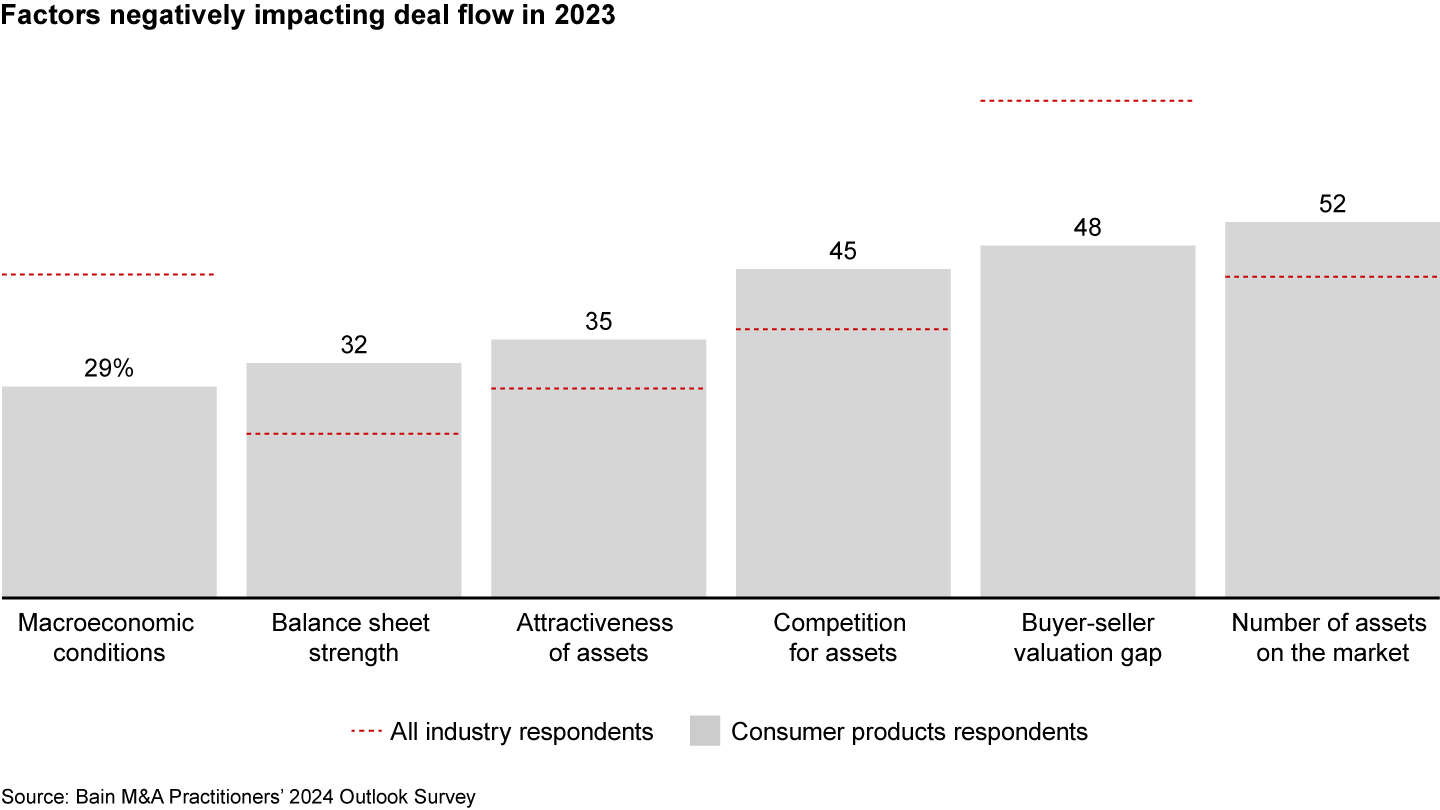
      Consumer products companies were less impacted by macroeconomic conditions than other industries, but balance sheets were a hindrance to dealmaking
      Consumer products companies were less impacted by macroeconomic conditions than other industries, but balance sheets were a hindrance to dealmaking
      Consumer products companies were less impacted by macroeconomic conditions than other industries, but balance sheets were a hindrance to dealmaking

      This is not a surprise. For acquirers, deals look expensive given the current shaky global economic outlook. Meanwhile, sellers still believe in their businesses. Indeed, deal multiples held relatively constant since the first quarter of 2022 through September 2023. The result has been much scanning, some diligence, but relatively little dealmaking. Deals that have gone ahead have attracted high premiums. For example, J.M. Smucker bought Hostess Brands at about a 50% premium to the closing share price prior to press coverage.

      Those same M&A practitioners in consumer products do not see this changing anytime soon, with roughly 35% expecting fewer deals next year and another 32% seeing the same number.

      Winning in this environment requires a rethink of the M&A process and capabilities to be more creative, more flexible, and faster.

      Companies need to refocus their M&A on the basics of creating profitable volume growth across their portfolio. This can be through deals that are grounded in increasingly complex consumer needs (across market, channel, and category) while also being clear on the unique parenting advantages they bring to an asset—advantages such as local relative market share or scaling of the value chain. Equally important is pruning their business of brands that don’t meet these criteria but might for another company.

      With this in mind, we see opportunity to modify the key elements of the M&A value chain to better suit these goals.

      Screening must be more proactive and holistic, reaching beyond the known large or midsize competitors. The most successful will update the screen to include new strategic criteria such as the environmental, social, and corporate governance (ESG) impact; channel relevance; and digital capabilities. They’ll search not only for standalone options but also for those hidden within others’ portfolios.

      For the highest-priority targets, a deal thesis must be created earlier—and not just for diligence. Leadership needs education, relationships need to be made, and speed is of the essence to compete with other consumer products companies and financial investors.

      Once the right target list is in place, acquirers must bring greater creativity to diligence to justify the deal premium. It should focus on the issues that really matter but that are often unclear—for instance, real lasting consumer relevance, the longer-term ESG impact, and the upsides that the parent can bring to growth and profitability. It should think through how the brand or company will be integrated to enable the cost or revenue upside.

      Integration of smaller assets must be more thoughtful. We have seen many fail because of overintegration, particularly in the early stages (for more, see “A Wave of Scope Deals and Portfolio Changes in Consumer Products”). Underintegration, however, can also stifle the generation of synergies. Buyers need to start with a clear articulation of what value needs to be created, leading to which areas of the business need to be integrated (and which don’t).

      Finally, when it comes to mastering a portfolio of smaller deals, doing a deal once is not enough. Successful acquirers continually evolve their operating model and codify learnings from every deal into clear playbooks.

      Read the Next Chapter

      M&A in Energy and Natural Resources: The Circular Economy Is Not Linear

      Read our 2024 M&A Report

      Download the PDF Explore the report
      저자
      • Headshot of Peter Horsley
        Peter Horsley
        파트너, London
      • Headshot of Maria Kurenova
        Maria Kurenova
        파트너, Atlanta
      • Headshot of Sam Rovit
        Sam Rovit
        파트너, Chicago
      • Headshot of Allison Snider
        Allison Snider
        파트너, New York
      • Headshot of Joost Spits
        Joost Spits
        파트너, Boston
      문의하기
      관련 산업
      • 소비재
      관련 컨설팅 서비스
      • M&A
      M&A Report
      Consumer Products M&A

      As more companies try corporate venture capital deals and alliances, they’re also learning how to avoid the pitfalls.

      자세히 보기
      소비재
      Shift to Vertical: David Haines, Group CEO, Flora Food Group

      What does it take to stay connected to your customers when scale and complexity threaten to pull you away? 

      자세히 보기
      M&A Report
      Banking M&A

      As conditions shift, leading banks are fusing scale with scope to create future-ready organizations.

      자세히 보기
      M&A Report
      Consumer Products M&A

      Large companies are buying insurgent brands to regain their growth momentum, but they need a new playbook to make them succeed.

      자세히 보기
      M&A Report
      Consumer Products M&A

      In their quest for profitable growth, more companies are divesting brands or buying insurgents.

      자세히 보기

      Overview

      • Looking Back at M&A in 2023: Who Wins in a Down Year?

      • Looking Ahead: How the Big Backlog Will Shape the 2024 M&A Agenda

      Hot Topics

      • Generative AI in M&A: Where Hope Meets Hype

      • Regulation and M&A: How Scrutiny Raises the Bar for Acquirers

      Industry Views

      • Aerospace and Defense M&A

      • Automotive and Mobility M&A

      • Banking M&A

      • Building Products M&A

      • Consumer Products M&A

      • Energy and Natural Resources M&A

      • Healthcare and Life Sciences M&A

      • Insurance M&A

      • Media M&A

      • Payments M&A

      • Retail M&A

      • Technology M&A

      • Telecommunications M&A

      • Wealth and Asset Management M&A

      Regional Perspectives

      • Brazil M&A

      • India M&A

      • Japan M&A

      • Middle East M&A

      First published in 1월 2024
      태그
      • 소비재
      • Insurgent Brands
      • M&A
      • M&A Report

      프로젝트 사례

      지속 가능성 및 기업의 사회적 책임 A Personal Care and Cosmetics Brand Charts a Course for Sustainability

      See more related case studies

      Results360® Propels an Appliance Maker Into a New Era of Growth

      See more related case studies

      고객 전략 및 마케팅 A sweet new branding strategy

      See more related case studies

      베인에 궁금하신 점이 있으신가요?

      베인은 주저 없이 변화를 마주할 줄 아는 용감한 리더들과 함께합니다. 그리고, 이들의 담대한 용기는 고객사의 성공으로 이어집니다.

      급변하는 비즈니스 환경에서 살아남기 위한 선도자의 시각. 월간 Bain Insights에서 글로벌 비즈니스의 핵심 이슈를 확인하십시오.

      *개인정보 정책을 읽었으며 그 내용에 동의합니다.

      Privacy Policy를 읽고 동의해주십시오.
      Bain & Company
      문의하기 환경정책 Accessibility 이용약관 개인정보 보호 쿠키 사용 정책 Sitemap Log In

      © 1996-2026 Bain & Company, Inc.

      문의하기

      무엇을 도와드릴까요?

      • 프로젝트 문의
      • 채용 정보
      • 언론
      • 제휴 문의
      • 연사 초청
      오피스 전체보기