

Brief

한눈에 보기
- Owners of power plants need to reduce costs in response to flattening load growth, the rise of renewables, and changes in the competitiveness of coal to gas.
- Baseload plants must remain fully resourced to ensure a reliable, low-cost supply of electricity. But as the missions of other plants change, they can be run more economically.
- Historically, plant managers and engineers optimize for safety and reliability. Leaders may need to create new incentives to also consider costs.
Reducing costs is always painful, more so when it requires changing the way employees think about work. In power generation, executives and frontline workers optimize to ensure safety and reliability of the power supply. That mission, of course, cannot and should not change.
Even so, power generation companies can find savings by actively changing the operations of plants and their support functions (including technical services, engineering and outage planning) as the operations of their units change. Plants fulfilling baseload missions, for example, must remain fully staffed and resourced. Some intermediate and peaking plants, however, can be staffed and resourced differently, while still fulfilling their missions. The challenge for utilities executives is to understand when the missions of power plants are changing, and to adjust staffing, maintenance, capital investments and support systems to reflect those new missions. For example, some coal plants that had historically operated as baseload assets might now operate only in summer and winter and during nuclear-power outages, with new implications on how they should be managed.
Jim Wininger, a partner with Bain's Utilities & Renewables practice, explains how companies can reconsider the missions of their plants to meet cost challenges.
The need to cut costs is urgent and acute. Analysis by Bain & Company indicates that over the next five years, North American utilities will need to reduce their spending by more than $15 billion, about 20% of their operations and maintenance costs, to maintain earnings commitments given slow load-growth expectations (see the Bain Brief "Cost Reduction for Utilities in a Zero Load-Growth World.")
And power generation executives will need to do their part. Electricity loads have flattened, and low-cost generation sources (gas, wind and solar) are taking market share, increasing pressure on wholesale electricity costs. For example, in the PJM region in the northeastern US, more than 22 gigawatts (GW) of new combined-cycle gas units are slated to come online by the early 2020s, right on top of low-cost shale formations. In the Ercot (Electric Reliability Council of Texas) region, wind has pushed market clearing prices down, while West Coast markets are seeing some wholesale solar power below $30 per megawatt hour (MWh). Across Europe, renewables are putting pressure on wholesale electricity prices, which are expected to remain in the range of €34 to €38 per MWh over the next three years. This has forced utilities to shut down 37 GW of coal and oil generation capacity between 2008 and 2016. Research by Carbon Tracker estimates that half of the European Union's 619 existing coal-fired power stations are still losing money. In light of all this, leading power generation executives will need to reevaluate their plant missions, including the option of shutting down facilities.
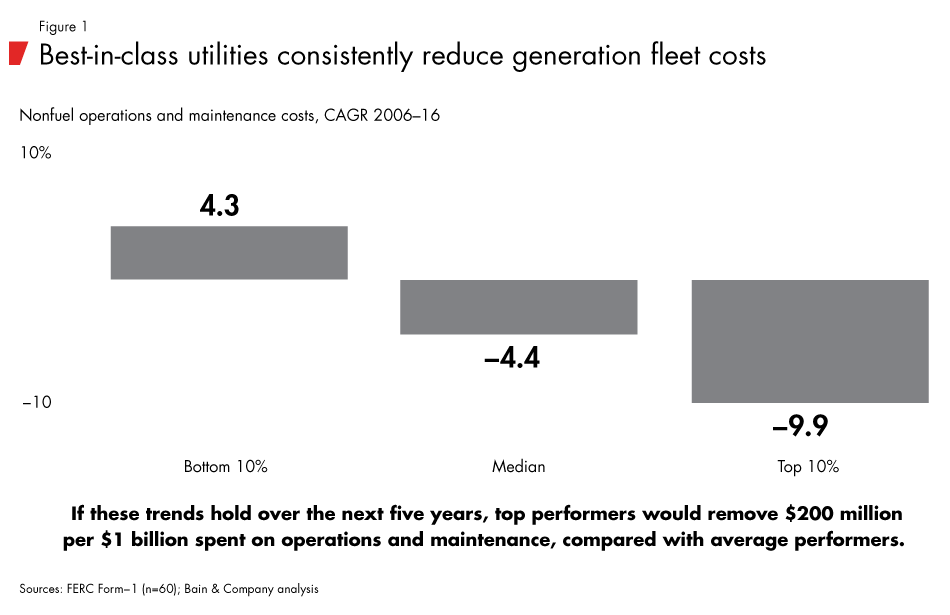
Best-in-class utilities are responding, taking out more than 5% of their nonfuel operations and maintenance costs every year by focusing on cost transformation (see Figure 1). In power generation, getting clarity on each plant's mission, this year and beyond, is a critical first step. This frees teams to think in new ways about the balance between cost and required reliability, including deploying straight-time outages, seasonal staffing models and different approaches to contractors. Thinking proactively about plant missions can also create opportunities to suspend or shut down operations at plants that may no longer be needed. Over the long term, these utilities embed a culture of productivity improvement that includes adjusting incentives for everyone in the organization to increase the focus on cost, while retaining the primacy of safety.
Match the mission
A transformation to sustainable, ongoing cost reduction starts with understanding the appropriate role or mission for each generation asset in the portfolio. Power companies often segment their generating plants according to their traditional operating characteristics with baseload, intermediate or seasonal plants, and peaking plants. By taking a more granular approach, generation executives can get a better understanding of the costs and opportunities associated with each plant. By clarifying the mission, they can optimize not only for safety and reliance, but also for cost (see Figure 2).
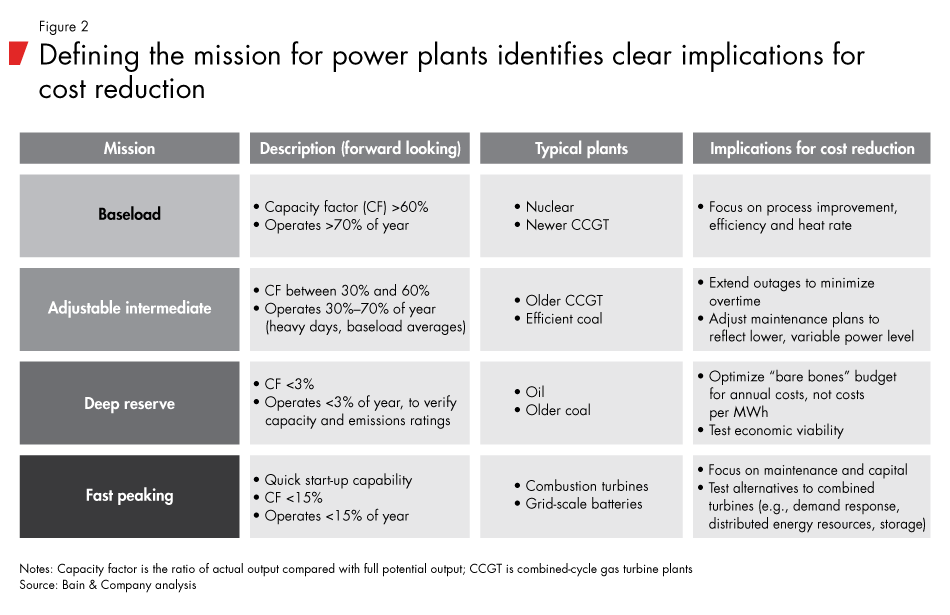
Plants with a baseload mission must continue to operate at full support to ensure a reliable, low-cost supply of electricity. However, power companies have more latitude with plants that are not always in use, particularly those with the characteristics of traditional baseload (long start-up periods, most efficient running near full capacities, higher fixed costs) and that are becoming less economical to operate due to market factors (coal plants in the US, gas and coal plants in Europe) and are therefore running less frequently. Matching resources to the mission of each plant could allow some intermediate and peaking plants to operate with reduced staffs during some hours or days, or in certain areas of the plant. In some cases, they may choose to staff plants only during higher demand seasons. And since these plants are not in continuous use, their managers might be able to reduce costs by relying on staff rather than contractors to perform outages or other periodic maintenance—even though these may take longer.
Putting this plan into action requires executives to take a clear-eyed view of the future.
- Begin by optimizing the portfolio. Determine the mission of each plant, based on future operating expectations, and add or remove plants from the portfolio. A fact-based assessment may highlight the need for some plants to be shuttered.
- Set cost expectations at plants and change work for the plants that remain. Cost objectives and targets will vary depending on the mission. Start with internal and external benchmarks to set cost targets for each plant. Benchmarking helps identify which plants have the most potential for cost reductions. It's critical to work closely with station managers to develop specific plans regarding where and how to cut costs, and how this will affect maintenance and daily operations. Take out low-value work and shift resources to improve processes on remaining work.
- Across the fleet, match support to plant missions. As the fleet changes, revisit management structures, vendor costs, off-site support and sharing of resources and tasks, including level two maintenance tasks (those requiring moderate skills). These legacy support systems often lag behind the pace of change of the fleet itself, creating inefficiencies. For example, in a competitive wholesale market, one power company was able to reduce its central engineering staff as the run time of the coal fleet came down.
Cost transformation essentials
Any successful transformation must work with, not against, the grain of organizational culture and receive prominent support from senior leadership. Executives need to make a compelling case for the urgency and legitimacy of cost reductions, and frontline workers should adopt a mindset of continuous cost reduction, a permanent part of the planning and execution processes.
- Make a clear case for change. Cost reduction efforts are more successful when everyone gets the mandate and the objective is broader than next quarter's earnings. To make a strong case among all stakeholders—regulators, local authorities, union workforces—power generation executives will need to convey urgency and criticality. For many companies, cost reduction is a sink-or-swim proposition.
- Align incentives to new missions. Teams and individuals have historically been measured on the reliability and safety of the plants. A balanced approach also considers the opportunities to optimize cost and flexibility of the plants, particularly for those requiring major cost reductions to reach the breakeven point.
- Deliver results quickly. Momentum is strongest at the beginning of any effort. Capitalize on that energy to demonstrate success while initiating longer-term changes that tap larger pools of cost savings embedded deep in the structure of the power generation business.
- Identify and encourage change agents. Sponsors who can inspire lasting change in their areas are an essential part of a transformation. This is especially true in union workforces, where cocreation of a cost-competitive asset portfolio is essential in order to ensure buy-in from their teams. At one power company, change agents identified more than 60 initiatives to reduce costs, while making the case for change with their coworkers.
Cost reduction is not a quick exercise, but a focused program can produce significant, lasting change in as little as 6 to 12 months. Such programs have enabled some operators to take more than 5% off their operating and maintenance budgets. With cost pressures in the generation industry likely to continue, mission-driven cost transformation is a tool that every executive should have a plan to deploy.
Grant Dougans is a principal in Bain & Company's Chicago office, and Arnaud Leroi and Jim Wininger are partners in Bain's Paris and Atlanta offices, respectively. All three work with Bain's Global Energy and Natural Resources practice.
First published in 6월 2018