

Brief
MetLife was on the move. The insurance giant was reengineering its operations, deepening its relationship with customers, expanding into global markets. The company’s organization already functioned pretty well, CEO Rob Henrikson thought. But reaching the full potential of the business required MetLife to work better than ever. People needed to make great decisions day in and day out. They needed to make those decisions quickly and execute them smartly.
Now, in the company’s Technology & Operations division, the rubber was about to meet the road. “We are counting on all of you,” executive vice president Maria Morris explained to 500 of her division’s leaders. “The path to transforming ourselves into a decision-driven organization will require commitment and tenacity. It will require new skills, new behaviors and new ways of working that will sometimes feel uncomfortable. Every individual will have to be open to change.” Morris could see that people were getting fired up. But would they follow through and embrace the change she was hoping for? The effort to improve decision making and execution couldn’t be seen as just another chore—people were already working hard on so many fronts. “Decision effectiveness is not another initiative,” she said firmly. “It is a capability—a capability that will help us deliver the initiatives our future depends on. Let’s get started!”
With effort, any organization can rid itself of internal logjams and get things decided and delivered for a period of time. But most organizations have enormous amounts of inertia and are likely to slide back into the old ways of doing things. If you want decision effectiveness to be more than a four-month flash in the pan, you’ll need to build lasting capabilities—to embed the new ways of working in the organization and ensure that they produce continuing results.
This fifth step in our program is last in the sequence. But as with any attempt to reshape an organization, you have to think about the change process from the very beginning. Which leaders will you count on to spearhead the effort? How will you persuade people of its importance? How will you maintain momentum and overcome the obstacles? As Maria Morris recognized at MetLife, how you plan and lead this journey makes the difference between success and failure.
Every company is different, so there’s no single road map. But the companies that have built durable decision capabilities have learned three important lessons, which we’ll summarize here.
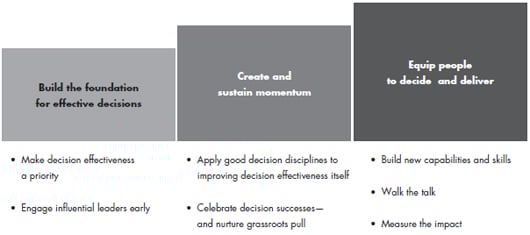
1. Build the foundation for effective decisions
The process has to begin with a powerful rationale for embarking on the journey: a big, meaningful, worthwhile goal. MetLife CEO Henrikson, for example, wanted the company to be recognized as a leading global insurance provider. He and his team made it clear that better decision making and execution were essential to achieving that goal. Along with two other senior leaders, Henrikson videotaped a speech shown at leadership meetings throughout the company. The three officers declared that MetLife would become a “decision-driven organization.” It would use best-practice tools to increase the speed of decisions and optimize the effort involved. It would shift to a participative style, with all the changes in leadership behaviors that shift implied. These measures, the officers said, would help the company become a true top performer. Leaders in each area of the business shared the video with their own teams and echoed the messages whenever they could. A year later, they were still starting major meetings with reminders of how important decision effectiveness was and what people still needed to do to improve it.
This kind of commitment from the senior team helps to engage influential leaders throughout the business. For example, Henrikson’s urgent appeal to boost decision effectiveness found a receptive ear in Bill Mullaney, then head of MetLife’s Institutional Business segment, which accounted for more than 40 percent of the company’s earnings. Mullaney rallied his executive team and met with his top 200 leaders to talk about why decision effectiveness was so important and to enlist their support. Then Maria Morris began to mobilize her team in Technology & Operations to work on decision effectiveness. Soon other leaders were following suit. Seeing influential executives like Mullaney and Morris embrace the effort was just the inspiration they needed.
Two techniques are particularly helpful in engaging influential leaders: building commitment through hands-on experience, and asking leaders to co-create the plan. Once the top team and other leaders are on board, the job of spreading the new ideas and approaches to the rest of the company becomes that much easier.

Decide & Deliver
Learn more about the five steps that leading organizations use to make great decisions quickly and execute them effectively.
2. Create and sustain momentum
If you have successfully laid the foundation, the next task is to harness people’s energy and build momentum. A great way to begin is to apply good decision practices to the process you will use to improve decision effectiveness. Establish clear accountabilities for the people who will lead the effort. Define the roles involved in selecting and resetting decisions, and in redesigning elements of the organizational system. Clarify up front the what, who, how and when for each of these major decisions. The process itself can be an object lesson, showing people the benefits of good decision making and execution.
One judgment call you’ll have to make is what must be decided at higher levels and what can be pushed outward. The senior leader—for a companywide effort, the CEO—must be involved from the beginning and needs to stay involved. He or she must make the tough calls on decision accountabilities, organizational redesign and people changes. But plenty of other decisions can be delegated, especially since you want future leaders involved in the process. MetLife launched its decision effectiveness effort as part of a broader change management program called Operation Excellence. Once the decision effort was under way, the company appointed Bill Moore, head of its Auto & Home business, to lead the charge. Moore’s job was to monitor progress, encourage and support the various businesses and functions and ensure that the new decision approaches became part of how MetLife did business day to day.
Successful companies also sustain momentum by celebrating decision and execution successes and thereby nurturing grassroots pull for more. People need to feel confident that there will be real victories. So announce the early wins loud and clear. Communicate them, celebrate them, show that others are likely to follow. The early wins don’t have to be huge. MetLife, for instance, revamped its process for evaluating IT investment decisions, which had been a bottleneck. The new process delivered tangible, measurable improvements to the process and illustrated the possibilities of a decision-centered approach.
One benefit of early wins is that they inspire people at the grassroots to explore the changes for their own organizations. Nothing is quite as powerful as when decision effectiveness goes viral—when people begin to say spontaneously, “I’d like to do that in my area,” or “Where can I go to learn about this?”
3. Equip people to decide and deliver
Improving decision making and execution over time requires investing in new skills and capabilities. Successful companies have developed four essential techniques for helping people handle important decisions more effectively.
•Develop a repeatable model that can be applied throughout the business. MetLife established a step-by-step approach to decisions and codified a set of tools that made it easier for each business and function to apply best practices in its own area. The repeatable approach meant that people could tackle a few decisions and improve them, tackle the next set and so on, until the approach became a natural part of continuous improvement.
•Use a “train the trainer” approach—and tailor the training to the audience. At MetLife, senior leaders and designated rollout champions got directly involved in redesigning important decisions and discussing the leadership behaviors that would be critical to the change. The next tier of leaders—individuals who would lead efforts to improve decisions in their areas—attended half-day sessions that taught them how to evaluate and redesign individual decisions. People from this group then worked on specific decisions, with support from the senior team and rollout leaders. In addition, a one-hour e-learning program provided an overview of the approach, helping people in the broader organization understand key terms, expected behaviors and the like.
•Help people learn through experience. Just as leaders need hands-on experience, so do other people throughout the organization. The most successful training programs involve actual decisions, not just theoretical exercises. Teams work with experienced coaches to develop capabilities on the job rather than in the classroom.
•Share best practices. At MetLife, executives held kickoff meetings in their own areas, inviting leaders from units that had already begun redesigning decisions to discuss their experiences. The company also formalized best-practice sharing by creating a council of rollout leaders from each area of the business to review progress and help resolve emerging issues.
Any change effort, big or small, requires resources, time and management attention. Naturally, you want to know whether you’re getting a return on your investment. You may want to run the decision diagnostic and organizational health surveys again and compare scores. You will certainly want to track progress on the specific decisions that you are working to improve. Effective measurement helps build enthusiasm about achievements and helps strengthen resolve to tackle the remaining challenges.
Even if you follow all these prescriptions, the journey to decision effectiveness isn’t necessarily an easy one. There are plenty of potential pitfalls along the way—difficult decisions, tough people issues and so on. It takes determination and perseverance, and a willingness to finish what you’ve started.
At MetLife, Maria Morris got her leadership team committed to drive the change. Team members learned RAPID, decision X-rays and other techniques. They laid out a plan, appointed a rollout leader and worked with the organization to identify critical decisions and redesign them. By the end of 2009, Morris and her team had worked through nearly 20 major decisions, and the new approaches were starting to gain traction. Maybe most important, the organization was beginning to show signs of a culture change—people were learning to act differently, day in and day out. Though Morris was enthusiastic about the results so far, she would be the first to tell you that the journey was far from over.
But MetLife had begun. Too many other organizations hold back from attacking their decision difficulties. They fail to reshape their organizations so that they can build stronger decision capabilities. The result, almost inevitably, is mediocre performance. Great results, by contrast, require a great organization—an organization that, like MetLife, is prepared to build on its strengths, work on its weaknesses and learn to decide and deliver, day after day after day.
Marcia W. Blenko is a partner with Bain & Company and leads the firm’s Global Organization practice. Paul Rogers is the managing partner of Bain’s London office. Michael C. Mankins is a partner with Bain’s San Francisco office. He leads Bain’s Organization practice in the Americas and is a key member of the firm’s Strategy practice.
Decisions—before and after
ABB, the big Zurich-based power technology and automation company, came close to bankruptcy several years ago. Part of the company’s trouble was that it couldn’t make good decisions on important matters such as bids on major jobs. Each ABB unit, for example, had its own profit targets and set its own transfer prices. By the time a bid got through the chain of ABB units, the price was often too high to be competitive.
But ABB recovered, partly because it fixed that kind of decision trouble and embedded a different way of working deep in the organization. A new leadership team simplified the organizational structure into just two divisions, centralizing profit-and-loss accountability. It simplified transfer pricing and required full margin transparency. New goals and incentives set managers’ sights on the company’s performance rather than the performance of individual units. Leaders launched a major change effort, communicating the new priorities relentlessly, building momentum, helping everyone learn the new ways of doing things.
By 2007, ABB was back on track, again profitable, again a leader in its industry. Its share price and market value had grown more than fivefold in the previous four years. And it was making and executing its key decisions well and quickly.
First published in 2월 2011