

Brief

Even as the electric utilities industry continues to work through the implications of renewable generation, executives are already grappling with the next big thing: energy storage.
Energy storage is coming online quickly as the rapid adoption of electric vehicles brings down battery costs. This revolution will have tremendous implications across the electricity value chain because energy storage can replace peaking plants, alter future transmission and distribution (T&D) investments, restructure power markets and help digitize the electricity ecosystem.
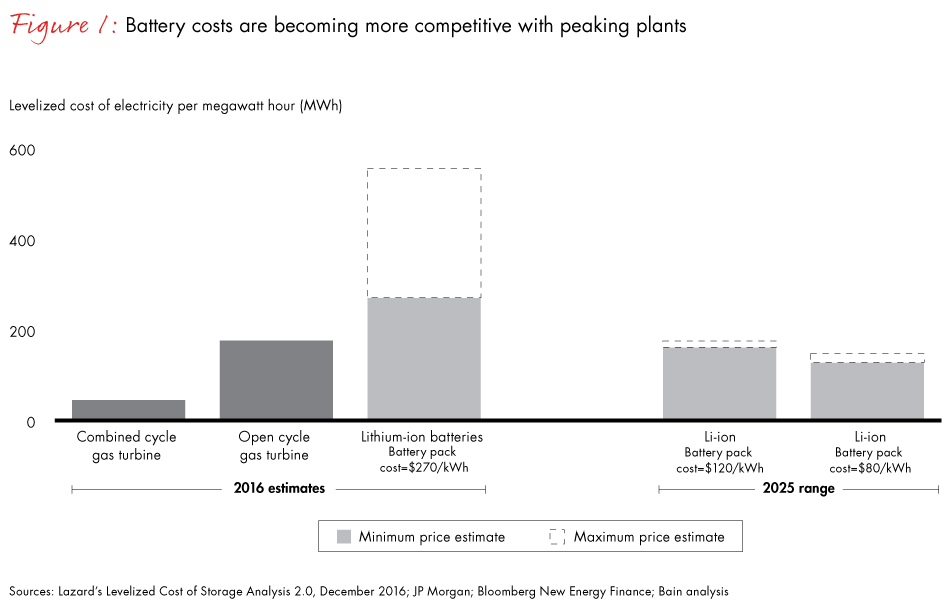
In some markets, battery storage is already coming close to economic parity with some forms of peaking generation. Bain & Company estimates that by 2025, large-scale battery storage could be cost competitive with peaking plants—and that is based only on cost, without any of the added value we expect companies and utilities to generate from storage (see Figure 1).
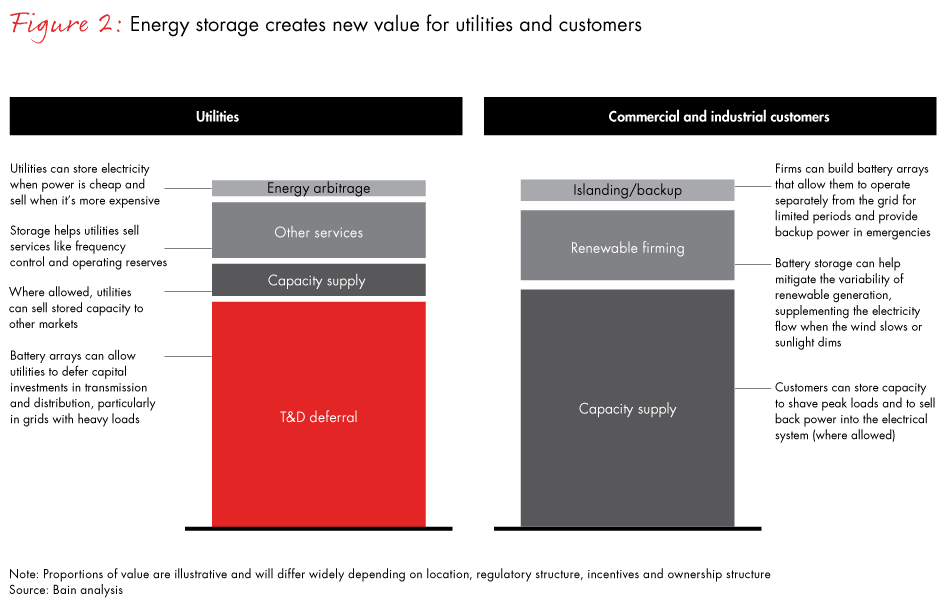
However, Bain research into utility-scale energy storage finds that early deployment will require new business models that create value in multiple ways—or as it is sometimes called, value stacking. Of course, utilities can use batteries to store electricity during periods of low demand and then tap the stored electrons during peak periods to shave peak loads, and customers can do the same to arbitrage electricity rates. But until costs come down, leaders in energy storage will need to explore ways to stack value on top of peak shaving, such as ensuring more reliability from renewable generation, enabling customers to operate independently of the grid when necessary, and providing services like voltage and frequency modulation (see Figure 2).
New value for utilities
Along with these new opportunities, energy storage also brings new challenges, particularly as they relate to regulatory schemes. Storage is a hybrid, a bit like a peaking plant, while also providing services like frequency stabilization and bearing qualities that make it part of the distribution infrastructure. Successful integration of storage requires a comprehensive overview of the entire system. However, while vertically integrated or regulated transmission and distribution companies may have the best integrated view of the need for storage, regulators are concerned that they not dominate or stifle the market.
As with renewable generation, storage will affect the entire electricity ecosystem, from utilities to end consumers. Every utility executive has an eye on energy storage, but many have not yet confronted the complexities, such as integration into strategic plans, investment decisions or regulatory priorities. They need to grasp the opportunities sooner rather than later to avoid the types of pitfalls they experienced as renewable energy, particularly distributed solar, took off.
Energy storage is also becoming increasingly attractive to commercial and industrial customers for the reliability and arbitrage advantages mentioned above, as well as for the value-stacking opportunities. These customers, and the energy service companies that serve them, may have a clearer path to benefit from these new technologies, free from legacy generation and T&D, as well as the regulatory rules that apply to utilities.
For everyone in the electricity ecosystem, the advent of cost-effective energy storage can bring new opportunities for reliability, resiliency, sustainability and control.
Large-scale energy battery storage is reaching an inflection point, advancing from limited experimentation to wide adoption. In just the first half of 2017, several utilities announced their plans to build and deploy large arrays of grid-connected batteries in Australia, New Zealand and several states across the US. For utilities, battery storage will become an integral tool for managing peak loads, regulating voltage and frequency, ensuring reliability from renewable generation and creating a more flexible transmission and distribution system. For their customers, storage can be a tool for reducing costs related to peak energy demand and help them meet sustainability goals by ensuring a more reliable flow of electrons from distributed renewable generation, solar in particular.
Utilities will have to adjust their operating models to take advantage of some of the opportunities from storage and other technological developments in the electricity system (see the Bain Brief “Harnessing the Value of Grid-Edge Technologies”). For example, as energy storage shaves peaks and flattens the load curve, utilities may be able to forgo some investments in peaking capacity and defer investments in transmission and distribution infrastructure. Also, because energy storage can come in much smaller increments and can be mobile, the investment comes at a lower cost. In this way, storage not only becomes a tool to meet system needs but can also reduce system costs as it pushes unnecessary capacity and waste out of the system (see the Bain Brief “Cost Reduction for Utilities in a Zero Load-Growth World”).
Additional opportunities may come from new business models related to value stacking. To make the most of these, utilities will need to think creatively about ways to partner with commercial and industrial customers. Consider, for example, a large commercial customer running a fleet of electric vehicles. For efficiency, this company may choose to deploy an array of large batteries at a garage where vehicles are parked and recharged in the evening. This electricity storage asset may be available for use by the utility during the hours when the vehicles are fully charged or on the road. Similarly, a company with large data centers may invest in battery storage to ensure a reliable supply of electricity, but may allow the utility to tap those resources when the data center doesn’t require them. Deals like these will require some new muscles within utilities, since most are not accustomed to managing these types of partnerships.
Central to all of these efforts will be enhancing utilities’ IT capabilities, particularly mastery over advanced data analytics (see the Bain Brief “How Utilities Are Deploying Data Analytics Now”). Increasingly, they will need better visibility of supply, demand, and voltage and frequency needs, sometimes down to the circuit level, as customers and regulators demand more from utilities.
While few utilities currently have the capabilities necessary to manage such large volumes of data and to draw valuable, real-time insights, many utility executives say they are beginning to build up such capabilities internally. However, it may be more cost efficient and more effective to partner with a third-party analytics vendor. By pairing the utility’s deep industry experience and troves of data with the vendor’s analytic expertise, such partnerships are often the faster, more economic pathway to gain deep insights.

How Utilities Can Win the Energy Storage Revolution
Rapid advances in electric vehicles are pushing down battery costs. This infographic examines how utilities can unlock new value through battery storage.
Energy services for commercial and industrial companies
As with renewable generation, momentum behind the adoption of energy storage will also come from new companies that can move nimbly to take advantage of these burgeoning energy storage opportunities for commercial and industrial customers. These customers are becoming increasingly sophisticated as they look to reduce costs, improve their reliability and resiliency, and in general take greater control over their energy use. Increasingly, they are looking beyond their utility provider to energy service companies to meet those needs.
While the role of energy service companies is not new— companies like EnerNOC (acquired by Enel in August 2017), Ameresco and many regional firms have existed for years—storage is a new addition to their toolkit. These firms, which have deep experience managing demand response, are beginning to provide a wide range of services to stack value atop energy storage, shaving peaks in demand (and thus reducing fixed demand charges based on those peaks), firming up the flow from distributed solar, providing backup or “islanding” capabilities that allow customers to operate independently off the grid, and supporting customers’ bids into capacity and ancillary services markets. Sophisticated developers and software players can help create differential value for customers by successfully adding these revenue streams based on new software and data analytics capabilities.
Stem, one of the leading providers of commercial energy storage systems, based in Millbrae, California, offers storage services to commercial clients and utilities. For example, Stem worked with the StubHub Center, a tennis and football stadium in Los Angeles, to provide the stadium with large-scale batteries that allow it to bank electricity at lower rates and consume it during afternoon events, when peak demand raises rates. Stem uses machine-learning techniques and relies on data from its broad customer base to optimize power distribution.
Energy storage provides immediate benefits to commercial and industrial customers, who tap even greater value by partnering with utilities. Advanced Microgrid Solutions, an energy storage leader based in San Francisco, offers services that help customers arbitrage rates while also reserving capacity that can then be bid back into electricity markets. Solutions like these benefit the customer and utilities.
The path forward for utility executives
For utility executives assessing the energy storage opportunity, the first step is to define the role of energy storage and related services within the strategic plan. This requires a deep understanding of the technologies available and how they might be deployed. A broad assessment of competitors—a new capability for most regulated utilities—is essential to defining the opportunities and how to pursue them.
Most utilities will need to build the capabilities for success and may also choose to partner with service firms or large customers to acquire the necessary skills. Pilot projects will help develop these new muscles, as utilities explore the possibilities of new revenue streams in nonregulated areas of the energy industry. Executives should continue to work to shape their regulatory environments, including performance-based incentives that encourage the deployment of storage to improve reliability, resilience and safety while lowering system costs.
As energy storage costs continue to decline, new business models that integrate a wide range of value streams together will unlock its potential. Energy storage will transform the entire electricity value chain as it enables an ever richer mix of large-scale renewables in the generation stack, creates a more modular, flexible and localized T&D system, and delivers more value for customers. Utility executives need to move aggressively to capture the opportunities at hand.
Julian Critchlow is a partner with Bain & Company in London, and Aaron Denman is a partner in Bain’s Chicago office. Both work with Bain’s Global Utilities practice, which Julian leads.
First published in 10월 2017