

Founder's Mentality Blog

I just returned from a trip to India, where I had the opportunity to spend an afternoon with P.R. Kothari, who leads strategy for Indian conglomerate Larsen & Toubro (L&T).
As my colleague and The Founder’s Mentality co-author Chris Zook noted nearly six years ago in the Harvard Business Review, L&T is one of about 100 companies that has managed to consistently deliver sustained, profitable growth over the past two decades or more. In India, as Chris noted this year in The Economic Times, it’s one of only three companies—along with Tata Group and Aditya Birla Group—that have remained among the top 15 companies by market cap or the equivalent since 1970.
Mr. Kothari has been there almost all that time. Having worked at L&T for 45 years, he has one of the longest tenures there, though not as long as L&T Chairman A.M. Naik, who has served for more than 50 years in the company. Started by two Danes (you guessed it, Henning Holck-Larsen and Søren Kristian Toubro) in 1938, L&T holds leading positions across several strong businesses in technology, engineering, construction, manufacturing and financial services. With $17 billion in revenue, it has grown by over 15% annually in the last 10 years. Oh, and one fun fact: L&T’s first bridge was built for the 1957 movie The Bridge on the River Kwai.
Although most of his businesses are enjoying double-digit growth, Mr. Kothari is already thinking about next-generation businesses that will take the company forward for years to come. In other words, he’s thinking about what we call Engine 2.
As a conglomerate, L&T has repeatedly branched out into new areas during its history. It started as a representative of Danish manufacturers of dairy equipment, but today makes everything from boilers and ships to electrical equipment, and offers services in real estate, construction, IT and financial services. I was fortunate to be a part of a lively discussion and debate with Mr. Kothari as I presented Bain’s “Seven Lessons about Engine 2,” which we captured on L&T’s whiteboards. These lessons are:
1. Definitions matter. In every Engine 2 exercise, we find that clear definitions help a lot.
- Engine 1 is your core business or businesses (in the case of conglomerates). As Chris and I argued in Profit from the Core, companies that grow sustainably and profitably will have well-established leadership positions in their core business and will enjoy leadership economics (the superior economic returns that are available, but never guaranteed, to leaders). As we noted in Beyond the Core, the best companies start with a strong, well-defined core business and pursue one-step adjacencies—new business opportunities that leverage and reinforce the core.
- Engine 2 is a set of new business opportunities that might take advantage of Engine 1 capabilities, but are further from the core and further from “today.” These businesses usually take six to eight years to develop before they materially affect company earnings. The best companies invest continuously in Engine 2 in order to develop next-generation businesses and capabilities. Probably the best-known example of Engine 2 investment was Louis V. Gerstner Jr.’s strategy to move IBM from hardware to services (see his outstanding book, Who Says Elephants Can’t Dance?).
- There are two ways leaders tend to describe their Engine 2 efforts. The first is what we call the Mars Colony idea of Engine 2. The description goes something like this: “Our core business is in permanent decline and we need to build a new engine of growth to take over from the inevitable end of Engine 1.” In this scenario, Engine 2 is almost a plan to escape and start a new life on Mars, where you at least ensure that part of the company will go on thriving, even though Engine 1 (Mother Earth) is doomed. We don’t talk about Engine 2 this way and can identify only a couple companies that have ever successfully escaped a doomed Engine 1 for new and prosperous growth in Engine 2. The alternative description, which we endorse, goes like this: “We must continue to find new growth opportunities and capabilities for the company outside our current core. We’ll invest aggressively across a variety of new businesses and continually use these businesses to challenge and refresh the core, or Engine 1. Over time, our business will be redefined as a combination of Engine 1 and Engine 2 and then we’ll start challenging new core again.” Engine 2 gives you an opportunity to identify new areas of growth and ensures that your core business is constantly challenged and refreshed (see “The Changing Question of China,” where we discuss how to make China your Engine 2).
2. In developing an Engine 2 strategy, remember that identifying themes is the easy bit. Most Engine 2 strategy exercises start with what we call “theme identification.” The themes are new ideas that cluster around common elements. There are many ways to identify themes. Some companies source them internally through workshops—your people have a lot of great ideas. Others have their leaders participate in brainstorming sessions, where facilitators organize discussions around global macro trends and case examples from other companies. These exercises generate hundreds of Engine 2 ideas, which companies can cluster into five to seven themes. The good news is this is straightforward. The bad news is this is the easy bit. We see two common patterns in theme development.
- Pattern 1. The real business opportunities emerge only as you explore the second- and third-generation move from the theme. For example, let’s examine how the Alibaba Group uncovered Engine 2 opportunities. When the e-commerce company launched Taobao, its consumer-to-consumer platform, most Chinese shoppers didn’t own credit cards. The firm needed to address a critical infrastructure gap to support the platform’s rapid growth. Its solution has been a series of ideas reflecting a financial services theme. Alibaba’s first generation of investments led it to launch Alipay, an online and mobile payment platform. As Alibaba identified the new capabilities needed for digital payments, it determined its next-generation move—a fintech company, Ant Financial, which operates Alipay, as well as a money-market fund and private credit platform. Like Alibaba, companies can uncover the big Engine 2 opportunities only if they investigate the new revenue streams that emerge from their initial solutions. As firms continue to make second-generation investments on a theme, they might discover far greater opportunities.
- Pattern 2. It’s far more difficult to determine your point of departure than your point of arrival. Pattern 1 says that you’ll need to think through the point of arrival beyond the first move, to the second- and third-generation moves. Pattern 2 says there’s something more difficult and more important to do. You must brainstorm on the first step that the firm can take. You should identify a specific investment with a known partner or acquisition candidate. Too often, leaders agree on themes, but never agree on specific actions to get started. For us, a theme isn’t a real theme unless you invest in something at the proverbial Monday morning meeting. Bringing a theme back to a first step and getting corporate approval demands work. You need to answer the questions, “Who can we buy?” or “What can we invest in?” or “With whom can we partner?” Any theme can live in PowerPoint. Real strategic initiatives live through investments.
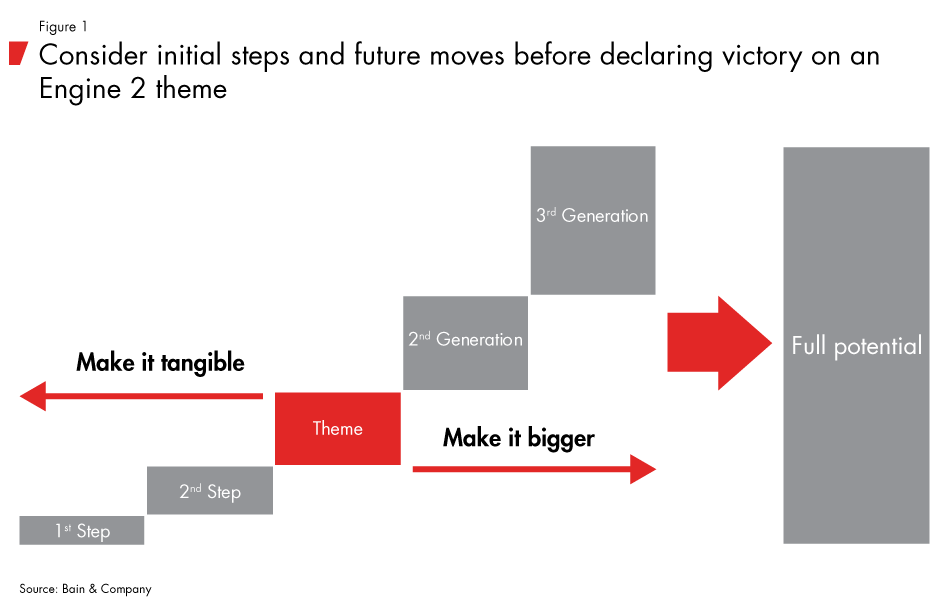
According to the two patterns, identifying themes isn’t as easy as it seems. Before they declare victory on a theme, strategy teams should consider second- and third-generation moves (“make it bigger”) as well as initial steps (“make it tangible”). Only then are they ready to execute, moving from the determined point of departure to point of arrival in order to achieve full potential (see Figure 1).
3. Even though you’re stuck with it, don’t always assume Engine 1 is your friend. While most companies expect investments in Engine 2 to someday help Engine 1, we must note that good old Engine 1 isn’t always your friend in the journey to build Engine 2. Engine 1 is awesome, big and amazingly predictable—at least to you. After all, you’re veterans of Engine 1 and your systems are fine-tuned to run it brilliantly. In fact, you’re so good at running this business that almost all of your systems are run with tolerances of less than 1%. Your factories run predictably. Your sales operations generally hit monthly revenue targets. Your Engine 1 leaders are smooth operators. But those same leaders, with all of their perfect models, can often be terrible managers of Engine 2. Why? Many Engine 2 businesses are filled with unknowns. They’re collections of start-ups, new partnerships, or new-to-the-world products and services. They have no demand forecasting at all. You can’t run your Engine 2 business with the tools and capabilities you use with Engine 1. These new capabilities are hard to build, take time, and challenge current norms. You must build them with a new mindset—one that’s more like a venture capitalist (VC) than a corporate leader. But the good news is that these capabilities will help you expand Engine 1 at some point (more on this in lesson 4). Until that point, there are three rules of Engine 1 vs. Engine 2 partnership:
- Engine 2 businesses must be liberated to grow however necessary—even if this includes the full cannibalization of Engine 1. If you start to create rules about where and how Engine 2 can play, you might as well shut it down. It’s hard enough to start a new business. It’s impossible with a rule book of all of the things you’re not allowed to do.
- Engine 1 can beg, borrow and steal all the good ideas generated by Engine 2. Rather than allowing the Engine 1 leadership team to complain about the challenges created by Engine 2, tell them to replicate what Engine 2 is doing and compete.
- There’s no good organizational solution for the appropriate distance between Engine 1 and Engine 2. If you keep Engine 2 very close to Engine 1, Engine 1 folks will probably kill Engine 2. They’ll smother it with Engine 1 ways of working, or kill it slowly because they don’t like the new kid on the block. If you keep Engine 2 entirely separate from Engine 1, then you’re not the best venture capitalist. You’re bringing nothing to the table from Engine 1 but corporate overhead. Just remember: no matter what organizational decision you make, you’ll need to invest in mitigating the inevitable risks.

About the Founder's Mentality
The three elements of the Founder's Mentality help companies sustain performance while avoiding the inevitable crises of growth.
4. Engine 2 helps you rediscover the art of business building. One of the major reasons you should start an Engine 2 initiative is to develop new capabilities, and the most important is business building. With Engine 1, you’re constantly innovating. You’re always launching new products and services. You can’t be a leader in Engine 1 without constant renewal. But most of your work in Engine 1 is about product or service innovation. You’re offering new products or services to be sold through an existing business, where you understand how to go to market and know your role in the ecosystem. You’re rarely building a new business. As a result, all of your financial models around innovation are built on gross margin or operating margin economics. Your teams must determine the predicted price they can command for the product and compare it with the cost of goods sold (gross margin). They must sort out selling costs (operating margin), and forecast forward and discount back to give you a positive or negative net present value for the investment. The team is forced into endless iterations of pricing predictions over three to five years. The Engine 1 team wants to control variance. They want a predictable pattern before they approve the business model.
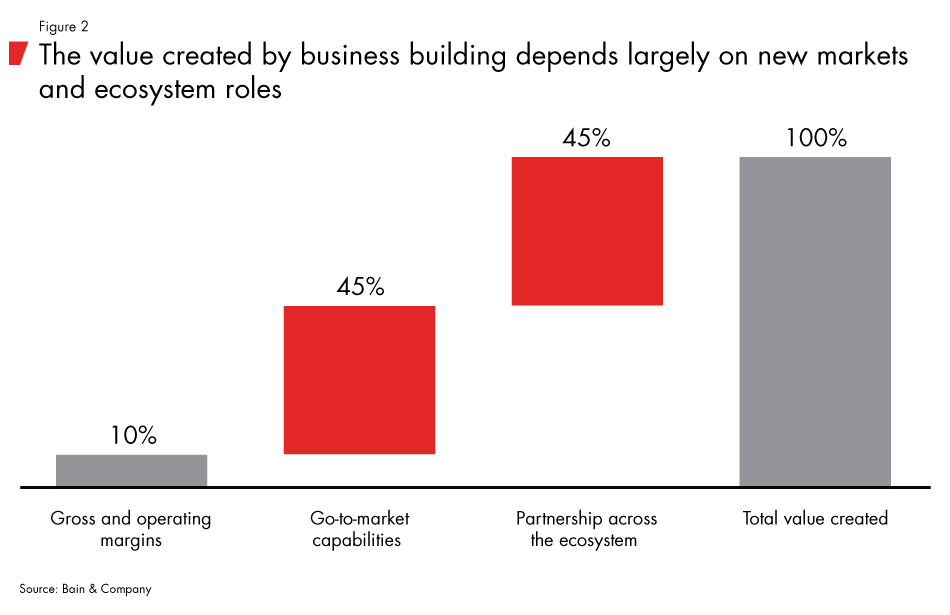
Engine 2 is more often than not about building new businesses. In business building, predicting gross margin and operating margin is often less than 10% of the value that will be created. What really matters is determining a go-to-market strategy that creates sustainable competitive advantage and controlling the profit pool of the market (see Figure 2). The modeling of gross margin assumptions dooms them with false predictability and distracts you from the far more important task of figuring out how to create a new market. As we discuss in our book The Founder’s Mentality, when you rediscover the art of business building, you’re often going back to the first generation of your company, when your leaders were incredibly disruptive and committed to building a new and varied business. Business building is in your DNA—or you would never have become a large, successful company.
5. Getting back to business building helps you rebalance your activities between delivering and developing. Building Engine 2 capabilities will challenge how you manage Engine 1. We know Engine 1 is typically managed with tight variance and refreshed through narrow product and service innovations. Now let’s look at the strategic and financial planning processes. In Engine 1, you primarily focus on what the business can deliver. You spend huge amounts of time and attention to a set of social contracts.
- Annual planning is a social contract between your central leaders and your market and product leaders regarding the revenues and profits they’ll deliver in specific time periods. These contracts are critical and determine investment decisions. They influence how people are rewarded. The obligation to deliver—and the consequences of failure—explains why budgeting is an endless fight against “sandbagging,” or the lowering of expectations to produce better-looking results. Anyone in charge of a deliverable number wants it to be achievable, as most reward programs penalize failing to hit an aggressive target far more than hitting a less aggressive target. Humans are humans. We sandbag if the compensation structures reward it.
- Investor relations amasses all of your business leaders’ promises and turns them into a set of promises to your investors. A wise CFO takes a bit of the top, calling it a contingency, to make sure she can hit her investor promises, even if some of the business leaders fail. The stock price of the company depends on your track record of investor delivery. The same dynamic works for investors and your business leader. Your investors demand higher numbers, and your CFO learns to sandbag a bit to help you occasionally outperform.
This focus on the delivery agenda takes a huge amount of the energy of Engine 1—and wastes a lot of time (see “Why 97% of Corporate Planning is a Waste of Time”). It also comes at a cost. The leaders of Engine 1 spend significantly less time on the development agenda, that is, building new businesses. As we mentioned, business building doesn’t lend itself to financial models based on predictable product pricing and revenue streams. Business building is hard to contract. The actions to develop businesses are very different from the actions to deliver businesses. The strategic planning and budgeting processes must be different, too. You absolutely need development capabilities in Engine 1, because you have to manage the unknowns. It’s also true that as Engine 2 matures, you’ll need delivery capabilities in Engine 2. But for our purposes, we want to make a simpler point: The capabilities built in Engine 2 are all about development, and once mastered, they can be used in Engine 1. Engine 2 is a terrific place to get your business-building mojo back and figure out how to hardwire it into your budgeting and planning. Once sorted, you can bring these capabilities back to the mother ship.
6. Engine 2 demands that you network and partner with the start-up community and the VCs that support them. Many corporations recognize that to create new businesses, they must become better partners to the start-up world. In fact, many, if not all, of the Global 2000 have had their leaders take “treks” to Silicon Valley or other start-up centers to meet with founders and VCs. (Our Bain Innovation Exchange makes multiple treks a year, bringing hundreds of business leaders into potential start-up partnerships). We see that the most successful companies view these treks as opportunities to make deals and start partnerships. The unsuccessful companies use these treks as out-of-office team-building days—giving their leaders great stories to tell, but wasting the opportunity to accelerate new businesses, or more urgently, add immediate capabilities to their core business.
In The Founder’s Mentality, we detail the way many incumbents use partnerships with start-ups to revitalize their cultures. We also see them use these deals to build Engine 2. An important part of developing an Engine 2 strategy is defining the first steps—and these initial steps generally involve buying or partnering with start-ups, or investing in internal “start-ups.” To kick-start Engine 2 and revitalize Engine 1, begin doing deals with the world of insurgents. Have their people challenge and stretch your people. Combine their speed with your scale to compete differently. Begin to move your firm toward the big themes you’ve identified. Go on treks to do deals, not gather cocktail party stories.
7. Building Engine 2 really does help build Engine 1. Almost all Engine 2 strategies start with a desire to identify new growth opportunities far from the core. But rightly, almost all Engine 2 strategies become initiatives to revitalize the core, by:
- rediscovering business building skills;
- balancing internal processes between the delivery agenda and development agenda; and
- opening the firm up to the world of insurgents, start-ups and VCs.
With these new capabilities, you can begin to look at your Engine 1 business differently. Are there investments you’ve made in Engine 1 that you could use as a revenue opportunity with new customers? (Think Amazon Web Services.) Are there existing businesses that you’ve run conservatively with a delivery agenda that you could expand more aggressively with a development agenda? Are their innovations in products and services that you could reimagine as new markets?
That was the gist of our discussion with Mr. Kothari, who, after 45 years of strategy work for L&T, probably can be said to be working on its Engines 5 and 6, having helped the company develop Engines 2 and 3 years ago.
First published in 12월 2018