

Brief

Capital intensity has become a hot-button issue for network service providers (NSPs) around the world. Wireline and wireless CFOs are finding it more difficult to achieve the industry’s standard goal of 15%–20% capital intensity, defined as the ratio of capital expenditure to revenue. Revenue growth has slowed to low single digits in many markets, yet demand is unrelenting for big ticket infrastructure investments—including fiber to support internet traffic growth of more than 30% per year; the transition to an all-IP, fully virtualized technology stack; and the looming race to 5G.
Unfortunately, too many executives approach their capital intensity challenge solely through a lens of efficiency by trying to squeeze as many projects as possible into a restrictive capital envelope. The budget cuts and funding deferrals that follow draw the focus away from a fundamental truth: You cannot cost cut your way to long-term profit growth; you need to take market share. NSPs that fail to realize this head down a path that allows the competition to win.
The right way to think about capital intensity is through the lens of effectiveness, asking how you can channel investments to the things that will most improve your strategic position. This approach requires a steady focus on business goals and a willingness to pare back on those initiatives that may promise a good return on the investment (ROI) but do little to boost market share. Put differently, capital effectiveness is the sustained achievement of beating one’s competition at the lowest possible cost—and in that order: Effectiveness trumps efficiency.
Why are so few companies capital effective?
It’s not easy to be capital effective. Doing so requires several years of taking market share from competitors without excessive spending. Few companies are able to accomplish it. However, those that develop a repeatable capability for it have an engine for extraordinary shareholder returns.
Figure 1 maps relative capital investment against change in market share for every major global NSP. Only one out of eight providers could be considered capital effective, meaning that they have gained at least 1 percentage point of market share each year over the past five years without having spent significantly more than their fair share of capital to do so. The rest split into two groups:
- Half are caught in an efficiency trap—that is, while they have spent less capital than would be expected given their market share, they have failed to gain meaningful revenue.
- The other half are wasteful, spending more than their fair share of capital while either losing market share or failing to gain as much as their investments would warrant.
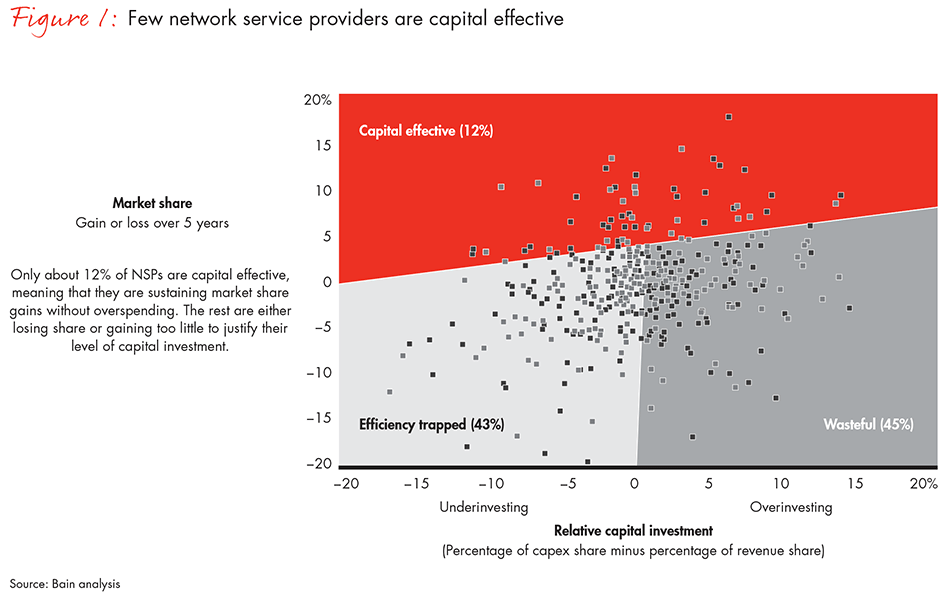
Experience shows that it is very hard for companies to become capital effective simply by spending less—that is, relying solely on the efficiency lens. Those who try, often end up putting themselves at a competitive disadvantage by slowing down critical investments. The better approach is to focus on effectiveness. But this can be challenging if executives haven’t defined their strategic goals clearly enough to allow for meaningful prioritization of capex.
Becoming capital effective
Leaders take a programmatic approach to capital effectiveness that can help companies shave up to 10% off spending—savings that can then be invested to gain market share or returned to shareholders. Another 30% of the total capital budget typically gets redistributed to strategically important programs that help companies meet their strategic goals, including:
- accelerating a fiber-to-the-home build-out rather than deploying low-return satellite television consumer equipment;
- reducing IT operating costs by ending unfavorable managed service agreements, which will require some investment in data centers and IT infrastructure and bringing some operations back in house; and
- buying transport backhaul infrastructure via M&A rather than building.
A comprehensive approach must address a company’s situation, strategy, spend and structure—the four S’s of capital effectiveness (see Figure 2). For those readers more attuned to mathematical solutions, we can also describe this model algorithmically (see the sidebar, “An algorithmic lens on capital effectiveness”).
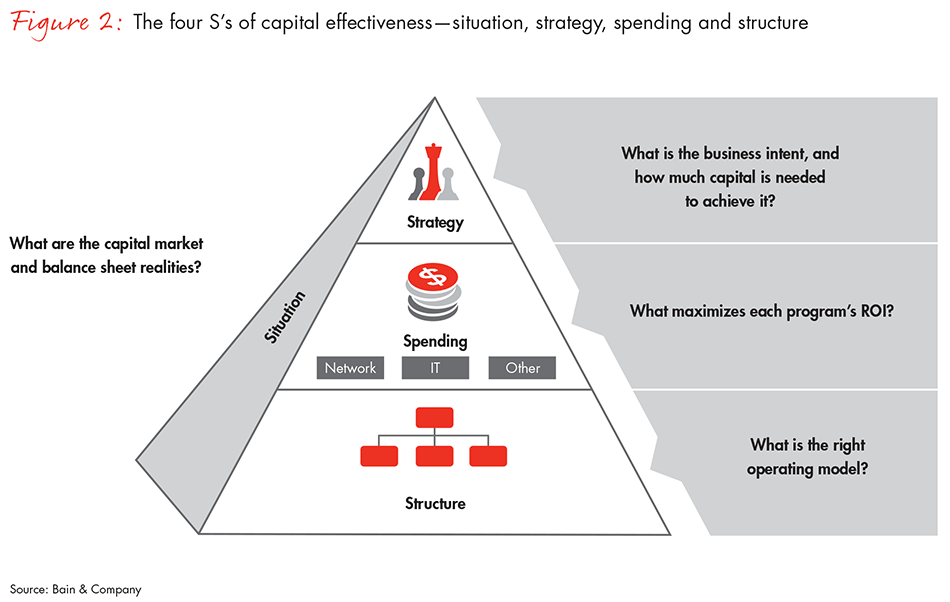
- Situation. Every company and every market is different, and a range of factors determine the right level of capital intensity. For example, an NSP with low leverage has more options for debt-financed infrastructure construction. An NSP that is a subsidiary of a multinational has options that a stand-alone NSP does not. And some markets impose stiff import tariffs that severely increase the cost of network assets. Even though many of these are external factors over which an NSP has little influence, executives still must account for them when setting capital intensity targets.
-
Strategy. A common mistake is to try to win everywhere, which can spread capital too thinly across too many efforts. A more effective approach focuses capital investments on the geographies and customer segments where senior leaders have made an explicit decision to play to win. This means making hard choices about where to pull back. It also requires clarity on competitors’ strategies and sources of differentiation. For example, will you emphasize better coverage or faster download speeds?
One reason why many NSPs struggle to gain clarity on strategy is that these decisions cross sales, marketing, network and IT boundaries, so misalignment is common. For example, a network team might be aiming at best-in-class peak-load utilization targets while a sales team pushes a “good enough” offer to price-sensitive customers. One way to address these gaps is with cross-functional capital summits that refocus the three-year capital envelope on achieving an explicit and measurable strategic intent.
-
Spending. Once senior management determines strategic intent, the challenge becomes maximizing each project’s ROI above and beyond what is possible through traditional procurement levers. The key to unlocking larger returns is disciplined consideration of alternatives to achieve the same goal. For example, consider a cable provider that wants to launch gigabit broadband. The default project to enable this would be network segmentation, which pushes fiber deeper into residential neighborhoods. But there are other ways to boost capacity, including increasing bandwidth, upgrading technology, transcoding video, reallocating channels from TV to data and shaping traffic to share capacity fairly across users. Also, preselling, restricting the geographic scope of the launch and reducing peak-hour service are some commercial options. While segmentation will almost certainly be part of the answer, a hybrid approach could deliver better returns.
When considering total costs, it’s not enough to focus only on big-rock projects; the pebbles can weigh just as much when added up. Hence, a key move to focus spending is to sweep up marginal efforts, reducing or ending investment in less promising programs. These choices require clarity and boldness, and a programmatic approach provides the discipline and objectivity that can help executives weigh the necessary trade-offs in difficult decisions.
-
Structure. Capital budgeting can be a painful process for everyone involved. The harder CEOs and CFOs look for opportunities to cut spending, the more IT chiefs and other business unit leaders look for ways to justify the projects they need to maintain the network and deliver on their profit targets.
One way to reduce this pain is to replace the typical annual capital budget battle royal with rolling quarterly reviews that are closely tied to business operations. Think of the difference between traditional waterfall software development—in which IT developers work with the business to define a spec, then go off for months before returning a finished product—and more agile methods (like Scrum) that depend on incremental design and tight integration with the business. Rolling capital reviews achieve many of the same benefits: closer integration with the business, ability to integrate feedback throughout the process, and the potential to shift direction as new opportunities or information come to light.
While rolling reviews can alleviate some of the pain, more treatment is required for full remediation, including resetting how to evaluate capital projects (both in terms of the type of information needed and how it’s gathered and used) and redefining the ways that roles and responsibilities are allocated.
Slowing revenue growth against the backdrop of explosive growth in internet traffic will continue to put pressure on the capital of NSPs. But focusing solely on efficiency can lead companies down a path that sacrifices long-term competitiveness in order to hit capital intensity targets. By contrast, pursuing capital effectiveness helps align spending decisions with strategic intent and encourages executives to go all in on the most important investments that will help gain market share and deliver returns for shareholders.
An algorithmic lens on capital effectiveness

Think of capital effectiveness (CapEft) as the product of a company’s situation (S0) and the sum of all decisions, each of which is the combination of making the right strategic choices (S1) with the highest returns on the spend (S2) divided by the time and effort it takes the organization given its existing structure (S3).
Viewing through this lens yields a way to maximize capital effectiveness:
- Situation (S0) is dominated by exogenous factors over which the network service provider has little control (for instance, the degree of direct competition within a given market and the favorability of local capital market conditions), but there are still options to improve one’s situation (for instance, changing capital structure and negotiating for favorable terms with regulators).
- Strategy (S1) is maximized by identifying and focusing on the geographic and consumer outcomes that not only deliver the highest share gains but also create the highest barriers to one’s competition.
- Spending (S2) is effectively the return on investment of the underlying project and is therefore maximized by minimizing cost while accelerating and assuring income. Interestingly, this is the classic efficiency lever that most NSPs use as the primary (if not only) variable in the capital optimization objective function.
- Structure (S3) denotes the effort involved in making and executing decisions and is minimized by creating an operating model that allows the organization to quickly come to effective decisions that can be consistently executed. In our experience, it accounts for more than half of why companies fail to be capital effective.
Herbert Blum is a partner with Bain & Company in Toronto. Darryn Lowe is a principal with Bain, also in Toronto. Both work with Bain’s global Telecommunications practice.
First published in 10월 2016