

Brief

한눈에 보기
- Climate change will likely increase the usage of telecom services, but there’s an even larger business opportunity for telcos that tap into new revenue streams and lean into helping customers decarbonize their own operations.
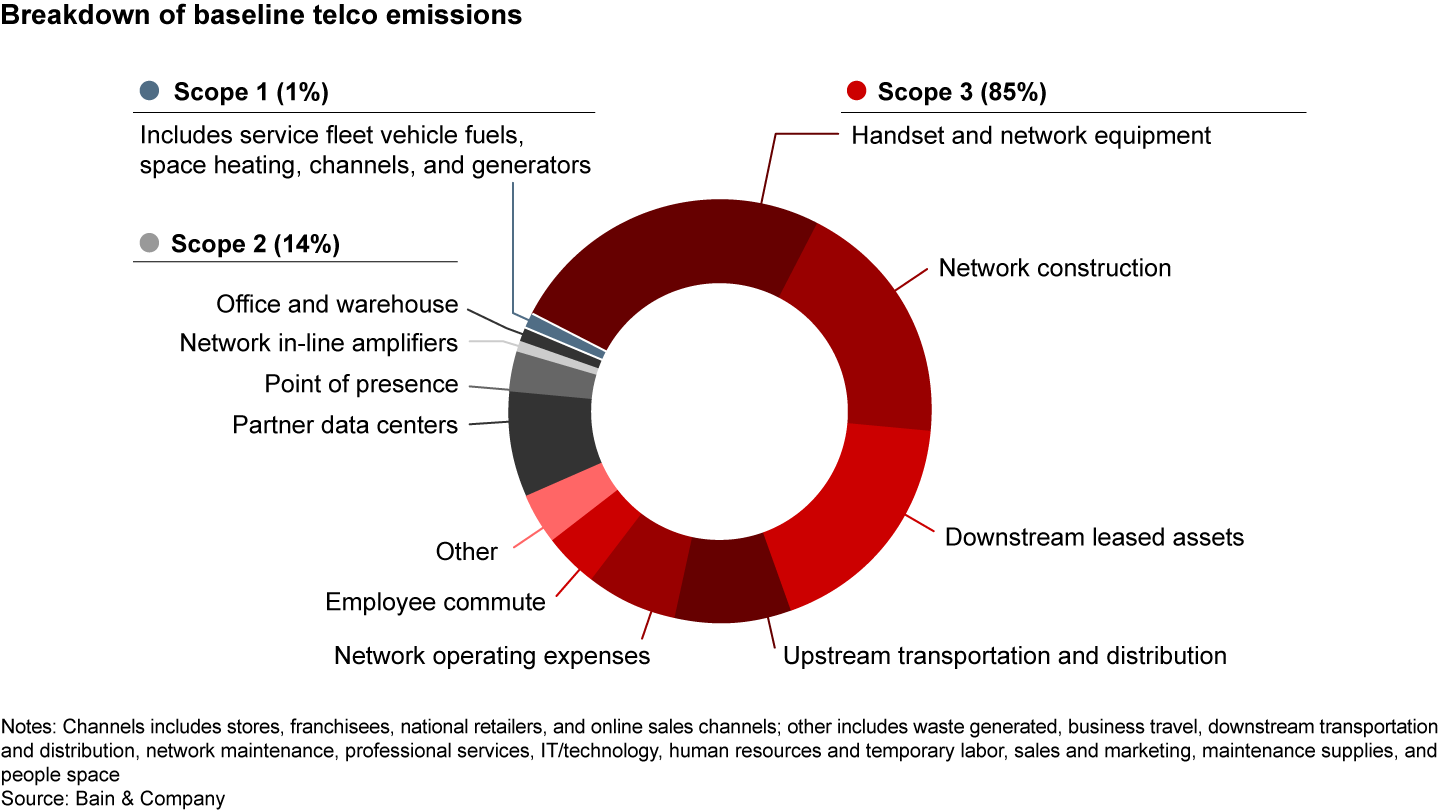
- However, telcos have been slow to achieve their own net-zero targets, as around 85% of their carbon footprint is Scope 3 emissions attributed to suppliers and partners.
- Leading telcos are moving quickly to develop a decarbonization strategy that includes adapting their operating model to enable the transformation required.
As telecommunications companies ramp up their decarbonization efforts, many executives are overlooking a key part of the equation: There’s a ton of upside for their businesses.
Telcos face growing pressure from customers, investors, and regulators to achieve their net-zero targets and do their part to solve the climate crisis. But many telcos have yet to fully evaluate how they can strengthen their businesses in tandem. We believe that there are four areas of significant business opportunity for telcos that take full advantage.
First, climate change will likely increase the usage of telecom services (and thus boost telcos’ revenue), as companies across industries seek to reduce their own carbon emissions by increasing remote operations, work from home, and digitization.
Second, telcos should be able to make sufficient operational improvements to reduce their costs, more than offsetting the operational cost pressure that will come from higher usage of their services. These cost reductions can free up budget space to help fund telcos’ internal decarbonization efforts, and in many cases, decarbonization and cost reduction will go hand in hand. For example, as telco employees work from home more often, this will shrink both the company’s carbon footprint and its office electricity bills. Technology can also help maximize operational efficiencies and cut costs; think of software that optimizes telco service fleets’ routing and scheduling, thereby minimizing their miles traveled.
Third, there’s growing evidence that consumers are willing to pay a premium for “greener” services, even in a period of high inflation. Telcos that successfully position themselves this way in the market can invest some of the incremental revenue back into their internal decarbonization initiatives, while also giving themselves more of a profit margin cushion.
Lastly, telcos can create additional revenue streams through new products and services that play a significant role in helping companies across industries to decarbonize. For example, remote equipment monitoring and diagnostics enabled by telco services can help businesses maintain their hardware more efficiently and with lower emissions. Telcos could also use their expertise in bundling offerings to promote new “green solutions” alongside their partners. One example is intelligent transportation, where a telco could team up with a connected device company to provide public transit riders with real-time route planning services.
As customers use telecom services to reduce their own emissions, telcos can track these reductions and count them as offsetting the telco’s own carbon footprint—an emerging metric called Scope 4 “emissions.” These avoided or reduced emissions have the potential to support a stronger market valuation for telcos as they become more widely tracked and recognized.
Complex challenges
However, most telcos are far from decarbonizing their own operations, let alone developing new revenue streams from helping customers reduce their emissions.
Most telcos have announced commitments to achieve net-zero emissions, but so far, few have followed through with real planning and execution. Even telcos that have already crafted a decarbonization strategy will likely need to continuously revise it because it will quickly become obsolete. The reason is actually good news for telcos: Decarbonization tools that were out of reach or not economically attractive are now increasingly accessible. That’s because advanced batteries, solar panels, and other technologies that support renewable energy capture and other decarbonization initiatives are progressing rapidly and their adoption costs are dropping.
So, why have most telcos only paid lip service to decarbonization to date? One of the challenges that industry executives would point to is that around 85% of telcos’ carbon emissions are Scope 3 emissions attributed to suppliers and partners, according to Bain analysis (see Figure 1).
Figure 1

Telco executives may be tempted to use this as an excuse if they fall short of decarbonization goals. But there’s actually an opportunity for telcos to influence sustainable practices across their value chain.
Telcos’ public decarbonization commitments can set the tone and encourage partners to follow their lead. Telcos could also pressure suppliers to reduce emissions through financial incentives or penalties, or by making it clear that the telco will switch to greener suppliers if the current supplier doesn’t step up its decarbonization efforts. Furthermore, telcos can work together in industry groups to reduce Scope 3 emissions, such as by coordinating to increase network equipment reuse and recycling, and implementing shared technology standards that allow for software upgrades to extend equipment life cycles.
To be fair, the complexity of decarbonization is compounded by the fact that sustainability isn’t a natural part of telcos’ organizational DNA. Companies only started considering the operational impact of emissions in recent years. So, the company leaders driving sustainability are often siloed, and limited shared objectives prevent sustainability goals from percolating throughout the organization. Since corporate sustainability is a recent phenomenon, most employees tasked with implementing sustainability initiatives have limited familiarity with sustainability terminology and best practices. The processes and tools required for measuring and tracking sustainability metrics are also new and evolving, and adoption has been limited.
When integrating sustainability into the corporate agenda, companies also often overlook required changes to their organizational culture. This can make it more difficult to efficiently embed sustainability into the organization’s strategy, and it often dooms corporate sustainability initiatives to be superficial exercises.
Charting the right path
There are no shortcuts to decarbonization, and overcoming the challenges above may seem daunting. In our work with telco clients worldwide, we’ve found that focusing on three things at the outset can put companies on the right path to not only achieve their net-zero ambitions but also capture the business opportunity that climate change presents.
- Do your research. Leading companies jumpstart the process by creating a checklist of critical questions that need to be addressed before kicking off the decarbonization effort. These might include “Why are we embarking on the decarbonization journey?” and “How are we thinking about going on defense (reducing emissions as required by key stakeholders) as well as offense (using decarbonization to enhance our value proposition and grow the business)?” Before developing their decarbonization plan, leading telcos evaluate their existing operations to establish an emissions baseline, assess emissions categories to prioritize the areas that will result in the highest emissions reductions per dollar invested, and run a benchmarking exercise to identify peers that are successfully addressing the sustainability issues that matter most to stakeholders.
- Develop the blueprint. With this baseline information in hand, companies are better positioned to set clear emissions reductions targets, aligning them with standards such as those developed by the Science Based Targets Initiative. Telcos can also then define a clear plan to create business value through decarbonization. The most effective value creation blueprints will likely include a combination of new offerings, such as those that help business customers monitor, track, and eventually reduce their own carbon emissions, as well as refreshing the telco’s existing portfolio of products and services to better serve societies’ net-zero emissions plans and new ways of life spurred by the Covid-19 pandemic. As telcos develop “greener” products and services to support customers’ decarbonization journeys, they would be wise to tailor offerings to each customer segment—an opportunity to deliver a stronger customer experience and capture additional value through a segmented pricing strategy.
- Adapt the operating model. Executing the plan will require modifying the company’s operating model. This is without a doubt the most complex task on this list. Establishing an organizational mesh that allows for sustainability to take root across all parts of the organization requires a massive transformation. It encompasses redesigning organizational processes to embed sustainability into every process and trade-off decision; agreeing on a new social contract to “walk the talk” with employees, customers, partners, investors, and other significant stakeholders; shifting ownership and accountability for sustainability from the “bridge” to the “engine room” of the organization; and fostering ecosystem thinking and co-creation with suppliers and partners to address the Scope 3 emissions challenge.
In our experience, a telco can complete an operational assessment and design a realistic decarbonization blueprint within two or three months. But the transformation journey will take years. Leading telcos recognize that work needs to start now. Those that move quickly and follow through on their decarbonization commitments have an opportunity not only to strengthen their company, but catalyze wider efforts to overcome the climate challenge.
First published in 1월 2023