

Brief
As the digital technology wave washes through banking across Asia, there’s that nagging matter of what to do with a huge network of traditional bank branches. How do you decide how many you need and how they should be configured?
Given the pressures on margins in a low-interest-rate environment, Asian banks are being cautious about making capital expenditures. What sets the leaders apart is their more intensive application of science to choose better locations and design innovative formats that benefit customers, engage employees and improve network economics.
Most executives at large retail banks sense that digital technology is rapidly changing their business. A growing number of customers have embraced mobile and online banking, especially for routine transactions and to compare loans or investment products among providers (see the Bain Brief “The digital challenge to retail banks.”) Digital channels can create “wow” experiences that make routine transactions such as bill paying fast and convenient. And these experiences, along with moments of truth such as resolving fraudulent activity, can prove decisive in winning customers’ loyalty. In China, Hong Kong and Singapore, for instance, online transactions are the channel interaction most likely to result in recommendations, a recent Bain & Company consumer survey found, while in South Korea, mobile transactions are the most prone to delight. Routine transactions handled at the branch, by contrast, don’t have a big impact on loyalty, and often are more prone to annoy than delight customers (see the Bain Report “Customer Loyalty in Retail Banking: Global Edition 2012.”)
Mobile and online channels, if executed well, also can divert volumes from higher-cost brick-and-mortar channels at less than 5% of the cost, based on data from Diebold. High branch costs have become an acute problem in some Asian countries such as China, India and Thailand, where the average customer reported making 31, 28 and 25 branch visits per year, respectively—far more than in Australia (12), France (13) or the UK (14), the Bain survey found. Worse, relatively more interactions in these Asian countries consist of routine transactions.
The branch won’t disappear, of course. While in theory one-third of branches in more developed markets could be closed based on the migration of many transactions to digital channels, the realities of regulation, political resistance and long-term leases will limit closings in the near term. Moreover, in many developing Asian countries the need for some form of a physical branch will continue because populations are growing, urbanizing and attaining middle-class incomes.
But the branch network will evolve to a very different shape. We estimate that one-third of branches will need to move to a better location. And almost all branches will need reformatting so that they can capture the full opportunity of their local market. Banks will be compelled to invest only in the best locations, shutter poor ones and design new formats that can integrate seamlessly with mobile, online, call center and other channels—all with an eye to both reducing costs and improving the customer experience.
For more on the new role of branch staff, see our related Brief at www.bain.com/branchpeople
In this “omnichannel” approach, basic transactions and sales of simple products increasingly migrate to digital channels. Branches more often serve as showrooms for complex product sales and as venues for expert advice. In-person sales and service interactions will appeal to consumers with more complex needs while follow-up communications and ongoing relationship management can be done remotely through video calls or email.
Forward-thinking banks in Asia are starting to use sophisticated modeling techniques, geo-demographic data and geo-mapping software to dramatically improve decisions about the branch network. They’re deploying innovative branch formats that better fit the specific local market opportunity and that improve overall network economics. The leaders are also changing goals, behaviors and incentives for staff so that they make the most of the new technologies.
A few leaders have already seen promising financial outcomes as a result of their early moves. The right location and the right site within that location can lift branch performance by roughly four times, in our experience. In developing Asian markets, branch science has caused Capex investment returns to be two times higher with a payback that’s six to 12 months faster.
Applying science to branch network design
For most banks today, branch location and network design continue to be informed largely by local knowledge and judgment; managers rarely use robust data sets or analytics. They could take a cue from retail chains such as McDonald’s and Starbucks, which for years have made store network decisions by relying on statistical methods to complement local judgment. To optimize the branch network, an effective process proceeds in four stages.
First, identify key local markets. By local market, we mean a city neighborhood or rural district that can support a dozen branches or so. For each potential local market, start by building a picture of potential revenues and profits in order to determine which are the large, growing markets where branches are or can be more profitable.
Several factors can combine to make a local market attractive. These include a large number of businesses, affluent residents, a large daytime working population, access to several means of public transportation and clusters of restaurants or shops.
Understanding the competitive position of the bank’s branches and other channels, such as third-party brokers or direct sales teams, is critical. As branch networks expand, they typically conform to an S-curve relationship between a bank’s share of all branches in a local market and its deposit share: Building out the network yields increasing returns up to a point, and then the returns diminish. Knowing where the branches and other channels lie on the S-curve helps a bank determine where to invest.
Key questions include: What is the bank’s branch share in these must-win markets? How close is that share to the sweet spot? By realigning the footprint, how much incremental profit could the bank generate?
The answers will emerge through analysis of each branch’s profit performance, customer segments, potential growth and other metrics of competitive intensity. And the analysis could apply to other investments, such as automated teller machines (ATMs) and deployment of staff.
Second, identify which factors have the greatest influence on branch performance. Within a bank’s network, the profitability of individual branches usually varies widely. Apart from internal operational and management issues, several factors can have a strong effect on performance (see Figure 1).
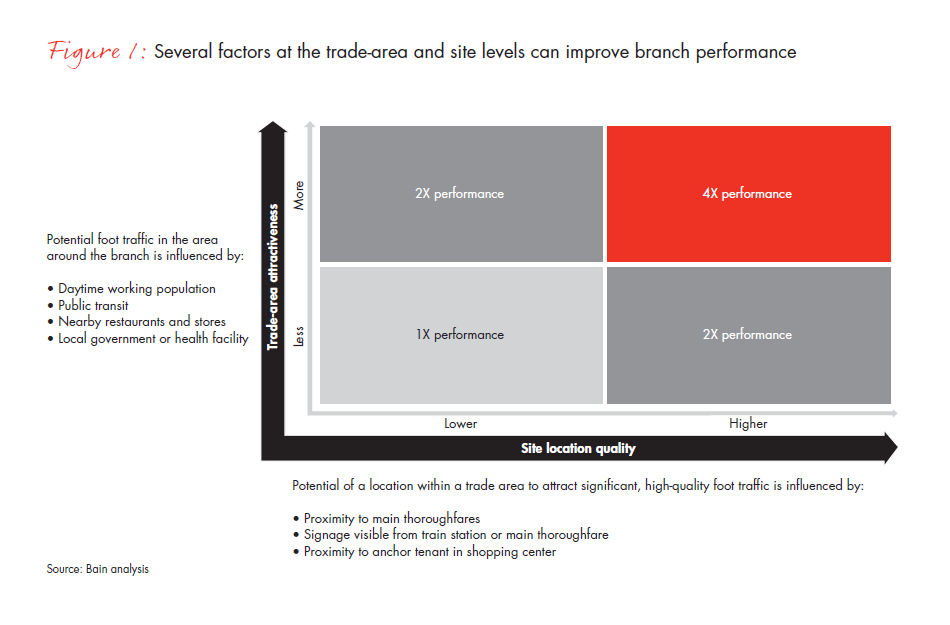
At the level of a 500- to 1,000-meter radius trade area, for example, foot traffic for a branch benefits from being close to a shopping center, supermarket or mass transit station. At the site level, a branch will perform better on the main thoroughfare of a shopping center, near an anchor tenant or with signage visible from several main thoroughfares. In rural regions, being close to local health or government facilities and car showrooms is important. The factors vary by country, region and branch format, but the right factors can be identified and their impact quantified using a combination of analytics and local knowledge of branch managers.
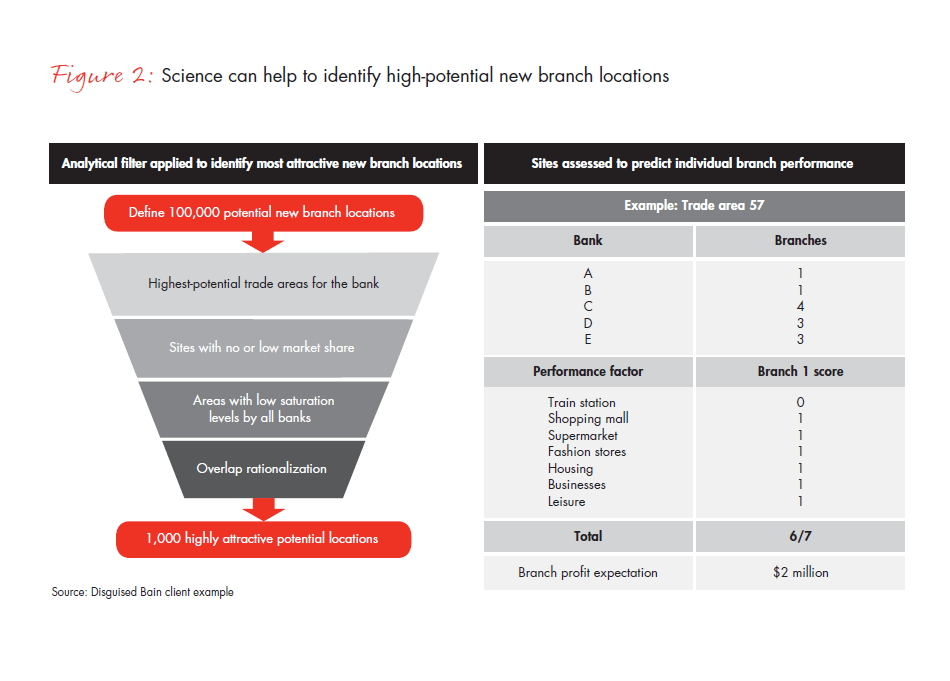
Third, identify high-potential new locations. Geo-spatial models can generate an exhaustive grid of thousands of potential new locations. These locations can then be filtered based on the most important characteristics discussed earlier. Low-priority markets can be swapped out for must-win markets, and poor locations replaced by attractive ones—those where the bank currently has few branches and where competing branches have not yet saturated the market (see Figure 2).
Fourth, assess the merits of existing locations. Sorting the existing portfolio of branches into several groups, based on profit potential, is the prelude to determining how to handle each group. The high-potential group merits the most investment. This group consists of branches that are well located but have gaps in location quality (signage not visible from the main street), look and feel (no renovation during the past 15 years or so) or staffing (senior positions remain vacant).
The group of lowest-potential branches, meanwhile, should be considered candidates for consolidation, with basic transactions and services migrated to other branches or to self-service channels.
A more resilient portfolio of branch formats
Optimizing the footprint is just part of what’s needed to evolve the branch network for a digital world. To raise the overall effectiveness of the network—by blending the best of digital and in-person channels— leading banks are also developing new branch formats that consist of lighter but sturdier alternatives to the traditional branch.
More diverse formats include hub-and-spoke configurations of advisory offices, light-retail consumer shops and self-service kiosks arrayed around the flagship fullservice store. The format will be chosen to capture the opportunity of a particular trade area. All of the new formats incorporate digital technologies, some to enhance the customer experience, others to attain efficiency at scale and many to accomplish both. A few examples:
- Citibank has started an Asian rollout of next-generation ATMs, called Citibank Express, equipped with an online banking connection, video conferencing and biometric identity authentication. A customer can start transactions such as applying for a loan or obtaining a cashier’s check and complete them at the ATM, and vice versa.
- Maybank One Solution kiosks, open during extended hours, target a mass market in Malaysia. The selfservice kiosks allow customers to open an account with just their identification in 10 minutes for seven product categories.
- OCBC’s “FRANK by OCBC” branches in Singapore could pass for a hip clothing store. They target young consumers by offering edgy images on debit cards and a simple savings account. What you don’t find at FRANK are tellers or cash.
Lab branches, built relatively quickly inside warehouses, give banks a cost-effective way to test and refine innovative format layout or in-branch technology well before launch. Customers and staff can be brought in and their behavior recorded through tools that track where they walk, where they look, how long they linger and how they use technology. That gives branch planners rich, databased feedback about what works and what does not.
With the acceleration of digital technologies throughout all aspects of banking, Asian banks have a once-in-a-generation opportunity. Forward-thinking banks have already begun to reshape and revitalize their branches, testing and learning as they go. Smart technology deployed appropriately within and outside the branch can help some banks win a “triple crown” of a vastly improved experience for customers, more engaged branch employees and higher returns on branch Capex, which will yield faster revenue growth than competitors.
First published in 3월 2013