

Brief
We have been talking about healthcare costs for more than 40 years, but the worldwide financial crisis and subsequent climate of austerity are finally catalyzing change. Payers are searching for all available tools to stunt the growth of a sector that has successfully resisted cost containment for decades. Adding to the urgency for action is an anticipated global surge in demand precipitated by several factors: an aging population with chronic care needs, population and income growth in emerging markets and the potential for insurance coverage expansion due to health reform in the US and around the globe.
An increase in demand—even one accompanied by cost pressures—is generally good for companies supplying products to the healthcare sector. But in this case, it is concomitant with a precipitous decline in research and development productivity for pharmaceutical and medical technology companies, leading to a more than $100 billion loss in product exclusivity by 2015.1 Despite ongoing medical need across many diseases, these players can no longer depend on their innovation engine and pricing power to drive ongoing profit growth. The net result will be an unprecedented decline in the share of the overall healthcare profit pool captured by innovation-driven companies in favor of lower-margin sectors like generic manufacturers and providers.2
We do not suggest that healthcare will be less innovative over the coming decade, but rather that the focus of innovation will shift from the product arena to healthcare delivery. A demand surge in an environment of fiscal constraint and slower product innovation will create a climate that favors investment in new ways of delivering care, in part by applying the power of information technology—long overdue in healthcare, relative to other sectors. Indeed, the shift in emphasis from managing inputs, like the rate of adoption of new products and the number of physician visits, toward delivering outputs, like patient satisfaction, clinical outcomes and overall system savings, is already well underway.
Going forward, the critical question for companies will be how they can evolve their business model and thrive in a world of shifting profit pools by focusing on delivering better outputs, rather than by simply generating more inputs—more products, more procedures and ultimately more cost to the payers.
All of these disruptive changes will have two significant implications for the global healthcare market:
- There will be radical changes in the relative size and growth of the various parts of the global healthcare profit pool. In the past, growth by sector has been relatively consistent, but by 2020 and beyond, growth rates across sectors and geographies will diverge.
- The basis of competition in the marketplace will change as well. Different therapeutic areas will be affected in distinct ways by two significant trends: growing consumer engagement and increasing standardization of care (“protocolization”).3
How will you compete as global profit pools shift?
Even though the global profit pool will expand over the next 10 years, most players will need to develop new business models to win. We believe the total profit pool will grow at a compound adjusted growth rate (CAGR) of 4%—from $520 billion in 2010 to $740 billion in 2020—but lag overall healthcare expenditure as profitability declines in aggregate worldwide4 (see Figure 1).
Your business plans for the next decade will require a deeper understanding of the sector and regional shifts embedded in these global figures. For example, most of the growth in the global profit pool will come from increased volume in the delivery of care, while another significant source of growth will come from smaller sectors like contract research or manufacturing and nutrition, which are experiencing significant growth from a smaller base, particularly in the emerging markets.
Pharmaceutical companies will see low growth and some decline in margins over the coming decade. Brand-name pharmaceuticals will grow only 1%, and the market will become increasingly fragmented, as the main source of revenue growth will be smaller items like targeted oncology products.5 In the US the situation will be even worse, as the forecasted 1% growth rate will depend on substantial growth in the second half of the decade, overcoming patent expirations and pricing pressures. At the same time, generics will grow by 7%, driven by those same patent expirations as well as increased volume in emerging markets (and a few underpenetrated developed markets).
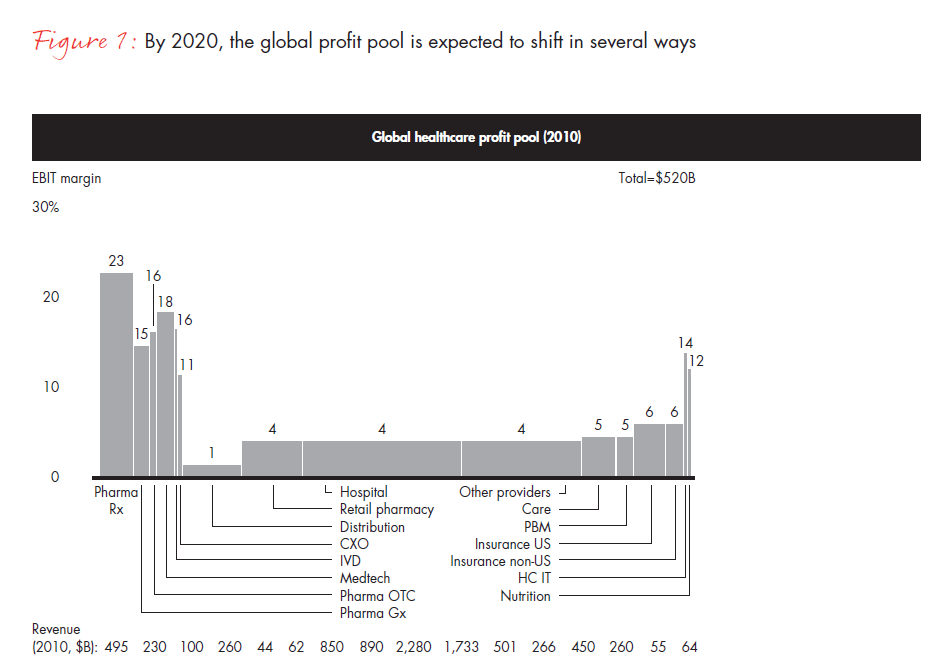
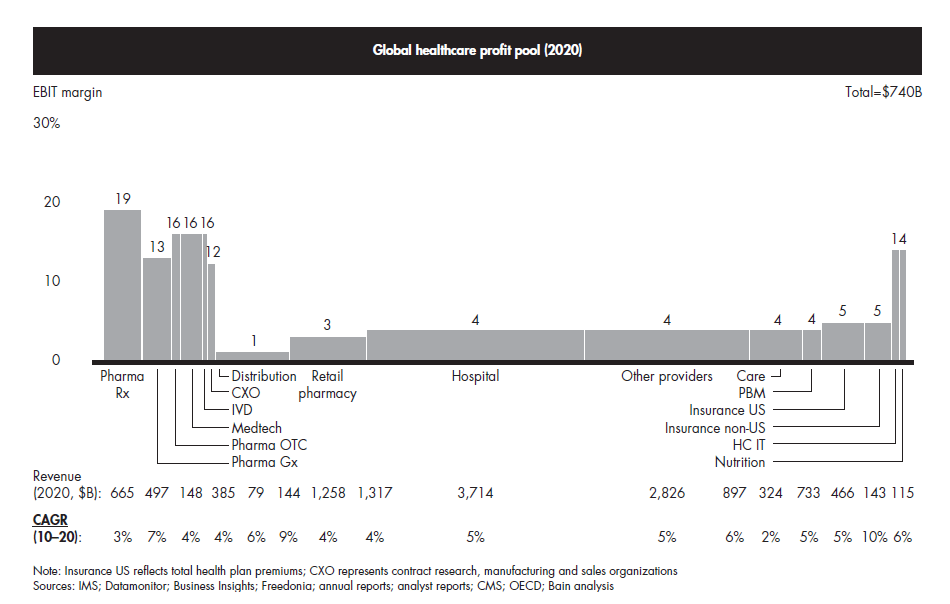
Global medical technology products will grow 3%, but with lower profit margins due primarily to worldwide pricing pressure. The slowdown will come mainly from peak penetration of products, such as stents, in developed markets and competition everywhere from “good enough” products. In China there is already fierce competition from locally produced stents, and this pricing pressure will continue as the Chinese and others develop cheaper alternatives.6
New healthcare value chain players will expand the overall profit pool to some degree. While margins in almost every other sector will slow, the growth in these sectors will be dramatic. Contract research, manufacturing and sales companies and healthcare IT companies will see significant volume growth as pharmaceutical companies outsource more functions and the demand for data accelerates.7 Contract research organizations will expand through greater use of strategic alliances and risk-sharing arrangements with pharmaceutical companies. Contract manufacturing organizations will see 8% CAGR, in part due to their expansion into China and India.
Because of the uncertainty of health reform in the US, payers are not likely to experience the growth they have experienced in the past. Even if there is more insurance coverage, there will be lower margins because of pressure on premiums. In fact, the traditional business model of US health insurers is increasingly coming into question with the rise of accountable care organizations (ACOs). The net result is that the expansion in worldwide insurance coverage will come largely from emerging markets, with growth in Europe remaining fairly stagnant.
Providers of care worldwide will see the largest volume gains, but not necessarily any increase in their overall margins. These volume increases will drive 30% of the overall profit pool growth (about $70 billion), but profitability will be flat or will decline. In fact, the overall profitability of healthcare players is expected to decrease by about 1% by 2020.8 The slower growth in US and European markets will be offset to some degree by expansion in emerging markets like China and India, specifically for generic drug products. Rapid economic growth and the rise of chronic diseases will produce substantial gains for price-sensitive generic products, but weak medical insurance and gaps in delivery capability in rural areas will remain challenges for these economies.
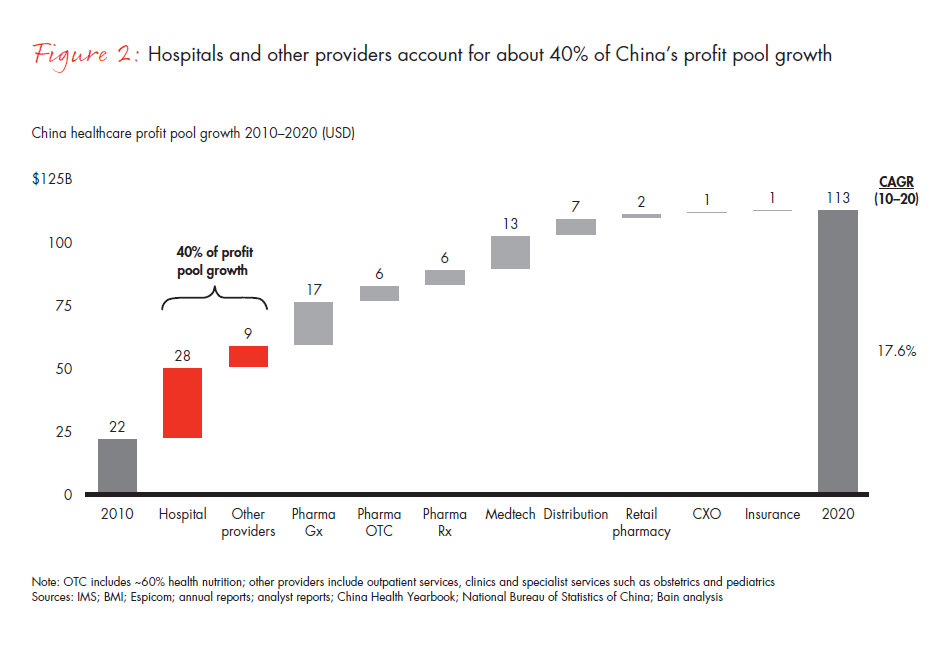
China’s healthcare profit pool will grow from about $22 billion in 2010 to $113 billion in 2020, a CAGR of 18%, 9 suggesting appealing opportunities for new investments, but hospitals and other providers will drive 40% of that growth (see Figure 2).10 Those providers will benefit from an aging population and a rising middle class, and there are also some signs of government policies that are favorable to private investment in the sector. Pharmaceutical and medical technology companies will continue to realize attractive earnings before interest and tax (EBIT), but brand, generic and over-the-counter products will shrink by one percentage point because of government-enforced price cuts and the increasing purchasing power of distributors.
Likewise, in India, the delivery of care and pharmaceutical sales will make up most of the fragmented $65 billion market.11
Disruptive changes will alter the basis of competition, creating new opportunities to redefine business models and enter new markets
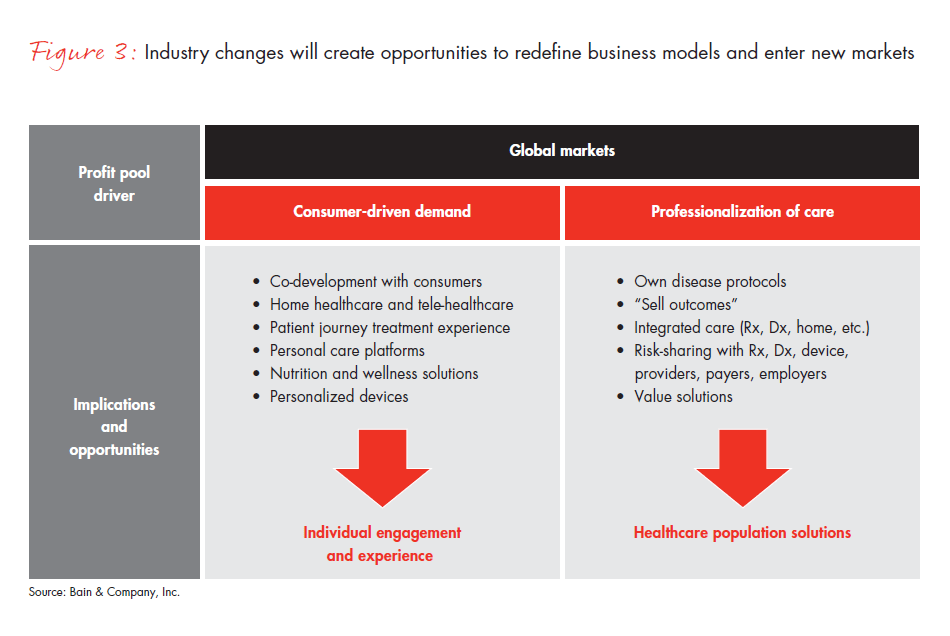
The sheer size of emerging markets makes them attractive offsets to more stagnant growth in other regions of the world. But to be successful, companies will need new business models to take advantage of the opportunities there (see Figure 3). Profit pool shifts and the lack of access to healthcare in many countries, for example, may spur some pharmaceutical and medical technology companies to meet the challenge by opening clinics in the developing world, or even entering the private insurance market.
In the developed world, providers and payers are already entering the device or drug market. Companies like Fresenius Medical Care, which started out producing dialysis machines, have emerged to “own” an entire segment of care—vertically integrated with machines, clinics and drugs. With global government spending estimated at about $50 billion for dialysis products and services, but with shrinking reimbursement per treatment, the vertically integrated model may be an effective path to capture a very specific part of the profit pool.12
While the specificities differ by market, the overall trend is that companies are seeking incremental growth in new profit pools that tie to disease knowledge or market know-how.
On what basis will you compete? If you can no longer depend only on increased volume or control pricing, where can you most profitably operate in the newly configured global market? This is where the acceleration of twin trends—consumer-driven demand and standardized and protocolized care—comes into play. These two trends are powerful and have the capacity to facilitate the shift to outputs over inputs, stimulating new opportunities for profitable growth, if you can adapt your business model.
- With more information about treatments available to an increasing number of consumers or patients around the globe, every company with a product to sell must understand how best to engage with consumers, in a way that speaks to their individual needs and patient experience. Search engines have produced a vast engaged patient population we could not have imagined even 10 years ago: 80% of Internet users now search for health information online, and more than half look for specific information about a medical treatment or disease.13 The demand for more engagement is not limited only to the US and Europe. Mobile phones and Internet access are now available in most emerging economies. While there will continue to be cultural differences in the way consumers engage with their care, the degree of engagement itself will only intensify globally. More than one-third of Indians, for example, currently use the Internet to search for health information, with similar percentages of younger, more educated people seeking health information online in Brazil, Mexico and China.14
- Along with the trend toward increased consumer engagement is an increasing professionalization of medical care processes. We call this trend protocolization because physicians and other providers are accepting and using more standardized protocols and guidelines for treating their patients. US providers have been somewhat slower to embrace clinical protocols than their European or Asian counterparts, but there is little doubt about the direction of this change. No longer will the individual physician be the lone decision maker. The cottage industry of medical care is being industrialized, as payers and providers increasingly align their businesses—and results—which may be threatening to some, but may well produce better care at lower cost.
Protocolization and consumerism will not affect all therapeutic areas equally
There are at least four “landscapes” where healthcare companies will have to make strategic decisions in order to survive and win (see Figure 4).15
On one axis of Figure 4, we included the conditions and diseases for which consumer engagement will be the main market driver; on the other, we have shown the degree to which standard protocol will guide treatment decisions. In some areas of treatment, both consumer engagement and protocolization will be in play, leading to an opportunity for patient-provider “teaming.” Both of these trends translate into reduced autonomy and decision-making control for physicians for established conditions.
Where there is a high degree of consumer engagement but low protocolization, the patient experience will impact the outcomes most strongly. Such treatment options are often cash-based or lifestyle therapies, like breast implants or erectile dysfunction. Brands will initially rule for these types of procedures because of their familiarity and marketing clout, but prices may be forced down over time as the experience curve is applied to these markets. The degree of protocolization for these therapies will start out weak, but will increase with competition, especially for treating conditions like infertility, where buyers perceive proprietary protocols to be an advantage.
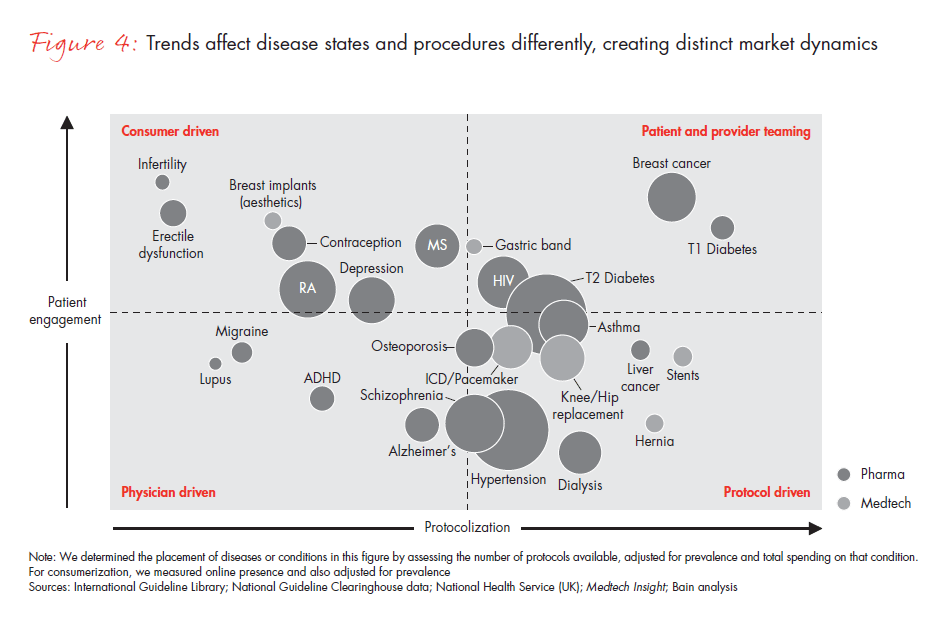
The more routine, protocol-driven therapies, such as for conditions like hypertension or procedures for knee or hip replacement, involve processes of care that are generally well accepted, but result in less physician discretion and patient choice. Manufacturers of products for these conditions will need to have good data to accurately price their products and ensure that they are included in any protocols being developed to guide treatment. Whatever patient marketing exists for these types of conditions will largely focus on adherence because care management, not just the specific product, results in better outcomes.
Where there is a high degree of consumer engagement along with a high degree of protocolization for diseases like breast cancer or Type 1 diabetes, manufacturers will need to be sure that they shape the protocols being used and target their marketing to those preferred therapeutic options. The “teaming” between providers and patients will be a significant challenge for payers and manufacturers. In the area of breast cancer alone, the existence of multiple effective patient advocacy organizations will inform patients of their options, and they in turn will put pressure on doctors to find the optimal treatment regimen. Payers will attempt to control the protocol development in this area in order to control costs.
The physician-driven quadrant, with its lower degree of consumer engagement and protocolization, is a “business as usual” state, and there is unlikely to be significant growth in those types of markets. Therapies for migraines or attention deficit hyperactivity disorder (ADHD), for example, have fewer accepted protocols, and thus payers will continue to struggle to control utilization beyond mere cost shifting. New physician-driven therapies will, of course, continue to emerge, but the overall trend is clearly away from full physician control as markets mature and consumers become more involved in their own healthcare.
Over time, more diseases will move up and to the righthand side of Figure 4. Protocolization and consumerism will increase, and payers will demand and use better data about outcomes. Although these changes will not guarantee increased revenue, good outcomes should result in a better share of the profit pool for players that can shape the protocol development by demonstrating how their products create value.
Where can you play—and win—by 2020?
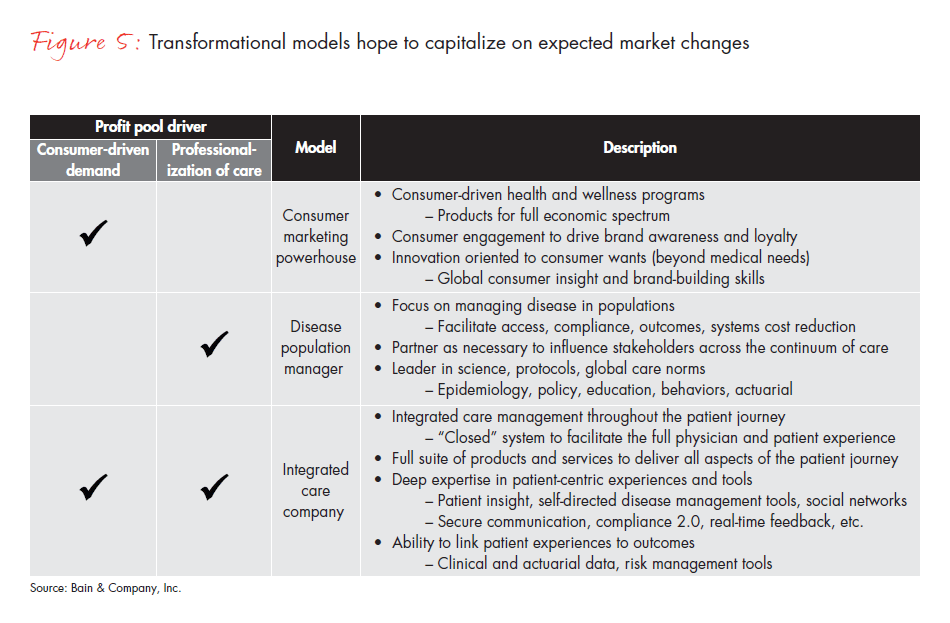
Only transformational business models will enable future winners to capitalize on the disruptive market changes at play (see Figure 5). The models identified in Figure 5 are very different from the business models being discussed in boardrooms today. Becoming a consumer marketing powerhouse, a disease population manager or a successful integrated care company will require different organizational capabilities. For example, for treatments and conditions where the degree of consumer demand is high, like health and wellness programs, or for treatments with high brand recognition, a consumer powerhouse approach can help produce differential growth and market share. For conditions with a high degree of protocolization like hypertension, a population- manager approach may be the answer. The most challenging model of all will be to create integrated care solutions that manage the full suite of products and services across the patient journey. This approach will require deep expertise in patient-centered care and the tools that support that care, such as real-time feedback, secure communication and digital technology to enhance patient participation.
These new approaches require a fresh look across the profit pool for each condition. Here are a few examples to think about:
- For businesses in the more traditional, physician-dominated quadrants of Figure 4, winners will build the capabilities to deliver risk-sharing models, potentially partnering with payers and providers— or even directly becoming more involved in the delivery of care.
- If you are operating in the top right-hand quadrant of Figure 4, patient-provider teaming, then you may need to partner or develop capabilities in data sharing and coordination to ”wrap around” the patient and manage a population for a payer or provider organization.
- If you operate more in the consumer world, you may need to move beyond branding the product and start branding the procedure by forming alliances with certified providers that can perform the procedure or provide medication, such as exclusive, branded and certified botulinum toxin clinics.
- Where the various components of the profit pool have created silos, with products and patients being passed around among them, the trend toward protocolization and consumerization will break down barriers and create a more integrated approach for a given medical condition or procedure. Firms like Fresenius and DaVita are already doing this, and other healthcare companies will either participate in this trend or risk becoming mere commodity suppliers.
- The industry’s metrics will need to change. Using annual budgets and per person savings will not reflect value adequately for either private or government payers. Can payers stay involved for long-term gain when paying for chronic diseases? Public payers may not be able to resist the pressures to simply reduce their costs. Private payers will need to identify ways to reduce cost and demonstrate improved quality. For providers, it will be a choice of joining the rush to become an integrated care company or trying to find room to be a branded provider of choice.
For a select few, the old models could work—breakthrough innovation will still drive profitable growth, but few, if any, have proven the ability to sustain this over time. Cost pressures will force nearly every company in the industry to rethink how and where it will grow moving forward. Good strategic choices will still yield growth. A profit pool that is growing at a breakneck pace will no longer shelter poor choices. Executives and investors can and must know where the profit pools are shifting—and how they will change course to successfully compete.
George Eliades is a partner with Bain & Company based in San Francisco and a leader in the firm’s Global Healthcare practice. Michael Retterath is a Bain partner based in New York and a leader in the Global Healthcare practice. Norbert Hueltenschmidt is a partner based in Zurich and the head of Bain’s Global Healthcare practice. Karan Singh is a partner based in New Delhi and head of Bain’s Asia-Pacific Healthcare practice.
- IMS Institute for Healthcare Informatics, “The Global Use of Medicines: Outlook Through 2015,” May 2011.
- The methodology Bain used for developing this profit pool analysis is based on detailed health sector revenue and EBIT margin analysis for US and global sectors. The sector revenues are based and triangulated on latest market reports; the sector margins are based on company annual reports; the 2010-2020 CAGRs are based on market reports, where available, and Bain estimates; and the margin changes from 2010 to 2020 are based on proprietary Bain analysis.
- The term “protocolization” refers to the application of proven standards of care and consistent protocols and guidelines to reduce variation in the delivery of healthcare.
- Sources: Bain analysis, IMS, Datamonitor, Business Insights, Freedonia, annual reports, analyst reports, Centers for Medicare and Medicaid Services (CMS), OECD
- Sources: Datamonitor; based on top 50 branded pharma companies
- Sources: Business Insights, Datamonitor, analyst reports, Bain analysis
- Sources: Business Insights, Datamonitor, Parexel, analyst reports, Bain analysis
- Sources: IMS, Datamonitor, Business Insights, Freedonia, annual reports, analyst reports, CMS, OECD, Bain analysis
- Sources: IMS, BMI, Espicom, annual reports, analyst reports, China Health Yearbook, National Bureau of Statistics of China, Bain analysis
- Sources: IMS, BMI, Espicom, annual reports, analyst reports, China Health Yearbook, National Bureau of Statistics of China, Bain analysis
- Source: Bain analysis
- Fresenius Medical Care, “Forward Looking Statements,” 2009, p.31.
- Susannah Fox, Pew Research Center’s Internet & American Life Project – Health Topics, February 1, 2011, http://pewinternet.org/Reports/2011/HealthTopics.aspx.
- “Indians Increasingly Use Internet for Their Healthcare Needs,” Express Healthcare, http://www.expresshealthcare.in/201201/theyearthatwas201152.shtml.
- Sources: International Guideline Library, National Guideline Clearinghouse data, National Health Service in UK, Medtech Insight and proprietary Bain analysis The methodology for determining the degree of consumer engagement and protocolization in Figure 4 was developed by collecting all the protocols on each disease from a variety of sources, scoring the current level of protocolization on a scale of one to 10 and then adjusting for prevalence and total spending on the disease. For consumerism, we monitored the presence of topics for each disease on a variety of patient websites and corrected for prevalence.
First published in 6월 2012