

Brief

At a Glance
- Far from being a technology for the future, artificial intelligence is already being used by leading telcos to gain a strategic advantage in 5G.
- By accelerating decisions at scale and with relentless precision, AI tools can unlock the attractive return on investment that a conventional 5G rollout may struggle to achieve.
- In 5G and other areas, truly AI-native telcos will gain an edge in the coming years by reinventing roles across the business rather than just optimizing existing processes.
Strategic opportunities don’t come bigger than 5G for telco executive teams today. Nor do strategic challenges.
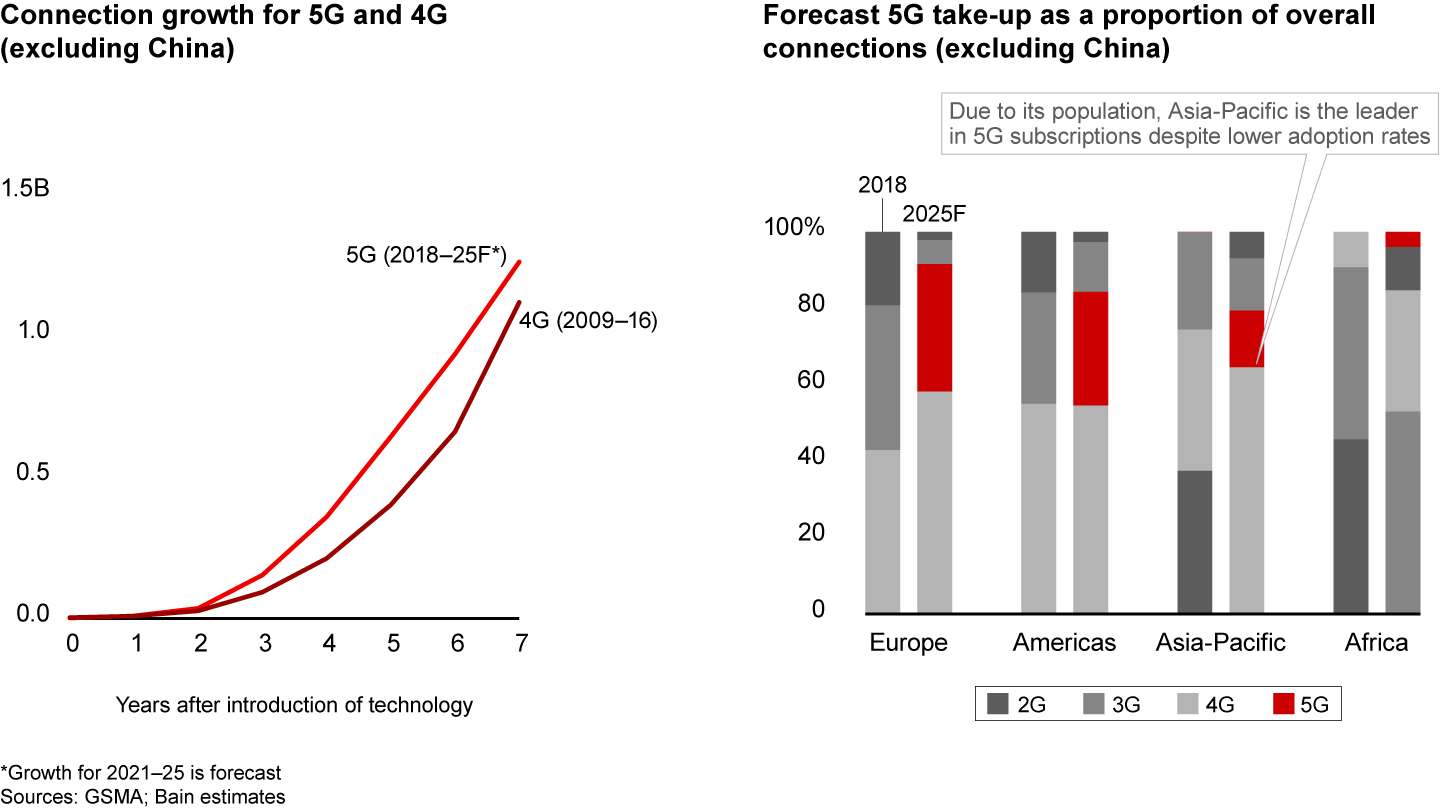
Between 2021 and 2025, we expect the technology truly to enter the mainstream, with the number of 5G connections worldwide tripling from less than 700 million to 2.1 billion. What’s more, the adoption of 5G is expected to be faster in its first seven years (2018–25) than the adoption of 4G in the seven years after its own market debut in 2009 (see Figure 1).
Figure 1

This momentum reflects heavy operator investment in 5G infrastructure, a gradual expansion of uses for the technology, and a global hunger for data connectivity that’s only been exacerbated by Covid-19’s transformation of how and where we work. Yet for all these tailwinds, many telcos still find it hard to make 5G pay.
To generate a strong return on investment from a 5G rollout, executive teams must excel at three things. They must map the physical environment at the level of centimeters and then work at this extreme high resolution at regional or national scale. Likewise, they must engage with millions of customers as individuals, not cities or marketing segments. And they must respond in real time to a host of other complex variables.
Gut feel alone can’t get the job done. Nor can current analytics tools. The economics of 5G may even defy some digitally native telcos, particularly if they still rely on labor-intensive workflows beneath a dazzling top layer of automation and advanced analytics. A fresh approach is starting to gain traction, however. Some farsighted operators are starting to use 5G and other high-stakes business areas as a proving ground for the deeper artificial intelligence (AI) capabilities they’ll need to gain in the coming years.
Early results suggest that cutting-edge tools of this kind do indeed have what it takes to solve the sector’s toughest challenges, by accelerating decisions from months and weeks to days and minutes, with a precision and scale that exceeds what’s humanly possible. On a broader strategic level, the nascent deployment of these solutions also offers a preview of how telcos can develop an AI-enabled operating model across their businesses. Over time, such AI natives are likely to thrive at the expense of slower-adapting telcos.
Surgical precision at scale
A large part of the ROI challenge with 5G stems from the spectrum bands the technology uses, of course. Its higher-frequency signals don’t travel as far or penetrate buildings as well as the lower-frequency kind used by 4G. In high-band 5G deployments, more cells are needed to compensate for the weaker, almost-line-of-sight propagation. Operators must deploy as many as 100 times the number of cells used by 4G, arranging them with unprecedented precision. Telcos that try to use 4G-era tools to surmount a challenge of this scale will likely struggle to gain a foothold.
As if that engineering conundrum weren’t enough to create a compelling use case for AI, telcos face an additional hurdle when they try to sell households 5G home broadband services delivered through fixed wireless access (FWA). Often, urban and suburban areas that are dense enough to be attractive for a 5G home broadband provider already feature competing ultrafast services delivered through fiber or cable at speeds that can more than hold their own against FWA. A 5G home broadband rollout designed on a “build it and they will come” basis can fail in such circumstances.
Against this backdrop, making FWA work at scale calls for fundamentally new capabilities that AI can supply. For instance, to create an attractive ROI, operators need to sift through millions of households to identify street-level clusters of consumers most likely to take 5G home broadband—and then tailor their rollout to these promising areas. Think of the family stuck with a snail’s pace copper-wire connection in the only apartment building on the street that hasn’t yet been hooked up to fiber. Then broaden that focus (with AI’s help) to identify a critical mass of households facing a similar constraint across the full breadth of your territories.
AI tools can help with sealing the deal too, automatically selecting the promotional or marketing message that will persuade a household to sign up, rather than merely consider doing so. For a family with data-hungry children, that might mean emphasizing the speed gains; for retirees on a budget, the AI-driven marketing might showcase a discount instead.
Today’s cutting-edge tools can also show how the immediate physical environment will influence the profitability of serving that customer at the speed they expect. For instance, signing up a customer who demands a minimum speed of 1 gigabit per second is likely to be a loss-making move if there are huge trees shielding their property from 5G signals, requiring a costly workaround. Mapping trees and all other possible obstacles across a region is a colossal undertaking, but it can now be done by telcos with AI’s help to guide 5G deployment and the resultant commercial push.
One telco at the vanguard of 5G deployment is using an AI platform to increase the penetration of its 5G fixed broadband offering, reduce the cost of customer acquisition, and identify the highest-value neighborhoods for the continued rollout of the service. In early deployment, the platform helped executives identify households that were as much as 2.5 times more likely to sign up than the average household; crucially, these opportunities were clustered in a way that allowed the telco to reach them at scale (and at speed). Furthermore, the individualized marketing enabled by the platform should cut the cost of acquiring each 5G FWA customer by $1,000, with further gains expected.
The AI platform is on track to improve ROI by as much as 1 percentage point—a gain that equates to hundreds of millions of dollars of incremental profit, at the scale of a typical 5G rollout requiring tens of billions of dollars of investment. But the direct financial benefit is likely to be only part of the attraction in such situations. There could also be a lasting boost to the speed and clarity of a telco’s decision making as the AI scales with the business.
Of course, the challenge doesn’t end with the build-out of a network; you must then delight the customer with your service levels. The reactive legacy model of network maintenance has often made that second task difficult. Something stops working for the customer, they complain, and it (eventually) gets fixed. However, the AI tools that can transform a 5G rollout bring with them an opportunity to delight users through preemptive network maintenance.
For instance, one Latin American telco has already made strides toward seamless “it just works” broadband by using machine learning functionality from the AI platform described above. The platform enabled it to sift through the generalized picture of network health to find indicators of low-quality individual experiences before they required more costly reactive intervention (or drove that customer into a competitor’s arms).
It also helped create more efficient solutions to problems that had already come to the attention of users. For instance, one customer was only getting a quarter of the 120 megabits per second he was promised: Machine learning data analysis identified fluctuations consistent with a loose modem connection, which was resolved remotely instead of through an on-site visit.
Another incident involved a regional upsurge in repair calls that didn’t correspond to any node problems. The AI platform found a problem with Google’s domain name system in the region, and the telco was able to resolve it without sending a single repair truck. Overall, in the city that piloted the machine learning solution, the telco reduced the volume of service calls and truck rolls by more than 20%, while improving the experience of customers.
The AI-enabled telco takes shape
For telcos today, 5G is the thin end of the wedge for AI. The technology is set to play a mounting part in the sector’s defining moments. Consider the strategic hot potato of whether to separate network infrastructure into a standalone “NetCo.” A telco that uses AI tools in its 5G rollout could begin to develop a differentiated capability for putting the right infrastructure in the right place—with surgical precision and at dizzying scale. That would be a potent way to decommoditize a NetCo. Such infrastructure expertise could be the platform for even bolder innovation by telcos, akin to the Japanese mobile network operator Rakuten’s move into selling 5G equipment.
AI’s use in 5G is already showing us what sort of telcos will rise best to the coming strategic opportunities in all their sprawling complexity. For a start, it’s clear that being truly AI-enabled means more than just investing in an AI team or center of excellence (COE). Don’t get us wrong: AI teams and COEs are a good first step many operators have already taken. In such a setup, the AI specialty is a business partner to the rest of the telco—a role similar to that played by HR, procurement, and other specialist shared services. That’s one way to chalk up quick wins, such as running analytics to pinpoint key reasons for customer churn and preemptively adapting the scripts used by call center agents to respond to customers’ individual experiences before they raise the issue.
But being AI-native calls for more than an optimization of existing business processes or workflow overlays. Take the retrospective churn analytics example described above. AI can go way further than that, supplying an automated solution for a problem before the customer is moved to complain. (It could also smooth any low-level frustration by using network-level dynamic resource allocation to ensure the customer has a good experience for the next few weeks.)
Over the coming years, AI’s strategic advantage will go to companies whose employees are evolving their jobs in partnership with the technology. During the build stage for next-generation services, that means creating cross-functional teams that are equipped to develop and deliver end-to-end processes (vs. local optimization of just one function). At the operational stage of those services, being truly AI-enabled demands that frontline employees across all functions elevate their roles from repeatedly making the same decision to defining rules by which a machine decides.
It’s easy to think that this vision of radical automation is still just around the corner. But AI-powered tools have already evolved to the point where operators are deploying them with concrete results—as shown in the rollout of 5G services. This is now science fact, not science fiction. It’s time for telcos to pick a use case and just get started.
First published in 9월 2021