
Skip to Content
  • 오피스

    오피스

    미주
    • Atlanta
    • Austin
    • Bogota
    • Boston
    • Buenos Aires
    • Chicago
    • Dallas
    • Denver
    • Houston
    • Los Angeles
    • Mexico City
    • Minneapolis
    • Monterrey
    • Montreal
    • New York
    • Rio de Janeiro
    • San Francisco
    • Santiago
    • São Paulo
    • Seattle
    • Silicon Valley
    • Toronto
    • Washington, DC
    유럽, 중동, 아프리카
    • Amsterdam
    • Athens
    • Berlin
    • Brussels
    • Copenhagen
    • Doha
    • Dubai
    • Dusseldorf
    • Frankfurt
    • Helsinki
    • Istanbul
    • Johannesburg
    • Kyiv
    • Lisbon
    • London
    • Madrid
    • Milan
    • Munich
    • Oslo
    • Paris
    • Riyadh
    • Rome
    • Stockholm
    • Vienna
    • Warsaw
    • Zurich
    아시아, 호주
    • Bangkok
    • Beijing
    • Bengaluru
    • Brisbane
    • Ho Chi Minh City
    • Hong Kong
    • Jakarta
    • Kuala Lumpur
    • Manila
    • Melbourne
    • Mumbai
    • New Delhi
    • Perth
    • Seoul
    • Shanghai
    • Singapore
    • Sydney
    • Tokyo
    오피스 전체보기
  • 얼럼나이
  • 미디어 센터
  • 구독
  • 연락처
  • Korea | 한국어

    지역 및 언어 선택

    글로벌
    • Global (English)
    미주
    • Brazil (Português)
    • Argentina (Español)
    • Canada (Français)
    • Chile (Español)
    • Colombia (Español)
    유럽, 중동, 아프리카
    • France (Français)
    • DACH Region (Deutsch)
    • Italy (Italiano)
    • Spain (Español)
    • Greece (Elliniká)
    아시아, 호주
    • China (中文版)
    • Korea (한국어)
    • Japan (日本語)
  • Saved items (0)
    Saved items (0)

    You have no saved items.

    관심 있는 내용을 북마크하여 Red 폴더에 저장할 수 있습니다. Red 폴더 에서 저장된 내용을 읽거나 공유해보세요.

    Explore Bain Insights
  • 산업
    메인 메뉴

    산업

    • 우주항공, 방산 및 정부 서비스
    • 농업 관련 산업
    • 화학
    • 인프라, 건설 및 건축 자재
    • 소비재
    • 금융 서비스
    • 헬스케어
    • 산업용 기계 및 장비
    • 미디어 및 엔터테인먼트
    • 금속
    • 광업
    • 석유 및 가스
    • 제지 및 패키징 산업
    • 사모펀드
    • 사회 및 공공 부문
    • 유통
    • 기술
    • 텔레콤
    • 운송
    • 여행·여가
    • 유틸리티 및 재생가능 에너지
  • 컨설팅 서비스
    메인 메뉴

    컨설팅 서비스

    • Customer Experience
    • ESG
    • Innovation
    • M&A
    • 운영
    • 조직
    • 사모펀드
    • 고객 전략 및 마케팅
    • 전략
    • AI, 인사이트 및 솔루션
    • Technology
    • 변화 혁신
  • Digital
  • 인사이트
  • 베인 소개
    메인 메뉴

    베인 소개

    • 업무 소개
    • 베인의 신념
    • 구성원 및 리더십 소개
    • 고객 성과
    • 주요 수상 경력
    • 글로벌 파트너사
    Further: Our global responsibility
    • 다양성과 포용
    • 사회 공헌 활동
    • Sustainability
    • World Economic Forum
    Learn more about Further
  • Careers
    메인 메뉴

    Careers

    • Work with Us
      Careers
      Work with Us
      • Find Your Place
      • Our Work Areas
      • Integrated Teams
      • Students
      • Internships & Programs
      • Recruiting Events
    • Life at Bain
      Careers
      Life at Bain
      • Blog: Inside Bain
      • Career Stories
      • Our People
      • Where We Work
      • Supporting Your Growth
      • Affinity Groups
      • Benefits
    • Impact Stories
    • Hiring Process
      Careers
      Hiring Process
      • What to Expect
      • Interviewing
    FIND JOBS
  • 오피스
    메인 메뉴

    오피스

    • 미주
      오피스
      미주
      • Atlanta
      • Austin
      • Bogota
      • Boston
      • Buenos Aires
      • Chicago
      • Dallas
      • Denver
      • Houston
      • Los Angeles
      • Mexico City
      • Minneapolis
      • Monterrey
      • Montreal
      • New York
      • Rio de Janeiro
      • San Francisco
      • Santiago
      • São Paulo
      • Seattle
      • Silicon Valley
      • Toronto
      • Washington, DC
    • 유럽, 중동, 아프리카
      오피스
      유럽, 중동, 아프리카
      • Amsterdam
      • Athens
      • Berlin
      • Brussels
      • Copenhagen
      • Doha
      • Dubai
      • Dusseldorf
      • Frankfurt
      • Helsinki
      • Istanbul
      • Johannesburg
      • Kyiv
      • Lisbon
      • London
      • Madrid
      • Milan
      • Munich
      • Oslo
      • Paris
      • Riyadh
      • Rome
      • Stockholm
      • Vienna
      • Warsaw
      • Zurich
    • 아시아, 호주
      오피스
      아시아, 호주
      • Bangkok
      • Beijing
      • Bengaluru
      • Brisbane
      • Ho Chi Minh City
      • Hong Kong
      • Jakarta
      • Kuala Lumpur
      • Manila
      • Melbourne
      • Mumbai
      • New Delhi
      • Perth
      • Seoul
      • Shanghai
      • Singapore
      • Sydney
      • Tokyo
    오피스 전체보기
  • 얼럼나이
  • 미디어 센터
  • 구독
  • 연락처
  • Korea | 한국어
    메인 메뉴

    지역 및 언어 선택

    • 글로벌
      지역 및 언어 선택
      글로벌
      • Global (English)
    • 미주
      지역 및 언어 선택
      미주
      • Brazil (Português)
      • Argentina (Español)
      • Canada (Français)
      • Chile (Español)
      • Colombia (Español)
    • 유럽, 중동, 아프리카
      지역 및 언어 선택
      유럽, 중동, 아프리카
      • France (Français)
      • DACH Region (Deutsch)
      • Italy (Italiano)
      • Spain (Español)
      • Greece (Elliniká)
    • 아시아, 호주
      지역 및 언어 선택
      아시아, 호주
      • China (中文版)
      • Korea (한국어)
      • Japan (日本語)
  • Saved items  (0)
    메인 메뉴
    Saved items (0)

    You have no saved items.

    관심 있는 내용을 북마크하여 Red 폴더에 저장할 수 있습니다. Red 폴더 에서 저장된 내용을 읽거나 공유해보세요.

    Explore Bain Insights
  • 산업
    • 산업

      • 우주항공, 방산 및 정부 서비스
      • 농업 관련 산업
      • 화학
      • 인프라, 건설 및 건축 자재
      • 소비재
      • 금융 서비스
      • 헬스케어
      • 산업용 기계 및 장비
      • 미디어 및 엔터테인먼트
      • 금속
      • 광업
      • 석유 및 가스
      • 제지 및 패키징 산업
      • 사모펀드
      • 사회 및 공공 부문
      • 유통
      • 기술
      • 텔레콤
      • 운송
      • 여행·여가
      • 유틸리티 및 재생가능 에너지
  • 컨설팅 서비스
    • 컨설팅 서비스

      • Customer Experience
      • ESG
      • Innovation
      • M&A
      • 운영
      • 조직
      • 사모펀드
      • 고객 전략 및 마케팅
      • 전략
      • AI, 인사이트 및 솔루션
      • Technology
      • 변화 혁신
  • Digital
  • 인사이트
  • 베인 소개
    • 베인 소개

      • 업무 소개
      • 베인의 신념
      • 구성원 및 리더십 소개
      • 고객 성과
      • 주요 수상 경력
      • 글로벌 파트너사
      Further: Our global responsibility
      • 다양성과 포용
      • 사회 공헌 활동
      • Sustainability
      • World Economic Forum
      Learn more about Further
  • Careers
    최근 검색어
      최근 방문 페이지

      Content added to saved items

      Saved items (0)

      Removed from saved items

      Saved items (0)

      World Economic Forum

      How Companies Can Accelerate and Galvanize Food System Transformation

      How Companies Can Accelerate and Galvanize Food System Transformation

      We need to act more quickly to build a more sustainable, inclusive, and healthy food system.

      글 John Blasberg, Jenny Davis-Peccoud, Sasha Duchnowski, and Vikki Tam

      • 읽기 소요시간

      Article

      How Companies Can Accelerate and Galvanize Food System Transformation
      en
      한눈에 보기
      • More sustainable food and agriculture offers one of our best shots at reversing climate change and environmental degradation.
      • Sustainable systems can improve health and livelihoods around the world.
      • Corporations have a critical role to play in this transformation.

      This article originally appeared on World Economic Forum.

      The global food system is a marvel of human achievement. It feeds 7.9 billion people, employs 40% of the world’s population, and generates a third of the global GDP. But at the same time, agriculture places a heavy burden on the environment, and the economic benefits are uneven.

      An inclusive and sustainable global food system

      We need to act more quickly to build a more sustainable, inclusive, and healthy food system. There are fewer than nine annual planting cycles left to meet key milestones of the Paris Agreement and the United Nations Sustainable Development Goals.

      Real progress depends on urgently tackling three paradoxes.

      Figure 1
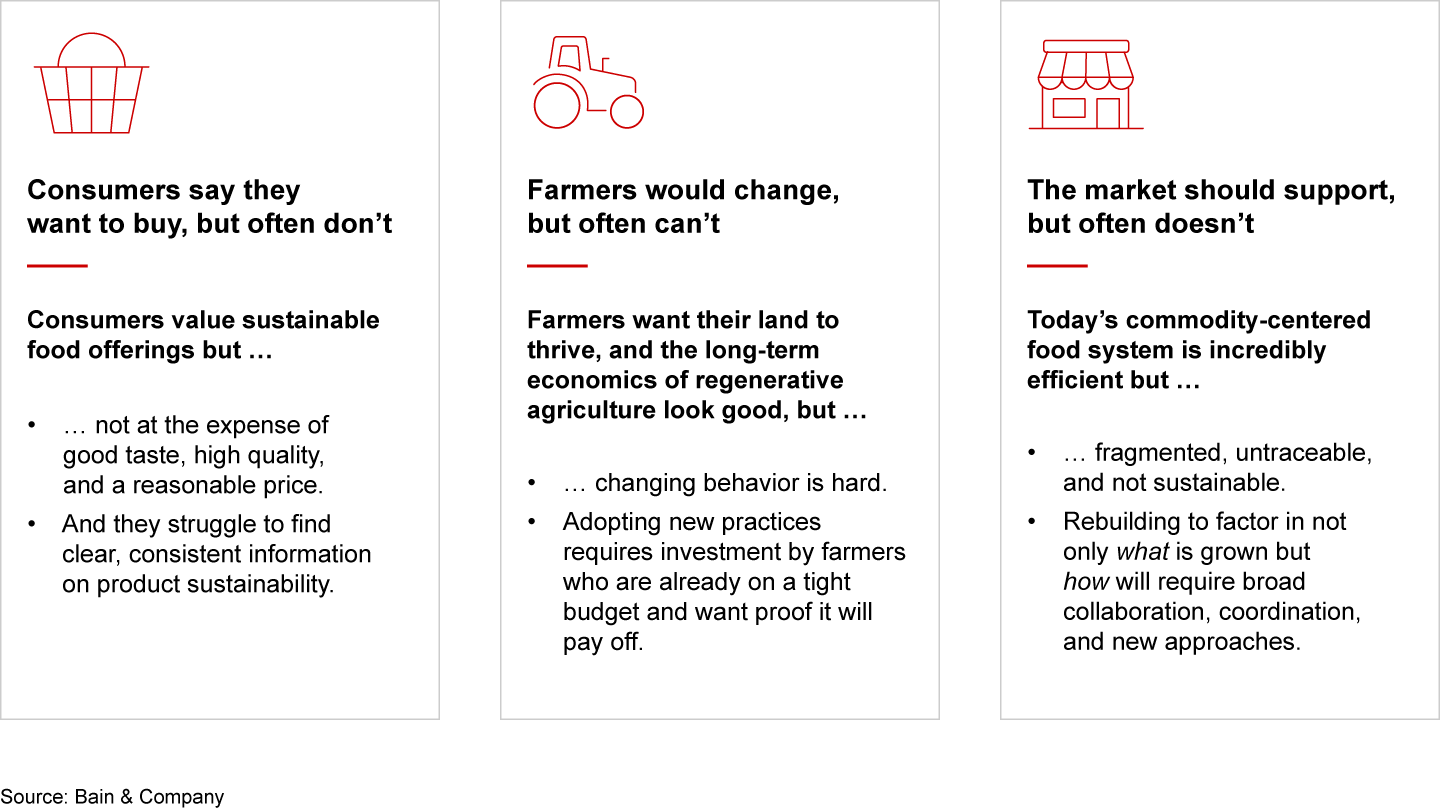
      Fixing our food system depends on solving three paradoxes

      1) Consumers say they want to buy, but often don’t

      Consumers around the world value sustainable food offerings. In a recent Bain & Company survey, 80% of European consumers report caring about sustainability, and 14% say ESG considerations are their main purchase criteria. Eighty-seven percent are willing to pay more for products made in an environmentally and socially responsible way. The figures are similar in Asia and the US.

      Unfortunately, shoppers’ high level of interest is not consistently reflected in what lands in their carts. Sustainable options often carry too high a price tag, and while sustainability is important to consumers, other factors are too, including taste, quality, and health benefits. Shoppers are also frustrated by how challenging it can be to get the information and guidance needed to evaluate a product’s sustainability. They want brands to provide clearer, simpler information.

      2) Farmers would change, but often can’t

      Individual farmers are critical to creating a more sustainable food system. As stewards of the land, farmers want to see it thrive, but farming is their livelihood, and they often operate on thin margins.

      Studies show that, over time, there is an economic benefit to shifting to the regenerative farming and grazing practices that help fight climate change by rebuilding soil’s organic matter, pulling carbon from the atmosphere and sequestering it in the ground. However, adopting these practices costs money and involves significant change, and farmers are looking for proof that it’s worth the investment.

      3) The market should support, but often doesn’t

      Our food system is optimized for scale and efficiency and is centered on commodities that meet common standards. Farmers work to produce those commodities, and food companies rely on them to create consistent products. Operated at high volumes, it’s an incredibly efficient system, but sustainability simply isn’t factored in.

      Transitioning from a food system aimed at maximizing yield and efficiency to one that also rewards how food is grown will require fresh thinking, collaboration, and coordination among key market participants.

      Five actions can break these paradoxes and speed food systems’ transformation.

      • Shifting consumption. Some companies are successfully helping consumers switch to healthier and more sustainable options by satisfying their taste and performance expectations, clearly articulating sustainability benefits, and setting reasonable price premiums. Brands that are seen as sustainable grow two times faster than rivals, according to Bain research. Upfield, a maker of plant-based spreads, butter, creams, and cheese, is an example of a company optimizing its entire product portfolio to reduce the use of plastics, emission of carbon, and generation of waste. Scale insurgents like Beyond Meat are working to disrupt whole categories and shift consumers to tasty yet sustainable offerings.
      • Embracing regenerative agriculture. Food companies can support and provide incentives to their farmer suppliers to adopt regenerative practices at scale. These incentives could include guaranteeing purchase contracts, offering premium pricing, facilitating access to technical assistance and financing, and potentially connecting farmers to carbon credit markets. Yara’s Agoro Carbon Alliance, for example, helps farmers implement practices and processes that ensure they can earn high-quality credits. Governments have a role to play too, by redirecting some of the more than $500 billion in annual agricultural subsidies toward climate-smart practices and commodities.
      • Reinventing the value chain. For some commodities, the existing value chain involves such high environmental costs, inequity, and labor abuses that the only way to transform the system is to reinvent it. This often means creating value chains that are shorter, more transparent, and capable of capturing more of the product’s economic value where it is grown, which depends on key market participants—corporate buyers, governments, NGOs, and others—working together in innovative ways. That is what The Nature Conservancy and the Republic of the Marshall Islands have done in founding Pacific Island Tuna (PIT), a fully transparent producer of sustainable, fairly caught and processed canned tuna. Walmart, which is buying this tuna for sale in its stores, provides a reliable source of demand, making possible ongoing investment that helps PIT scale much more efficiently.
      • Building resilient local food systems in developing markets. In many developing markets, especially in Africa, where food systems are nascent, yet hold significant potential, the urgency for transformation has never been greater. Public-private partnerships that prioritize support and financing for farmer-allied intermediaries—aggregators, food processors, and vertically integrated brands—are key to building resilient local food systems that enhance smallholder farmer livelihoods, create jobs, and provide more affordable nutrition. Established corporate demand can help these partnerships scale.
      • Accelerating innovation. A growing tidal wave of food and agriculture-focused technologies will accelerate the transition to more sustainable practices. In developed markets, entirely new forms of technology-enabled agriculture are already taking root, while other technologies are creating healthier versions of existing foods and, in some cases, entirely new foods. Large food companies must consider what these developments mean for their innovation and technology strategy: what partnerships they might need to launch with innovative start-ups or other technology leaders, the areas in which they should acquire or invest in their own technology, and the proper level of R&D spending.

      Overcoming the paradoxes of consumers, farmers, and the market will help build a food system that is strong enough to withstand cycles of global turbulence, that supports a thriving planet, healthy populations, and a prosperous society. With accelerated and committed corporate action, this is a goal within reach.

      Read more

      Food System Transformation: The Time Is Now

      More sustainable food and agriculture offers one of our best shots at reversing climate change and environmental degradation while improving health and livelihoods around the world.

      저자
      • Headshot of John Blasberg
        John Blasberg
        파트너, Boston
      • Headshot of Jenny Davis-Peccoud
        Jenny Davis-Peccoud
        파트너, Amsterdam
      • Headshot of Sasha Duchnowski
        Sasha Duchnowski
        파트너, Chicago
      • Headshot of Vikki Tam
        Vikki Tam
        파트너, New York
      문의하기
      관련 컨설팅 서비스
      • 지속 가능성 및 기업의 사회적 책임
      최적의 솔루션 찾기
      • Sustainable Food Systems
      Sustainable Food Systems
      First Movers Coalition for Food: CEO Lessons for the Future of Food Procurement

      How companies can move beyond pilot initiatives to embed resilient, sustainable sourcing at scale.

      자세히 보기
      지속 가능성 및 기업의 사회적 책임
      How AI Is Starting to Transform Circular Packaging

      There are 15 AI use cases companies across the value chain can use today to accelerate circularity.

      자세히 보기
      Sustainable Food Systems
      COP30: What Businesses Need to Do Now

      At this year’s COP30 in Brazil, the message for businesses was clear: Climate strategy can’t just be commitments—it must be about execution.

      자세히 보기
      지속 가능성 및 기업의 사회적 책임
      Exploring AI for Packaging Circularity

      AI is already creating value across the packaging lifecycle, from optimising design and reducing material use to improving sorting and traceability.

      자세히 보기
      Sustainable Food Systems
      Food vs. Fuel: Why US Sustainable Crops Are Suddenly in High Demand

      New clean fuel incentives are reshaping US crop economics—and raising strategic risks for food companies.

      자세히 보기
      First published in 5월 2022
      태그
      • 지속 가능성 및 기업의 사회적 책임
      • Sustainable Food Systems

      프로젝트 사례

      지속 가능성 및 기업의 사회적 책임 Can Microchips Turbocharge Sustainability Improvement?

      See more related case studies

      지속 가능성 및 기업의 사회적 책임 Sea Change: A Bold Partnership to Advance Sustainable Fishing

      See more related case studies

      지속 가능성 및 기업의 사회적 책임 A Paper Company Takes Bold Steps to Make Sustainability a Source of Profits

      See more related case studies

      베인에 궁금하신 점이 있으신가요?

      베인은 주저 없이 변화를 마주할 줄 아는 용감한 리더들과 함께합니다. 그리고, 이들의 담대한 용기는 고객사의 성공으로 이어집니다.

      급변하는 비즈니스 환경에서 살아남기 위한 선도자의 시각. 월간 Bain Insights에서 글로벌 비즈니스의 핵심 이슈를 확인하십시오.

      *개인정보 정책을 읽었으며 그 내용에 동의합니다.

      Privacy Policy를 읽고 동의해주십시오.
      Bain & Company
      문의하기 환경정책 Accessibility 이용약관 개인정보 보호 쿠키 사용 정책 Sitemap Log In

      © 1996-2026 Bain & Company, Inc.

      문의하기

      무엇을 도와드릴까요?

      • 프로젝트 문의
      • 채용 정보
      • 언론
      • 제휴 문의
      • 연사 초청
      오피스 전체보기