

Brief

Consumer goods companies need an innovation in innovation. The largest companies invest an average of $1.4 billion in research and development each year to bring new products to market, or typically 2%–3% of their net sales. When they factor in costs beyond R&D, however, such as advertising investments, trade spend and supply chain enhancements, companies sometimes find themselves devoting up to 30% of their resources to innovations. Unfortunately, far too often, there’s little to show for the huge investment.
Occasionally, innovation efforts will succeed in introducing the world to an entirely new product or category. But for every winner such as Swiffer sweeper or Red Bull energy drink, there are thousands of losers. Study after study reveals depressingly high odds of failure. For example, a study of new products introduced in Western Europe in 2011 through 2013 determined that only 15% survived after their second year.
Through our work with hundreds of brands, we have identified what we believe is a predictable pattern to failure. Often, consumer products executives helplessly watch sales growth decelerate for their top products. Convinced that those best-sellers have maxed out their potential, these executives embark on a furious attempt to compensate by unleashing a host of new products. This effort to offset the bleeding typically takes the form of releasing abundant variations of new products or brands, with the hope that at least one will eventually catch on. However, companies often neglect the fact that excessive innovation can actually hurt overall growth by shifting resources away from supporting the existing winning products. Those unproven efforts take advertising, shelf space, promotional slots, salesforce support and management attention away from proven winners. In essence, innovation ends up causing more bleeding to the core portfolio.
We advise executives to take exactly the opposite approach—that is, instead of innovating to offset the hemorrhaging from top products, they should seek ways to use innovation to reboot their best-sellers. Winning brands make their “heroes” the focus of their innovation strategy. Heroes are the handful of products for any particular brand that every shopper will know and look for and that contribute the bulk of sales and profits for both the manufacturer and the trade.
Consider Heinz. In 2002 the company introduced its famous ketchup in an upside-down bottle, a move that boosted sales by 6% when the rest of the category grew by only 2%, proving that, even after more than a century on the shelves, innovations can happen—and, in this case, that shoppers will pay more for increased convenience.
Most companies underestimate the profitability and full potential of hero products. But the best brands make the most of heroes in the following three ways: They innovate to keep heroes fit, they turn them into superheroes, and they give birth to new heroes (see Figure 1).
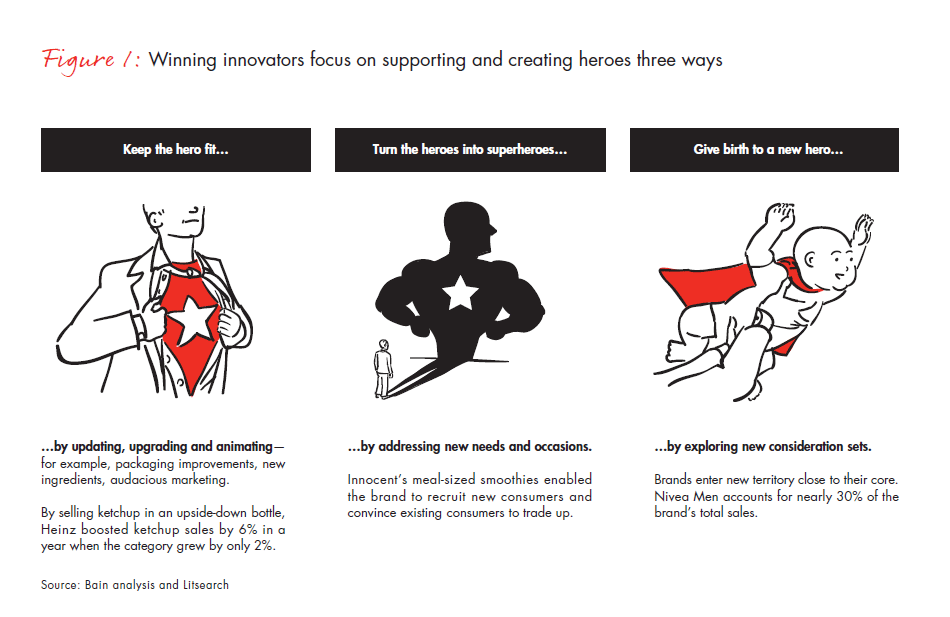
Keep existing heroes fit
Surprisingly, when we analyze brands, we find that many hero products are far from reaching their sales and profitability full potential. Winners use innovation to keep their strongest products in the best possible shape, continuously upgrading them to introduce new and concrete consumer benefits. That may mean slightly improving the formula by replacing or adding newly available ingredients to improve the taste or to make the product healthier. Such improvements strengthen a product over private labels or over competing brands that may be gaining market share.
Brands stay fit to appeal to the trade, too. For instance, they can change the product to provide easier logistics. Also, brands bolster their products to make them more profitable. One approach: seeking ways to make the product cheaper to produce. That was an objective of a Danone initiative aimed at improving operational flexibility in its dairy supply chain through standardization of yogurt pots across brands and the reduction of secondary packaging.

Heroes to the rescue
Winning consumer products brands focus their innovation dollars on best sellers.
Some of these moves seem simple, but they usually address a pressing consumer need. For instance, the makers of WD-40, the ubiquitous lubricant, learned that many consumers were frustrated when they lost the tiny straw that was taped to the spray bottle. In 2005, the Innovation in consumer goods company relied on packaging innovation and introduced a “smart straw” that’s permanently inserted into a newly designed cap that can be flipped up for a precision stream or down for a regular spray. WD-40 not only solved a real consumer problem but also was able to sell its innovatively packaged product at a significant premium over the original.
At times, a brand may also decide to use innovation in activation. In some categories, that might mean launching seasonal pack variations of all-star products to take advantage of the category’s high-consideration and high-consumption times without changing the product’s recipe. Keeping a hero fit can also take the form of audacious marketing, with only on-pack graphics changes required. Coca-Cola’s worldwide strategy called for doubling its size by 2020. However, in Australia, a potentially huge market, as much as 50% of teenagers and young adults had never tasted a Coke. Coca-Cola embarked on its highly ambitious “Share a Coke” campaign across Australia. Using customizing technology, the company personalized the labels of its Coke bottles, printing 150 of the country’s most popular names. Through strong advertising and innovative digital marketing via social networks, it promoted the beverage for a core consumption occasion: Share a Coke with a friend. The campaign exceeded expectations, contributing to a 7% rise in young adult consumption and was later expanded to 80 countries.
Turn your heroes into superheroes
In addition to making continuous improvements to their hero products, companies can take a major leap by turning them into superheroes, elevating penetration levels into the 20% to 50% range. Brands achieve these gains by strategically expanding usage among existing consumers through new needs or occasions and by recruiting new consumers.
Consider Innocent’s experience in the smoothie category in the UK. Its bottled smoothie, offered in 250 mL and 750 mL sizes, was an undisputed hero, controlling as much as 70% market share in its category. However, the brand knew it could do more. It wanted to turn its hero product into a superhero by both increasing penetration through a new usage occasion and encouraging consumers to trade up. Market analysis helped the brand uncover the opportunity to create that new usage occasion— the quick meal—by introducing smaller, single-portion 160 mL bottles. The innovation accomplished a number of important goals. For example, the smaller bottles, introduced in 2012, enabled Innocent to expand its store coverage with positioning on the “meal deals” shelves of Sainsbury and Tesco. At the same time, it allowed Innocent to sell its drinks at an average volume price that’s 75% more than that of its larger size.
Nivea has also managed to turn a hero into a superhero by expanding its product range multiple ways. Take its anti-age Q10 cream. Over time, the brand was successfully extended across the time of usage (day, night); texture (cream, serum, lotion); facial area (face, eyes); product function (moisturizer, cleansing); and strength (regular, light, energy).
Similarly, a biscuit brand analyzed consumption patterns of its hero snack, only to realize it was missing a big opportunity by selling a wrongly sized base pack. Shoppers in small households reported that the pack was too large and expensive. Those in large households said the pack was too small. The brand jump-started growth by offering both small and large pack sizes, and commanded higher prices in the process.
Give birth to a new hero
Most companies focus their efforts on giving birth to a new hero. While this approach may occasionally deliver high returns, it is also the riskiest innovation horizon. That’s why we advise companies to concentrate on the first two horizons while cautiously investigating how innovation can help them conquer untapped territory that is not too distant from their core. Category leaders must balance caution with the need to be proactive.
To see this in action, consider the steps taken by Dannon as it created a new hero in the booming US market for Greek yogurt. In the early 2000s, Dannon bought 85% of organic yogurt maker Stonyfield Farm. In 2007, it launched Stonyfield Oikos organic Greek yogurt, which it rebranded as Dannon Oikos. The company used Greek colors and a Greek American actor as a spokesperson to establish a consistent Greek image. It made a huge advertising push with an NFL partnership and Super Bowl commercials. Within two years, Dannon Oikos became the brand’s top-selling product—a new hero.
Likewise, in 1980 Nivea gave birth to a new hero with the launch of the Nivea for Men product range (now Nivea Men), which was intended to penetrate the market for male cosmetics. If Nivea had limited itself to its existing portfolio to define the future, it never could have dreamed of tapping into such a huge potential consumer base. The company progressively moved from male grooming products to broader care, supporting its efforts with strong marketing. Last year, Nivea Men accounted for nearly 30% of the brand’s total sales.
Five rules to live by
As companies refocus innovation on their heroes, those that come out ahead will adhere to five rules.
Aim for the sky. Again, brands should aspire to use innovation to push their best brands as far and high as possible, and not resolve to marginal product launches that don’t move the needle in terms of sales. The right innovations can help a brand reach its entire addressable consumer base. Targets should be set high to ensure that newly released products quickly become self-sustainable. Aim for 5%–10% penetration of the addressable population, threshold rotation in all channels and accretive margins within two to three years—or don’t even bother launching.
Support big. A logical consequence of aiming high is that you will need to support launches accordingly. This means full at-scale support, both above the line and below the line, for at least five years. Without such support, most launches will likely flop and be quickly washed away from store shelves, having never managed to penetrate consumer repertoires.
Switch from an “innovation funnel” to an “innovation pipeline.” Another logical consequence of aiming high and supporting big is that companies won’t be able to support too many launches. This should encourage them to abandon the standard “innovation funnel” approach of generating and screening a flurry of ideas. That path inevitably leads to considerable yield loss and product proliferation. Instead, the more effective strategy starts by determining what new products can win with shoppers and how many can reasonably be implemented in the store—then working backward to develop those products. This puts the onus on consumer products companies to boost their shopper insights and customer management capabilities.
Take advantage of new technologies. New technologies give companies the opportunity to turn heroes into superheroes with new packaging concepts and many other options. They also are critical to innovate during activation and audacious marketing campaigns. In addition, emerging technologies enable brands to break the old model of taking two to three years to get to market. For example, 3-D printing and other forms of rapid prototyping allow companies to test new products more quickly and consequently enhance them faster, speeding them to market and increasing their odds of success.
If you can’t build, buy. Finally, winners recognize when they lack the necessary internal capabilities to aim big and disrupt a value chain. That’s when an acquisition can be the best approach to innovation.
Are your heroes flying high enough? Answering these basic questions will help you see if it’s time to make more of your hero products.
- Have you been able to boost household penetration of your hero products by 1% annually?
- Is premiumization increasing for your hero products?
- Is price realization for heroes on the rise?
- Is the gross profit for your heroes reflecting their true profitability (and not subsidizing the complexity created by a portfolio of small products)? And is it growing?
- Is the trade profit on your hero products increasing in absolute terms? As a share of the category?
Nicolas Willemot is a Bain & Company partner based in Brussels. Mike Booker, a partner based in Singapore, leads the firm’s Consumer Products and Retail practices in Asia-Pacific. Kara Gruver is a partner based in Boston, and Amélie Dumont, a practice area manager for Bain’s Consumer Products and Retail practices in Europe, the Middle East and Africa, is based in Paris.
First published in 9월 2015