

Brief

VimpelCom—one of the world’s largest telecommunications companies, with 215 million customers—adopted the Net Promoter System® to improve the customer experience. In 2013, with Bain’s help, the company launched an assessment to determine how well the system was working.
The findings were not encouraging. “Our employees were really not focused on the customer, even in general,” Anton Telegin, the company’s group director for commercial transformation, recalled during a recent Net Promoter System podcast. Added Natalia Macpherson, group director of customer experience: “We didn’t have a unified customer strategy that everyone knew and agreed to.”
VimpelCom’s NPS advocates—Telegin, Macpherson and their colleagues—realized that they had to roll up their sleeves. They had to help employees understand the system better. They had to encourage leaders to get more involved. And they needed a better understanding of loyalty economics, so that they could build persuasive business cases for customer-centric investments.
This year, 2016, marks 10 years since Fred Reichheld laid out the principles behind the Net Promoter System in his best-seller, The Ultimate Question. Over the past decade, thousands of companies around the world have adopted the system.
But how well is it really working at all these organizations? Building a customer-centric company through Net Promoter, after all, is a complex and arduous journey. It wouldn’t be surprising if some companies found themselves stumbling or stalling out along the way.
To assess the successes and the stumbles, we have now studied close to 130 Net Promoter System companies, VimpelCom among them. Overall, we learned, only a small fraction of these companies are implementing all of the best practices that Bain’s experts recommend. So nearly everyone is still on the journey. Many, of course, are just starting out.
As we probed deeper, however, we found big differences among companies. At the top were a sizable group that gave the Net Promoter System a 9 or a 10 in answer to the question, “How successful has NPS been at helping you improve your business or organization?” It may sound a little meta, but we think of these organizations as promoters of their Net Promoter System. They would almost certainly recommend the system to other companies—probably excepting their competitors.
At the bottom, it’s a different story. Some companies scored their Net Promoter Systems between zero and 6 on the “helping you improve your business” question. We have to think of these companies as detractors—they’re certainly dissatisfied with their results, at least so far. One big difference between the two groups: A majority of promoters have adopted more than four-fifths of the 35 or so best practices identified by the experts. A majority of detractors have adopted less than one-fifth. In fact, the more best practices a company has adopted, the more likely it is to be a promoter.
What are the other key differences between the promoters and the detractors? Combing through the data, we found three big points of distinction—points that may help you focus your investments and make your own Net Promoter System more effective than it is today.
1. Reliable data
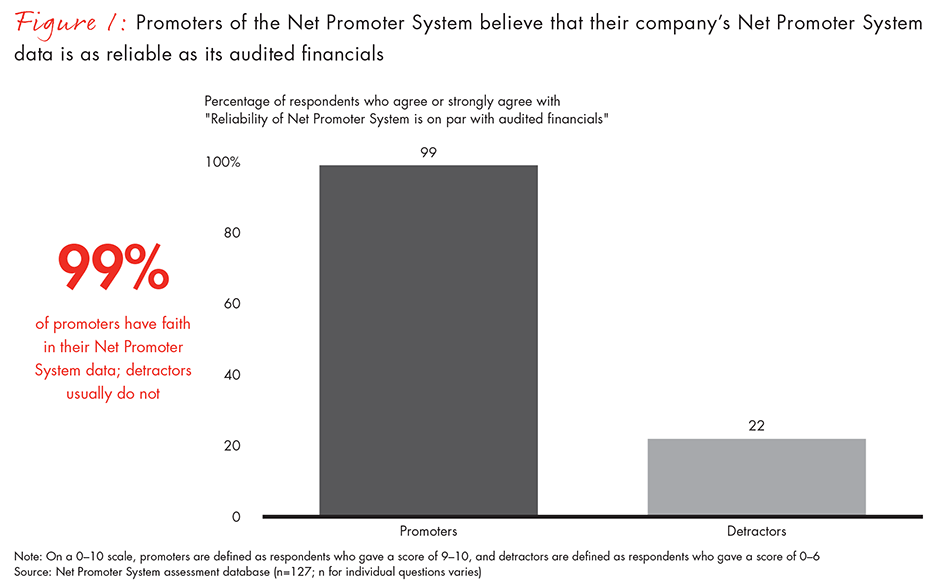
One difference was stunning, both in its magnitude and its implications. A whopping 99% of NPS promoters “agree” or “strongly agree” that their Net Promoter data is on a par with their audited financials (see Figure 1). In short, they gather data that they believe is reliable. They trust it. The detractors don’t. Only 22% of detractors, or fewer than one in four, believe that their NPS data is as trustworthy as their financial numbers.
Here’s a powerful symbol of this difference: 75% of promoters say their NPS results and improvement plans are directly addressed in their company’s annual report and communications with the board. The comparable number for detractors is only 17%.
One factor behind the gap may be a difference in response rates. Nearly half of the detractors report response rates of less than 20%. Promoters get higher rates, on average. And more than twice as many promoters as detractors say that survey respondents represent more than 80% of their revenue.
Reliable data is the foundation of the Net Promoter System. If a company’s leaders don’t believe the data, why should employees? And why should anyone take action, let alone invest money, based on what the data seems to show? Without good data you can’t understand loyalty economics. You can’t tell how much it might be worth to invest in increasing the ratio of promoters to detractors, because you don’t have an accurate gauge of your success. Low response rates are a giveaway: they almost always indicate unreliable data, and are thus a sign of a struggling Net Promoter System. If you can’t get most of your customers to respond to your requests for feedback, it’s little wonder you can’t trust the feedback you do get.
2. Closing the loop with employees and customers
Customer feedback, of course, is just a starting point—it’s what you do with the data that counts. In a well-functioning Net Promoter System, the feedback flows directly to frontline employees and others responsible for the customer experience. The feedback then triggers actions of all sorts. Customer-service reps discuss how to improve the quality of their services. Cross-functional teams address procedural or policy issues that are getting in the way of a great customer experience. Frontline managers call customers who are unhappy—or who have offered particularly helpful feedback—to learn more. They close the loop.
Here, too, there are vast disparities between promoters and detractors (see Figure 2):
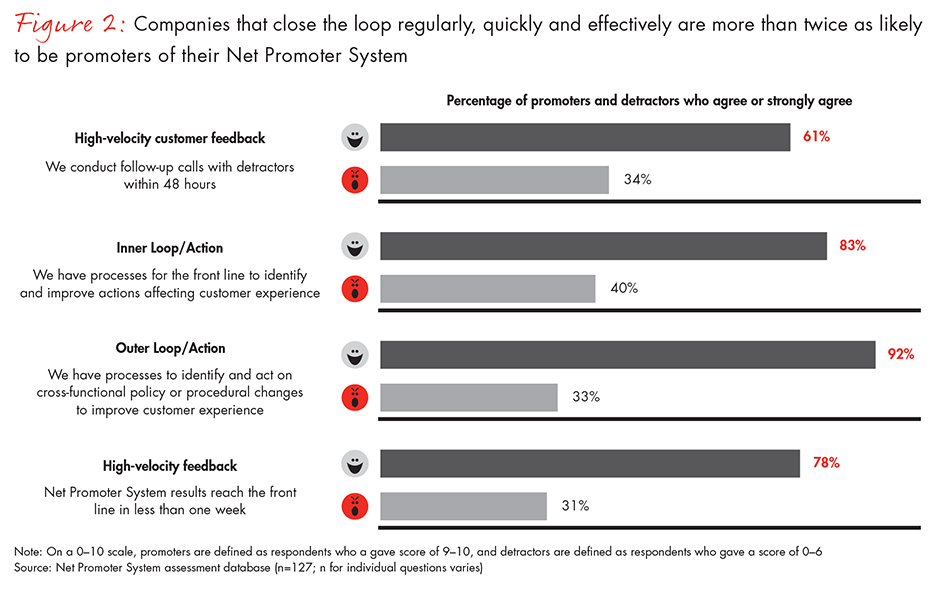
- 78% of promoters say that they share customer feedback with frontline employees within a week or less. Only 31% of detractors do so.
- 61% of promoters say that they conduct follow-up calls with detractors within 48 hours. Only 34% of detractors do so.
- 83% of promoters say that have processes by which frontline employees can identify and improve actions affecting the customer experience. Only 40% of detractors have such processes.
- 92% of promoters report that they have established processes to identify and act on cross-functional policy or procedural changes to improve the customer experience. Only 33% of detractors have such processes.
The giveaway here is whether frontline employees understand and can explain the Net Promoter System and what they can accomplish by using it. More than twice as many promoters as detractors say that the majority of employees could explain what NPS is, why it is important and what it takes to delight customers. The essence of the system is that it offers people throughout the organization the ability to learn and to grow in their jobs by delivering a better and better experience to customers. But if people don’t understand how Net Promoter works or why it’s important, how can they ever do so?
3. Understanding loyalty economics
The ultimate goal of the Net Promoter System is to improve the lives of customers and thus to fuel profitable growth. The connection between these two objectives is critical. A company has to measure the value of loyalty among each customer segment. It has to establish the differential value of promoters as compared with detractors and thereby determine what it should invest in creating more promoters. This “loyalty economics” is the business reality that underlies a successful Net Promoter System. Unless a company has a deep understanding of the connections between loyalty and financial results, its system will always be in jeopardy when the next round of cost-cutting comes along.
Yet most companies, we found, do not yet have a solid grasp of loyalty economics—in other words, they haven’t calculated the value of creating promoters among their customers. Overall, nearly three-quarters of respondents disagreed with the statement, “We have been able to calculate word of mouth and referral economics,” indicating that they had not yet connected the scores they were collecting with loyalty economics. But here, too, there were big differences. Nearly four times as many promoters as detractors say they do calculate loyalty economics. About four times as many incorporate these calculations into their assessments of the lifetime value of a customer. More than twice as many report that their CFO has certified their NPS-derived customer lifetime value calculations.
Lurking under all these numbers is one key organizational difference. Virtually all—99%—of the promoters reported that their CEO and other senior leaders were committed to the fundamental goal of creating more customer promoters and fewer customer detractors. The same percentage reported that their senior leaders were aligned on the company’s NPS goals in their communications and actions. The comparable figures for detractors weren’t terrible, but they were considerably lower. To be sure, we don’t know which way the causal arrow points: leaders at detractor companies may not be aligned because they don’t yet trust their data, or their lack of alignment may have led the company to underinvest in gathering reliable data. Whatever the relationship, it’s clear that leadership commitment and alignment is a very big factor in determining how well a company’s Net Promoter System is likely to work.
Assessments like these are a powerful tool. Measuring your own company’s successes and failures shows you where you need to improve. Comparing your results with Bain’s database points out your standing on each dimension of the system relative to the practices of other companies, including the highly successful ones that we have been calling promoters. The database itself lets us highlight the key factors that seem to make the most difference to results. Reliable data, effective closed-loop feedback and loyalty economics are three big ones.
VimpelCom has used the assessment twice now, once in 2013 and again in 2015. The company’s group directors Telegin and Macpherson could scarcely be happier with what they’ve learned. At first, for example, the system was slow to catch on because leaders weren’t sufficiently involved. “Yes, you can implement the operational NPS,” said Macpherson. “But without the leadership knowledge, engagement and driving the program, it’s not going to be that effective.” Another key: getting finance involved in building business cases for customer-related investments. For instance, a team calculated the relative impact of customer promoters and detractors on churn rates. When VimpelCom took measures to increase the number of promoters, churn rates dropped by 10% in one year, generating $350 million in extra revenue.
Not a bad return on the company’s investment in assessments.
Rob Markey is a partner and director in Bain & Company’s New York office and leads the firm’s Global Customer Strategy & Marketing practice. He is coauthor of the best-seller The Ultimate Question 2.0: How Net Promoter Companies Thrive in a Customer-Driven World. Aaron Cheris is a partner in Bain’s San Francisco office and leads Bain’s Retail practice in the Americas.
First published in 3월 2016