
Skip to Content
  • 오피스

    오피스

    미주
    • Atlanta
    • Austin
    • Bogota
    • Boston
    • Buenos Aires
    • Chicago
    • Dallas
    • Denver
    • Houston
    • Los Angeles
    • Mexico City
    • Minneapolis
    • Monterrey
    • Montreal
    • New York
    • Rio de Janeiro
    • San Francisco
    • Santiago
    • São Paulo
    • Seattle
    • Silicon Valley
    • Toronto
    • Washington, DC
    유럽, 중동, 아프리카
    • Amsterdam
    • Athens
    • Berlin
    • Brussels
    • Copenhagen
    • Doha
    • Dubai
    • Dusseldorf
    • Frankfurt
    • Helsinki
    • Istanbul
    • Johannesburg
    • Kyiv
    • Lisbon
    • London
    • Madrid
    • Milan
    • Munich
    • Oslo
    • Paris
    • Riyadh
    • Rome
    • Stockholm
    • Vienna
    • Warsaw
    • Zurich
    아시아, 호주
    • Bangkok
    • Beijing
    • Bengaluru
    • Brisbane
    • Ho Chi Minh City
    • Hong Kong
    • Jakarta
    • Kuala Lumpur
    • Manila
    • Melbourne
    • Mumbai
    • New Delhi
    • Perth
    • Seoul
    • Shanghai
    • Singapore
    • Sydney
    • Tokyo
    오피스 전체보기
  • 얼럼나이
  • 미디어 센터
  • 구독
  • 연락처
  • Korea | 한국어

    지역 및 언어 선택

    글로벌
    • Global (English)
    미주
    • Brazil (Português)
    • Argentina (Español)
    • Canada (Français)
    • Chile (Español)
    • Colombia (Español)
    유럽, 중동, 아프리카
    • France (Français)
    • DACH Region (Deutsch)
    • Italy (Italiano)
    • Spain (Español)
    • Greece (Elliniká)
    아시아, 호주
    • China (中文版)
    • Korea (한국어)
    • Japan (日本語)
  • Saved items (0)
    Saved items (0)

    You have no saved items.

    관심 있는 내용을 북마크하여 Red 폴더에 저장할 수 있습니다. Red 폴더 에서 저장된 내용을 읽거나 공유해보세요.

    Explore Bain Insights
  • 산업
    메인 메뉴

    산업

    • 우주항공, 방산 및 정부 서비스
    • 농업 관련 산업
    • 화학
    • 인프라, 건설 및 건축 자재
    • 소비재
    • 금융 서비스
    • 헬스케어
    • 산업용 기계 및 장비
    • 미디어 및 엔터테인먼트
    • 금속
    • 광업
    • 석유 및 가스
    • 제지 및 패키징 산업
    • 사모펀드
    • 사회 및 공공 부문
    • 유통
    • 기술
    • 텔레콤
    • 운송
    • 여행·여가
    • 유틸리티 및 재생가능 에너지
  • 컨설팅 서비스
    메인 메뉴

    컨설팅 서비스

    • Customer Experience
    • ESG
    • Innovation
    • M&A
    • 운영
    • 조직
    • 사모펀드
    • 고객 전략 및 마케팅
    • 전략
    • AI, 인사이트 및 솔루션
    • Technology
    • 변화 혁신
  • Digital
  • 인사이트
  • 베인 소개
    메인 메뉴

    베인 소개

    • 업무 소개
    • 베인의 신념
    • 구성원 및 리더십 소개
    • 고객 성과
    • 주요 수상 경력
    • 글로벌 파트너사
    Further: Our global responsibility
    • 다양성과 포용
    • 사회 공헌 활동
    • Sustainability
    • World Economic Forum
    Learn more about Further
  • Careers
    메인 메뉴

    Careers

    • Work with Us
      Careers
      Work with Us
      • Find Your Place
      • Our Work Areas
      • Integrated Teams
      • Students
      • Internships & Programs
      • Recruiting Events
    • Life at Bain
      Careers
      Life at Bain
      • Blog: Inside Bain
      • Career Stories
      • Our People
      • Where We Work
      • Supporting Your Growth
      • Affinity Groups
      • Benefits
    • Impact Stories
    • Hiring Process
      Careers
      Hiring Process
      • What to Expect
      • Interviewing
    FIND JOBS
  • 오피스
    메인 메뉴

    오피스

    • 미주
      오피스
      미주
      • Atlanta
      • Austin
      • Bogota
      • Boston
      • Buenos Aires
      • Chicago
      • Dallas
      • Denver
      • Houston
      • Los Angeles
      • Mexico City
      • Minneapolis
      • Monterrey
      • Montreal
      • New York
      • Rio de Janeiro
      • San Francisco
      • Santiago
      • São Paulo
      • Seattle
      • Silicon Valley
      • Toronto
      • Washington, DC
    • 유럽, 중동, 아프리카
      오피스
      유럽, 중동, 아프리카
      • Amsterdam
      • Athens
      • Berlin
      • Brussels
      • Copenhagen
      • Doha
      • Dubai
      • Dusseldorf
      • Frankfurt
      • Helsinki
      • Istanbul
      • Johannesburg
      • Kyiv
      • Lisbon
      • London
      • Madrid
      • Milan
      • Munich
      • Oslo
      • Paris
      • Riyadh
      • Rome
      • Stockholm
      • Vienna
      • Warsaw
      • Zurich
    • 아시아, 호주
      오피스
      아시아, 호주
      • Bangkok
      • Beijing
      • Bengaluru
      • Brisbane
      • Ho Chi Minh City
      • Hong Kong
      • Jakarta
      • Kuala Lumpur
      • Manila
      • Melbourne
      • Mumbai
      • New Delhi
      • Perth
      • Seoul
      • Shanghai
      • Singapore
      • Sydney
      • Tokyo
    오피스 전체보기
  • 얼럼나이
  • 미디어 센터
  • 구독
  • 연락처
  • Korea | 한국어
    메인 메뉴

    지역 및 언어 선택

    • 글로벌
      지역 및 언어 선택
      글로벌
      • Global (English)
    • 미주
      지역 및 언어 선택
      미주
      • Brazil (Português)
      • Argentina (Español)
      • Canada (Français)
      • Chile (Español)
      • Colombia (Español)
    • 유럽, 중동, 아프리카
      지역 및 언어 선택
      유럽, 중동, 아프리카
      • France (Français)
      • DACH Region (Deutsch)
      • Italy (Italiano)
      • Spain (Español)
      • Greece (Elliniká)
    • 아시아, 호주
      지역 및 언어 선택
      아시아, 호주
      • China (中文版)
      • Korea (한국어)
      • Japan (日本語)
  • Saved items  (0)
    메인 메뉴
    Saved items (0)

    You have no saved items.

    관심 있는 내용을 북마크하여 Red 폴더에 저장할 수 있습니다. Red 폴더 에서 저장된 내용을 읽거나 공유해보세요.

    Explore Bain Insights
  • 산업
    • 산업

      • 우주항공, 방산 및 정부 서비스
      • 농업 관련 산업
      • 화학
      • 인프라, 건설 및 건축 자재
      • 소비재
      • 금융 서비스
      • 헬스케어
      • 산업용 기계 및 장비
      • 미디어 및 엔터테인먼트
      • 금속
      • 광업
      • 석유 및 가스
      • 제지 및 패키징 산업
      • 사모펀드
      • 사회 및 공공 부문
      • 유통
      • 기술
      • 텔레콤
      • 운송
      • 여행·여가
      • 유틸리티 및 재생가능 에너지
  • 컨설팅 서비스
    • 컨설팅 서비스

      • Customer Experience
      • ESG
      • Innovation
      • M&A
      • 운영
      • 조직
      • 사모펀드
      • 고객 전략 및 마케팅
      • 전략
      • AI, 인사이트 및 솔루션
      • Technology
      • 변화 혁신
  • Digital
  • 인사이트
  • 베인 소개
    • 베인 소개

      • 업무 소개
      • 베인의 신념
      • 구성원 및 리더십 소개
      • 고객 성과
      • 주요 수상 경력
      • 글로벌 파트너사
      Further: Our global responsibility
      • 다양성과 포용
      • 사회 공헌 활동
      • Sustainability
      • World Economic Forum
      Learn more about Further
  • Careers
    최근 검색어
      최근 방문 페이지

      Content added to saved items

      Saved items (0)

      Removed from saved items

      Saved items (0)

      Brief

      The Net Promoter System®'s Journey to Employee Advocacy: The First Mile

      The Net Promoter System®'s Journey to Employee Advocacy: The First Mile

      How companies can lay the foundation for employee advocacy.

      글 Rob Markey

      • 읽기 소요시간
      }

      Brief

      The Net Promoter System®'s Journey to Employee Advocacy: The First Mile
      en

      Imagine heading into your local Target store, as I did recently. It’s a busy Saturday morning and you’re ready for the crowds. You select what you need and then stand in line at the checkout. But when it’s your turn, you get a surprise. The checkout clerk is a young woman who greets you with a smile, looks you in the eye and seems completely delighted to be serving you. She chats, she laughs, she makes sure you got everything you wanted— and yet she somehow moves you through the line with the utmost efficiency. You go out into the parking lot feeling good about your experience. You’ll be glad to come back to that store the next time you’re out shopping.

      How different this is from our usual experience as shoppers! Far too often, sales and checkout clerks at supermarkets, department stores and wherever else we go seem uninterested and lackadaisical. Their manner, their speech and their body language all convey the same message: They’re just trying to get through the day. You, the customer, are a hassle—one more person they have to take care of so they can move on to the next. Maybe they tap the credit-card reader impatiently. Maybe they shove your goods into bags as if they can’t wait to get you out of there (or, alternatively, bag the goods at a glacial pace). Whatever the specifics, you don’t feel good when you leave, and you begin to think about where else you might do your shopping.

      What’s the difference here? The employee’s personality? Inadequate training? Maybe that’s sometimes the case. But far more often the problem is organizational. Employees who are sour or unhappy, employees who don’t respond to customers positively, are usually employees who hate their jobs. And they hate their jobs because their company has failed to provide them with the basics, the minimum requirements for employee satisfaction.

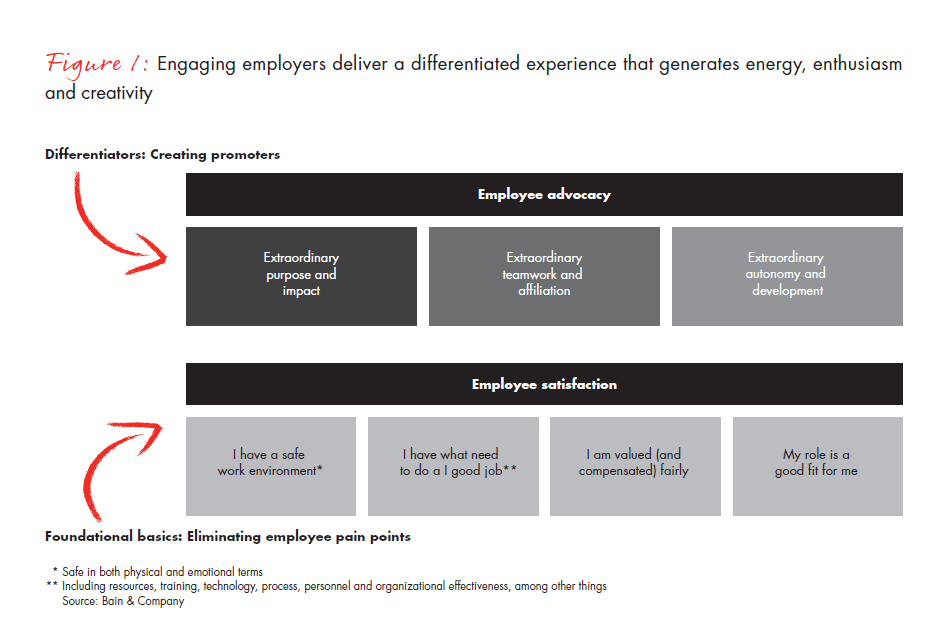
      In most employees’ minds, these basics boil down to four conditions. If you were working on the front lines of an organization, these are the questions you would ask yourself every day.

      1. Is my work environment safe?

      Physical safety is paramount. A century ago, more than 20,000 people died each year on the job in the US alone, and many more were injured. We have come a long way since then, but manufacturing and construction sites (to say nothing of hazardous worksites like mines and commercial fishing boats) can still be dangerous.

      While parts of the workforce still face physical danger at work, every employee may face issues of emotional safety. People who feel threatened, bullied, humiliated or harassed react much as they do to physical danger. These reactions are powerful. When people fear for their safety, their brains emit chemicals that put them on high alert. Their defense mechanisms are activated. They focus on keeping themselves as safe as possible—on surviving whatever danger they perceive. Employees in a threatening environment necessarily think first about themselves. Taking care of customers will always be secondary.

      li-journey-to-employee-advocacy-fig-01_embed


      2. Am I in the right job?

      Most of us have been in situations where we have had to stretch, to learn something new. That often works out well. But sometimes employees find themselves in jobs that they will never be suited for. They may lack the hard skills they need—an advanced level of programming, say—and find it difficult or impossible to acquire those skills. They may have personality traits that get in the way of good performance. A person dealing directly with customers, for instance, needs good social and verbal skills and the ability to empathize with what the customer is feeling. An introverted technical analyst who’s great with data may lack the ability to interact well with people, and is unlikely to succeed in such a role.

      For people who are in the wrong job, every day is a struggle. They feel like fish out of water. They’re constantly aware that they’re not doing great work, and they may not even know why. The resulting frustration makes it difficult or impossible to think about a customer’s needs. Why should I care about them when nobody seems to care about me?

      3. Do I have what I need to succeed?

      No one in an organization succeeds alone. Employees need the training, tools and technologies to do the job well. They need processes that work and support systems that help rather than hinder.

      If this condition isn’t met, the effects are grim. As customers, we all feel frustrated when we watch a sales clerk or airline reservation agent stare helplessly at a balky computer. But now put yourself in the employees’ position: No matter how hard they try, they know that something will get in the way of doing their job well. That kind of difficulty breeds acute dissatisfaction. It also leads to a deep cynicism about the company’s commitment to customers.

      4. Am I being treated fairly?

      Fairness is always hard to define, but people are quick to react when they feel they are being treated unfairly. Consider situations like these:

      • I never hear how I’m doing. When supervisors never give employees any feedback—or when the feedback they do give is always negative—employees start to get resentful. They wonder why no one seems to notice or appreciate their efforts. Before long, they’re apt to figure, Why bother? (Or else they start to look for a new job.)
      • Good work has nothing to do with success around here. Employees generally find it fair when they and their colleagues advance on the basis of merit and effort. They find it distinctly unfair when other criteria—favoritism, office politics and so on—determine advancement or raises. There’s little point in going the extra mile when your colleague in the next cubicle will shine because he knows how to curry favor with the boss.
      • I could make a lot more money working for a competitor. Compensation is always a loaded issue, and sometimes complaints about pay are a smokescreen for other issues. Still, money is one form of appreciation for a job well done. When pay doesn’t relate to performance—or when the level of compensation is way out of line with the market—it feels unfair. Employees start worrying about getting their fair share of the pie rather than thinking about how to make the pie bigger.

      When any one of these conditions is broken—let alone more than one—it generates anxiety and anger as well as frustration. The results are all too obvious: low morale, poor collaboration and teamwork, low productivity, high turnover. The situation distracts employees from what really matters: improving customers’ lives. Even if they stay on the job, they rarely go the extra mile. Nor do they do what’s necessary to earn customers’ trust and make them feel good about the experience, the way I felt that day at Target.

      Make no mistake: Meeting these four conditions sets the baseline for employee satisfaction. It doesn’t achieve the real goal: employee advocacy. But it’s a start. As the psychologist Abraham Maslow famously pointed out, most of us human beings can’t focus on higher-level goals until we have met more fundamental objectives, such as safety and security. So it is in the workplace. Unless employees feel that their basic needs are being met, there’s little chance that they’ll ever develop the enthusiasm, energy and creativity that mark true advocacy.

      So it’s critical to build a solid foundation before reaching for higher goals. How do loyalty leaders accomplish this? The most successful companies are almost maniacal about identifying weak spots in their organization’s foundation—places where employees don’t feel safe, believe they’re in the wrong job, don’t feel they have the tools or support necessary to deliver for customers, or don’t feel valued fairly. They then turn the company’s best resources to shoring up that foundation as quickly and securely as possible, so they can move on to the more meaningful work of earning their employees’ deep commitment.

      A future article will address how to create the conditions that do create advocacy, a state in which employees consistently go the extra mile for customers. In the meantime, be sure your employees are satisfied because your organization meets the four conditions outlined here. Satisfaction may not be sufficient for advocacy, but it certainly is necessary.

      Rob Markey is a partner and director in Bain & Company’s New York office and leads the firm’s Global Customer Strategy & Marketing practice. He is coauthor of the best seller The Ultimate Question 2.0: How Net Promoter Companies Thrive in a Customer-Driven World.


      li-journey-to-employee-advocacy-fig-01_full
      저자
      • Headshot of Rob Markey
        Rob Markey
        어드바이저 파트너, Boston
      문의하기
      관련 컨설팅 서비스
      • 고객 전략 및 마케팅
      • Net Promoter System®
      최적의 솔루션 찾기
      • Net Promoter®
      고객 전략 및 마케팅
      Who Should Run Your Net Promoter System®?

      Gritty, passionate executives are key to implementing a Net Promoter System effectively.

      자세히 보기
      고객 전략 및 마케팅
      The Net Promoter System®'s "Inner Loop": The Secret to Individual Learning and Connections with Customers

      The key is enabling employees to get real-time feedback directly from customers.

      자세히 보기
      고객 전략 및 마케팅
      The Net Promoter System®'s "Outer Loop"

      How companies make systemic changes—and show employees they’re serious about customer centricity.

      자세히 보기
      고객충성도
      Net Promoter for People: Give Employees a Voice, Get Their Best

      Net Promoter® for People is about empowering employees to bring energy, enthusiasm and creativity to delight customers.

      자세히 보기
      고객충성도
      After Years of Customer Loyalty Programs in Insurance, What Works, and What’s Next?

      Based on Bain’s 10 years of research, five themes describe the progress and challenges of earning customers’ advocacy in an increasingly digital experience.

      자세히 보기
      First published in 11월 2015
      태그
      • 고객 전략 및 마케팅
      • 고객충성도
      • Net Promoter System®
      • Net Promoter®

      프로젝트 사례

      변화 혁신 전략 Turning around a pioneering service for working parents with sick children

      See more related case studies

      변화 혁신 전략 Transformation sparks financial leader's turnaround

      See more related case studies

      고객 전략 및 마케팅 Revitalizing a utility's market position with customer loyalty

      See more related case studies

      베인에 궁금하신 점이 있으신가요?

      베인은 주저 없이 변화를 마주할 줄 아는 용감한 리더들과 함께합니다. 그리고, 이들의 담대한 용기는 고객사의 성공으로 이어집니다.

      급변하는 비즈니스 환경에서 살아남기 위한 선도자의 시각. 월간 Bain Insights에서 글로벌 비즈니스의 핵심 이슈를 확인하십시오.

      *개인정보 정책을 읽었으며 그 내용에 동의합니다.

      Privacy Policy를 읽고 동의해주십시오.
      Bain & Company
      문의하기 환경정책 Accessibility 이용약관 개인정보 보호 쿠키 사용 정책 Sitemap Log In

      © 1996-2026 Bain & Company, Inc.

      문의하기

      무엇을 도와드릴까요?

      • 프로젝트 문의
      • 채용 정보
      • 언론
      • 제휴 문의
      • 연사 초청
      오피스 전체보기