

Brief

한눈에 보기
- Energy companies have built their fossil-fuel infrastructure (such as power plants and refineries) to last as long as they can be operated profitably—but that’s changing.
- The energy transition may cause these companies to decommission these assets before the end of their useful lives.
- To manage the risks and costs of these stranded assets, companies will have to determine when they should continue to invest, and when it’s time to sell, convert, or close facilities.
Energy executives evaluating capital investments in fossil-fuel infrastructure hear two very different narratives about the future. On the one hand, pricing levels and the demands of the market signal the need for new capital investment in the energy system. On the other, energy companies are under pressure from investors, regulators, and other stakeholders to throttle investments in fossil-fuel infrastructure, to help put the world on an emissions path consistent with a 1.5°C temperature rise from preindustrial levels.
Much of the discussion on fossil-fuel assets is binary. That is, they’re either vital to prosperity or unacceptable given climate change. And reports from trusted industry sources also point in multiple directions. In May 2021, the International Energy Agency, the world’s energy modeler of record, stated that “no new oil and natural gas fields are needed” if the world is to stay on a path that limits warming to 1.5°C. However, just seven months later, a report from IHS Markit and the International Energy Forum indicated that continued underinvestment in oil and gas development could contribute to volatility, price shocks, and scarcity.
In spite of this uncertainty, executives still need to make investment decisions on energy infrastructure, based on the economics of each project. Increasingly, a top concern is the risk of stranded-asset costs: that a power plant, refinery, oil well, or other asset won’t continue to operate through its useful life due to changes in policy or economic shocks.
This is no small change, but rather a fundamental reshaping of the rules that have guided energy infrastructure investment for more than a century. Until recently, executives and investors could assume that assets would operate for as long as possible, serving steadily rising demand. Now, they can no longer assume that market demand will dictate how long an asset will be allowed to continue operating.
This dramatic disruption of the rules-based order will require a new approach to capital allocation. In our work with energy companies developing new approaches to manage the risk of stranded assets, three types of actions are helping executives make decisions more confidently.
- Build assets that have shorter life spans, are convertible, and can be invested in incrementally.
- Quantify each project’s “uninvestible” moment.
- Consider the project as a part of an evolving portfolio.
With these approaches, management teams are reimagining their investments in traditional energy assets, despite uncertainty about future returns or terminal value. When combined with a sound energy transition strategy, companies can navigate risks associated with individual projects and build the right assets for the coming years.
But the time to start managing stranded cost risk is now.
Build shorter-term projects that are more convertible and modular
Leading players are using five key tools to reduce the overall risk of a given project.
- Deploy capital in chunks and upgrade before building new. Rather than focus on a pipeline of new projects with long useful lives, companies will increasingly look for ways to extend the lives of existing assets, or invest in assets with a more modular capital profile, that is, one that allows them to invest in segments rather than all at once. In oil and gas, some asset classes and project types by nature have shorter cycles and require more incremental deployments of capital up front. With larger projects (such as subsea or LNG liquefaction) designs oriented around repeatable modules can accelerate project timelines and reduce costs.
- Assume assets will have shorter lives. When approving investments or determining depreciation, companies will want to take into account the risk of stranded assets. Some local gas distribution companies (LDCs) are already exploring whether to depreciate pipes with 60 years of rated physical use over a 30-year period to line up with policy, then have that faster depreciation schedule factor into their rate of cost recovery from customers.
- Design with options to convert to low carbon. Where possible, companies should design assets in ways that anticipate their conversion to lower carbon use—for example, gas-powered generating stations that can be converted to run on hydrogen, industrial and power plants that can be retrofitted with carbon-capture, or biodiesel options for refineries. These designs may cost marginally more up front, but when policy is uncertain, the ability to keep assets running in a net-zero future creates more value over time and reduces the assets’ risk.
- Design for value. Shorter life spans for assets imply revisiting traditional design specs; they don’t have to be designed to last forever. Many energy companies have thrived on their engineers’ abilities to push the limits of what can be achieved safely. Now it may be time for engineers to design more modestly for the task at hand, making use of what’s already been done by others. If they can reduce up-front costs without affecting safety, payback timelines can be shortened, reducing the risk of stranding.
- Accelerate returns. Many energy projects make money either on long-term, locked-in agreements (for example, utilities and pipelines) or based on market movements (merchant power plants, oil and gas production). Long-term agreements earn an attractive return on capital, but the market model offers the possibility of higher and quicker returns, along with some pricing risk. A blended approach can help accelerate returns and mitigate risk. For example, an LNG facility that contracts for most (but not all) of its capacity on a long-term basis could benefit by selling some of its volume at attractive spot market prices.
Quantify the project’s uninvestable moment
Stranded-cost risks will vary widely for different assets of any given company, which must have a concrete understanding of the individualized risk profile for any particular investment. The stranded-cost risk specific to an asset is shaped by three key questions.
- How much value will the asset create for operators, shareholders, and customers? Project assessment always requires scenarios, but the level of uncertainty is rising. The risk of stranded costs means that management teams will need to focus more on mission-critical capital projects that offer rapid returns.
- How long will the asset operate relative to its useful life? An asset that might strand in year 25 of 30 represents a small risk of stranded costs (and the ultimate write-down) relative to a long period of value creation for customers and shareholders. An asset that strands in the 10th year of a 30-year plan represents a significant write-down risk with much less value creation potential. For this reason, assets with shorter life spans are less risky than those with longer life spans.
- What is the real option value of the asset in stranding scenarios? An asset that can be converted to a lower-carbon use or sold is more valuable than one that can only be shut down and written off. We’ve seen more large energy companies offloading fossil-fuel assets to buyers with less stringent environmental, social, and corporate governance (ESG) requirements. The continued presence of this source of capital is an important signpost to monitor when assessing portfolio value and options for fossil-fuel assets.
Consider a natural gas power plant built to last 30 years, but with a reasonable chance of being stranded after 25 (see Figure 1). The company could write off about 17% of the plant’s value after 25 years of operations, a small figure compared with the earnings over its active life. Given the value generated over its useful lifetime, it may be worth investing in this plant, which has a lifetime return on equity above 7.8%, even if the company writes it off after 25 years.
Figure 1
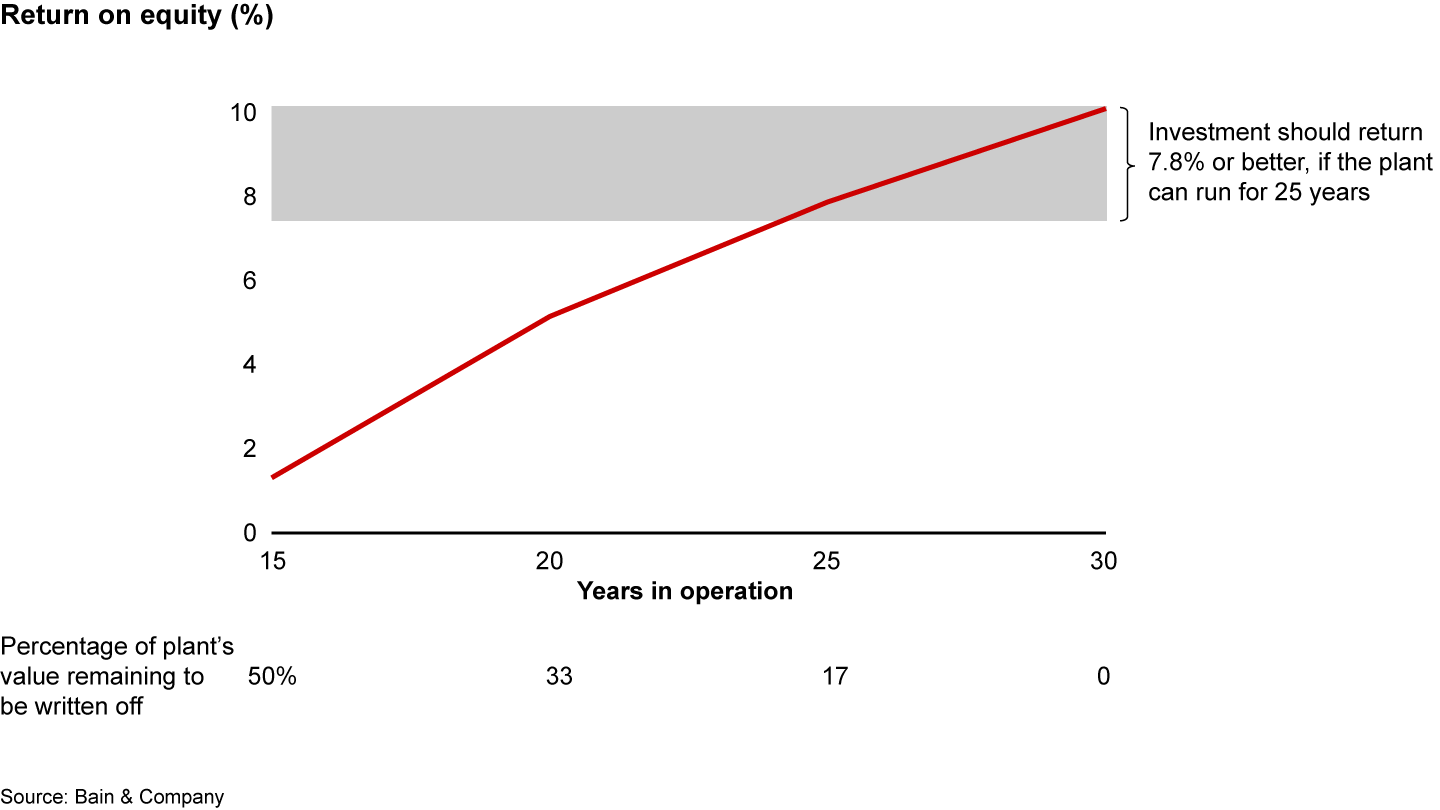

On the other hand, if the company has to stop operating the plant after 15 years, it has to write off about half its total value. That’s a much larger loss than if the plant operated another 10 years, and return on equity would drop to 1.3%. In this case, the option of converting the plant to a lower-carbon use would be very valuable.
Because of this, we expect more and more gas power plants to be built with the option of converting to hydrogen fuel. Companies will also look for ways to provide stranded-cost protections for investors, such as legislation that ensures investors receive some level of recovery.
In an example from another industry, consider a large, deepwater oil and gas project with billions of dollars of front-loaded capital cost, but a production lifetime that could last to 2050 or beyond. Since operating costs are low once a project comes online, the production stream from the asset should generate substantial free cash flow for as long as the reservoir can be safely depleted. But with demand for crude oil eroding and investors focused on reducing emissions, companies may need to decommission some facilities well before they’d be abandoned under normal conditions.
While a utility-owned power plant earns returns based on a regulated rate, and an oilfield generates returns based on the market price of oil, both companies need to change the way they evaluate the long-term economics of long-lived projects. Stranded-cost analyses should include corner case scenarios that take into consideration new and extreme conditions, relevant to the region and jurisdictions where assets operate. (For more, read the Bain Brief “Managing the Energy Transition: Three Scenarios for Planning.”)
Consider the project as a part of an evolving portfolio
For companies that need to maintain and invest in fossil-fuel infrastructure, managing the risks of stranded assets could become more challenging every year. They’ll need to manage this risk as part of a broader strategy to evolve the business and sustain a compelling proposition for investors.
To do this, they’ll need a clear strategy for navigating the energy transition, and then lining up capital-allocation processes that support the strategy. For some energy companies, this means adding new criteria to the traditional processes, including:
- more scenarios and strategic context in project approvals;
- specific consideration of carbon and ESG project risks;
- evolution of oil and gas project investment criteria, with shortened payback periods;
- lower cost-of-capital assumptions for some projects and use of special-purpose finance tools, such as green bonds, government subsidies, and incentives;
- adjustment of risk assessment criteria and hurdle rates; and
- ongoing review of approved capital requirements and performance.
Companies will want to tune their capital-allocation approach to the needs of their investors. Two groups of investors to pay particular attention to might be considered “green capital” and “gray capital.”
Green capital investors focus on ESG metrics. Some place carbon budgets on their portfolios, which can limit the availability of the capital they manage. These investors will look to management for signals that the company is serious about the energy transition, even as they make investments in fossil-fuel assets that may become stranded.
90% of new gas power-plant production in the Pennsylvania–New Jersey–Maryland region is funded by private capital.
Gray capital investors, by contrast, are less focused on ESG topics and more comfortable taking risks on fossil-fuel assets. This group is taking on a growing share of investment in fossil-fuel infrastructure. For example, in the Pennsylvania–New Jersey–Maryland (PJM) power utility region, about 90% of the planned construction of combined-cycle gas production is coming from private equity, organized into various LLCs and LPs. Gray capital could become an important source of potential value when considering the value of fossil-fuel infrastructure.
All investors, whether green or gray, are likely to increase their reliance on ESG metrics and ingest vast amounts of data to identify which companies are best situated to generate returns from the energy transition. Scrutiny on management teams will increase, particularly on management’s ability to decide whether to invest in assets with a risk of stranding, and for which reasons. This is a relatively new issue, but one that management teams at energy companies will have to contend with for the rest of their careers. The field is changing rapidly, and no one can be certain how policy and investor sentiment will evolve. Developing the skills to make these assessments and the flexibility to adapt based on shifts in policy, investor sentiment, or other conditions will be critical for success.
First published in 1월 2022