
Skip to Content
  • 오피스

    오피스

    미주
    • Atlanta
    • Austin
    • Bogota
    • Boston
    • Buenos Aires
    • Chicago
    • Dallas
    • Denver
    • Houston
    • Los Angeles
    • Mexico City
    • Minneapolis
    • Monterrey
    • Montreal
    • New York
    • Rio de Janeiro
    • San Francisco
    • Santiago
    • São Paulo
    • Seattle
    • Silicon Valley
    • Toronto
    • Washington, DC
    유럽, 중동, 아프리카
    • Amsterdam
    • Athens
    • Berlin
    • Brussels
    • Copenhagen
    • Doha
    • Dubai
    • Dusseldorf
    • Frankfurt
    • Helsinki
    • Istanbul
    • Johannesburg
    • Kyiv
    • Lisbon
    • London
    • Madrid
    • Milan
    • Munich
    • Oslo
    • Paris
    • Riyadh
    • Rome
    • Stockholm
    • Vienna
    • Warsaw
    • Zurich
    아시아, 호주
    • Bangkok
    • Beijing
    • Bengaluru
    • Brisbane
    • Ho Chi Minh City
    • Hong Kong
    • Jakarta
    • Kuala Lumpur
    • Manila
    • Melbourne
    • Mumbai
    • New Delhi
    • Perth
    • Seoul
    • Shanghai
    • Singapore
    • Sydney
    • Tokyo
    오피스 전체보기
  • 얼럼나이
  • 미디어 센터
  • 구독
  • 연락처
  • Korea | 한국어

    지역 및 언어 선택

    글로벌
    • Global (English)
    미주
    • Brazil (Português)
    • Argentina (Español)
    • Canada (Français)
    • Chile (Español)
    • Colombia (Español)
    유럽, 중동, 아프리카
    • France (Français)
    • DACH Region (Deutsch)
    • Italy (Italiano)
    • Spain (Español)
    • Greece (Elliniká)
    아시아, 호주
    • China (中文版)
    • Korea (한국어)
    • Japan (日本語)
  • Saved items (0)
    Saved items (0)

    You have no saved items.

    관심 있는 내용을 북마크하여 Red 폴더에 저장할 수 있습니다. Red 폴더 에서 저장된 내용을 읽거나 공유해보세요.

    Explore Bain Insights
  • 산업
    메인 메뉴

    산업

    • 우주항공, 방산 및 정부 서비스
    • 농업 관련 산업
    • 화학
    • 인프라, 건설 및 건축 자재
    • 소비재
    • 금융 서비스
    • 헬스케어
    • 산업용 기계 및 장비
    • 미디어 및 엔터테인먼트
    • 금속
    • 광업
    • 석유 및 가스
    • 제지 및 패키징 산업
    • 사모펀드
    • 사회 및 공공 부문
    • 유통
    • 기술
    • 텔레콤
    • 운송
    • 여행·여가
    • 유틸리티 및 재생가능 에너지
  • 컨설팅 서비스
    메인 메뉴

    컨설팅 서비스

    • Customer Experience
    • ESG
    • Innovation
    • M&A
    • 운영
    • 조직
    • 사모펀드
    • 고객 전략 및 마케팅
    • 전략
    • AI, 인사이트 및 솔루션
    • Technology
    • 변화 혁신
  • Digital
  • 인사이트
  • 베인 소개
    메인 메뉴

    베인 소개

    • 업무 소개
    • 베인의 신념
    • 구성원 및 리더십 소개
    • 고객 성과
    • 주요 수상 경력
    • 글로벌 파트너사
    Further: Our global responsibility
    • 다양성과 포용
    • 사회 공헌 활동
    • Sustainability
    • World Economic Forum
    Learn more about Further
  • Careers
    메인 메뉴

    Careers

    • Work with Us
      Careers
      Work with Us
      • Find Your Place
      • Our Work Areas
      • Integrated Teams
      • Students
      • Internships & Programs
      • Recruiting Events
    • Life at Bain
      Careers
      Life at Bain
      • Blog: Inside Bain
      • Career Stories
      • Our People
      • Where We Work
      • Supporting Your Growth
      • Affinity Groups
      • Benefits
    • Impact Stories
    • Hiring Process
      Careers
      Hiring Process
      • What to Expect
      • Interviewing
    FIND JOBS
  • 오피스
    메인 메뉴

    오피스

    • 미주
      오피스
      미주
      • Atlanta
      • Austin
      • Bogota
      • Boston
      • Buenos Aires
      • Chicago
      • Dallas
      • Denver
      • Houston
      • Los Angeles
      • Mexico City
      • Minneapolis
      • Monterrey
      • Montreal
      • New York
      • Rio de Janeiro
      • San Francisco
      • Santiago
      • São Paulo
      • Seattle
      • Silicon Valley
      • Toronto
      • Washington, DC
    • 유럽, 중동, 아프리카
      오피스
      유럽, 중동, 아프리카
      • Amsterdam
      • Athens
      • Berlin
      • Brussels
      • Copenhagen
      • Doha
      • Dubai
      • Dusseldorf
      • Frankfurt
      • Helsinki
      • Istanbul
      • Johannesburg
      • Kyiv
      • Lisbon
      • London
      • Madrid
      • Milan
      • Munich
      • Oslo
      • Paris
      • Riyadh
      • Rome
      • Stockholm
      • Vienna
      • Warsaw
      • Zurich
    • 아시아, 호주
      오피스
      아시아, 호주
      • Bangkok
      • Beijing
      • Bengaluru
      • Brisbane
      • Ho Chi Minh City
      • Hong Kong
      • Jakarta
      • Kuala Lumpur
      • Manila
      • Melbourne
      • Mumbai
      • New Delhi
      • Perth
      • Seoul
      • Shanghai
      • Singapore
      • Sydney
      • Tokyo
    오피스 전체보기
  • 얼럼나이
  • 미디어 센터
  • 구독
  • 연락처
  • Korea | 한국어
    메인 메뉴

    지역 및 언어 선택

    • 글로벌
      지역 및 언어 선택
      글로벌
      • Global (English)
    • 미주
      지역 및 언어 선택
      미주
      • Brazil (Português)
      • Argentina (Español)
      • Canada (Français)
      • Chile (Español)
      • Colombia (Español)
    • 유럽, 중동, 아프리카
      지역 및 언어 선택
      유럽, 중동, 아프리카
      • France (Français)
      • DACH Region (Deutsch)
      • Italy (Italiano)
      • Spain (Español)
      • Greece (Elliniká)
    • 아시아, 호주
      지역 및 언어 선택
      아시아, 호주
      • China (中文版)
      • Korea (한국어)
      • Japan (日本語)
  • Saved items  (0)
    메인 메뉴
    Saved items (0)

    You have no saved items.

    관심 있는 내용을 북마크하여 Red 폴더에 저장할 수 있습니다. Red 폴더 에서 저장된 내용을 읽거나 공유해보세요.

    Explore Bain Insights
  • 산업
    • 산업

      • 우주항공, 방산 및 정부 서비스
      • 농업 관련 산업
      • 화학
      • 인프라, 건설 및 건축 자재
      • 소비재
      • 금융 서비스
      • 헬스케어
      • 산업용 기계 및 장비
      • 미디어 및 엔터테인먼트
      • 금속
      • 광업
      • 석유 및 가스
      • 제지 및 패키징 산업
      • 사모펀드
      • 사회 및 공공 부문
      • 유통
      • 기술
      • 텔레콤
      • 운송
      • 여행·여가
      • 유틸리티 및 재생가능 에너지
  • 컨설팅 서비스
    • 컨설팅 서비스

      • Customer Experience
      • ESG
      • Innovation
      • M&A
      • 운영
      • 조직
      • 사모펀드
      • 고객 전략 및 마케팅
      • 전략
      • AI, 인사이트 및 솔루션
      • Technology
      • 변화 혁신
  • Digital
  • 인사이트
  • 베인 소개
    • 베인 소개

      • 업무 소개
      • 베인의 신념
      • 구성원 및 리더십 소개
      • 고객 성과
      • 주요 수상 경력
      • 글로벌 파트너사
      Further: Our global responsibility
      • 다양성과 포용
      • 사회 공헌 활동
      • Sustainability
      • World Economic Forum
      Learn more about Further
  • Careers
    최근 검색어
      최근 방문 페이지

      Content added to saved items

      Saved items (0)

      Removed from saved items

      Saved items (0)

      Brief

      Peak oil: Does it matter?

      Peak oil: Does it matter?

      Peak oil, the point at which global petroleum extraction reaches its maximum rate, is overrated as a source of concern or celebration. The truth is, the days of easy oil never really happened.

      글 Rob Fisher and Sharad Apte

      • 읽기 소요시간

      Brief

      Peak oil: Does it matter?
      en

      Peak oil—the point at which global petroleum extraction reaches its maximum rate—is a source of concern for some and celebration for others.

      Although this widely accepted definition appears simple enough, it masks some complex issues. Are we talking about oil alone, or oil and gas? Do we count both conventional and unconventional production? Do we include coal-bed methane, shale oil and tar sands? Most importantly, how significant is this event?

      We often hear that "the days of easy oil are over," but they never really occurred. They only appear so in retrospect. For example, shallow-water production in the North Sea today seems easy in comparison with production in deep-water offshore West Africa or tar-sands extraction in western Canada. Yet try telling project managers of the first North Sea gravity-based structures in the 1970s that their tasks were not so difficult. Significant cost overruns and multiyear delays were the norm. Likewise, today's methods for reaching the most difficult oil and gas deposits will someday be dismissed as easy. The point is that, even if we have already passed the point of peak oil, those who imply that the petroleum industry is dying greatly exaggerate the threat. Why?

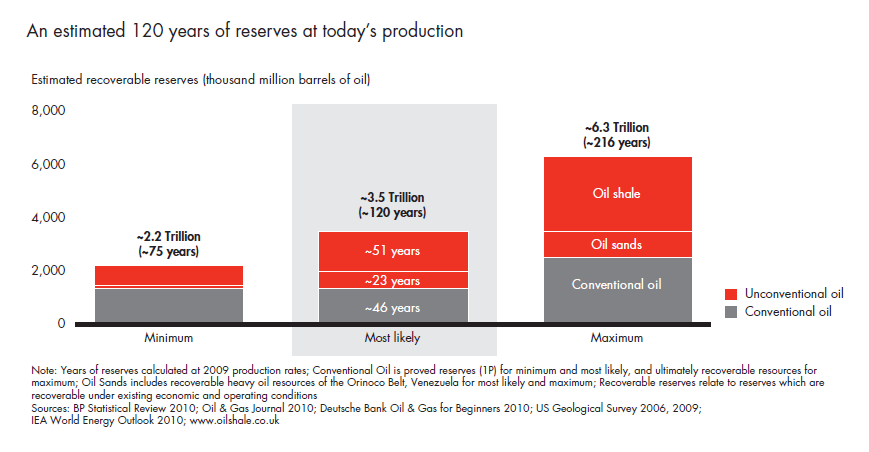
      First, at today's consumption rates, we have approximately 120 years of recoverable oil reserves. That includes 40 years of conventional reserves and 80 years of "unconventional" reserves. While oil consumption increased over the past 25 years by more than 30 percent, those reserves have not only been replaced, the reserve base has grown by the same 30 percent. In other words, global reserves have remained approximately constant since the mid-1980s. Most of this has come not from "easy" oil, but—from a mid-1980s perspective—from "difficult" or even "impossible" oil. And the industry continues to increase reserves through new discoveries, new extractions from discovered resources, field optimizations and unconventional resources. All this comes despite geopolitical events restricting access to many of the world's most promising regions. It defies logic and experience to maintain that this trend will suddenly end.

      Second, we know that oil consumption swings on two primary factors: global demand for energy and petroleum's price relative to energy alternatives. Again, it sounds simple, but these hinge on multiple variables that are difficult to predict. For example, global energy demand rises with population growth and economic development, region by region and country by country. Yet relative price is affected by complex interactions among technology development, economic subsidies and the handicapping of other energy sources.

      peak-oil-does-it-matter-fig-01_embed

      Determining how these will develop is impossible, as evidenced by history's many erroneous predictions of petroleum demand and price. What we can know is that economic growth depends on a reliable supply of energy, provided at the lowest cost. Put another way, it is more useful to identify ongoing energy demand and source trends than the growth rate of new petroleum reserves.

      In our view, three trends are most important

      First, new technologies must continue to emerge. That will make production of ever-more difficult petroleum reserves possible and economically feasible, and will reduce the cost of competing energy sources. Environmental concerns will focus technology development on fossil-fuel alternatives. Improved battery technology will eventually provide a better transportation alternative to gasoline power. Wind and water power will grow too, although affected by financial subsidies more than the free market. The main constraint will be human. It requires scientists and engineers to achieve these technological developments. Companies that succeed will be those recruiting, developing and directing qualified personnel in research and technology.

      Second, flexibility is essential. That means that governments should not constrain any potential energy source. Each will likely be required at some stage. As things sort themselves out, we can expect winners and losers, with varying effects on the pace of countries' development. Governments that embrace market solutions to energy supply will ensure that their nations are best positioned to develop. They must also monitor scientifically and economically justified environmental developments, maintain stable commercial and fiscal environments in the energy sector, and prioritize the education of young people in the required disciplines.

      Finally, the petroleum industry will face competition from alternative and potentially subsidized energy sources. The industry must continue to invest in the kind of research and people to develop its own new technologies. The task is not just to find and produce petroleum more effectively. As alternatives develop, the industry must ensure that every petroleum molecule adds the maximum economic value.

      No one knows how the last barrel of oil produced will be used. Whatever way it plays out, peak oil will occur one day. But it won't signal the demise of petroleum as a growth enabler. With sufficient investment in technology and people, the industry can look forward to continuing to fuel global economic development for decades to come.

      Rob Fisher is a Bain Advisor. Sharad Apte, a Bain & Company partner in the Bangkok office, leads the firm’s Asian Energy practice.


      peak-oil-does-it-matter-fig-01_full
      저자
      • Headshot of Sharad Apte
        Sharad Apte
        파트너, Bangkok
      문의하기
      관련 산업
      • 석유 및 가스
      • 유틸리티 및 재생가능 에너지
      관련 컨설팅 서비스
      • 지속 가능성 및 기업의 사회적 책임
      유틸리티 및 재생가능 에너지
      Business Breakthrough Barometer 2025

      The annual pulse check from leading businesses on the pace of the net-zero transition.

      자세히 보기
      유틸리티 및 재생가능 에너지
      Sustaining Capital: From Chaos to Discipline

      Fragmented budgets, poor visibility, and missed forecasts are fixable with the right approach.

      자세히 보기
      지속 가능성 및 기업의 사회적 책임
      How AI Is Starting to Transform Circular Packaging

      There are 15 AI use cases companies across the value chain can use today to accelerate circularity.

      자세히 보기
      유틸리티 및 재생가능 에너지
      Energy Capital Expenditures: Steady Growth Ahead

      Utilities, oil and gas, and mining will see uneven capex growth through 2027 as companies balance supply security with energy transition goals.

      자세히 보기
      지속 가능성 및 기업의 사회적 책임
      Exploring AI for Packaging Circularity

      AI is already creating value across the packaging lifecycle, from optimising design and reducing material use to improving sorting and traceability.

      자세히 보기
      First published in 12월 2010
      태그
      • 석유 및 가스
      • 유틸리티 및 재생가능 에너지
      • 지속 가능성 및 기업의 사회적 책임

      프로젝트 사례

      An Environmental Services Company Captures Massive Savings from a Merger

      See more related case studies

      조직 Centralization boosts performance for an energy giant

      See more related case studies

      고객 전략 및 마케팅 Revitalizing a utility's market position with customer loyalty

      See more related case studies

      베인에 궁금하신 점이 있으신가요?

      베인은 주저 없이 변화를 마주할 줄 아는 용감한 리더들과 함께합니다. 그리고, 이들의 담대한 용기는 고객사의 성공으로 이어집니다.

      급변하는 비즈니스 환경에서 살아남기 위한 선도자의 시각. 월간 Bain Insights에서 글로벌 비즈니스의 핵심 이슈를 확인하십시오.

      *개인정보 정책을 읽었으며 그 내용에 동의합니다.

      Privacy Policy를 읽고 동의해주십시오.
      Bain & Company
      문의하기 환경정책 Accessibility 이용약관 개인정보 보호 쿠키 사용 정책 Sitemap Log In

      © 1996-2026 Bain & Company, Inc.

      문의하기

      무엇을 도와드릴까요?

      • 프로젝트 문의
      • 채용 정보
      • 언론
      • 제휴 문의
      • 연사 초청
      오피스 전체보기