

Founder's Mentality Blog

This blog asks and tries to answer one question: “What are the organizational design principles that define a scale insurgent?” First, let’s remind ourselves why this question is so important.
- Your ambition is to become the scale insurgent in your industry. You want to capture the benefits of size as you grow (scale/scope advantages, learning, market power and influence) while also retaining a strong sense of the Founder’s Mentality (insurgency, frontline obsession, owner mindset). We call companies that do this scale insurgents.
- You’re going to pursue this ambition by launching micro-battles. While there are multiple building blocks that comprise what you do to become a scale insurgent, micro-battles represent the how. Through micro-battles you rediscover the art of getting things done fast and the science of learning. We talk about this as a “system.”
- Over time, the lessons from these micro-battles will help you redesign your company. As you learn by running micro-battles, you’ll see patterns emerge. These patterns will inform and inspire larger initiatives to change the operating model, to act with more agility, to simplify noncore processes, to free up resources for growth. We don’t advocate starting with these changes because you will learn what you really need to do over time while running micro-battles.
- Defining the design principles of a scale insurgent will set the right target. The heart of any micro-battle system is the learning center. This is where all the micro-battle teams meet with senior leadership and where all lessons are shared (see "The Micro-battles Learning (Training) Agenda"). The first of this room’s four walls is meant to showcase your shared ambition. A critical element of that ambition is to align around the key design principles of the scale insurgent you want to become. This will remind your teams to recall their common ambition at every meeting. It will prompt them to ask, “Does this decision move us closer to our ambition to be a scale insurgent, or does it move us further away?”
The purpose of this blog post is to encourage that kind of alignment. We want to spur a discussion about what it really means to be a scale insurgent. Ultimately, your ambition is your ambition, and we know each leadership team will have a different list of design principles based on its own context and experience. But we’ve been in enough learning centers over the past three years to see patterns. And from these patterns we’ve developed a list of six design principles that are common to roughly 80% of companies. They’re listed below, and we’ll use most of this blog to explain each (see Figure 1).
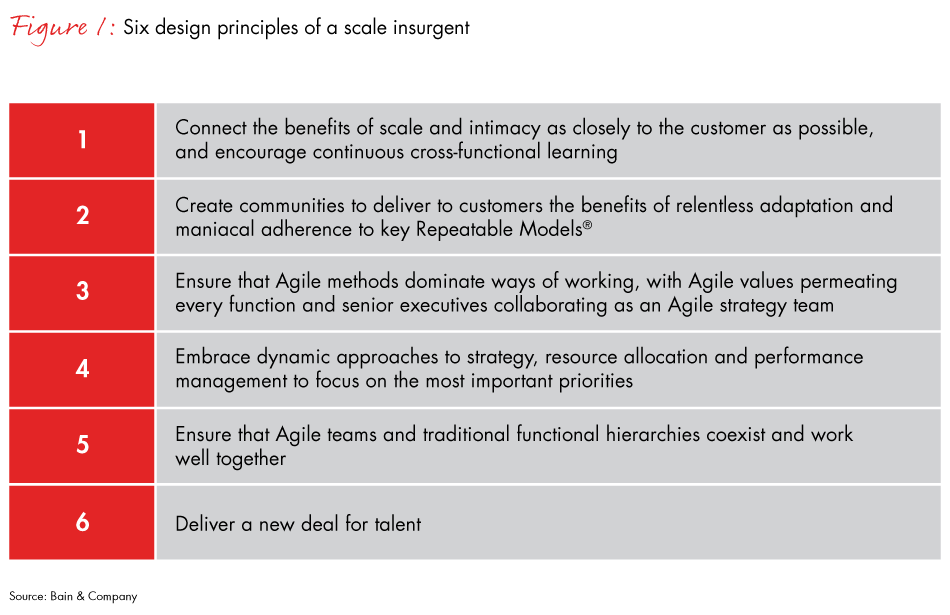
Principle 1: Connect the benefits of scale and intimacy as closely to the customer as possible, and encourage continuous cross-functional learning.
Scale insurgents start with the customer. Every organizational change they consider must make it easier to deliver to their best customers the benefits of intimacy and the benefits of scale. Why? Your customers win when you deliver intimacy, or the “benefits of difference,” because they value things that meet their individual needs. But they also win when you deliver scale, or the “benefits of sameness,” because they reap huge quality improvements and cost savings that come from you doing things 1,000 times in the same way. The challenge is that these two benefits can be in direct conflict with each other, and what your customers don’t benefit from is an inability to resolve the conflict rapidly on their behalf. Scale insurgents excel at negotiating the conflicts that arise between intimacy and scale, and they do so as closely to the customer as possible.
Several key points:
- This demands teams. Too often the sides of the organization representing intimacy and scale get locked into silos that don’t talk to each other. Scale insurgents break down these barriers by teaming together in all things and resolving the day-to-day conflicts within the team framework. We refer to the leaders of the teams that deliver intimacy and scale as the “franchise players,” and you want to ensure that they are fully empowered to do what it takes to embrace and resolve conflict quickly on behalf of customers.
- These teams must adopt Agile principles and benefit from strong learning systems. Agile makes your teams more comfortable with fast adaptation and responding to market feedback. The right learning systems get customer feedback to your teams immediately and make sure they are supported and coached to respond effectively.
- Everyone else in the organization must support these teams. Those who aren’t on the teams understand first and foremost that their job is to help the teams do whatever it takes to improve customer solutions and remove obstacles that are getting in the way of delivering those solutions. There’s no confusion about who’s got the ball. The franchise players and their teams are on the soccer field scoring goals and defending. Then there are the rest of us in support roles aimed at helping them win.
Principle 2: Create communities to deliver to customers the benefits of relentless adaptation and maniacal adherence to key Repeatable Models®.
A scale insurgent focuses a lot of energy on nurturing three core communities within the organization. These aren’t new organizational entities with hierarchies and reporting functions. They are communities of individuals who get together sometimes but who also may belong organizationally to other teams. These communities represent the broad sets of skills the company needs to thrive in today’s fast-changing markets. Consequently, you have to start paying close attention to their health. As a community, are they world class? Can they develop expertise in their community and learn from others? Do the more experienced folks in that community feel a sense of responsibility to develop and coach folks who are more junior?
The three core communities are:
- The Agile/disruptive/innovator community. These people promote innovation through Agile ways of working. Some Agile teams come together for specific projects and then disband. Some are “persistent” teams, meaning they stay focused on a single product or service for multiple years, bringing disruptive innovation to their own solutions. Agile teams can also focus on core business processes or the business model, innovating to disrupt your internal ways of working or strategy.
- The expert/execution community. These are the people who execute core repeatable business processes day in and day out. They focus on continuous improvement of existing playbooks and, as experts, share what they’ve learned across the organization. They are also asked at times to support Agile and scaling teams.
- The scaling community. These people take winning innovations and scale them across the organization, testing for transferability and repeatability. They help define the next generation of execution playbooks. They also help mobilize resources, internally and externally, including ecosystem partners.
We think one of the biggest challenges for the scale insurgent is to develop the skills of the scaling community. These are the folks who bridge the key scaling sequence that runs from Agile experimentation to repeatability to perfect execution of known routines.

Micro-battles
Want to learn more about the journey to scale insurgency? Explore the Bain Micro-battles System℠, step by step.
Principle 3: Ensure that Agile methods dominate ways of working, with Agile values permeating every function and senior executives collaborating as an Agile strategy team.
Scale insurgents recognize that formal Agile teaming isn’t appropriate for all parts of a mature organization. But they also ensure that Agile thinking permeates everything they do.
This demands:
- Micro-battles. Scale insurgents run their top strategic initiatives as micro-battles, with senior executives playing key roles on the Leadership team. Micro-battle teams bring together the best of the innovator, expert and scaling communities as they win and scale.
- Agile teams. The innovator community runs Agile teams, and as we said, many run whole product and service areas as persistent teams that work together for years. This ensures that teams are constantly looking at changes in the marketplace to make sure you aren’t displaced by the new insurgents in the industry.
- Agile mindset. But let’s be clear, the expert and scaling communities also share an Agile mindset and use it to continuously improve the playbooks used to execute Repeatable Models and to help scale major initiatives across the enterprise.
Principle 4: Embrace dynamic approaches to strategy, resource allocation and performance management to focus on the most important priorities.
Scale insurgents have liberated themselves from the sun—or more precisely, the Earth’s movement around the sun. It is amazing to think about how many core processes, starting with strategy planning and budgeting, are still tied to the yearly calendar at most companies. Thank goodness we’re not on Saturn or we’d be budgeting in 30-year cycles. When it comes to strategy and resource allocation, scale insurgents rely on processes that are much more dynamic and responsive.
Most notably:
- Strategy moves from a calendar-based planning process to an issues-based continuous process. That allows market and competitive realities to drive the cadence of decision making, which means reactions don’t have to wait until the next planning cycle. Strategy is also much more ecosystem focused. While a core outcome of strategy is to dominate your industry’s profit pool, this will depend less on the assets your firm owns and more on your firm’s ability to partner with others in the ecosystem to gain marketing power and influence. (See “The Firm of the Future”)
- Just as planning has to be more dynamic, resource allocation also has to be more fluid. Based on changing circumstances, your teams are continuously being redeployed to work on the most important priorities. Costs are always zero-based to free up resources to fund growth.
- And performance management is simplified. Because scale insurgents empower their teams more, they clearly define what they mean by “freedom within a framework.” This sets the guardrails and lets teams know which decisions they own. Most companies base performance management on a lack of trust, requiring lots of meetings to check on progress and vet decisions. Scale insurgents manage performance more by exception. This means fewer meetings, but Lord help the teams that hit the exception button—that invites a lifetime of “senior management review.”
Principle 5: Ensure that Agile teams and traditional functional hierarchies coexist and work well together.
OK. Now the rubber hits the road. Up to this point, the principles we’ve laid out have been aspirational but clearly achievable. This next one is the most aspirational of all. Getting the three communities to work together in harmony is one of the major challenges on the journey to scale insurgency. Many folks, in fact, believe it’s impossible—that large companies can never rediscover Agile ways of working at scale or recapture their Founder’s Mentality. We disagree. And we wrote a book about it. But the doubters do have a point—many scale insurgents or Agile enterprises were born Agile (usually recently), and they grew quickly. It’s a lot harder for an existing incumbent or struggling bureaucracy to transform itself into a scale insurgent because micro-battle teams and Agile teams eventually run into the older, more traditional parts of the organization. These rely on more hierarchical decision making and ways of working that grew out of established routines and behaviors.
How you get Agile teams and traditional functional hierarchies to thrive together is a sprawling subject, which we’ll tackle in another blog post. Here we’re concerned with the “point of arrival,” focusing on the finished product.
This is what it looks like at a scale insurgent:
- All leaders share the ambition to capture the benefits of size while retaining the Founder’s Mentality. That means they all recognize that scale insurgents rely on both Agile teams and traditional hierarchies. The leaders of scale insurgents don’t argue this point. They are committed to it.
- Leaders are clear on which initiatives should be supported by Agile teams and which by traditional functional hierarchies. This becomes a natural part of resource allocation. The leaders of the scale insurgents are thoughtful and deliberate in how they deploy resources among the three communities, matching the right initiative to the right approach.
- They also develop the skills to ensure that functional hierarchies can support micro-battles and Agile teams, even though these teams have much faster cycle times. Agile teams have a specific cadence that is often directly at odds with the traditional hierarchies locking in Repeatable Models for core processes. Yet, specific disciplines—IT, for example—must work at both speeds. Agile teams that have competitors breathing down their necks need IT to engage on multiple rapid rounds of prototypes. But the IT hierarchy is also responsible for making sure the technology operations running in the background are flawless and don’t disrupt innovation. (Please read The Phoenix Project to see this dilemma in action.) Rather than hide from this trade-off or deny it, the scale insurgent has the critical skills and discipline to develop integrated roadmaps for deploying teams that can operate across all time frames. Many of these skills are nurtured within the scaling community.
- Senior leadership sets meetings to a cadence that ensures they can quickly resolve any bottlenecks between the two groups that impede progress. Because scale insurgents aren’t bound by the Earth’s rotation around the sun, they aren’t locking in processes that are reviewed quarterly or annually. The leader’s job is to constantly manage trade-offs across the three communities. And the company builds in the systems to resolve these trade-offs every hour, not on the equinox.
- Therefore, the scale insurgent invests massively in itself, recognizing that common training and coaching across all communities and teams are necessary to create a common language and Agile mindset. The scale insurgent is trying to get the best out of Agile teams and the best out of traditional hierarchies to gain the benefits of size while retaining the Founder’s Mentality.
Principle 6: Deliver a new deal for talent.
Every firm has thinkers and doers, but the doers are the heroes at a scale insurgent. These companies recognize and reward execution in new ways. As we’ve seen, they still have (and value) traditional hierarchies in some areas of the business. But they have moved away from an exclusive reliance on the old path to success—climbing the ladder, increasing your span, becoming primarily a thinker who has moved further and further from customers and execution roles. Scale insurgents offer a new deal for talent. They reward people for measuring their careers by the great teams they joined and led, and taking satisfaction in the impact those teams had on customers and society.
We offer these principles not as hard and fast rules but as input for your company’s journey. They’ve emerged from the patterns we’ve observed at the scale insurgents we’ve worked with, and they are, in many ways, an aspiration.

Making the Case for Change: The Role of the Founder’s Mentality Survey
The best leadership teams use the Founder's Mentality survey as a starting point for introspection, and for engaging the organization in a richer, deeper dialogue.
First published in 9월 2017