

Brief
Most utility CEOs agree that it's wise to invest in smart meters, the digital devices that help track electricity usage in real time. Smart meters help increase the productivity of field service employees and improve billing quality. They provide consumers with more information on how to save on electricity bills. Smart meter rollouts get government support through subsidies. And smart meters represent a critical component in the broader vision to build the smart grid.
Yet many CEOs remain cautious about how much or how soon to invest in rolling out smart meters. Consumers are unsure about what smart meters can do—or whether they even want one in the house. Smart meter pilots that tested pricing and encouraged electricity consumption at off-peak hours drew a mixed response from customers. State and local governments remain undecided on policies such as flexible pricing for electricity. And for both developed economies and emerging markets, the business case for pure smart meter deployments remains weak: without government subsides, most smart meter rollouts lead to a negative NPV. While utilities undertake much of the cost of installing smart meter technology, many of the claimed benefits accrue to consumers or society at large.
Like all new technologies, smart meters have had their share of highs and lows. In the US, expectations spiked in 2009, when the Obama administration's economic stimulus bill promised it would "place smart meters in homes to make our energy bills lower, make outages less likely and make it easier to use clean energy." But as utilities invested in smart meter pilots, the excitement waned when consumers raised health, privacy and security concerns—and in some cases, experienced an increase in rates.
Now, utility CEOs question not only their smart meter deployment, but also the business case for earning revenues from providing consumers with services enabled by smart meters. Many see little sense in rushing ahead when there are no precise estimates of the business opportunity "beyond the meter." For example, utilities focused only on transmission and distribution services have no incentive to invest in smart meters. Such utilities don't benefit either by avoiding the cost of building new plants or switching power usage to periods of plentiful supply.
While utilities are therefore justified in exercising caution when planning smart meter investments, they must still make tough choices. At what pace should they approach the beyond-the-meter opportunity so that they don't over-invest beyond the real opportunity—or leave themselves vulnerable to new competitors for too long? In the following sections, we will share our findings on the market for smart meter-enabled services based on three different methodologies. We will then focus on what utilities can do, despite the limitations, to make the most of the smart meter opportunity—now and in the future.
Sizing the new opportunity
Over the last few months, Bain & Company conducted several research initiatives to gauge the size of the market for smart meter-enabled services. We sought ideas that went beyond the common business case for smart meters to look specifically for cash and profit-generating opportunities.
We found that in dollar terms, the size of the market for such services is a fraction of what the hype might suggest. Our estimates indicate that in the US, assuming at least 46 million households eventually have smart meters in place, the total incremental revenues from smart meter-enabled services for residential consumers are likely to be between $2 billion and $4 billion (see Figure 1). That implies an associated incremental profit pool of less than $1 billion—compared with the nearly $40 billion profit pool the US utility sector currently enjoys. We estimated the size of the market for smart meter-enabled services using three separate methodologies:
- Revenues earned by helping consumers save energy: First, we calculated the revenue pool based on the residential consumers' energy-saving potential (projected average household electricity bill in 2014 times the potential savings per smart meters). This model projects smart meter revenues in the range of $1.7 billion to $5.2 billion, depending on the extent of savings on the annual bill ranging from 4% to 12%.
- Revenues based on the willingness of consumers to pay: Next, we projected the market size based on US consumers' willingness to pay (see sidebar) for energy-efficient services (the total number of "environmental activists" and "passive greens" times the price they are willing to pay). The "environmental activists" and "passive greens" together constitute about 32 million to 58 million households in the US. Assuming they all install smart meters, this yields a similar market size, in the range of $1.9 billion to $3.4 billion.
- Revenues from beyond-the-meter services: Finally, we focused on four specific potential "beyond the meter" business opportunities: demand management, data/information, services and market making. We then projected the size of each of these businesses (the estimated number of customers in 2014 times the value per customer). That projects a market in the range of $1.7 billion to $4.2 billion, based on varying demand for each service.
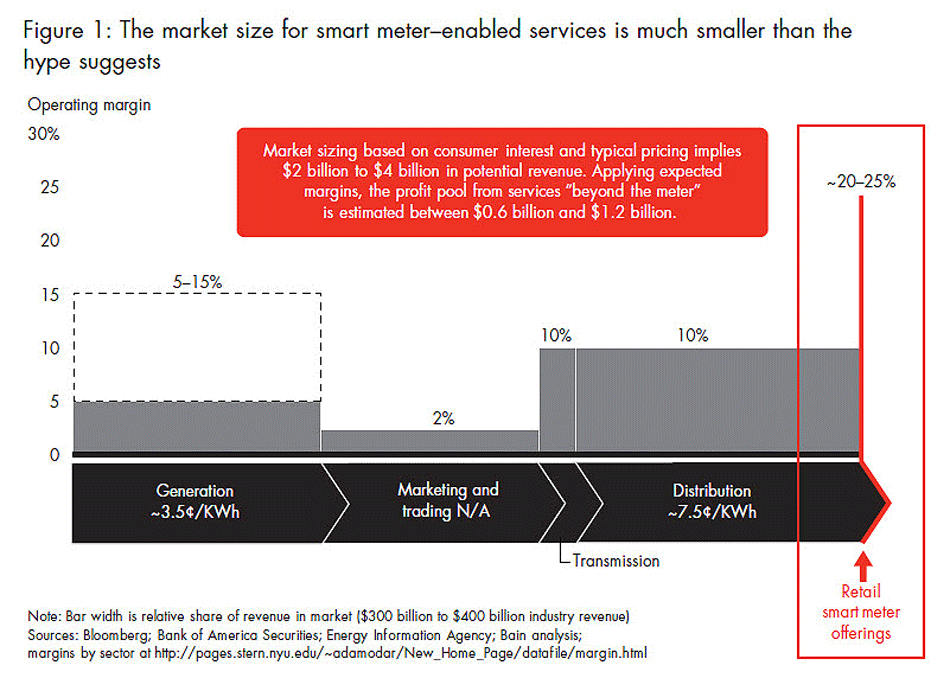
Whichever way we approach the estimate, the result is the same: smart meters pose a business challenge for utilities. They raise high expectations in consumers. They offer limited incremental financial gain. And they open an avenue for new entrants into the industry. Technology companies (Google, Microsoft), consumer electronics retailers (Best Buy) and energy equipment suppliers (Whirlpool) all see smart meter-enabled services as a part of the e-home bundle. Expected to grow to $380 billion by 2014, the e-home market consists of equipment (consumer electronics, appliances, smart phones, PCs), data services, communications, security and maintenance. The power energy segment is but a small sliver of the e-home market for these new entrants, but the presence of such strong competitors substantially changes the competitive landscape for utilities.
How to play in the emerging space
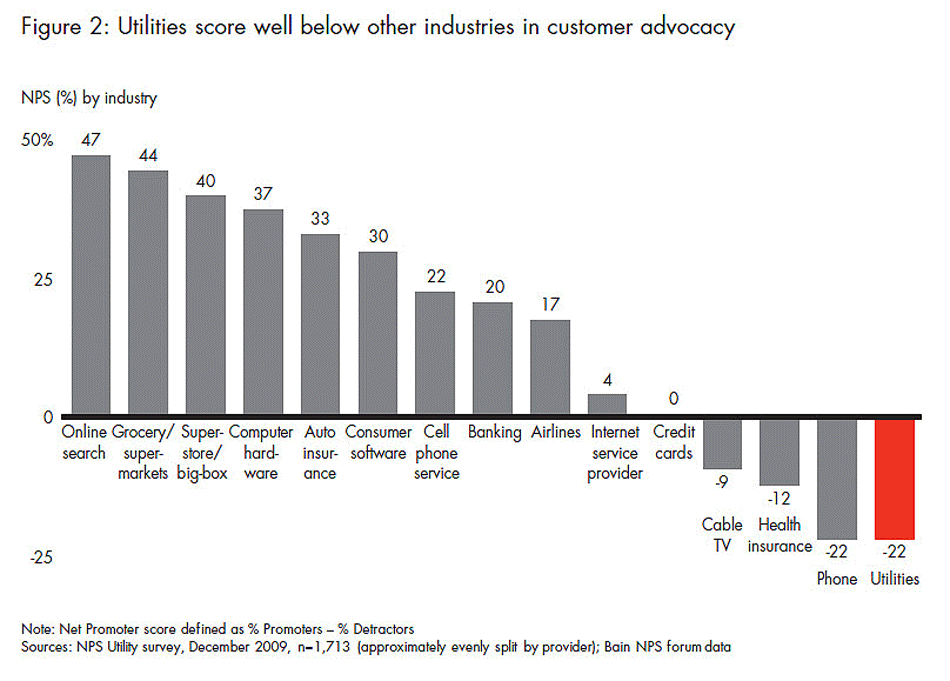
New rivals from other industries pose a threat to utilities in several ways. While most utilities operate regionally, the new competitors bring geographic scale to their operations. Moreover, they have much greater experience in understanding and serving customer needs. In a separate survey of 1,700 customers, we measured the Net Promoter® score1 of utilities as well as of 15 potentially disruptive industries. The highest scores, indicating higher customer advocacy, went to industries such as online search, big-box retailers and the computer hardware industry. Utilities scored the lowest (see Figure 2).
Against that background, utilities can ill afford to nurture the market at their own pace. Instead, they must safeguard their position by playing on three traditional strengths. One, unlike rivals from industries like consumer electronics or technology, utilities already have an existing, energy-focused relationship with local customers and have direct access to households and businesses in the region.
Two, utilities have access to customer information, both current as well as historical records. That puts utilities in the unique position to develop business models that help consumers understand and use energy consumption information. A utility can partner—say with a consumer electronics company—to provide data services beyond the smart meter. Based on trend data on how much electricity a customer consumes at different times along with the pricing, a utility can develop customized solutions for its customers to help them spend less on energy each month.
Finally, utilities have extensive field-service employees in place. Utilities can offer consumers in-home smart meter services, such as energy audits or consumer education on energy efficiency, using this field force. Most importantly, employees provide a valuable resource that utilities can use to delight customers, deepen relationships and further strengthen the trust in the utility brand.
Building on these strengths, we see three strategies emerging across the utility landscape:
- Stick to the core: These utilities seek to get the most out of their existing assets. Their primary focus becomes improving the integrity of the grid and strengthening the quality of their operations. For example, even as PG&E explores smart meter-enabled services by providing customers online tools for real-time usage data, the utility's primary focus is on getting the basics right: ensuring consumers get bills on time and that their energy consumption is measured accurately.
- Play defense: These utilities take actions to protect their relationship with consumers and seek to expand only in those areas of smart meter-enabled services that help them "own" the customer better. These services include online bills, energy consultations and flexible pricing options. For example, San Diego Gas & Electric partnered with Google to offer consumers the PowerMeter. Consumers can go online to view hourly information on how much electricity their home used the previous day—on a personalized home page on Google.
- Play offense: These utilities believe the time is right to expand aggressively into new adjacent businesses related to smart meter-enabled services—all the way from energy trading to equipment installation and maintenance. They want to move fast to gain share and capture the emerging profit pool, as well as block new entrants.
Direct Energy, for example, wants to create a home energy management product that can become a standard for the industry and "has the potential to do what the iPhone did for communication." The utility is now leading a partnership with Whirlpool International, Best Buy, Lennox International and Open Peak to develop a home energy manager that helps consumers track energy usage in "smart" appliances like dryers and water heaters by using a touch-screen device with an intuitive, graphical user interface. The strategy a utility chooses will depend on its regulatory environment and utility incentives as well as factors such as the state of the technology, cost competitiveness and the kind of customers it services. Investing in making the right decision and speedily executing on the strategy will remain critical as increasingly, potential competitors will not allow utilities to play the waiting game.
Will consumers pay for smart meter-enabled services?
"If I'd asked my customers what they wanted, they'd have said a faster horse." We were very conscious of Henry Ford's aphorism as we surveyed more than 2,000 residential consumers in the US on how they valued a range of services enabled by smart meters—some of which exist today, others that could be developed in the future. As we worked to identify the broad segments in future consumption patterns, we encouraged survey respondents to think about "speed" instead of "horses"—that is, the potential needs that smart meter-enabled services might meet and customers' willingness to pay for them. Despite a growing awareness about energy consumption, a majority of consumers report indifference to managing their power bill more efficiently. Notionally, they express enthusiasm for smart meter-enabled services in the future. In practice, electricity remains a low-involvement product. A majority of consumers perceive no incentive to pay extra for energy-saving services.
The survey revealed four distinct types of residential electric consumers, of which only two segments showed a propensity to pay for smart meter-enabled services:
- Do-it-yourselfs: Representing the largest category of consumers, the "do-it-yourself" (DIY) households constitute about 40% of the US market. They believe they already take basic steps to protect the environment and are unwilling to spend extra money to conserve energy.
- Apathetics: Accounting for 15% of the market, these consumers neither actively conserve, nor are they interested in conservation efforts.
- Environmental activists: Constituting about 25% of the market, these consumers actively promote conservation and want utilities to help them in their conservation efforts. They are willing to pay utilities $75 to $125 a year—about 5% to 7.5% more than an average annual electricity bill—for services that help conserve energy.
- Passive greens: Determining the last 20% of the market, these consumers admit that currently, they do not take any environment-friendly actions. But the idea of conservation appeals to them, and they are willing to pay $25 to $75 a year (2.5% to 5% of the average annual bill) for smart meter-enabled services.
First published in 5월 2011