
Skip to Content
  • 오피스

    오피스

    미주
    • Atlanta
    • Austin
    • Bogota
    • Boston
    • Buenos Aires
    • Chicago
    • Dallas
    • Denver
    • Houston
    • Los Angeles
    • Mexico City
    • Minneapolis
    • Monterrey
    • Montreal
    • New York
    • Rio de Janeiro
    • San Francisco
    • Santiago
    • São Paulo
    • Seattle
    • Silicon Valley
    • Toronto
    • Washington, DC
    유럽, 중동, 아프리카
    • Amsterdam
    • Athens
    • Berlin
    • Brussels
    • Copenhagen
    • Doha
    • Dubai
    • Dusseldorf
    • Frankfurt
    • Helsinki
    • Istanbul
    • Johannesburg
    • Kyiv
    • Lisbon
    • London
    • Madrid
    • Milan
    • Munich
    • Oslo
    • Paris
    • Riyadh
    • Rome
    • Stockholm
    • Vienna
    • Warsaw
    • Zurich
    아시아, 호주
    • Bangkok
    • Beijing
    • Bengaluru
    • Brisbane
    • Ho Chi Minh City
    • Hong Kong
    • Jakarta
    • Kuala Lumpur
    • Manila
    • Melbourne
    • Mumbai
    • New Delhi
    • Perth
    • Seoul
    • Shanghai
    • Singapore
    • Sydney
    • Tokyo
    오피스 전체보기
  • 얼럼나이
  • 미디어 센터
  • 구독
  • 연락처
  • Korea | 한국어

    지역 및 언어 선택

    글로벌
    • Global (English)
    미주
    • Brazil (Português)
    • Argentina (Español)
    • Canada (Français)
    • Chile (Español)
    • Colombia (Español)
    유럽, 중동, 아프리카
    • France (Français)
    • DACH Region (Deutsch)
    • Italy (Italiano)
    • Spain (Español)
    • Greece (Elliniká)
    아시아, 호주
    • China (中文版)
    • Korea (한국어)
    • Japan (日本語)
  • Saved items (0)
    Saved items (0)

    You have no saved items.

    관심 있는 내용을 북마크하여 Red 폴더에 저장할 수 있습니다. Red 폴더 에서 저장된 내용을 읽거나 공유해보세요.

    Explore Bain Insights
  • 산업
    메인 메뉴

    산업

    • 우주항공, 방산 및 정부 서비스
    • 농업 관련 산업
    • 화학
    • 인프라, 건설 및 건축 자재
    • 소비재
    • 금융 서비스
    • 헬스케어
    • 산업용 기계 및 장비
    • 미디어 및 엔터테인먼트
    • 금속
    • 광업
    • 석유 및 가스
    • 제지 및 패키징 산업
    • 사모펀드
    • 사회 및 공공 부문
    • 유통
    • 기술
    • 텔레콤
    • 운송
    • 여행·여가
    • 유틸리티 및 재생가능 에너지
  • 컨설팅 서비스
    메인 메뉴

    컨설팅 서비스

    • Customer Experience
    • ESG
    • Innovation
    • M&A
    • 운영
    • 조직
    • 사모펀드
    • 고객 전략 및 마케팅
    • 전략
    • AI, 인사이트 및 솔루션
    • Technology
    • 변화 혁신
  • Digital
  • 인사이트
  • 베인 소개
    메인 메뉴

    베인 소개

    • 업무 소개
    • 베인의 신념
    • 구성원 및 리더십 소개
    • 고객 성과
    • 주요 수상 경력
    • 글로벌 파트너사
    Further: Our global responsibility
    • 다양성과 포용
    • 사회 공헌 활동
    • Sustainability
    • World Economic Forum
    Learn more about Further
  • Careers
    메인 메뉴

    Careers

    • Work with Us
      Careers
      Work with Us
      • Find Your Place
      • Our Work Areas
      • Integrated Teams
      • Students
      • Internships & Programs
      • Recruiting Events
    • Life at Bain
      Careers
      Life at Bain
      • Blog: Inside Bain
      • Career Stories
      • Our People
      • Where We Work
      • Supporting Your Growth
      • Affinity Groups
      • Benefits
    • Impact Stories
    • Hiring Process
      Careers
      Hiring Process
      • What to Expect
      • Interviewing
    FIND JOBS
  • 오피스
    메인 메뉴

    오피스

    • 미주
      오피스
      미주
      • Atlanta
      • Austin
      • Bogota
      • Boston
      • Buenos Aires
      • Chicago
      • Dallas
      • Denver
      • Houston
      • Los Angeles
      • Mexico City
      • Minneapolis
      • Monterrey
      • Montreal
      • New York
      • Rio de Janeiro
      • San Francisco
      • Santiago
      • São Paulo
      • Seattle
      • Silicon Valley
      • Toronto
      • Washington, DC
    • 유럽, 중동, 아프리카
      오피스
      유럽, 중동, 아프리카
      • Amsterdam
      • Athens
      • Berlin
      • Brussels
      • Copenhagen
      • Doha
      • Dubai
      • Dusseldorf
      • Frankfurt
      • Helsinki
      • Istanbul
      • Johannesburg
      • Kyiv
      • Lisbon
      • London
      • Madrid
      • Milan
      • Munich
      • Oslo
      • Paris
      • Riyadh
      • Rome
      • Stockholm
      • Vienna
      • Warsaw
      • Zurich
    • 아시아, 호주
      오피스
      아시아, 호주
      • Bangkok
      • Beijing
      • Bengaluru
      • Brisbane
      • Ho Chi Minh City
      • Hong Kong
      • Jakarta
      • Kuala Lumpur
      • Manila
      • Melbourne
      • Mumbai
      • New Delhi
      • Perth
      • Seoul
      • Shanghai
      • Singapore
      • Sydney
      • Tokyo
    오피스 전체보기
  • 얼럼나이
  • 미디어 센터
  • 구독
  • 연락처
  • Korea | 한국어
    메인 메뉴

    지역 및 언어 선택

    • 글로벌
      지역 및 언어 선택
      글로벌
      • Global (English)
    • 미주
      지역 및 언어 선택
      미주
      • Brazil (Português)
      • Argentina (Español)
      • Canada (Français)
      • Chile (Español)
      • Colombia (Español)
    • 유럽, 중동, 아프리카
      지역 및 언어 선택
      유럽, 중동, 아프리카
      • France (Français)
      • DACH Region (Deutsch)
      • Italy (Italiano)
      • Spain (Español)
      • Greece (Elliniká)
    • 아시아, 호주
      지역 및 언어 선택
      아시아, 호주
      • China (中文版)
      • Korea (한국어)
      • Japan (日本語)
  • Saved items  (0)
    메인 메뉴
    Saved items (0)

    You have no saved items.

    관심 있는 내용을 북마크하여 Red 폴더에 저장할 수 있습니다. Red 폴더 에서 저장된 내용을 읽거나 공유해보세요.

    Explore Bain Insights
  • 산업
    • 산업

      • 우주항공, 방산 및 정부 서비스
      • 농업 관련 산업
      • 화학
      • 인프라, 건설 및 건축 자재
      • 소비재
      • 금융 서비스
      • 헬스케어
      • 산업용 기계 및 장비
      • 미디어 및 엔터테인먼트
      • 금속
      • 광업
      • 석유 및 가스
      • 제지 및 패키징 산업
      • 사모펀드
      • 사회 및 공공 부문
      • 유통
      • 기술
      • 텔레콤
      • 운송
      • 여행·여가
      • 유틸리티 및 재생가능 에너지
  • 컨설팅 서비스
    • 컨설팅 서비스

      • Customer Experience
      • ESG
      • Innovation
      • M&A
      • 운영
      • 조직
      • 사모펀드
      • 고객 전략 및 마케팅
      • 전략
      • AI, 인사이트 및 솔루션
      • Technology
      • 변화 혁신
  • Digital
  • 인사이트
  • 베인 소개
    • 베인 소개

      • 업무 소개
      • 베인의 신념
      • 구성원 및 리더십 소개
      • 고객 성과
      • 주요 수상 경력
      • 글로벌 파트너사
      Further: Our global responsibility
      • 다양성과 포용
      • 사회 공헌 활동
      • Sustainability
      • World Economic Forum
      Learn more about Further
  • Careers
    최근 검색어
      최근 방문 페이지

      Content added to saved items

      Saved items (0)

      Removed from saved items

      Saved items (0)

      Brief

      Power Struggle: Making the Most of Generation Assets in Turbulent Times

      Power Struggle: Making the Most of Generation Assets in Turbulent Times

      A thorough review of a power generation portfolio informs decisions about how to reduce costs, raise revenues and make broader strategic plans.

      글 Arnaud Leroi, Jim Wininger and Julien Jaulin

      • 읽기 소요시간

      Brief

      Power Struggle: Making the Most of Generation Assets in Turbulent Times
      en

      Many of the factors squeezing margins on some types of thermal power generation are beyond the control of utility executives: the rise of renewables and distributed generation, low natural gas prices in North America, greater availability of coal in Europe and, in developed markets, a leveling off in demand due to greater energy efficiency. In some places, margins from power generation have declined by more than half over the past five years, leaving many coal plants in North America and combined-cycle gas turbine (CCGT) plants in Europe unprofitable.

      But some factors are within executives’ control, such as determining the right portfolio of power generation assets and keeping those plants running as efficiently as possible by reducing fixed and variable costs.

      Getting the most out of a generation portfolio begins with stepping back and reviewing strategic goals for the larger organization, then examining performance targets and clarifying the role that power generation plays in hitting those targets. Vertically integrated companies should review their business model to decide whether power generation is still vital to their business and a source of differentiation from their competitors. Executives should consider not only the current value of a scaled and balanced thermal generation portfolio, but also its future value given potential market changes. They should also assess how this value compares with other models, such as generation from renewables or a pure retail model (see Figure 1).
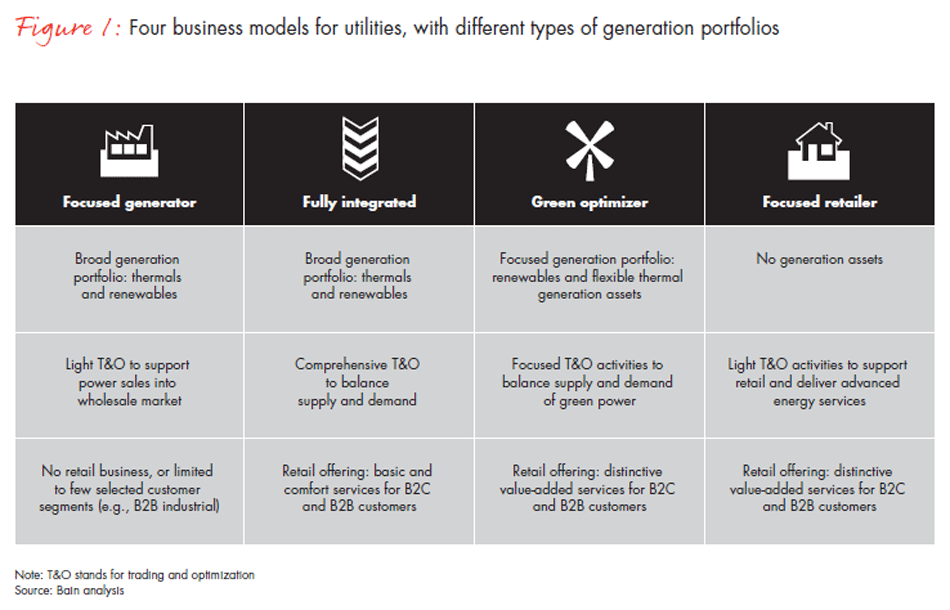

      power-struggle-making-the-most-of-generation-assets-fig01_embed

      The next critical step is reviewing the entire power generation portfolio to identify the least profitable plants. Executives can then evaluate strategic options for those plants while also identifying tactical levers to improve operational excellence, reduce costs and operate more efficiently across the portfolio. These reviews should consider different scenarios that could affect future profitability, such as changes in electricity demand and the cost of fuel.

      These insights can inform decisions about which plants to close, mothball or convert. Executives can then put measures in place to reduce costs and boost efficiency at the remaining plants. One utility was able to raise margins and, over three years, bring the portfolio back to profitability by closing a single large plant (saving about 40% of operating costs), implementing a stringent cost-reduction program (cutting about 25% of operating expenses) and maximizing revenue from the rest of its portfolio (an uplift of 15%).

      Assess the portfolio’s potential

      A thorough evaluation of the potential within a power generation portfolio begins with a review of the current and future profitability of each plant (see Figure 2). These reviews should assess the operating expenses and profitability of each site, and consider any investments and capital expenses that may be necessary to keep the plant running.
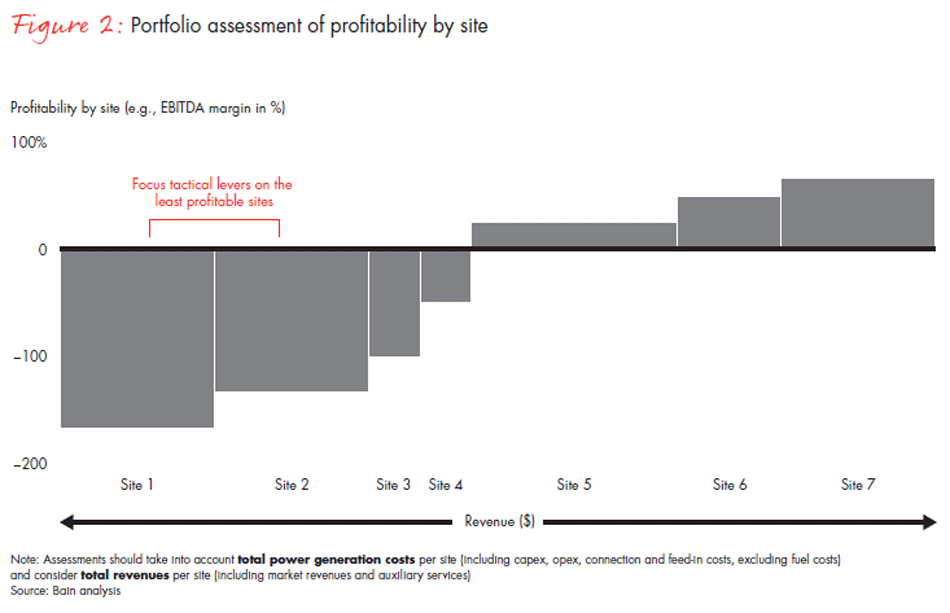

      power-struggle-making-the-most-of-generation-assets-fig02_embed

      Once executives have a clear picture of each plant’s profitability, they should consider different tactical measures to improve the portfolio’s performance. Three measures offer the greatest potential to raise profitability:

      • Reduce external costs (fuel supply, vendors). One energy company reduced fuel supply costs by as much as 6% to 10% through a series of initiatives, including exploring alternative coal suppliers, consolidating purchases among its subsidiaries to gain greater volume discounts, renegotiating contracts and sourcing more directly. By renegotiating contracts with its subcontractors, like facilities maintenance companies, the energy company saved another 3% to 5% in expenses.
      • Increase revenues. A utility can raise its revenues by 15% or more by increasing the flexibility of its assets and offering different types of ancillary services. For example, the utility can develop or extend its capabilities to deliver extra capacity when the grid demands it, in exchange for annual compensation.
      • Reorganize to reduce operating costs. Centralizing functions can create significant cost savings, particularly for the core of the labor force, like production and maintenance. By centralizing its procurement and general and administrative functions while also improving the effectiveness of its logistics chain, one utility saved 20% on labor costs.

      In addition to implementing these tactical measures, utilities should assess the future profitability of their power generation portfolio and the assets in it. They should calculate profitability under a range of scenarios and factors, including fluctuations in demand, wholesale prices and fuel costs, and also consider the effects of shifting to renewables and distributed generation.

      Evaluate strategic options

      Once executives have a clear understanding of the portfolio’s profitability potential, they can consider broader and more strategic options, including converting plants (for example, from a combined cycle to an open cycle or a cogeneration system) or mothballing or closing them. Because utilities need to consider the technical and regulatory constraints of closing plants, this process should include discussions with regulators to explore how plant closures could affect the region’s energy capacity. These conversations should include the possibility of obtaining support for unprofitable plants, such as annual compensation for maintaining sufficient reserve capacity to prevent the risk of blackouts.

      Executives can then assess the economics of each scenario by applying four best practices:

      • Calculate option values based on the asset’s life cycle. This requires evaluating future costs, revenues and capital expenditures like major maintenance overhauls.
      • Calculate the return on investment for the entire portfolio rather than for each asset. These calculations must take into account the interdependency among plants in a portfolio: Closing one plant, for example, may increase the revenue from other plants —even less efficient plants—that might have to operate more often to meet the area’s energy and reliability requirements.
      • Assess sensitivity to the evolution of market prices. Future market prices are a sensitive parameter in decisions about whether to close or mothball a plant. This step involves getting validation from teams throughout a company, especially trading and strategic planning teams.
      • Assess all restructuring costs for each scenario. In addition to considering the onetime social costs of restructuring, utilities must take an exhaustive assessment of technical costs, including safety decommissioning, fees for terminating supplier contracts and disconnecting from the grid, and, in the case of mothballing, costs for dismantling or restarting a plant.

      Utilities should then perform a detailed risk assessment on each of the potential options with a positive economic return, including technical, regulatory, social and legal risks. These assessments should consider revenue uncertainty as market conditions change and the possibility of disruption in the competitive market if other utilities change their portfolios.

      Armed with these key recommendations, the senior executive team can make long-term strategic decisions about their power generation portfolio. These decisions will inform a comprehensive plan that includes a vision of the future portfolio, a detailed roadmap with milestones and a cross-functional governance structure that clarifies accountability.

      When to review

      While most utility executives continually scan the horizon as they consider their long-term strategic options, dramatic shifts or sustained trends can serve as a specific prompt for reviewing the power generation portfolio. Among the indicators that could spark a broad review:

      • Significant and sustained changes in commodity costs, for example, the decrease in US natural gas costs
      • Changes in regulation, including deregulation, new environmental rules and plans that favor renewables
      • Changes in competition, either from other power generators or from other sources of power at the edge of the grid, which are changing the demand curve
      • Ongoing systematic underperformance in revenues or profitability

      These and other factors should lead executives to take a measure of their options and consider the range of appropriate actions designed to position their organizations for long-term sustainability and profitability in the power sector.

      Arnaud Leroi is a partner in Bain & Company’s Paris office, where Julien Jaulin is a manager. Jim Wininger is a Bain partner in Atlanta. All three work with Bain’s Global Utilities practice.


      power-struggle-making-the-most-of-generation-assets-fig01_full

      power-struggle-making-the-most-of-generation-assets-fig02_full
      저자
      • Headshot of Arnaud Leroi
        Arnaud Leroi
        파트너, Paris
      • Headshot of Jim Wininger
        Jim Wininger
        파트너, Atlanta
      • Julien Jaulin
        Former Partner, Middle East
      문의하기
      관련 산업
      • 에너지와 천연자원
      • 유틸리티 및 재생가능 에너지
      유틸리티 및 재생가능 에너지
      Distributed energy: Disrupting the utility business model

      More customers are generating their own power. Utilities can remain vital in this new energy world if they understand where they can profitably engage.

      자세히 보기
      유틸리티 및 재생가능 에너지
      Be Right More Often: How Utilities can Make Better Bets

      By identifying and monitoring the signposts that indicate market shifts, executives can see further out as they make investment decisions.

      자세히 보기
      유틸리티 및 재생가능 에너지
      Utilities Can Power Growth Through a Better Customer Experience

      Top performers turn everyday interactions into loyalty, lower costs, greater revenue streams, and stronger reputations.

      자세히 보기
      유틸리티 및 재생가능 에너지
      Can the US Energy Grid Keep Up with AI Data Centers?

      Our latest forecast projects data centers will consume 9% of US electricity by 2030, straining the grid without new solutions.

      자세히 보기
      유틸리티 및 재생가능 에너지
      Sustaining Capital: From Chaos to Discipline

      Fragmented budgets, poor visibility, and missed forecasts are fixable with the right approach.

      자세히 보기
      First published in 8월 2014
      태그
      • 에너지와 천연자원
      • 유틸리티 및 재생가능 에너지

      프로젝트 사례

      An Environmental Services Company Captures Massive Savings from a Merger

      See more related case studies

      성과 개선 Boosting a utility's workforce productivity

      See more related case studies

      고객 전략 및 마케팅 Revitalizing a utility's market position with customer loyalty

      See more related case studies

      베인에 궁금하신 점이 있으신가요?

      베인은 주저 없이 변화를 마주할 줄 아는 용감한 리더들과 함께합니다. 그리고, 이들의 담대한 용기는 고객사의 성공으로 이어집니다.

      급변하는 비즈니스 환경에서 살아남기 위한 선도자의 시각. 월간 Bain Insights에서 글로벌 비즈니스의 핵심 이슈를 확인하십시오.

      *개인정보 정책을 읽었으며 그 내용에 동의합니다.

      Privacy Policy를 읽고 동의해주십시오.
      Bain & Company
      문의하기 환경정책 Accessibility 이용약관 개인정보 보호 쿠키 사용 정책 Sitemap Log In

      © 1996-2026 Bain & Company, Inc.

      문의하기

      무엇을 도와드릴까요?

      • 프로젝트 문의
      • 채용 정보
      • 언론
      • 제휴 문의
      • 연사 초청
      오피스 전체보기