

Brief
Australian financial-services companies are making significant investments in digital channels. The ‘big four’ banks, for example, have announced in recent years technology investments of more than $5 billion between them. By transitioning consumers and small and medium enterprises (SMEs) to digital channels, they seek to improve the customer experience, reduce their cost to serve, and create cross-selling opportunities. To date, however, financial providers have found it even harder than they anticipated to deepen relationships with consumer and SME customers.
Why are banks, insurers, wealth managers, and other financial providers facing such strong headwinds? The problem may be that their strategies are misaligned with what customers really want, a recent Bain & Company survey finds. The survey of more than 1,000 consumers and SME owners points to several critical misalignments between financial providers’ strategies and their customers’ preferences.
By understanding this preference gap, financial institutions can identify improvement opportunities and adjust their approaches to win in an increasingly competitive market.
Gauging the preference gap
Five survey findings highlight the misalignments:
Customers aren’t actively seeking to consolidate. Financial institutions are trying to increase the number of products held by each customer and boost their share of the customer’s spending. Yet, surprisingly, only one in five Australian customers is keen to con-solidate products with fewer providers.
This is true despite the fact that, on average, consumers hold five to eight financial product types across three or more providers. Younger consumers hold fewer financial products than older consumers, but they tend to have more providers; 33% have five or more compared with 22% of older consumers. They are also more likely than older consumers to want to consolidate—20% versus 11%.
Notably, half of larger SMEs (more than 20 employees) said they want to consolidate their holdings. Reinforcing this consolidation opportunity, SMEs told us they intend to increase their holdings of most financial products.
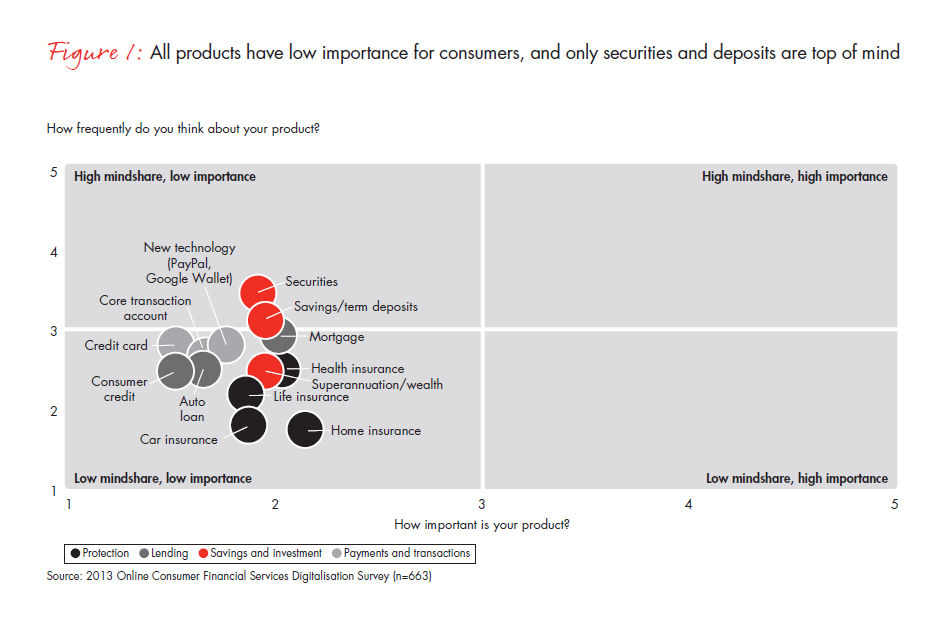
Perceived importance and mindshare are low. It’s a steeper uphill battle for customers’ attention than many financial institutions believe —particularly for certain lending, payment, and protection products. Indeed, consumers and SMEs didn’t rate any financial products as having either high importance or high mindshare, even those with which they frequently interact.
Auto loans, consumer credit, core transaction accounts, and credit cards have the lowest importance for consumers, as well as low mindshare. Life, car, and home insurance are each somewhat more important but have the lowest mindshare. Securities, savings and term deposits, and mortgages have the highest mindshare (see Figure 1).
Digital channels aren’t yet the first choice for many customers. Although it’s still early days, only about half of customers use digital channels as the primary means of interacting with their financial-services providers. This falls to approximately 40% for the early stages of the product relationship— exploring and researching offers, getting advice, and opening an account or buying a product. And even in the two late stages—managing and transacting—only about two-thirds of customers use digital as the primary channel.
The age disparity is particularly pronounced in the early stages. Approximately 55% of younger consumers use digital as the primary channel early on, but only about 30% of older consumers do.
Customers want an ‘omnichannel’ relationship. Customers appear to want a range of human and digital interactions available to them. Fifty percent of consumers in all age-groups use both digital and nondigital channels in each stage of the product relationship (see Figure 2).
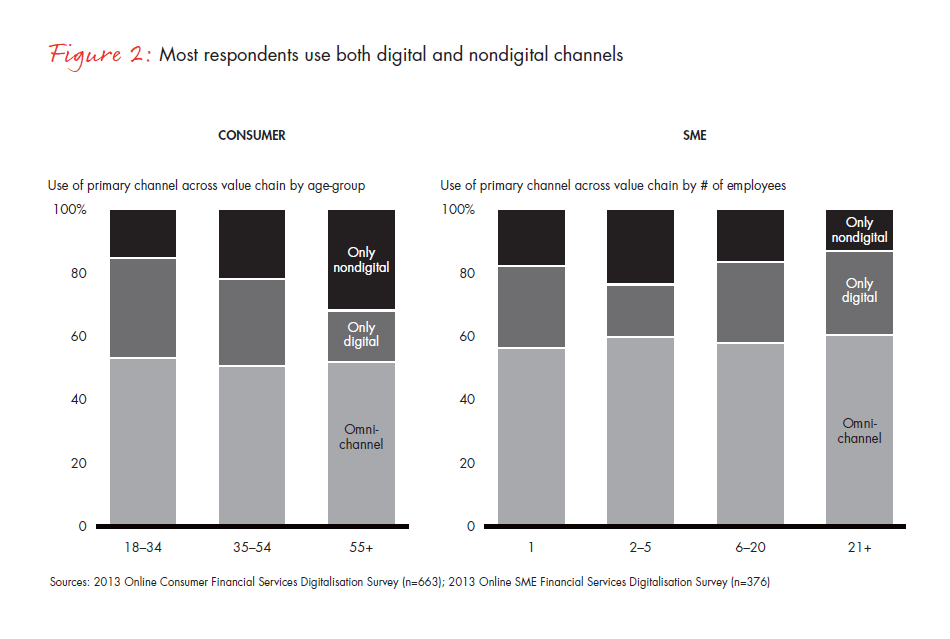
Only about 30% of 18- to 34-year-olds and just 16% of those 55 or older use digital as their sole primary channel. SMEs are even more likely to pursue omnichannel interactions—they conduct 60% of primary interactions and more than 80% of all interactions using both digital and nondigital channels.
Customers still haven’t become advocates. Despite providers’ significant digital investments, they have not sufficiently improved the customer experience to earn higher advocacy. Across almost every product type, our survey found that the Net Promoter ScoreSM (NPS®) is negative for both consumers and smaller SMEs (20 employees or fewer). The only group of advocates is larger SMEs, perhaps indicating that they receive better service.
Providers’ inability to turn their customers into advocates has prevented them from capturing a valuable prize. Another Bain survey, assessing more than 9,000 Australian consumers and covering financial services and 18 other industries, found that the average NPS for the largest eight financial institutions in Australia was –10%. With few promoters, these busi-nesses are leaving money on the table; our research finds that the lifetime value of promoters for financial institutions is, on average, more than 2.2 times greater than that of detractors.
Capturing the opportunities
Financial institutions can consider five corresponding actions to close the preference gap and capture the opportunities:
Sell the benefits of doing more with your institution. Beyond offering discounts for product bundles (which have worked well in personal lines insurance), providers need to clearly communicate to customers how consolidating financial services products can help them, such as through a common online interface and preferential service. The consolidated view of a customer’s holdings enabled by digitalisation can be a strong selling point. It’s also cost effective to offer product ‘packages’ at a particular acquisition point. For example, a customer taking out a mortgage can be offered a transaction account, a credit card, and insurance.
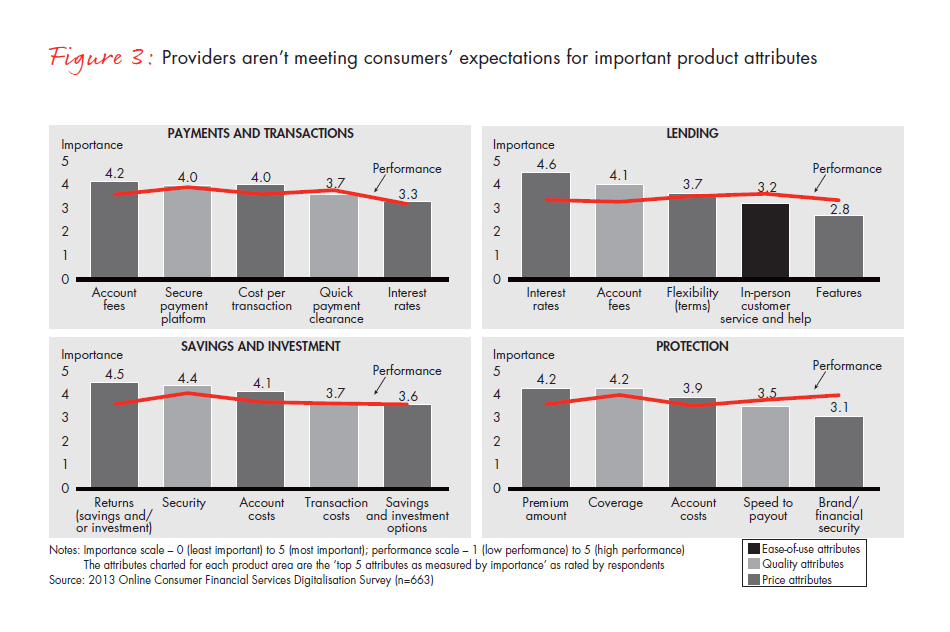
Tailor products and marketing to preferences and transitions. To strengthen customer relationships, providers must focus on fully understanding their customer base. This means conducting preference profiling and segmentation, and tailoring go-to-market strategies accordingly. It is especially critical to design products that emphasise the attributes most important to customers. For example, our survey found that consumers consider returns, security, and account costs to be the most important attributes for savings and investment products (see Figure 3).
Providers should also seek to track customers along their personal or business journey and support them with major product offerings to take advantage of mindshare when it spikes at each milestone. An often-overlooked opportunity for institutions offering wealth management products is to target customers as they pay down their mortgage. At this transition point, customers become significantly more interested in wealth management products and are more likely to seek advice. Success will require financial institutions to focus on customers’ future profitability as well as the present size of their holdings.
Get customers comfortable with digital. Financial institutions need to move beyond ‘build it and they will come’ as their philosophy for digital investments. They must complement their significant investments in technology with investments in changing their customers’ behaviour and training their staff to help them do so.
Investments in people, training, and education are often the first to be cut in the face of profit targets, but the related capabilities are more critical than ever to promote faster adoption of digital channels. For example, providers need capabilities to offer hands-on education to customers regarding the ease, convenience, and lower costs of digital usage.
Embrace an omnichannel future. A successful omnichannel experience entails consistency of the brand and the same levels of service online as for other channels. This means having seamless transition points between channels and absolute consistency of information. Providers may lose customers if they experience poor service online or through other elec-tronic channels, such as next-generation ATMs.
While costs must shift away from traditional face-to-face distribution, this channel is still critical and must deliver services jointly with the digital channel. As customers migrate online, particularly for simpler interactions, personal interactions can refocus on sales, advice, and needs assessments. Traditional branches, for example, can evolve to smaller formats oriented toward sales and digital service, but in a similar number of locations.
Build advocacy through loyalty-based pricing and service. Financial providers should look for opportunities to use preferential pricing to build loyalty throughout the customer life cycle. Although they use low prices to attract new customers, they often underutilise preferential pricing as a means to deepen their relationships with existing customers. The objective should be to price for loyalty, not promiscuity.
Financial institutions should also ensure that all personal interactions focus on individual needs, particularly for high-value customers. Beyond building advocacy, the needs-based service will capture a higher share of wallet and therefore increase the customer’s lifetime value.
Each of these five opportunities reflects the need for financial providers to apply a customer-centric focus in defining their digital strategies to deepen relationships and get more business. For many organisations, this will require a new mind-set that places customers’ needs as the starting point for deciding how and where to invest in digital channels and how to change behaviours.
Peter Stumbles is a Sydney-based partner and leader of Bain & Company’s Financial Services practice in Australia. Gary Turner is a Sydney-based partner and leader of Bain & Company’s Asia-Pacific Financial Services practice.
Net Promoter® and NPS® are registered trademarks of Bain & Company, Satmetrix Systems, and Fred Reichheld. Net Promoter SystemSM and Net Promoter ScoreSM are trademarks of Bain & Company, Inc., Fred Reichheld and Satmetrix Systems, Inc.
First published in 9월 2013