
Skip to Content
  • 오피스

    오피스

    미주
    • Atlanta
    • Austin
    • Bogota
    • Boston
    • Buenos Aires
    • Chicago
    • Dallas
    • Denver
    • Houston
    • Los Angeles
    • Mexico City
    • Minneapolis
    • Monterrey
    • Montreal
    • New York
    • Rio de Janeiro
    • San Francisco
    • Santiago
    • São Paulo
    • Seattle
    • Silicon Valley
    • Toronto
    • Washington, DC
    유럽, 중동, 아프리카
    • Amsterdam
    • Athens
    • Berlin
    • Brussels
    • Copenhagen
    • Doha
    • Dubai
    • Dusseldorf
    • Frankfurt
    • Helsinki
    • Istanbul
    • Johannesburg
    • Kyiv
    • Lisbon
    • London
    • Madrid
    • Milan
    • Munich
    • Oslo
    • Paris
    • Riyadh
    • Rome
    • Stockholm
    • Vienna
    • Warsaw
    • Zurich
    아시아, 호주
    • Bangkok
    • Beijing
    • Bengaluru
    • Brisbane
    • Ho Chi Minh City
    • Hong Kong
    • Jakarta
    • Kuala Lumpur
    • Manila
    • Melbourne
    • Mumbai
    • New Delhi
    • Perth
    • Seoul
    • Shanghai
    • Singapore
    • Sydney
    • Tokyo
    오피스 전체보기
  • 얼럼나이
  • 미디어 센터
  • 구독
  • 연락처
  • Korea | 한국어

    지역 및 언어 선택

    글로벌
    • Global (English)
    미주
    • Brazil (Português)
    • Argentina (Español)
    • Canada (Français)
    • Chile (Español)
    • Colombia (Español)
    유럽, 중동, 아프리카
    • France (Français)
    • DACH Region (Deutsch)
    • Italy (Italiano)
    • Spain (Español)
    • Greece (Elliniká)
    아시아, 호주
    • China (中文版)
    • Korea (한국어)
    • Japan (日本語)
  • Saved items (0)
    Saved items (0)

    You have no saved items.

    관심 있는 내용을 북마크하여 Red 폴더에 저장할 수 있습니다. Red 폴더 에서 저장된 내용을 읽거나 공유해보세요.

    Explore Bain Insights
  • 산업
    메인 메뉴

    산업

    • 우주항공, 방산 및 정부 서비스
    • 농업 관련 산업
    • 화학
    • 인프라, 건설 및 건축 자재
    • 소비재
    • 금융 서비스
    • 헬스케어
    • 산업용 기계 및 장비
    • 미디어 및 엔터테인먼트
    • 금속
    • 광업
    • 석유 및 가스
    • 제지 및 패키징 산업
    • 사모펀드
    • 사회 및 공공 부문
    • 유통
    • 기술
    • 텔레콤
    • 운송
    • 여행·여가
    • 유틸리티 및 재생가능 에너지
  • 컨설팅 서비스
    메인 메뉴

    컨설팅 서비스

    • Customer Experience
    • ESG
    • Innovation
    • M&A
    • 운영
    • 조직
    • 사모펀드
    • 고객 전략 및 마케팅
    • 전략
    • AI, 인사이트 및 솔루션
    • Technology
    • 변화 혁신
  • Digital
  • 인사이트
  • 베인 소개
    메인 메뉴

    베인 소개

    • 업무 소개
    • 베인의 신념
    • 구성원 및 리더십 소개
    • 고객 성과
    • 주요 수상 경력
    • 글로벌 파트너사
    Further: Our global responsibility
    • 다양성과 포용
    • 사회 공헌 활동
    • Sustainability
    • World Economic Forum
    Learn more about Further
  • Careers
    메인 메뉴

    Careers

    • Work with Us
      Careers
      Work with Us
      • Find Your Place
      • Our Work Areas
      • Integrated Teams
      • Students
      • Internships & Programs
      • Recruiting Events
    • Life at Bain
      Careers
      Life at Bain
      • Blog: Inside Bain
      • Career Stories
      • Our People
      • Where We Work
      • Supporting Your Growth
      • Affinity Groups
      • Benefits
    • Impact Stories
    • Hiring Process
      Careers
      Hiring Process
      • What to Expect
      • Interviewing
    FIND JOBS
  • 오피스
    메인 메뉴

    오피스

    • 미주
      오피스
      미주
      • Atlanta
      • Austin
      • Bogota
      • Boston
      • Buenos Aires
      • Chicago
      • Dallas
      • Denver
      • Houston
      • Los Angeles
      • Mexico City
      • Minneapolis
      • Monterrey
      • Montreal
      • New York
      • Rio de Janeiro
      • San Francisco
      • Santiago
      • São Paulo
      • Seattle
      • Silicon Valley
      • Toronto
      • Washington, DC
    • 유럽, 중동, 아프리카
      오피스
      유럽, 중동, 아프리카
      • Amsterdam
      • Athens
      • Berlin
      • Brussels
      • Copenhagen
      • Doha
      • Dubai
      • Dusseldorf
      • Frankfurt
      • Helsinki
      • Istanbul
      • Johannesburg
      • Kyiv
      • Lisbon
      • London
      • Madrid
      • Milan
      • Munich
      • Oslo
      • Paris
      • Riyadh
      • Rome
      • Stockholm
      • Vienna
      • Warsaw
      • Zurich
    • 아시아, 호주
      오피스
      아시아, 호주
      • Bangkok
      • Beijing
      • Bengaluru
      • Brisbane
      • Ho Chi Minh City
      • Hong Kong
      • Jakarta
      • Kuala Lumpur
      • Manila
      • Melbourne
      • Mumbai
      • New Delhi
      • Perth
      • Seoul
      • Shanghai
      • Singapore
      • Sydney
      • Tokyo
    오피스 전체보기
  • 얼럼나이
  • 미디어 센터
  • 구독
  • 연락처
  • Korea | 한국어
    메인 메뉴

    지역 및 언어 선택

    • 글로벌
      지역 및 언어 선택
      글로벌
      • Global (English)
    • 미주
      지역 및 언어 선택
      미주
      • Brazil (Português)
      • Argentina (Español)
      • Canada (Français)
      • Chile (Español)
      • Colombia (Español)
    • 유럽, 중동, 아프리카
      지역 및 언어 선택
      유럽, 중동, 아프리카
      • France (Français)
      • DACH Region (Deutsch)
      • Italy (Italiano)
      • Spain (Español)
      • Greece (Elliniká)
    • 아시아, 호주
      지역 및 언어 선택
      아시아, 호주
      • China (中文版)
      • Korea (한국어)
      • Japan (日本語)
  • Saved items  (0)
    메인 메뉴
    Saved items (0)

    You have no saved items.

    관심 있는 내용을 북마크하여 Red 폴더에 저장할 수 있습니다. Red 폴더 에서 저장된 내용을 읽거나 공유해보세요.

    Explore Bain Insights
  • 산업
    • 산업

      • 우주항공, 방산 및 정부 서비스
      • 농업 관련 산업
      • 화학
      • 인프라, 건설 및 건축 자재
      • 소비재
      • 금융 서비스
      • 헬스케어
      • 산업용 기계 및 장비
      • 미디어 및 엔터테인먼트
      • 금속
      • 광업
      • 석유 및 가스
      • 제지 및 패키징 산업
      • 사모펀드
      • 사회 및 공공 부문
      • 유통
      • 기술
      • 텔레콤
      • 운송
      • 여행·여가
      • 유틸리티 및 재생가능 에너지
  • 컨설팅 서비스
    • 컨설팅 서비스

      • Customer Experience
      • ESG
      • Innovation
      • M&A
      • 운영
      • 조직
      • 사모펀드
      • 고객 전략 및 마케팅
      • 전략
      • AI, 인사이트 및 솔루션
      • Technology
      • 변화 혁신
  • Digital
  • 인사이트
  • 베인 소개
    • 베인 소개

      • 업무 소개
      • 베인의 신념
      • 구성원 및 리더십 소개
      • 고객 성과
      • 주요 수상 경력
      • 글로벌 파트너사
      Further: Our global responsibility
      • 다양성과 포용
      • 사회 공헌 활동
      • Sustainability
      • World Economic Forum
      Learn more about Further
  • Careers
    최근 검색어
      최근 방문 페이지

      Content added to saved items

      Saved items (0)

      Removed from saved items

      Saved items (0)

      Brief

      Rethinking M&A Valuation Assumptions

      Rethinking M&A Valuation Assumptions

      Why the assumptions behind many M&A models may be too onerous.

      글 Michael Robbins and Hubert Shen

      • 읽기 소요시간
      }

      Brief

      Rethinking M&A Valuation Assumptions
      en

      Global mergers and acquisitions are on pace to reach a record high this year. Yet we continue to hear from many chief financial officers (CFOs), treasurers and other executives assessing M&A opportunities that they just can’t make deals pencil out.

      For every buyer, it seems, another dozen potential buyers have been walking away because their M&A models show that they will not earn adequate returns. They might have strong balance sheets, abundant dry powder and prospective targets that could add strategic value and growth, but many still choose to sit on the sidelines, in the interest of being prudent with their shareholders’ capital. And recent volatility in financial markets could make potential buyers even more hesitant.

      These reasons have led companies into a no-growth trap: Cautious companies wind up holding on to their cash, returning it to shareholders through dividends and share buybacks, or trying to boost profit margins through cost reductions. What should CFOs who are discarding potential deals and investments in their own business do with the mounting cash on their balance sheets? Should they simply wait for better valuations and, in the meantime, continue returning capital to shareholders?

      We suggest an alternative: Reassess internal hurdle rates to make sure they accurately capture current capital markets conditions. This reassessment could help expand and clarify the universe of attractive investment opportunities, whether they be M&A or organic.

      Two factors generally account for higher-than-necessary hurdle rates: the reluctance of companies to lower internal hurdle rates to the same extent as declines in their weighted average cost of capital (WACC), and the acquisition premiums placed on potential deals.

      Michael Robbins, a partner in the Corporate Finance practice, discusses what companies can do to avoid falling into a no-growth trap when M&A deals fall through.

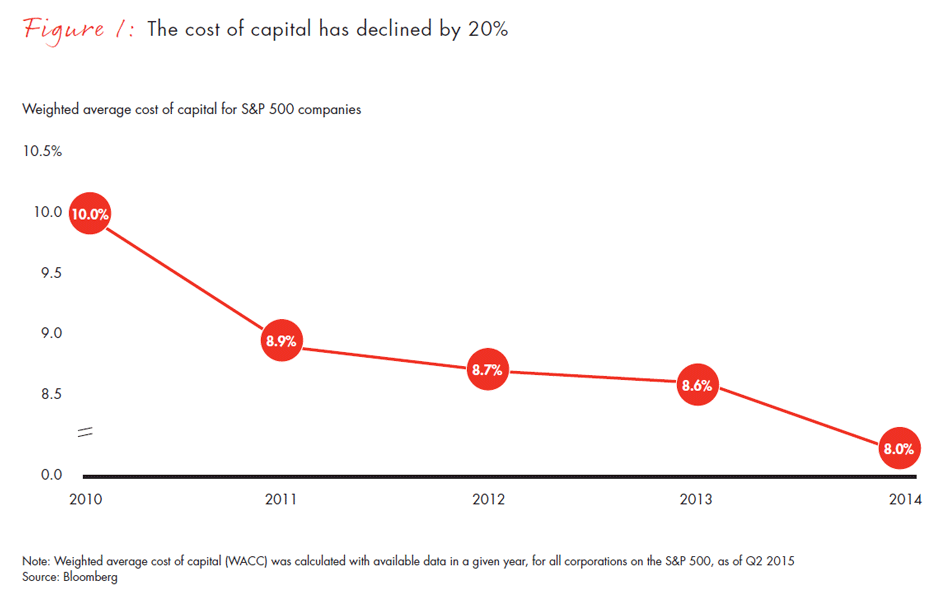
      Our analysis suggests that the WACC of the S&P 500 companies has steadily decreased and is, on average, 20% less than just a few years ago (see Figure 1). Many CFOs, however, have not lowered their internal investment hurdle rates as quickly or as far. Believing that interest rates must rise again soon, they have adopted a more conservative approach, lowering hurdle rates less than what the declining WACC would suggest.

      In addition, the risk premium they give to acquisitions (typically 200 to 300 basis points) and their general conservatism regarding WACC (typically 50 to 100 basis points) has not changed, further building in conservatism on a lower base.

      rethinking-ma-valuation-fig01_embed

      Why interest rates likely will remain low

      What corporate stewards of capital do from here depends in large part on the source of their concerns. If deals are not penciling out because potential buyers cannot get comfortable with the growth projections sellers have embedded into the price, then that may be a reasonable constraint. On the other hand, if the conservatism stems from worry that long-term interest rates will soon rise, that’s another matter.

      There is enough evidence to believe that long-term interest rates will remain low for a while, even after the US Federal Reserve begins the process of normalizing monetary policy. For one thing, the capital superabundance we first wrote about in 2012 continues to prevail, with $600 trillion in global financial assets available for investment. The law of supply and demand means that the cost of capital will likely remain low. (For more about capital superabundance, see Bain’s report, A World Awash in Money: Capital Trends through 2020.)

      Weakness in major economies, such as the eurozone, Japan and China, and in smaller markets, like Canada and Australia, has caused aggressive monetary easing in these countries, based on the pattern set by the Fed. It will be difficult for US interest rates to move sharply higher when overseas rates are being suppressed.

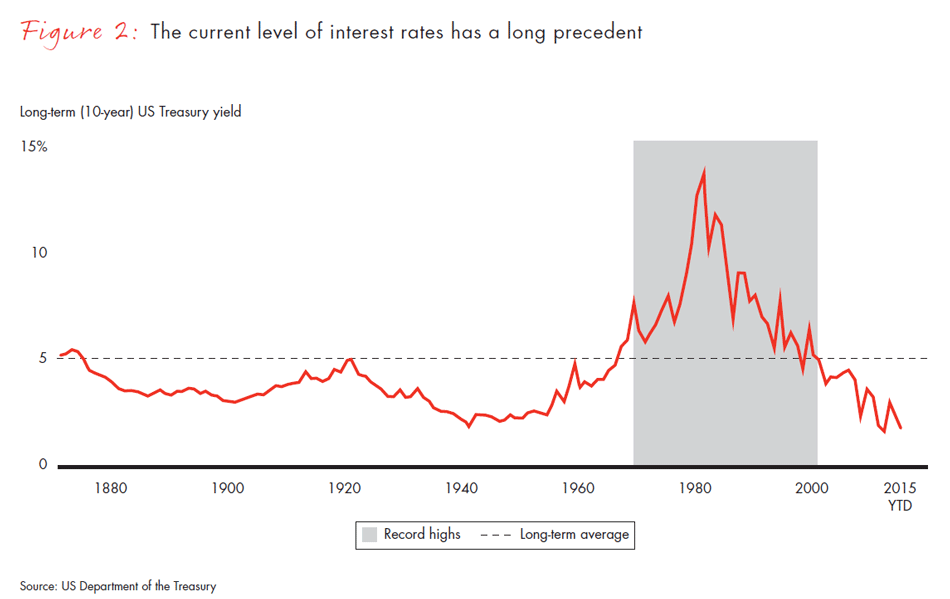
      Moreover, the strengthening of the US dollar serves as both signal and carrier of rising capital flows to the US. As international investors buy longer-term government and corporate bonds, interest rates generally will be suppressed. It’s also worth noting that the current level of rates is close to the long-term average over the past two centuries (see Figure 2).

      rethinking-ma-valuation-fig02_embed

      A prolonged period of capital surplus likely will be characterized by persistent low interest rates and thin real rates of return. The implication for CFOs, treasurers and others hunting for acceptable deals: Reevaluate and adjust internal investment hurdle rates and portfolio investment return targets accordingly. Without these adjustments, executives may end up parking capital on the sidelines indefinitely while waiting for higher-return opportunities that will not materialize.

      To be sure, by recent historical measures, valuation multiples in today’s environment still seem rich. Yet investors cannot invest in opportunities of the past, and very few can accurately time the valuation cycles of assets in the market. They must make capital allocation decisions and trade-offs against the only options presently available. And at present, interest rates have reached generational lows, partly because investors have found no better risk-reward trade-offs.

      Rethinking the assumptions that underlie a deal model is a big step. CFOs and other executives should examine several questions to determine whether to take that step and how much to reset the model (see the sidebar, “Fundamental questions for CFOs”).

      Fundamental questions for CFOs

      1. Do you separate the predictability of cash flows from the actual cost-of-capital requirements? This may require you to double down on due diligence efforts and invest more in scenario planning than in probability weighting and setting conservative hurdle rates, which serve to penalize the investment valuation twice.
      2. Have you updated cost-of-capital benchmarks to reflect most of the recent requirements for returns across different asset classes? Shareholders’ requirements for returns change over time and are influenced by the universe of alternatives available to them. In today’s capital markets, expectations for returns across asset classes have been tempered.
      3. Do you give yourself credit for having experience in making similar investments in the past? Do you evaluate the assigned risk premiums, given the lower cost of capital today? Our research suggests that serial acquirers are better at underwriting realistic assumptions and executing on deals. Your embedded acquisition premium may not need to be what it once was.
      4. Have you reevaluated the right target capital structure? Given current interest rates, it’s possible that your capital structure could be more productive at a different level, potentially lowering your WACC.

      Given current interest rates, it’s possible that your capital structure could be more productive at a different level, potentially lowering your WACC.

      Executives who still worry about timing this market at high valuations could consider a series of smaller investments or acquisitions over time, rather than one big acquisition that may be more susceptible to timing risk. Bain’s analysis shows that frequency and materiality both matter: Building M&A capabilities with a series of smaller acquisitions often leads to better returns over time. In addition, a company is more likely to perform better when more of its market capitalization comes from its acquisitions.

      More broadly, the most successful acquirers think long term about their portfolio of assets. They understand that strategic investments that complement their company’s core business can unlock more value than deals that simply pencil out in the near term. For CFOs finding deals that are attractive but too expensive, a reevaluation just might lead to a different conclusion.

      Michael Robbins, a Washington, DC-based partner with Bain & Company, is a leader of the firm’s Corporate Finance practice in the Americas. Hubert Shen is a principal with the practice and is based in Los Angeles.


      rethinking-ma-valuation-fig01_full

      rethinking-ma-valuation-fig02_full
      저자
      • Headshot of Michael Robbins
        Michael Robbins
        파트너, Washington, DC
      • Headshot of Hubert Shen
        Hubert Shen
        파트너, Los Angeles
      문의하기
      관련 컨설팅 서비스
      • M&A
      최적의 솔루션 찾기
      • Corporate Finance
      M&A
      Agitators and Reformers: How to Respond to Activist Investors

      Someday soon, an activist investor is likely to show up on your corporate doorstep.

      자세히 보기
      헬스케어
      Mega-Mergers in Health Insurance: 10 Steps to Successful Integration

      Tailor integration to identify value, keep the right people and focus on critical decisions.

      자세히 보기
      Corporate Finance
      Looking Ahead to 2026: Getting a Boost from the Great Rebound

      Why more companies will move from awareness to action.

      자세히 보기
      M&A
      What Agency Consolidation Means for CMOs

      As agency holding companies get bigger and deeper, CMOs must rethink ownership, integration, and how to stay in control.

      자세히 보기
      Corporate Finance
      M&A Capability for a New Era: Five Ways AI Is Creating More Value in M&A Right Now

      What companies are learning as they use AI across more of the M&A process.

      자세히 보기
      First published in 10월 2015
      태그
      • Corporate Finance
      • M&A

      프로젝트 사례

      M&A Helping a Healthcare Company Unlock Maximum Value

      See more related case studies

      M&A Finance transformation: For one company, second time’s the charm

      See more related case studies

      고객 전략 및 마케팅 Salesforce integration generates M&A success in healthcare

      See more related case studies

      베인에 궁금하신 점이 있으신가요?

      베인은 주저 없이 변화를 마주할 줄 아는 용감한 리더들과 함께합니다. 그리고, 이들의 담대한 용기는 고객사의 성공으로 이어집니다.

      급변하는 비즈니스 환경에서 살아남기 위한 선도자의 시각. 월간 Bain Insights에서 글로벌 비즈니스의 핵심 이슈를 확인하십시오.

      *개인정보 정책을 읽었으며 그 내용에 동의합니다.

      Privacy Policy를 읽고 동의해주십시오.
      Bain & Company
      문의하기 환경정책 Accessibility 이용약관 개인정보 보호 쿠키 사용 정책 Sitemap Log In

      © 1996-2026 Bain & Company, Inc.

      문의하기

      무엇을 도와드릴까요?

      • 프로젝트 문의
      • 채용 정보
      • 언론
      • 제휴 문의
      • 연사 초청
      오피스 전체보기