

Brief

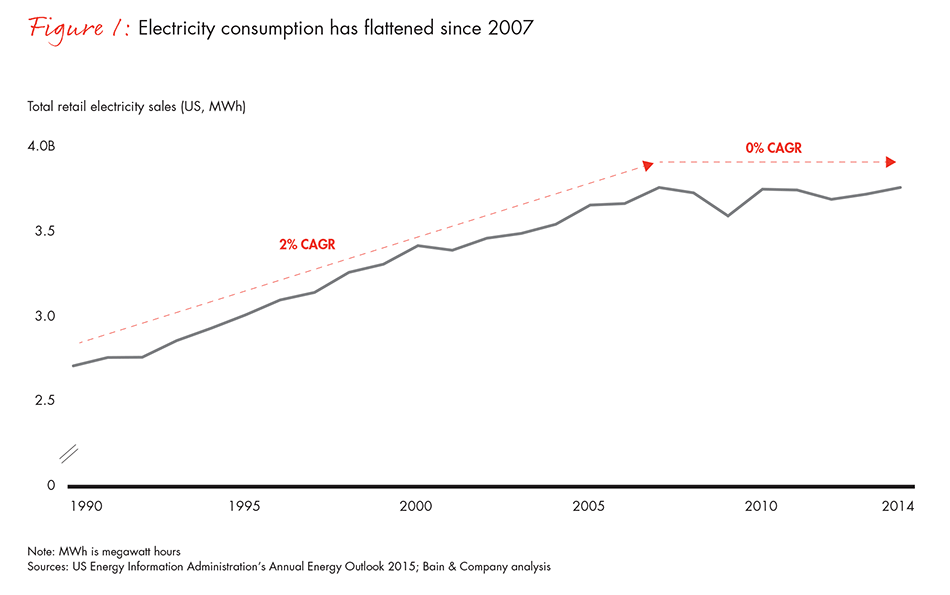
Utilities have been reliable performers for investors looking for long-term, stable growth, and this steady flow of investment funds has allowed utilities to build and upgrade their power generation and their transmission and distribution infrastructure. However, utilities face an unprecedented challenge as electricity consumption flattens out due to a combination of factors, including rising energy efficiency, distributed generation and a post-recession shift to less energy-intensive industries (see Figure 1). Without the benefit of demand growth, executives looking at this flat curve must now find other ways to deliver on the earnings growth targets that shareholders expect. Their thoughts, naturally, turn to scale.
Mergers and acquisitions are one of the most visible ways to gain benefits from scale, whether from merging across borders, acquiring gas local distribution companies (LDCs) or increasing the size of a power generation portfolio. Utilities, however, are uniquely challenged in this aspect because of regulatory constraints that eat up potential efficiency gains; for example, by requiring the newly merged company to maintain multiple administrative centers (one in each region) or requiring any savings to be reflected in rate reductions. Such constraints are in addition to the difficulties of gaining merger approval from the regulators of acquisition targets. So the value of inorganic growth pales compared to other industries.
In utilities, the real benefit of scale doesn’t come from short-term, deal-driven, back-office synergies. Rather, it comes from developing a scale platform and tapping a broad range of benefits, including not only traditional cost benefits but also a wider application of repeatable processes and more effective use of capital (see Figure 2).
Benefits of a scale platform
Scale creates different kinds of value, and companies should adopt different business models and practices to capitalize on the kinds of scale advantages that they are pursuing.
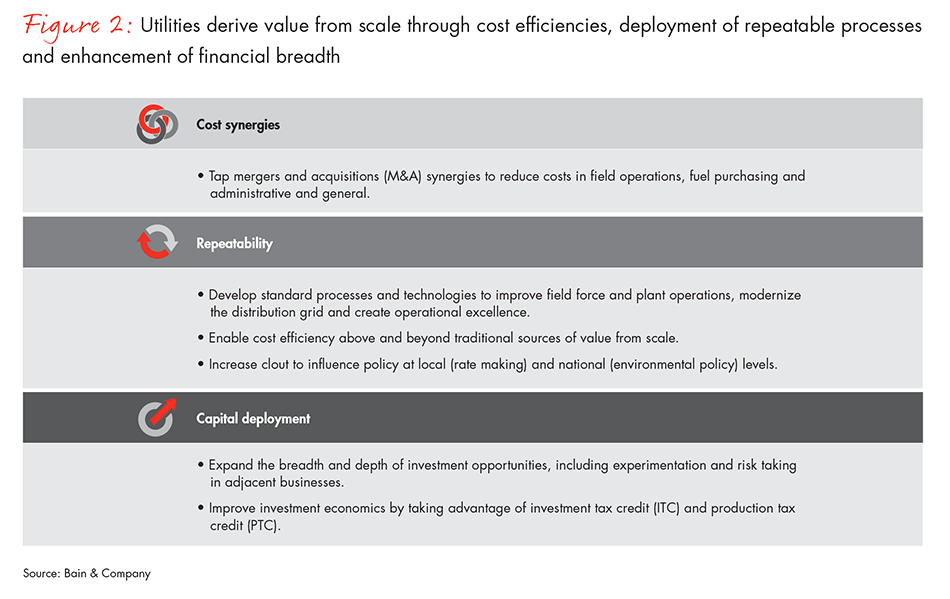
Traditional cost benefits. The regulatory constraints on utilities can make it difficult to realize some of the traditional cost benefits of scale. Acquisitions in neighboring regions offer some opportunities, but utilities may struggle to merge field operations when territories are not adjacent. Frequently, utilities cannot merge field operations because the territories are not near each other. Merging utilities can expect to take a good chunk out of administrative costs, but since such costs also make up a relatively small proportion of company expenses, the overall impact might be minimal. Often, merged utilities cannot even reap the savings of combining back-office operations because regulatory bodies typically want a commitment that the merged utility will keep a presence in each territory before they agree to a deal. Though difficult to quantify, a more significant gain from M&A is a greater influence in shaping regulatory policy, which helps unlock value from rate constructs and national policies. Even more opportunity, however, comes from two other aspects of scale.
Repeatability. Repeatability helps scale players reduce complexity and costs, and thus can help keep the growth of customers’ bills lower than inflation. Companies that have developed a competitive advantage through their repeatable models can then extend these models when they acquire other companies, vastly increasing the scale benefits. Opportunities for repeatable models include investment decisions and deployment practices for new technologies (such as advanced metering infrastructure or distributed management systems) and standardization of the processes that field forces use. Repeatability across a sustained cost-transformation program or deployment of digital capabilities can also create significant value. For example, wholesale energy supplier NextEra has built one of the largest renewable portfolios in the US with repeatable practices for identifying attractive niches (such as those with existing transmission capacity) and scale benefits in buying equipment like turbine blades. These models help NextEra identify good deals and attractive power purchase agreements.
Capital deployment. Scale allows larger companies to assume greater risks—risks that would be “bet the company” moves for smaller firms, which would need to devote a greater percentage of their operating cash flow to the integration. For example, Duke Energy, Southern Company and Dominion have all made adjacent moves into gas distribution that carry an acceptable level of risk for each of these very large, vertically integrated utilities but would be much more difficult for smaller competitors to take on. Similarly, other utilities have built out adjacencies that extend the scale and strength of the core business, including Sempra in liquid natural gas (LNG), NextEra in large-scale renewables and Dominion in midstream gas infrastructure.
Scale also enables better use of tax incentives. For example, the extension of both the production tax credit (PTC) and investment tax credit (ITC) in late 2015 has created significant value for companies that can develop large-scale solar and wind generation. However, companies with smaller tax burdens might not be able to take full advantage of these incentives. Large companies with a significant tax burden are better able to capture that value. For example, Berkshire Hathaway Energy has built a significant, unregulated large-scale renewable portfolio based on its ability to benefit from related tax incentives.

For Utilities, Scale Matters
As electricity demand plateaus, utilities seek scale to key growth but face unique challenges.
Developing a scale platform and successfully executing at scale is a labor- and capital-intensive process that has a greater chance for success when a company is already operating near full potential in its core business. Before pursuing greater scale, executives should first tend to any easier and less expensive ways to unlock value in the organization. Is the company taking advantage of all available efficiencies in its current organization? Is the core business operating at full potential? Could the company take advantage of investment opportunities within its current grid or power plant portfolio, without the need for acquisitions?
Executives also need to be sure that their scale ambitions can withstand a range of potential scenarios. In the early 2000s, the EU’s utility sector experienced consolidation along the same lines as we see in North America today. This trend resulted in several very large, cross-border utilities that were successfully outperforming their mid-tier rivals—until the EU’s regulatory landscape shifted dramatically to encourage and reward investment in renewable sources such as wind and solar. Scale did not protect these large EU utilities from the influx of capital into smaller, agile, distributed energy start-ups.
Only after the core business is on track to deliver peak value should the focus be on how to build scale, including M&A planning, to create more value for customers, shareholders and employees.
Jim Wininger, a partner in the Utilities practice, discusses how utilities can maximize the benefits that come with scale.
Implications for the utility industry
This broader, comprehensive look at the value of scale has important implications for each of the key players in the utility sector.
Vertically integrated electric utilities. Consolidation in the sector has reduced the number of vertically integrated utilities in North America. Further consolidation could create more scale benefits, particularly in terms of repeatability, which creates standardization and cost efficiencies across the value chain while expanding investment opportunities in gas infrastructure and large-scale renewables. Executives at vertically integrated utilities can prepare by ensuring that they are developing repeatable processes within their organizations, laying the groundwork to extend those processes to any future acquisitions.
Mid-tier electric utilities. Lack of scale might limit midtier electric utilities’ ability to unlock the full set of benefits, restricting their growth opportunities. Over the long term, mid-tier players might find it challenging to compete effectively without gaining scale, as happened in the EU during its consolidation wave a decade ago. At that time, a large gulf opened between the biggest players, who outperformed mid-tier players significantly until shifts in the regulatory and tax structure reshuffled the landscape in favor of renewables and more nimble players. Executives in these mid-tier companies should determine whether they will act as a consolidator, a bystander or a target for consolidation. Consolidators should continue to build value from their core operations while exploring M&A with nearby utilities of similar size and creating partnerships and joint ventures with larger utilities.
Electric distribution companies (EDCs). From New York to Texas to California, the demands to modernize the grid and incorporate more distributed energy resources are intensifying. However, without standardization across distribution networks, costs and complexity are also likely to increase. EDCs should explore a two-pronged approach. First, a roll-up of EDCs along common geographic corridors (as seen with Utility Service New England) could create significant scale advantages that unlock value for customers and shareholders. Second, EDCs should work closely with regulators and ESCOs to explore alternative customer models that might be more effective for companies and their customers.
Energy service companies (ESCOs). Although larger ESCOs (including Direct Energy and Constellation) have formed over the past decade, the market remains highly fragmented, with smaller ESCOs and many retail customers—representing more than 40% of sales measured in MWh—still residing with incumbent EDCs. Larger ESCOs can operate more efficiently so it’s in their best interests to continue to consolidate, which can also reduce costs for their customers.
Gas LDCs. Unlike electric utilities, the gas distribution industry has not consolidated and remains mostly fragmented. However, given lower gas prices, increasing infrastructure needs and greater demands for pipeline integrity, this trend is unlikely to persist. Electric utilities might continue to acquire gas LDCs, as in the deals referenced earlier. In addition, more regional or national gas LDCs might emerge as they build scale to unlock value from repeatability and to meet the coming wave of regulatory standards.
For executives across the utility ecosystem, building a scale platform will become increasingly important as they try to deliver against shareholder expectations, even as the underlying economics of the industry shift. The sector is likely to experience further consolidation—and executives will need to make sure that their skills in deal making and post-merger integration are up to the task. Equally important will be their ability to create benefits from their scale platform, far beyond the simple cost efficiencies that drive M&A in most other industries. They will need clarity about how they intend to generate value from scale, and they will then need to build the internal capabilities necessary to support the scale platform.
Aaron Denman is a principal with Bain & Company in Chicago. Jim Wininger is a partner in Bain’s Atlanta office, and Jason Glickman is a Bain partner in San Francisco. All three work with Bain’s Global Utilities practice.
First published in 5월 2016