
Skip to Content
  • 오피스

    오피스

    미주
    • Atlanta
    • Austin
    • Bogota
    • Boston
    • Buenos Aires
    • Chicago
    • Dallas
    • Denver
    • Houston
    • Los Angeles
    • Mexico City
    • Minneapolis
    • Monterrey
    • Montreal
    • New York
    • Rio de Janeiro
    • San Francisco
    • Santiago
    • São Paulo
    • Seattle
    • Silicon Valley
    • Toronto
    • Washington, DC
    유럽, 중동, 아프리카
    • Amsterdam
    • Athens
    • Berlin
    • Brussels
    • Copenhagen
    • Doha
    • Dubai
    • Dusseldorf
    • Frankfurt
    • Helsinki
    • Istanbul
    • Johannesburg
    • Kyiv
    • Lisbon
    • London
    • Madrid
    • Milan
    • Munich
    • Oslo
    • Paris
    • Riyadh
    • Rome
    • Stockholm
    • Vienna
    • Warsaw
    • Zurich
    아시아, 호주
    • Bangkok
    • Beijing
    • Bengaluru
    • Brisbane
    • Ho Chi Minh City
    • Hong Kong
    • Jakarta
    • Kuala Lumpur
    • Manila
    • Melbourne
    • Mumbai
    • New Delhi
    • Perth
    • Seoul
    • Shanghai
    • Singapore
    • Sydney
    • Tokyo
    오피스 전체보기
  • 얼럼나이
  • 미디어 센터
  • 구독
  • 연락처
  • Korea | 한국어

    지역 및 언어 선택

    글로벌
    • Global (English)
    미주
    • Brazil (Português)
    • Argentina (Español)
    • Canada (Français)
    • Chile (Español)
    • Colombia (Español)
    유럽, 중동, 아프리카
    • France (Français)
    • DACH Region (Deutsch)
    • Italy (Italiano)
    • Spain (Español)
    • Greece (Elliniká)
    아시아, 호주
    • China (中文版)
    • Korea (한국어)
    • Japan (日本語)
  • Saved items (0)
    Saved items (0)

    You have no saved items.

    관심 있는 내용을 북마크하여 Red 폴더에 저장할 수 있습니다. Red 폴더 에서 저장된 내용을 읽거나 공유해보세요.

    Explore Bain Insights
  • 산업
    메인 메뉴

    산업

    • 우주항공, 방산 및 정부 서비스
    • 농업 관련 산업
    • 화학
    • 인프라, 건설 및 건축 자재
    • 소비재
    • 금융 서비스
    • 헬스케어
    • 산업용 기계 및 장비
    • 미디어 및 엔터테인먼트
    • 금속
    • 광업
    • 석유 및 가스
    • 제지 및 패키징 산업
    • 사모펀드
    • 사회 및 공공 부문
    • 유통
    • 기술
    • 텔레콤
    • 운송
    • 여행·여가
    • 유틸리티 및 재생가능 에너지
  • 컨설팅 서비스
    메인 메뉴

    컨설팅 서비스

    • Customer Experience
    • ESG
    • Innovation
    • M&A
    • 운영
    • 조직
    • 사모펀드
    • 고객 전략 및 마케팅
    • 전략
    • AI, 인사이트 및 솔루션
    • Technology
    • 변화 혁신
  • Digital
  • 인사이트
  • 베인 소개
    메인 메뉴

    베인 소개

    • 업무 소개
    • 베인의 신념
    • 구성원 및 리더십 소개
    • 고객 성과
    • 주요 수상 경력
    • 글로벌 파트너사
    Further: Our global responsibility
    • 다양성과 포용
    • 사회 공헌 활동
    • Sustainability
    • World Economic Forum
    Learn more about Further
  • Careers
    메인 메뉴

    Careers

    • Work with Us
      Careers
      Work with Us
      • Find Your Place
      • Our Work Areas
      • Integrated Teams
      • Students
      • Internships & Programs
      • Recruiting Events
    • Life at Bain
      Careers
      Life at Bain
      • Blog: Inside Bain
      • Career Stories
      • Our People
      • Where We Work
      • Supporting Your Growth
      • Affinity Groups
      • Benefits
    • Impact Stories
    • Hiring Process
      Careers
      Hiring Process
      • What to Expect
      • Interviewing
    FIND JOBS
  • 오피스
    메인 메뉴

    오피스

    • 미주
      오피스
      미주
      • Atlanta
      • Austin
      • Bogota
      • Boston
      • Buenos Aires
      • Chicago
      • Dallas
      • Denver
      • Houston
      • Los Angeles
      • Mexico City
      • Minneapolis
      • Monterrey
      • Montreal
      • New York
      • Rio de Janeiro
      • San Francisco
      • Santiago
      • São Paulo
      • Seattle
      • Silicon Valley
      • Toronto
      • Washington, DC
    • 유럽, 중동, 아프리카
      오피스
      유럽, 중동, 아프리카
      • Amsterdam
      • Athens
      • Berlin
      • Brussels
      • Copenhagen
      • Doha
      • Dubai
      • Dusseldorf
      • Frankfurt
      • Helsinki
      • Istanbul
      • Johannesburg
      • Kyiv
      • Lisbon
      • London
      • Madrid
      • Milan
      • Munich
      • Oslo
      • Paris
      • Riyadh
      • Rome
      • Stockholm
      • Vienna
      • Warsaw
      • Zurich
    • 아시아, 호주
      오피스
      아시아, 호주
      • Bangkok
      • Beijing
      • Bengaluru
      • Brisbane
      • Ho Chi Minh City
      • Hong Kong
      • Jakarta
      • Kuala Lumpur
      • Manila
      • Melbourne
      • Mumbai
      • New Delhi
      • Perth
      • Seoul
      • Shanghai
      • Singapore
      • Sydney
      • Tokyo
    오피스 전체보기
  • 얼럼나이
  • 미디어 센터
  • 구독
  • 연락처
  • Korea | 한국어
    메인 메뉴

    지역 및 언어 선택

    • 글로벌
      지역 및 언어 선택
      글로벌
      • Global (English)
    • 미주
      지역 및 언어 선택
      미주
      • Brazil (Português)
      • Argentina (Español)
      • Canada (Français)
      • Chile (Español)
      • Colombia (Español)
    • 유럽, 중동, 아프리카
      지역 및 언어 선택
      유럽, 중동, 아프리카
      • France (Français)
      • DACH Region (Deutsch)
      • Italy (Italiano)
      • Spain (Español)
      • Greece (Elliniká)
    • 아시아, 호주
      지역 및 언어 선택
      아시아, 호주
      • China (中文版)
      • Korea (한국어)
      • Japan (日本語)
  • Saved items  (0)
    메인 메뉴
    Saved items (0)

    You have no saved items.

    관심 있는 내용을 북마크하여 Red 폴더에 저장할 수 있습니다. Red 폴더 에서 저장된 내용을 읽거나 공유해보세요.

    Explore Bain Insights
  • 산업
    • 산업

      • 우주항공, 방산 및 정부 서비스
      • 농업 관련 산업
      • 화학
      • 인프라, 건설 및 건축 자재
      • 소비재
      • 금융 서비스
      • 헬스케어
      • 산업용 기계 및 장비
      • 미디어 및 엔터테인먼트
      • 금속
      • 광업
      • 석유 및 가스
      • 제지 및 패키징 산업
      • 사모펀드
      • 사회 및 공공 부문
      • 유통
      • 기술
      • 텔레콤
      • 운송
      • 여행·여가
      • 유틸리티 및 재생가능 에너지
  • 컨설팅 서비스
    • 컨설팅 서비스

      • Customer Experience
      • ESG
      • Innovation
      • M&A
      • 운영
      • 조직
      • 사모펀드
      • 고객 전략 및 마케팅
      • 전략
      • AI, 인사이트 및 솔루션
      • Technology
      • 변화 혁신
  • Digital
  • 인사이트
  • 베인 소개
    • 베인 소개

      • 업무 소개
      • 베인의 신념
      • 구성원 및 리더십 소개
      • 고객 성과
      • 주요 수상 경력
      • 글로벌 파트너사
      Further: Our global responsibility
      • 다양성과 포용
      • 사회 공헌 활동
      • Sustainability
      • World Economic Forum
      Learn more about Further
  • Careers
    최근 검색어
      최근 방문 페이지

      Content added to saved items

      Saved items (0)

      Removed from saved items

      Saved items (0)

      Brief

      Sustainability—Your Brand’s Next Cost-Saving Weapon

      Sustainability—Your Brand’s Next Cost-Saving Weapon

      By taking a sustainability lens, consumer goods companies are breathing new life into their products—and cutting costs.

      글 Allard Vegter and Markus Bürgin

      • 읽기 소요시간
      }

      Brief

      Sustainability—Your Brand’s Next Cost-Saving Weapon
      en
      한눈에 보기
      • Consumer goods companies regaining their footing in the current downturn are reevaluating product portfolios for opportunities to redesign products and take out costs.
      • By using a design-to-X approach that considers sustainability as a design factor, some are finding they can cut costs while also making their products more sustainable.
      • Companies can use a cross-functional Agile approach to identify and execute promising ideas that can be rolled out in as soon as six months, improving cost efficiency and creating sustainable products that have more consumer appeal.

      What seemed unachievable is now a no-brainer.

      Many consumer goods companies struggling to meet sustainability goals assume that adapting product formulations or packaging to generate lower carbon emissions or produce less potential waste means boosting costs with expensive new materials and production processes that eat into margins. Now, some are finding the opposite is true: By making their products more sustainable, they are able to cut costs—sometimes significantly—even as they create products that have more consumer appeal. Consider it a positive consequence of the Covid-19 pandemic. As companies strive to regain footing in the downturn, they quickly are reevaluating product portfolios. Many are looking for opportunities to take costs out while adding value. Companies achieve both by using an approach called design-to-X (D2X), in which the X factor is anything the consumer values that has an impact on design. By making sustainability an X factor, some companies are finding better answers than they anticipated, and a way to help them emerge from the crisis stronger (see Figure 1).

      Figure 1
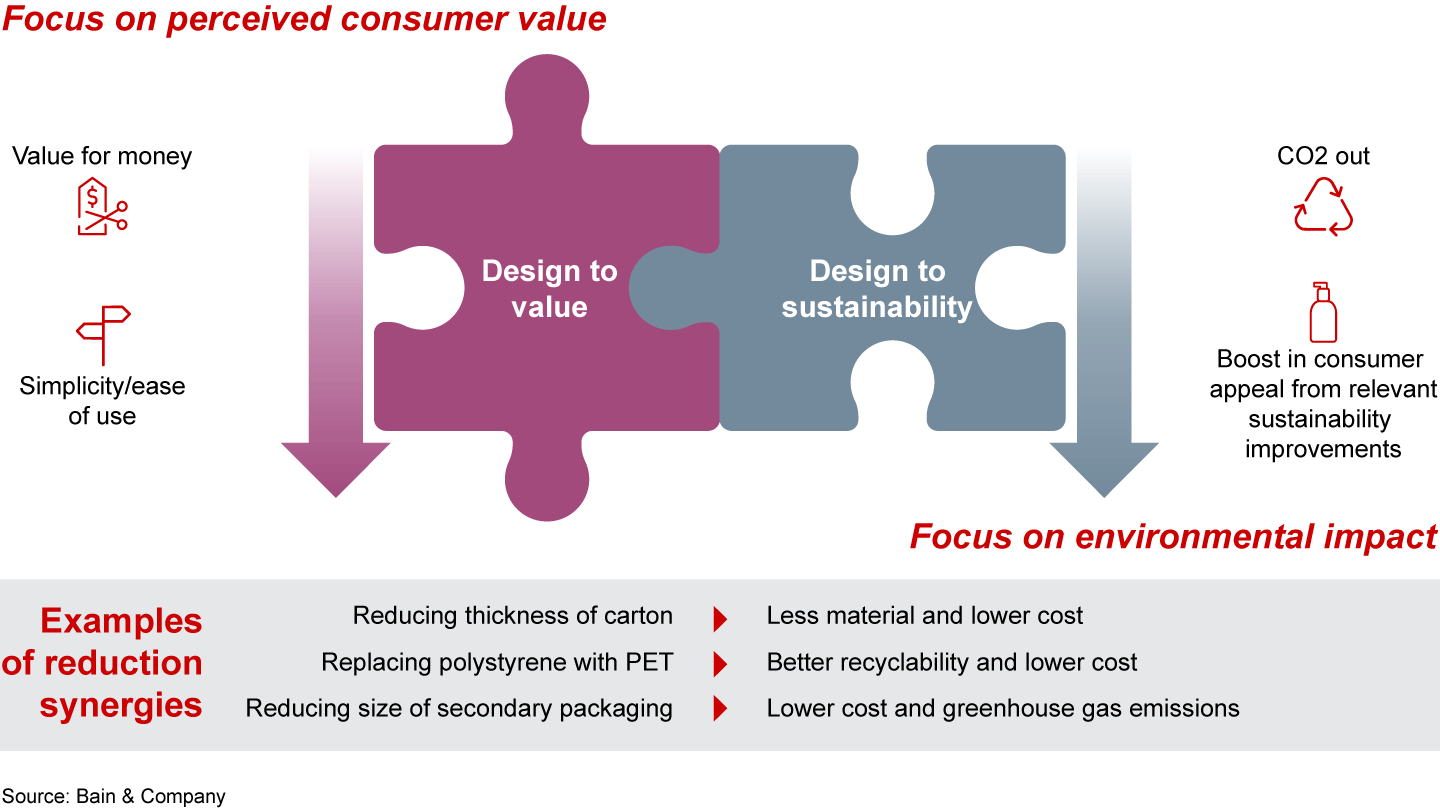
      Contrary to popular belief, in a design-to-X process companies can optimize for both cost reduction and sustainability improvement simultaneously

      They are learning, for example, that eliminating just one gram of PVC in a product can lead to measurable savings and a nearly 3.4 gram reduction in fossil fuels. No large company can afford to ignore sustainability. So while they may choose to optimize for something else, sustainability should be a “must consider” variable in their decisions.

      For Our Clients

      Macro Surveillance Platform

      For more detail on the business implications of coronavirus from Bain’s Macro Trends Group, log on to the Macro Surveillance Platform. Learn more about the platform >

      A range of consumer goods companies across product categories have reduced procurement spending and improved their environmental footprint through changes that could be rolled out in as soon as six months. For example, packaging harmonization saved one company as much as 11% on costs while substantially lowering materials requirements. Some companies have moved to such options as 3-D printing to eliminate scrapping costs, also allowing them more quickly to change label messaging for marketing promotion.

      These and other changes help companies improve costs at a time when they need cash to help them grow out of the downturn. It also enables companies to benefit from consumers’ embrace of sustainability. US sales of products marketed as sustainable grew 5.6 times faster than other products from 2013 to 2018, according to the NYU Stern Center for Sustainable Business.

      When companies use sustainability as one of the key X factors in design, they typically take a four-step approach.

      Set the rules. Companies need to clarify their ambition, their cost reduction and their margin improvement targets—while also determining the sub-X factors; that is, which dimensions of sustainability are most important to the brand. They need to set guidelines on how to manage trade-offs by product category or brand. That means asking, for example, how product packaging and design are linked to what consumers really value, and how to quantify the trade-off between those values, costs and sustainability. Cost-cutting steps that also showcase a sustainability effort may signal a highly visible commitment to something that consumers value. 

      Get the facts. The best companies conduct a rigorous cost analysis of both existing products and newly designed products. Alongside such considerations as detailed material costs and capex requirements, they assign a sustainability score to each product, looking at such factors as emissions and recyclability. The fact base covers all of the four Rs of sustainability: reducing unnecessary materials as much as possible; creating product packaging that is reusable; finding ways to replace existing materials with more sustainable materials; and ensuring products can be recycled. They also take a “shelf back” and “factory forward” approach to find the middle ground between consumer needs and cost efficiency. That involves designing the product assortment to win at the point of sale—and eliminating complexity by focusing on best-selling “hero” SKUs, for example. At the same time, it requires engineering the products for a sustainable cost advantage. Many efforts fail when there is a lack of close collaboration and agreement between supply- and operations-focused teams and the consumer-oriented marketing teams.

      Speed the process. The benefits of Agile execution are well documented. When properly conducted, Agile ways of working reduce project delivery times from 18–24 months to 5–6 months. Companies attribute rapid results in large part to empowered, cross-functional Agile teams and effective governance based on a set of specific operating principles. Among those principles: design targets that are co-owned by marketing, supply chain, procurement and sustainability, with a senior, cross-functional review board empowered to approve projects in order to hit targets. Also important: The review board has sole and final decision authority to approve ideas from the design sprints. 

      Make it stick. As with any performance improvement initiative, it is essential to rigorously track results to both fully capture savings and ensure those savings stick. The most successful companies will use their learnings to make sustainability part of their new product development process. Generating the most value from the effort also means capitalizing on sustainability gains for stronger branding and a cultural shift. The best companies embed sustainability in marketing and branding by celebrating and communicating the sustainability benefits to employees, customers and consumers.

      Even before Covid-19 began taking its toll, forward-thinking companies started reaping the rewards of taking sustainability seriously—and marketing those efforts. Brands tied to Danone’s “One Planet. One Health” corporate-level manifesto grow three times faster than the rest of the company’s portfolio. Unilever’s 28 sustainable living brands are growing 69% faster than its other brands and are the engine powering 75% of the company’s growth.

      The reality is that companies don’t need to choose between cutting costs and meeting the growing demands by consumers, retailers and regulators for sustainable products. It’s possible to optimize for both and come out stronger in a post-Covid world.

      Related Insights

      Coronavirus

      The global Covid-19 pandemic has extracted a terrible human toll and spurred sweeping changes in the world economy. Across industries, executives have begun reassessing their strategies and repositioning their companies to thrive now and in the world beyond coronavirus.

      저자
      • Headshot of Allard Vegter
        Allard Vegter
        파트너, Amsterdam
      • Headshot of Markus Bürgin
        Markus Bürgin
        파트너, Munich
      문의하기
      관련 산업
      • 소비재
      관련 컨설팅 서비스
      • 지속 가능성 및 기업의 사회적 책임
      소비재
      Exploring AI for Packaging Circularity

      AI is already creating value across the packaging lifecycle, from optimising design and reducing material use to improving sorting and traceability.

      자세히 보기
      소비재
      Insurgent Q&A: Chomps Cofounder Rashid Ali

      “Our retail expansion story isn’t about taking share—it’s about growing the category.”

      자세히 보기
      지속 가능성 및 기업의 사회적 책임
      How AI Is Starting to Transform Circular Packaging

      There are 15 AI use cases companies across the value chain can use today to accelerate circularity.

      자세히 보기
      소비재
      Shift to Vertical: David Haines, Group CEO, Flora Food Group

      What does it take to stay connected to your customers when scale and complexity threaten to pull you away? 

      자세히 보기
      소비재
      Consumer Products M&A

      In their quest for profitable growth, more companies are divesting brands or buying insurgents.

      자세히 보기
      First published in 5월 2020
      태그
      • 소비재
      • 지속 가능성 및 기업의 사회적 책임

      프로젝트 사례

      지속 가능성 및 기업의 사회적 책임 A Personal Care and Cosmetics Brand Charts a Course for Sustainability

      See more related case studies

      고객 전략 및 마케팅 A sweet new branding strategy

      See more related case studies

      How Micro-battles Powered a Brand and Sales Lift at BeautyCo

      See more related case studies

      베인에 궁금하신 점이 있으신가요?

      베인은 주저 없이 변화를 마주할 줄 아는 용감한 리더들과 함께합니다. 그리고, 이들의 담대한 용기는 고객사의 성공으로 이어집니다.

      급변하는 비즈니스 환경에서 살아남기 위한 선도자의 시각. 월간 Bain Insights에서 글로벌 비즈니스의 핵심 이슈를 확인하십시오.

      *개인정보 정책을 읽었으며 그 내용에 동의합니다.

      Privacy Policy를 읽고 동의해주십시오.
      Bain & Company
      문의하기 환경정책 Accessibility 이용약관 개인정보 보호 쿠키 사용 정책 Sitemap Log In

      © 1996-2026 Bain & Company, Inc.

      문의하기

      무엇을 도와드릴까요?

      • 프로젝트 문의
      • 채용 정보
      • 언론
      • 제휴 문의
      • 연사 초청
      오피스 전체보기