
Skip to Content
  • 오피스

    오피스

    미주
    • Atlanta
    • Austin
    • Bogota
    • Boston
    • Buenos Aires
    • Chicago
    • Dallas
    • Denver
    • Houston
    • Los Angeles
    • Mexico City
    • Minneapolis
    • Monterrey
    • Montreal
    • New York
    • Rio de Janeiro
    • San Francisco
    • Santiago
    • São Paulo
    • Seattle
    • Silicon Valley
    • Toronto
    • Washington, DC
    유럽, 중동, 아프리카
    • Amsterdam
    • Athens
    • Berlin
    • Brussels
    • Copenhagen
    • Doha
    • Dubai
    • Dusseldorf
    • Frankfurt
    • Helsinki
    • Istanbul
    • Johannesburg
    • Kyiv
    • Lisbon
    • London
    • Madrid
    • Milan
    • Munich
    • Oslo
    • Paris
    • Riyadh
    • Rome
    • Stockholm
    • Vienna
    • Warsaw
    • Zurich
    아시아, 호주
    • Bangkok
    • Beijing
    • Bengaluru
    • Brisbane
    • Ho Chi Minh City
    • Hong Kong
    • Jakarta
    • Kuala Lumpur
    • Manila
    • Melbourne
    • Mumbai
    • New Delhi
    • Perth
    • Seoul
    • Shanghai
    • Singapore
    • Sydney
    • Tokyo
    오피스 전체보기
  • 얼럼나이
  • 미디어 센터
  • 구독
  • 연락처
  • Korea | 한국어

    지역 및 언어 선택

    글로벌
    • Global (English)
    미주
    • Brazil (Português)
    • Argentina (Español)
    • Canada (Français)
    • Chile (Español)
    • Colombia (Español)
    유럽, 중동, 아프리카
    • France (Français)
    • DACH Region (Deutsch)
    • Italy (Italiano)
    • Spain (Español)
    • Greece (Elliniká)
    아시아, 호주
    • China (中文版)
    • Korea (한국어)
    • Japan (日本語)
  • Saved items (0)
    Saved items (0)

    You have no saved items.

    관심 있는 내용을 북마크하여 Red 폴더에 저장할 수 있습니다. Red 폴더 에서 저장된 내용을 읽거나 공유해보세요.

    Explore Bain Insights
Bain.com 홈페이지
Founder's Mentality®
  • Overview
  • About
    Bain.com 홈페이지
    Founder's Mentality®

    About

    • About Founder's Mentality
    • About Micro-battles
  • Podcast
  • Book
  • Blog
  • 오피스
    메인 메뉴

    오피스

    • 미주
      오피스
      미주
      • Atlanta
      • Austin
      • Bogota
      • Boston
      • Buenos Aires
      • Chicago
      • Dallas
      • Denver
      • Houston
      • Los Angeles
      • Mexico City
      • Minneapolis
      • Monterrey
      • Montreal
      • New York
      • Rio de Janeiro
      • San Francisco
      • Santiago
      • São Paulo
      • Seattle
      • Silicon Valley
      • Toronto
      • Washington, DC
    • 유럽, 중동, 아프리카
      오피스
      유럽, 중동, 아프리카
      • Amsterdam
      • Athens
      • Berlin
      • Brussels
      • Copenhagen
      • Doha
      • Dubai
      • Dusseldorf
      • Frankfurt
      • Helsinki
      • Istanbul
      • Johannesburg
      • Kyiv
      • Lisbon
      • London
      • Madrid
      • Milan
      • Munich
      • Oslo
      • Paris
      • Riyadh
      • Rome
      • Stockholm
      • Vienna
      • Warsaw
      • Zurich
    • 아시아, 호주
      오피스
      아시아, 호주
      • Bangkok
      • Beijing
      • Bengaluru
      • Brisbane
      • Ho Chi Minh City
      • Hong Kong
      • Jakarta
      • Kuala Lumpur
      • Manila
      • Melbourne
      • Mumbai
      • New Delhi
      • Perth
      • Seoul
      • Shanghai
      • Singapore
      • Sydney
      • Tokyo
    오피스 전체보기
  • 얼럼나이
  • 미디어 센터
  • 구독
  • 연락처
  • Korea | 한국어
    메인 메뉴

    지역 및 언어 선택

    • 글로벌
      지역 및 언어 선택
      글로벌
      • Global (English)
    • 미주
      지역 및 언어 선택
      미주
      • Brazil (Português)
      • Argentina (Español)
      • Canada (Français)
      • Chile (Español)
      • Colombia (Español)
    • 유럽, 중동, 아프리카
      지역 및 언어 선택
      유럽, 중동, 아프리카
      • France (Français)
      • DACH Region (Deutsch)
      • Italy (Italiano)
      • Spain (Español)
      • Greece (Elliniká)
    • 아시아, 호주
      지역 및 언어 선택
      아시아, 호주
      • China (中文版)
      • Korea (한국어)
      • Japan (日本語)
  • Saved items  (0)
    메인 메뉴
    Saved items (0)

    You have no saved items.

    관심 있는 내용을 북마크하여 Red 폴더에 저장할 수 있습니다. Red 폴더 에서 저장된 내용을 읽거나 공유해보세요.

    Explore Bain Insights
Founder's Mentality®
  • 산업
    • 산업

      • 우주항공, 방산 및 정부 서비스
      • 농업 관련 산업
      • 화학
      • 인프라, 건설 및 건축 자재
      • 소비재
      • 금융 서비스
      • 헬스케어
      • 산업용 기계 및 장비
      • 미디어 및 엔터테인먼트
      • 금속
      • 광업
      • 석유 및 가스
      • 제지 및 패키징 산업
      • 사모펀드
      • 사회 및 공공 부문
      • 유통
      • 기술
      • 텔레콤
      • 운송
      • 여행·여가
      • 유틸리티 및 재생가능 에너지
  • 컨설팅 서비스
    • 컨설팅 서비스

      • Customer Experience
      • ESG
      • Innovation
      • M&A
      • 운영
      • 조직
      • 사모펀드
      • 고객 전략 및 마케팅
      • 전략
      • AI, 인사이트 및 솔루션
      • Technology
      • 변화 혁신
  • Digital
  • 인사이트
  • 베인 소개
    • 베인 소개

      • 업무 소개
      • 베인의 신념
      • 구성원 및 리더십 소개
      • 고객 성과
      • 주요 수상 경력
      • 글로벌 파트너사
      Further: Our global responsibility
      • 다양성과 포용
      • 사회 공헌 활동
      • Sustainability
      • World Economic Forum
      Learn more about Further
  • Careers
    최근 검색어
      최근 방문 페이지

      Content added to saved items

      Saved items (0)

      Removed from saved items

      Saved items (0)

      Founder's Mentality Blog

      The Beams Are Burning

      The Beams Are Burning

      Companies that embrace their Founder’s Mentality create “pull” by designing with the front line, for the front line.

      글 James Allen

      • 읽기 소요시간

      Article

      The Beams Are Burning
      en

      In their book Why Nations Fail, an examination of the reasons for the prosperity of some nations and the poverty of others, Daron Acemoglu and James A. Robinson include a strong critique of the international aid community. Using Afghanistan after the fall of the Taliban as an example, the authors paint a picture of ineptitude as dozens upon dozens of World Bank and NGO officials descend on the country at great expense, siphoning off resources and inadvertently weakening the war-torn nation’s already fragile infrastructure.

      I was particularly struck by a story about villagers in one remote area of Afghanistan who heard over their radios about a multimillion-dollar initiative to restore shelters that had been damaged during the fighting. No aid arrived for months. Of the money promised, the authors write, 20% was used to cover the United Nations’ overhead costs in Geneva. Another 20% went to an NGO. Three more layers of bureaucracy each took a cut as well. Finally, the money left over was used to purchase wooden beams at inflated prices through Western Iran. When these beams were finally ready, they were delivered to the village by a warlord—again at inflated costs—but were too large to be of any use for building shelters. Ultimately, the local villagers burned them for firewood—$20 million worth of firewood.

      I hasten to point out that many in the aid community disagreed with Acemoglu and Robinson’s conclusions about foreign aid (this is one very thoughtful response).

      But the story of the $20 million firewood provides a useful analogy for our work on Founder’s Mentality SM. The story is remarkably similar to the way many frontline folks talk about top-down initiatives in big struggling bureaucracies. Here’s the typical pattern:

      • Executives at the group level devise a strategy that includes a key initiative to improve the customer experience. Money is allocated to train the front line in how to implement the initiative and provide them with new tools (much like the aid agencies targeting monies to replace village shelters).
      • In budgeting, this money is allocated to the three main regional directors, minus the costs incurred by HR to mock up the training program (like the 20% the authors say went to UN overhead costs).
      • The three regional directors are asked to design pilot programs, and they appoint local HR and sales teams to come up with a plan. They pick three markets in three geographies and provide funds to launch pilots, minus the costs incurred by regional HR and sales teams (akin to 20% being consumed by an NGO’s administrative costs).
      • The three pilot markets work with a training firm, an ad agency and their respective regional teams to develop the pilot program in more detail (like the three more layers of bureaucracy that reportedly took a cut).
      • The final pilot program is incomprehensible to the salesforce and there are insufficient funds left over to roll it out in a meaningful way to key customers. The salesforce rejects it out of hand. (The beams are too big to be of any use and are burned as firewood.)
      • Group executives at the top view the pilot’s failure as further evidence that the salesforce is set in its ways and resistant to change. (Which would be analogous to aid agencies blaming the fiasco on incompetence and corruption in the countries they were trying to help).

      I know this sounds far-fetched, but we hear examples of beam burning in the business world every day. Recently, I was at a board meeting of a company that had just hired a new executive. He had been asked to give his observations after his first 100 days, or what French companies call a rapport d’étonnement. He observed that in his previous company, 90% of initiatives were created by the front line in order to fulfill their mission of continuous cost improvement. “Initiatives are started with the front line, designed by the front line and executed by the front line,” he said. “The necessary change is pulled through the company.”

      His new company, he said, had many strong qualities. But he had one telling observation: “Here, initiatives are designed at the top and then pushed on our people,” he said. “But to be honest, as far as I can tell, our people simply view them as fireworks displays. The initiatives are shot high into the air with great fanfare, but like fireworks, the color and excitement die by the time anything hits the ground. Our people are trained to ignore what the leaders say, because our initiatives and pronouncements have no meaning or impact.”

      Figure 1
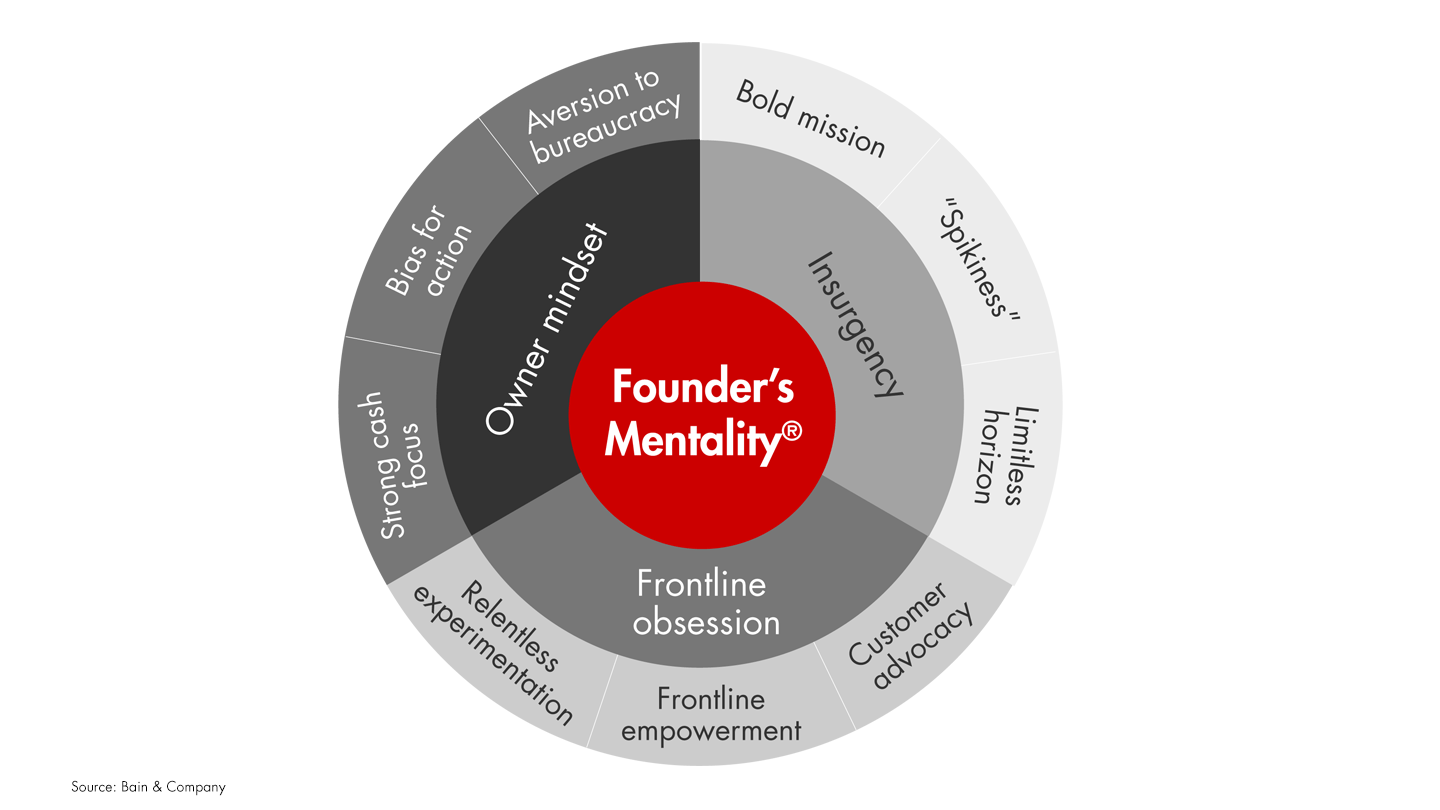
      The most sustainably profitable companies nurture and maintain three traits
      The most sustainably profitable companies nurture and maintain three traits
      The most sustainably profitable companies nurture and maintain three traits

      Fred Hassan, the extraordinary turnaround specialist, addressed this issue in a Harvard Business Review article called “The Frontline Advantage.” He wrote: “The managers most responsible for a company’s success or failure happen to be the ones with whom the CEO spends the least amount of time … It is the frontline managers who must motivate and bolster the morale of the people who do the work. … These managers are central to a company’s business strategy because they oversee its execution.”

      In an earlier blog post, we noted that many leaders in large corporations continue to rely on old processes in which key initiatives are developed at the top and then pushed down through the organization. In contrast, companies that embrace their Founder’s Mentality create “pull” by engaging directly with frontline employees to determine what initiatives are necessary and then adjust incentives accordingly to ensure the needed buy-in. These companies think about strategy and frontline behaviors/routines as inseparable. They design with the front line, for the front line. Their CEOs get out of their box to work directly with the people accountable for delivering to customers.

      The burning beams and fireworks analogies both highlight the debilitating costs of relying on push instead of pull.

      저자
      • Headshot of James Allen
        James Allen
        어드바이저 파트너, London
      문의하기
      관련 컨설팅 서비스
      • 전략
      Change Management
      Micro-battles and the Journey to Scale Insurgency

      Discrete, fast-moving initiatives bring focus to strategic choices and help companies rediscover the art of getting stuff done.

      자세히 보기
      전략
      The Founder's Mentality: How to Overcome the Predictable Crises of Growth

      The Founder's Mentality® can help businesses achieve lasting, profitable growth.

      자세히 보기
      전략
      Barriers and Pathways to Sustainable Growth: Harnessing the Power of the Founder's Mentality

      Some companies have been able to anticipate and address the internal obstacles to growth.

      자세히 보기
      창업자 정신
      The Magic of Founder-led Companies

      Companies with their founder present performed twice as well as their peers in the S&P 500 over the past decade.

      자세히 보기
      전략
      Six Threats Demand a New Playbook for Banks in Wealth and Asset Management

      AI, direct-to-consumer models, and the return of local priorities are redrawing industry lines.

      자세히 보기
      First published in 4월 2014
      태그
      • 전략
      • 창업자 정신

      프로젝트 사례

      전략 Jump-starting innovation for a telecom solutions provider

      See more related case studies

      전략 New products propel profitability for metals manufacturer

      See more related case studies

      전략 An auctioneer makes a winning online bid

      See more related case studies

      베인에 궁금하신 점이 있으신가요?

      베인은 주저 없이 변화를 마주할 줄 아는 용감한 리더들과 함께합니다. 그리고, 이들의 담대한 용기는 고객사의 성공으로 이어집니다.

      급변하는 비즈니스 환경에서 살아남기 위한 선도자의 시각. 월간 Bain Insights에서 글로벌 비즈니스의 핵심 이슈를 확인하십시오.

      *개인정보 정책을 읽었으며 그 내용에 동의합니다.

      Privacy Policy를 읽고 동의해주십시오.
      Bain & Company
      문의하기 환경정책 Accessibility 이용약관 개인정보 보호 쿠키 사용 정책 Sitemap Log In

      © 1996-2026 Bain & Company, Inc.

      문의하기

      무엇을 도와드릴까요?

      • 프로젝트 문의
      • 채용 정보
      • 언론
      • 제휴 문의
      • 연사 초청
      오피스 전체보기