

Brief
Not long ago, we studied 2,300 managers at an industrial company with 14,000 employees around the globe. As a group, these individuals sent and received more than 260,000 emails a month, just with one other. But high levels of email communication did not prevent meeting proliferation. The typical manager devoted eight hours each week to meetings—for senior managers the figure was more like 20 hours—and the volume was growing. During the average meeting, we found that about a quarter of attendees were sending at least two emails every 30 minutes.
This is today’s connected enterprise: always on, everyone linked to everyone else, a flood of information coursing through its electronic arteries (see “The connected enterprise” below). The enterprise is partly a creature of collaborative technologies, including not just email but also instant messages, anywhere-anytime phone calls and meetings, Web-based conferencing, internal social networks and so on. It’s also a creature of globalization, capability sourcing and partnerships that extend beyond a company’s walls. Many people and teams around the world, often from different employers, collaborate physically and virtually on nearly everything they do.
All this information and collaboration should make companies far more agile than they used to be, and they should be able to respond nimbly and decisively to new ideas and market developments.
In practice, the opposite is often the case. The organization grows more complex, not less. Critical decisions slow to a crawl, trapped in an endless cycle of data collection and debate. An invitation to collaborate has blurred the distinction between participative and consensus styles of decision making and risks turning every decision into a referendum.
In the industrial company we studied, for example, operating expenses were growing faster than sales—a sure sign of trouble. A survey showed that only 18% of employees thought that the company’s decision processes led to good decisions. As one respondent said, “There are far too many people involved with the decision making process…too many meetings and too much email being circulated.” And this company isn’t alone. Typically, people in a connected enterprise are aware of what’s going on, and many believe they should have a say in whatever issue is at hand. But no one seems to know who’s really responsible for decisions and actions.

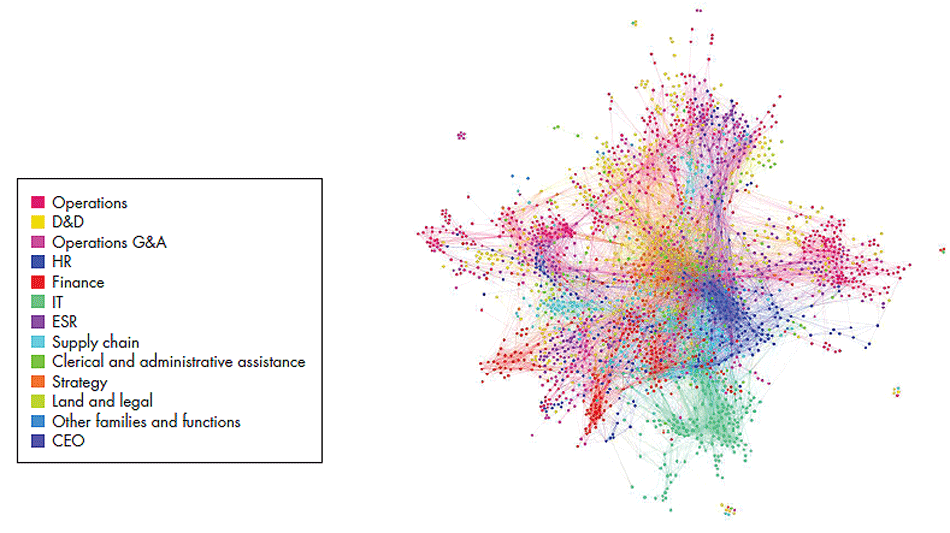
The connected enterprise
Today’s technology allows you to map your company’s connectivity. Maps such as the one pictured to the right can highlight functions, regions or individuals that are isolated from others, as well as those that are most plugged in.
Fortunately, things don’t have to be that way. Many companies have already learned how to create streamlined, decisive organizations. They make good decisions day in and day out, make them quickly and translate them into action promptly and effectively. Organizations like these outperform their competitors. They’re also great places to work, and they attract the kind of employee who likes to get things done. Companies with that kind of organization nearly always find that connectivity is a boon. It turbocharges performance, and it helps people do their jobs more effectively than ever.
It’s when the organization itself is needlessly complex— when decision processes are murky and decision rights unclear—that connectivity causes trouble. If you expect social technologies and interconnections to cut through this complexity all by themselves, you’re in for a disappointment.
So what follows are four principles that can help a company to keep its priorities straight. The connected enterprise, after all, presents huge opportunities. If you focus on decisions first and connectivity second, you will be well positioned to capitalize on them.
1. Keep the organization simple. Simple organizational structures and decision-making models nearly always outperform competitors. Effective companies design their processes so that key decisions are made quickly and repeatedly by a relative handful of people. They keep spans broad and layers few. They never have large decision-making meetings, and they eliminate organizational fragmentation.
Simplicity and clarity of this sort pay off quickly in a connected world. A global technology company, for instance, found that its spending on marketing was increasing at 1.5 times the rate of revenue growth, while market share was declining. Its headcount had also increased, its programs had proliferated and its decision making had slowed down. To attack the problem, the company consolidated its marketing functions, reduced the number of managerial layers and centralized key decisions. The moves contributed to 10% faster revenue growth and a 30% reduction in marketing expense.
2. Align management forums. Companies that are best at decisions foster cross-boundary collaboration whenever it creates high value, such as in R&D or sales. But even in this context, they keep decision-making authority simple. They also create efficient management forums for key decisions. A $2 billion Internet services company had grown by acquisition, but synergies were scarce and margins, flat. Thanks to connectivity, the company could replace its fragmented senior management forum, which was business unit-based, with 10 or more people involved—with a core team of just three, including the CEO, head of products and head of sales. Decision making and execution improved radically, and margins rose by more than 30%.
3. Target technology and information. Companies with simple structures and well-aligned decision processes rely on social technologies whenever those technologies accelerate decision making and execution—for a complex technical issue, for instance, that needs as many brains as possible. But they don’t do social for the sake of social. They understand what information they need for key decision processes and don’t flood participants with unnecessary data. They find ways to reduce email information overload while ensuring maximum access to pull-oriented collaboration sites.
Technology can often help decisions about innovation, but only up to a point. A $3 billion software and financial services company, for instance, used collaboration technology to encourage and capture new business and product ideas from individuals throughout the organization. Participants generated more than 700 new ideas in one area alone, providing decision makers with a host of good possibilities for innovation. Still, the company didn’t rely wholly on this technology: It used the collaboration tool to augment the normal product development and decision-making process, not to supplant it.
4. Keep connectivity in perspective. Virtual is fine for many purposes, but nothing can replace direct human interaction. So these companies instill—and invest in— cultural norms that reinforce face-to-face communication. They also structure meetings to encourage and reinforce the exchange of ideas. When a new CEO took over a struggling software company, he learned that people in the organization universally complained about unfocused and frustrating meetings, despite vast numbers of elaborate PowerPoint presentations. The new CEO quickly instituted a no-presentation, working-session-only rule, with printed documents distributed and no laptops allowed. The leadership team almost immediately noticed a change in energy level, focus and meeting effectiveness.
As organizations strive to have less rigid boundaries, there is one thing you can be sure of: Connectivity has already taken hold in the fabric of your organization. It’s a powerful force, and it can either boost performance or get in the way. The critical question is whether you are creating an organizational model that can capitalize on its promise.
Chris Brahm is a partner with Bain & Company and leads the firm’s Technology practice for the Americas in San Francisco. Eric Garton is a partner in Bain’s Chicago office and is the leader of Bain’s Industrial practice in the Americas.
The connected enterprise
Today’s technology allows you to map your company’s connectivity. This image shows connections among 2,300 individuals—all the corporate managers and the first six layers of regional managers—at a large industrial company. Any two people are connected on the image if they attended at least 10 meetings together over the course of a year (excluding town halls and other large meetings). The more meetings they attended together, the closer the dots are.
The dots in this image are colored by function, but they can be colored by any attribute that is useful, including management layer, type of site and so on. The map can highlight functions, regions or individuals that are isolated from others, as well as those that are most plugged in.
Warning signs
Is your organization prepared to benefit from connectivity? If you’re noticing some of these symptoms, the answer may be no.
- Your meetings are over attended and ineffective
- Your decision-making processes are slow and often involve managing “stakeholder mountains”
- Accountability is hard to pinpoint in your core, high-value processes
- You’re often unable to connect the best resources to the most important initiatives
- Your organization’s execution capability is eroding as complexity impairs consistency
First published in 10월 2012