

Brief

For Genesys CEO Paul Segre, the shift from on-premise software to the cloud required a complete rethinking of how the company works with customers. “Enterprise software to cloud is a huge transformation. When you sell enterprise, you sell and maybe install it, and there’s some customization. But the actual running of it is done by a partner or the customer. When we sell cloud, we are the service provider, with constant interaction.”
At Genesys, a global leader in contact center software, that constant interaction brought on a whole level of learning about what its customers thought about them. “Much of what we’re learning isn’t about the product or its functionality,” Segre says. “It’s about whether we’re communicating with the right people, or at the right times. Maybe they’re retailers, and they don’t want to hear from us on Black Friday. And in the on-premise world, those are things that we just would not ever have to consider.”
Segre’s experience underscores what thousands of enterprise technology vendors are going through as they move from a time when they could get by with customer support that was just so-so. For many years, enterprise technology companies got along fine with pretty low customer experience ratings—just about the lowest, in fact, of the industries we measured. In Bain’s 2015 survey of more than 1,200 enterprise customers, the average Net Promoter Score® of enterprise hardware vendors was 14; for IT and business process services, it was 13 and for enterprise software, a surprising negative 3. Compared with other industries like hotels, with an average score of 33, or department stores, with a score of 62, you would think enterprise IT would be suffering mightily.
But the enterprise tech industry thrived in spite of this, partly because it could rely on a model of focused sales efforts on a limited set of buyers—in most cases the CIO and senior IT executives—rather than focusing on end users and their needs. Once software or hardware was installed and running, companies were reluctant to go through the expense and hassle of changing vendors, even if the technology wasn’t delivering a superior experience.
That’s changing rapidly now, as cloud computing subscription sales reshape the relationship between vendor and customer, bringing more business customers into the decision-making process. “People who buy cloud are not the same folks who buy premise,” Segre says. “Often they’re business users; maybe they’ve fired their IT shop. So their expectations are different. [Net Promoter] has really informed us about what the requirements are on us as a service provider.”
Improving the customer experience
Every day, technology executives like Segre face the challenge of making their companies more focused on the customer. Most are working hard to define good customer experience, parsing through reams of data and hundreds of anecdotes. Some use metrics like the Net Promoter Score to track customer satisfaction. However, most still struggle to convert those metrics into a system for changing the way they operate. In our work with more than 2,000 companies designing customer experience systems, we developed an approach that describes the key capabilities necessary to improve the customer experience—one that has been applied successfully at many leading technology companies (see Figure 1).
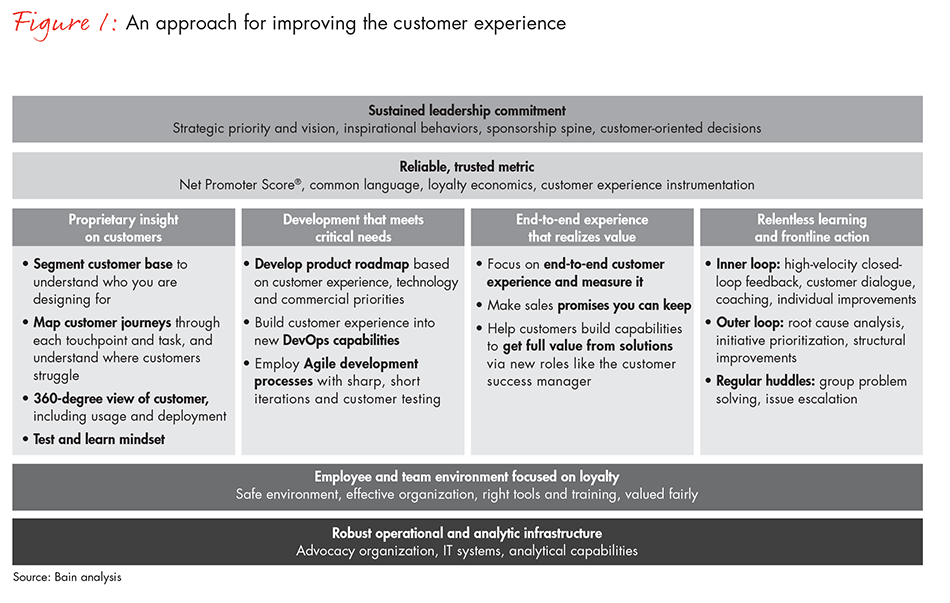
Sustained leadership commitment. Success depends on C-level commitment to becoming a customer-centric organization. As David Sudbey, Genesys’ chief customer officer, puts it: “Customer isn’t something we do; it’s everything we do.” But how does that actually play out in a fast-moving company with multiple priorities? It takes time and patience to build an organization focused around the customer experience, and senior executives should not set out thinking it will take six months; it’s more like three to five years. Of course, the senior team must remain committed through the ride.
Reliable, trusted metrics. Establishing the right metrics allows everyone in the organization to speak a common language about the customer experience and to measure progress transparently. Many technology companies are well under way in these efforts, with more than two-thirds of companies we surveyed adopting the Net Promoter Score as a metric to track customer success. Most share what they learn across the organization to encourage new behaviors. A better understanding of customer economics and the implications of customer advocacy also helps inform investment decisions. For example, raising customer advocacy lowers acquisition costs and improves price realization.
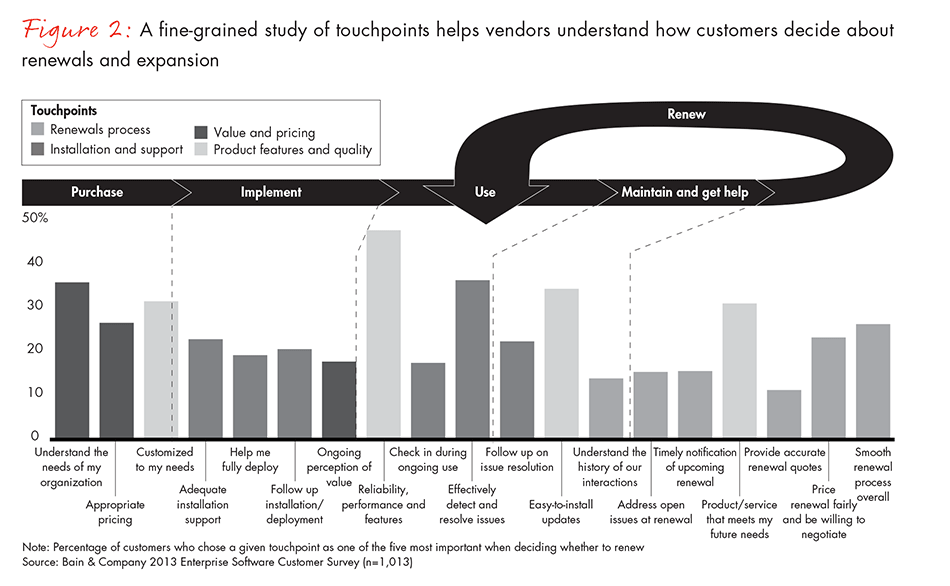
Proprietary insights on customers. Technology companies should be looking beyond IT to understand how end users value their products, as well as what irritates them. These customers are increasingly responsible for expansion and renewal decisions. While most technology companies have tried to map out the key touchpoints in the customer journey, few have taken a data-driven approach to determine exactly which events matter most to customers as they decide on purchases and renewals (see Figure 2). Sitting with these customers and studying how they use products yields a deeper understanding of critical pain points.
SaaS applications also create new opportunities to understand how customers use products and to predict and preempt customer pain. A customer should never have to call to report an outage or tell the vendor which features get used most. Cloud service providers should know all this and much more from their usage data—and they should use those insights to continually improve the customer experience.
Development that delivers on critical needs. These insights can help shape development priorities detailing where and how to enhance and upgrade products, based on available technology and commercial needs. Companies should take a “design thinking everywhere” approach, with nothing off limits. Old waterfall methodologies, with their long cycles, are quickly giving way to Agile—and that should make development more responsive to end users.
End-to-end customer experience that realizes value. Sometimes customers have to change their processes to get the full value of new technology. Several vendors, including Microsoft, Salesforce, SAP and Ariba, are helping by building up networks of service providers that can help customers reengineer their processes or by introducing the role of a customer success manager (CSM). These CSMs work closely with customers to help them learn how to get the most out of their investments, to build long-term relationships and to encourage renewal. They work with the sales team but usually are organizationally separate to ensure their role as customer advocates. One Salesforce customer told us he loved it when his CSM called, because he was always focused directly on helping him do his job better, rather than selling the merits of the system.
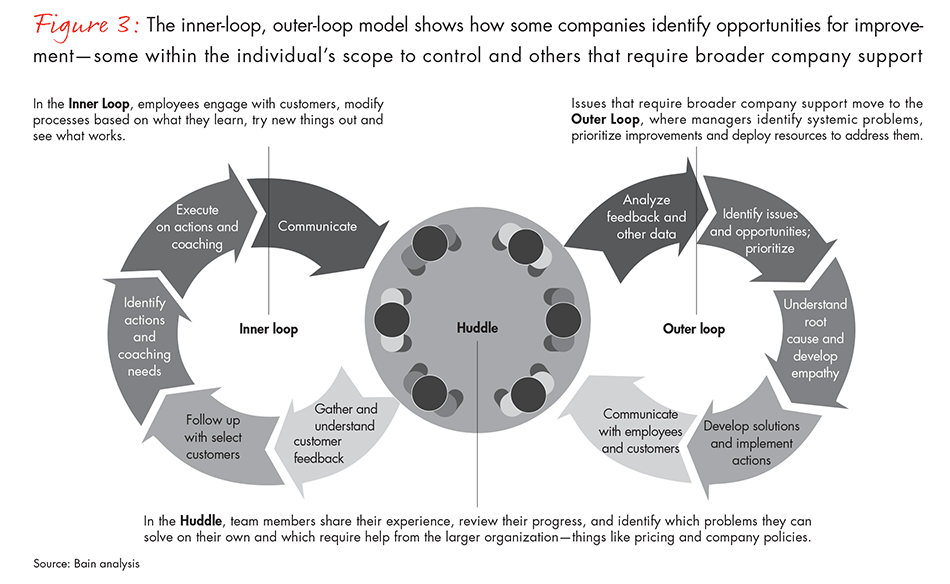
Relentless learning and frontline action. What keeps customers from switching to another product? Leading enterprise IT companies find out by listening continually to users and trying to understand what frustrates and delights them. They monitor these trigger points closely and build systems like the Net Promoter System® that feed these insights back into the organization, especially to the design process. When done right, this learning and integration plays in a series of internal and external feedback loops, facilitated by regular team huddles (see Figure 3).
Building a culture of customer excellence. It takes time and patience to develop an organization focused around the customer experience. Leading companies start with recruitment, integrating awareness of customer centricity into their hiring process. Training is also key, not only for new employees but also continuous training for existing staff, to reinforce lessons about the customer experience and to draw new learning into the broader process. Finally, change of this scale requires rewards and recognition. Leading companies create incentives for customer advocacy and measure the organization’s shift toward better customer experience with key metrics.
Robust operational and analytic infrastructure. Underlying these elements, companies need to put in place a robust operational infrastructure that supports bringing feedback from the right customers to the right employees. This typically includes an advocacy group within the larger organization, which works with IT and analytics teams to track action and initiatives, and ensure customer experience initiatives continue to make progress.
Our recent survey of enterprise ISVs (independent software vendors) found that many are experimenting with different organizational models to improve the customer experience:
- 13% place responsibility for advocacy along functional lines
- 17% place it at the front line
- 25% give the center responsibility, and
- 29% distribute ownership across the organization.
Improving the customer experience requires patience and time, but the approach is clear and proven. For Genesys, it took at least two years to deploy a complete customer experience system and get it running, but the investment was worthwhile. The company saw a 30-point improvement in Net Promoter Scores between early 2014 and late 2015 as the system came up to speed.
Any executive or team setting out on their customer experience journey should ask themselves a few questions to help assess their readiness and put the project in motion.
- Are the CEO and senior leadership fully committed to improving the customer experience?
- Is the business case for greater customer advocacy clear? Has the organization aligned on a set of metrics to measure the effect of advocacy on customer value?
- Do you know exactly which customer journeys and touchpoints matter most for delighting and angering customers?
- Do you have IT and operational systems in place to enable a fact-based and transparent approach to the customer experience, with clear accountability?
- Do you have an Agile process in place to act on customer feedback?
- Has the organization defined roles, such as customer success manager, to ensure excellence in the customer experience?
Chris Brahm, James Dixon and Rob Markey are partners with Bain & Company in San Francisco, Silicon Valley and New York, respectively. Chris and James work with Bain’s Global Technology practice, and Rob leads the firm’s Global Customer Strategy & Marketing practice.
The authors would like to acknowledge the contributions of Radhika Josyula, a manager in Bain’s Silicon Valley office.
Net Promoter System(R) and Net Promoter Score(R) are registered trademarks of Bain & Company, Inc., Fred Reichheld and Satmetrix Systems, Inc.
First published in 4월 2016