

Brief
In 2012, Bain & Company presented its groundbreaking research on the behavior of Chinese shoppers, taking an unconventional approach to learn what they actually bought, as opposed to what they said they bought. This year, we present a second look: Partnering again with Kantar Worldpanel, we studied the shopping habits of 40,000 Chinese households. We analyzed categories spanning personal and home care products, beverages and packaged foods—the four largest consumer goods groups, which account for more than 80% of China’s consumer goods market.1 Our analysis confirms and refines our 2012 findings and provides additional invaluable insights into how shoppers make purchases. These insights will be critical to marketers as they seek to grow their brands in a Chinese market characterized by an economic slowdown and increasing competition. The days of growing a brand just by riding a category wave are coming to an end, especially in top-tier cities. As in more mature markets, brand growth in China will need to come from market share gains. (See our full report, "Growing brands by understanding what Chinese shoppers really do.")
Key findings
Our research results confirm what we learned last year: Repertoire behavior prevails in China. Shoppers engaging in repertoire behavior choose multiple brands within a category for the same occasion or need, and the more they shop, the more they tend to buy multiple brands. Strong repertoire categories include skin care, biscuits and candy. In some product categories, however, shoppers are more loyal, repeatedly buying one brand for a specific need or occasion. Strong loyalist categories include infant formula, baby diapers and milk (see Figure 1).
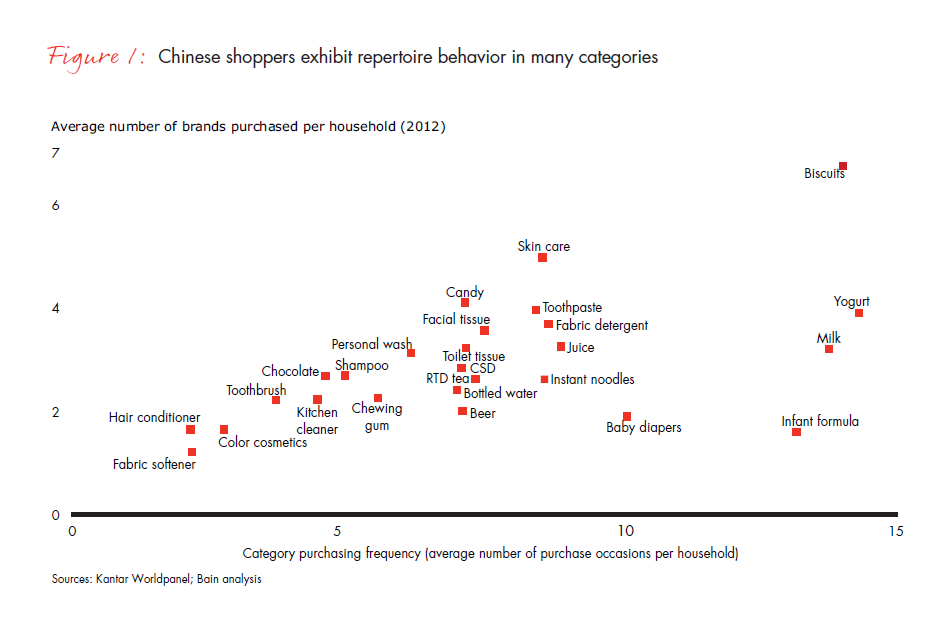
Across all analyzed categories, we found very similar behaviors in terms of the number of brands purchased and the frequency of purchase from year to year. In both years, shoppers tended to purchase more brands when they purchased more frequently—that is, they tended to exhibit repertoire behavior. Understanding where a category falls along the continuum from repertoire to loyalist should be at the center of any brand strategy.
Although brands are important to Chinese shoppers, they don’t think about one brand very often. Our study reveals that the average purchase frequency of any particular brand is very low—less than five times a year. Even at the category level, the average purchase frequency rarely exceeds once a month. This low level of engagement with brands should be sobering news for marketers who believe that the key to success is devoting tremendous effort and resources to getting shoppers to love their brands.
Penetration is paramount to driving market share
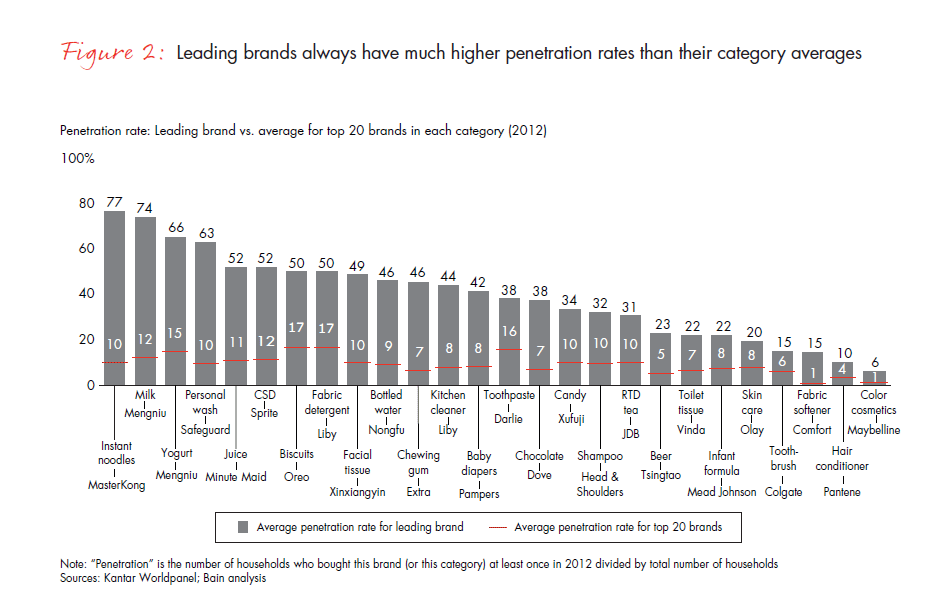
Our findings also confirm that penetration2 is the most important driver of market share across all key categories. Across categories, increasing penetration is the primary way to build big brands. This is a key insight from the research of the Ehrenberg-Bass Institute for Marketing Science, summarized by Professor Byron Sharp, director of the Institute, in his book How Brands Grow, based on decades of observations of buying behavior. Confirming that point, we found the leading brand in a category had a penetration rate 3 to 10 times higher than the average penetration rate of the category’s top 20 brands (see Figure 2).
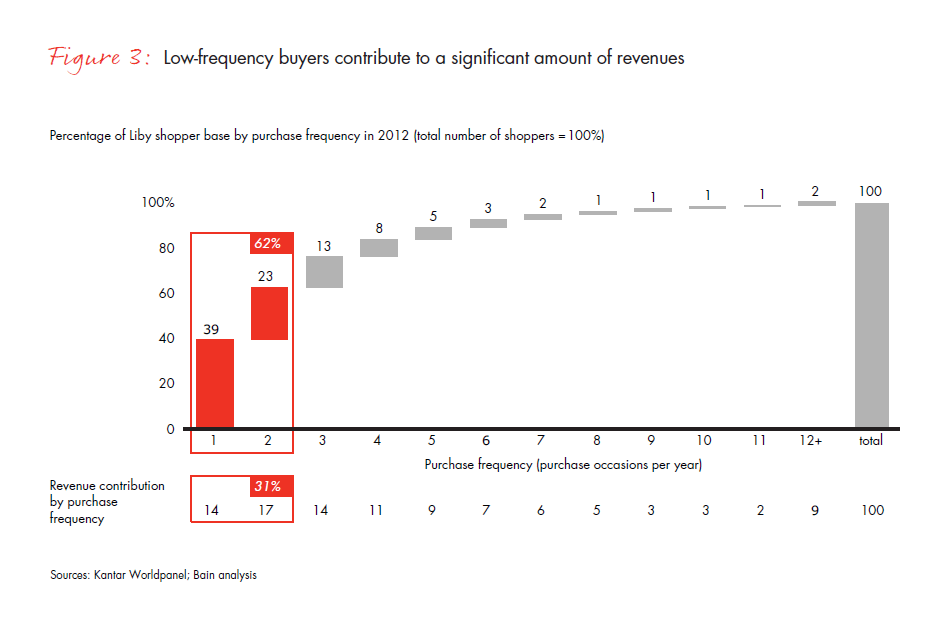
Focusing on 10 selected categories, we verified that most shoppers have very low purchase frequency. Approximately 60% to 80% of shoppers purchase a certain brand no more than twice a year, and as a group, they drive 20% to 55% of a brand’s revenue. The Liby brand in the detergent category is a good example (see Figure 3). Given this, penetration is the key to growth for any brand.
Our research demonstrates that a category’s leading brand invariably has the highest purchase frequency and repurchase rate. This finding suggests that niche brands3 don’t exist; the brands that have a small shopper base are simply small brands, whose buyers usually buy less frequently and churn more often.
Given that Chinese shoppers are inclined to buy multiple brands, it isn't possible to create big brands by targeting and selling to only a few shoppers in the hope that they will become heavy or loyal buyers. Chinese shoppers simply don’t behave this way. Instead, to build a big brand, companies need to sell to as many shoppers as possible.
A brand’s shopper base is a "leaky bucket"
Marketers who believe their shopper base and revenue are stable should stop and take note. Our study shows that, on average, the top five brands in a category lose 30% to 60% of their shopper base every year, and the percentages are even higher for small brands. Even if shopper base and revenue show little variation from year to year, this apparent stability often conceals the fact that a significant number of shoppers are lost and recruited each year (see Figure 4).
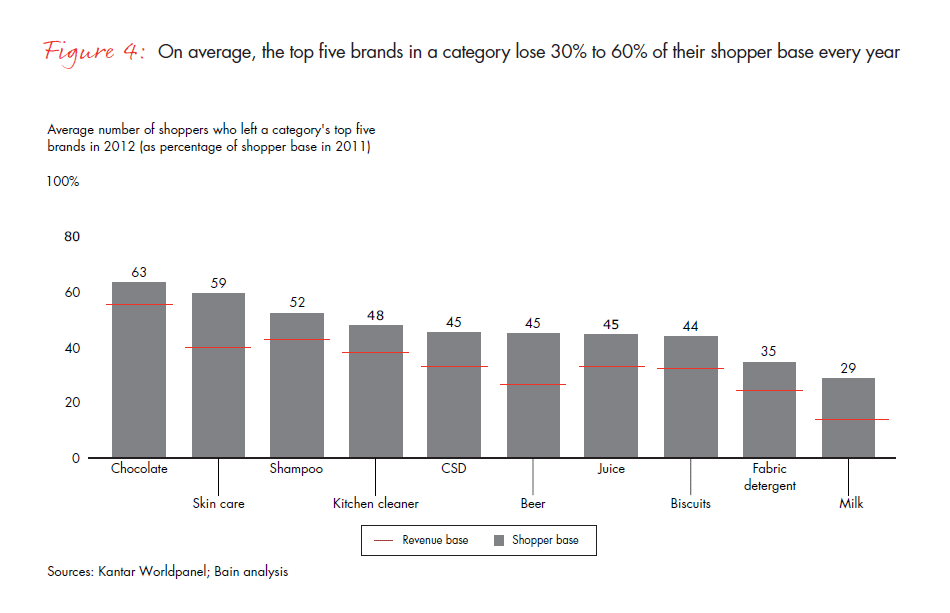
Because a brand’s shopper base is a "leaky bucket," a brand seeking to grow must not only attract new shoppers but also replace lost shoppers with new ones each year. Given that most shoppers have very low engagement with brands in terms of purchase frequency and repurchase rate, companies need to find ways to recruit customers again and again—essentially, each time they go shopping.
Rules of the road: How consumer products companies can drive penetration
The implications of our research are far-reaching, providing insights that can help marketers shape strategic decisions. The route to success begins with understanding where a brand category falls on the repertoire- loyalist continuum. Armed with this understanding, marketers can choose the right approach to building penetration.
In repertoire categories
Build consideration first. Repertoire category shoppers consider multiple brands when they shop, so a company must ensure that its brand is one that shoppers will consider. Some strategies for becoming part of the repertoire include investing in the right above-the-line mass marketing (like TV commercials), focusing on distinctive brand assets and associating the brand with specific needs and occasions. For example, Head & Shoulders has consistently and heavily invested in above-the-line marketing to promote the concept of dandruff control, building strong consideration as a result.
Achieve perfect in-store execution so that consideration translates into penetration. Because Chinese shoppers buy so infrequently, wide distribution across channels is important. Brands need high levels of below-the-line marketing (like in-store sales promotions) and trade spending to ensure shoppers are constantly engaging them at the point of sale. To achieve superior visibility and distinctiveness in the store, marketers should present their brands in multiple locations beyond the main shelf, targeting store "hot spots," in particular shelf ends and checkout counters.
Use product and packaging innovations to create new consumption occasions and reach new consumer groups. Promotions, seasonal packs and ubiquity on the shelf are some of the top ways a company can find fresh appeal with consumers. Mondeléz’s Oreo brand, for one, has done just that—offering multiple formats of its biscuit (sandwich, wafer and mini, to name a few) in various package sizes.
In loyalist categories
Build preference, beyond consideration. Marketers should strive to make theirs the preferred brand for shoppers and create high switching costs. Above-the-line marketing can help in this effort, as well as “shopper recruitment” programs, such as offering free trials for a period of time.
Be visible and strong on the main shelf. For loyalist brands, it’s not necessary to continually activate new shoppers or be present outside the main shelf. Loyalist shoppers are likely to find the brands they prefer. Pampers, the leading brand of baby diapers, always ensures it has large shelf space and very good visibility for its products in stores.
Use innovations to get shoppers to trade up to premium offerings. By staying ahead of the competition with product innovations, companies can build on shoppers’ loyalty to encourage purchases of more expensive products. Dairy giant Bright, for example, successfully launched its premium-priced yogurt (Momchilovtsi) based on imported lactobacillus to capture consumers' desire for high-quality products.
•••
China is a complex market—all the more so as growth slows and competition intensifies. To win in this market, it’s critical for companies to truly understand Chinese shoppers. More tactically, this requires increasing penetration and recruiting shoppers every time they step into a store— or, at the very least, replacing the consumers whom the brands inevitably lose through churn. With a solid understanding of a category’s position on the repertoire-loyalist continuum, marketers can take more of the right steps to attract new shoppers to their brands. For executives seeking the route to success in China, our 2013 research findings will provide valuable insights to developing strategies that will help brands grow and outpace the competition.
Bruno Lannes is a partner in Bain & Company's Shanghai office and leads the firm’s Consumer Products and Retail practices for Greater China. Kevin Chong is a partner in Bain’s Shanghai office and a member of the firm’s Consumer Products and Retail practices.
The authors extend gratitude to all who contributed to this brief—in particular Fiona Liu, Chen Chen and Iris Zhou from Bain & Company and Vincent Shao and Lydia Wang from Kantar Worldpanel.
1 We looked at 26 categories, including beverages (milk, yogurt, juice, beer, ready-to-drink [RTD] tea, carbonated soft drink [CSD], bottled water), packaged foods (biscuits, chocolate, instant noodles, candy, chewing gum, infant formula), personal care products (skin care, shampoo, personal wash, toothpaste, color cosmetics, hair conditioner, toothbrush, baby diapers) and home care products (toilet tissue, fabric detergent, facial tissue, kitchen cleaner, fabric softener).
2 Penetration, expressed as a percentage, is the number of households that bought a brand or category item at least once during the year, divided by the total number of households in the study.
3 A niche brand has a small shopper base that displays exceptionally high loyalty or buying frequency.
First published in 11월 2013