

Brief
Great customer experiences produce great business results. Look at companies such as Apple, Costco, American Express, Philips and Allianz. Different industries, different business models. But they have one thing in common—large and growing groups of passionate customer advocates, earned by delivering an experience competitors can’t match. That, more than anything else, is why these companies lead their industries in profitable organic growth.
Every company can tap into that power. And making the commitment to deliver a superior customer experience can turn a laggard into a fierce competitor, or an “also ran” organization into an industry leader. Charles Schwab is an example. Between 2003 and 2005, Schwab was a troubled company that had a compound annual growth rate of –3.6 percent. Over the next two years, it began a dramatic recovery, growing at an average rate of +17.5 percent, and by 2008 it had regained its position as an industry leader. One big reason for the change: Schwab’s large investments in creating a stellar customer experience. The company’s Net Promoter® score (NPS®)—the percentage of advocates or “promoters” among its customers minus the number of detractors—rose from -34 percent to +42 percent in the five years between 2005 and 2010. That’s a record-setting increase.
 |
Why don’t more companies emulate Apple, Schwab and others that win with customer experience? It’s a long, hard road, especially for companies that have neglected their customers. Turning that around requires energy and resources, and it takes time. But the journey is not mysterious, and the rewards are substantial. Our research and experience over the past several years have led us to three fundamental insights that can help you get there:
1. Understand loyalty economics. An outstanding customer experience creates promoters, and promoters are more valuable to a company than other customers. Customer experience leaders analyze loyalty economics in detail, so that everyone in the organization knows not only where to invest but how much and what the payoff will be.
2. View the experience from the outside in. Customers don’t see the web of organizations and processes that operate behind the scenes to deliver their experiences. They see that series of interactions from the outside in, colored by their expectations and their alternatives. Customer experience leaders embrace the same perspective, rising above internal complexity to see and manage the whole picture from the customer’s point of view.
3. Design and deliver. You don’t need to be a Steve Jobs to create this kind of customer experience. Yes, it is hard, and yes, it takes time. But it’s a process that can be learned and launched like any major change program. Eventually it can be built into an organization’s DNA.
Let’s take a deeper look at these three insights and explore how companies—the up-and-comers as well as the leaders—are using them to outstrip the competition.
1. Understand your loyalty economics to build the business case for change
The logic that connects customer experience to bottom-line results is simple. If people love doing business with you, they become promoters. Promoters are the customers that every company wants more of. They’re less likely to defect. They buy more products and services over time. They sing your praises to friends, colleagues and complete strangers over social networks, in online reviews, through blogs and in every conceivable channel. They cost less to serve, and they provide constructive feedback. All of these behaviors have direct, quantifiable economic benefits, as our colleagues Fred Reichheld and Rob Markey demonstrate in their book The Ultimate Question 2.0 (Harvard Business Review Press, September 2011). You can determine how much a promoter is worth to you in incremental sales and profits, and you can use that analysis to determine where and how much to invest in improving the customer experience.
 |
This direct link between promoters and business results helps to clarify what it takes to be a customer experience leader. Some people believe that a leader should delight every customer. Others argue for eliminating defects in products and interactions, or reducing the effort customers spend in dealing with a company. We think these arguments miss the point. Delight, quality and reduced effort may all be part of the package, but the goal of change has to be the creation of promoters. They are the customers who produce the economic benefits for your business. Everything else is simply a means to that end.
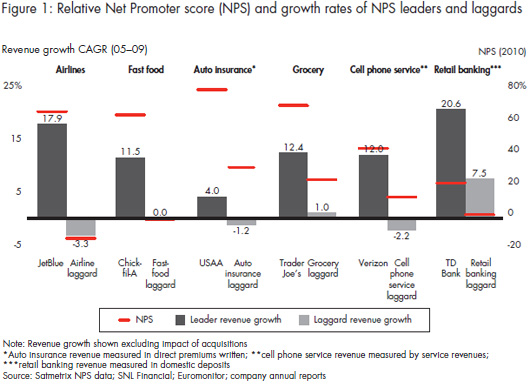
We see loyalty economics play out across most industries. A study of six different industries, for example, shows an order-of-magnitude gap on both NPS and organic revenue growth between the industry leaders and laggards (see Figure 1). To take just one example, Chick-fil-A’s NPS exceeds 60 percent and its four-year compound annual growth rate is 11.5 percent. The laggard in the fast food business had a negative NPS and a negative growth rate.
2. View the experience from the outside in
Many companies define the customer experience from the inside out. When they try to improve the experience, they look at each of the individual functions that affect the experience—marketing, customer service and so on. Leaders turn this approach on its head. They examine the experience from the customer’s point of view, and they use that perspective to make improvements and manage the experience. Viewed from the outside in, a customer’s experience results from three types of interactions:
• The brand, such as advertisements, marketing communications and signage
• The offering—the specific characteristics of products and services and how customers use or experience them
• The touch points, including stores, contact centers, websites, social media and customer communities
All three types of interactions, alone or in combination, play a role in creating promoters, but their relative importance depends on the industry and the company’s positioning within it. For automobile manufacturers, product interactions are typically the most important factor that determines promoters. The importance of product may be even higher for an auto manufacturer attempting to differentiate the customer experience through innovative engineering, such as BMW. For consumer property and casualty insurers, it’s the interactions with sales and service touch points that matter most. The customer experience leaders make it a point to learn which parts of the whole experience are most important to each segment of their target customers, and then invest to differentiate on those dimensions.
Customer experience engages both sides of the brain. Executives work hard to get the economic details of their offerings right, and they should. But we human beings are emotional creatures as well as rational ones. We want good value and efficiency, but we also want to like and trust the companies we patronize. We want to feel good about ourselves when we do business with them. We’ll put up with less than perfect service if we feel that the people we’re dealing with care about us, are trying hard and will get there in the end (see Figure 2).
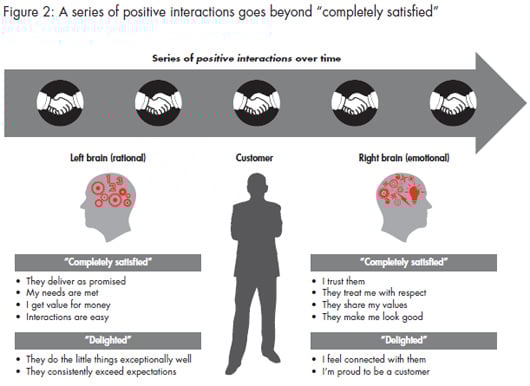
This is the classic left brain-right brain dichotomy, and it shows up repeatedly in Bain’s studies of what’s most important to customers. Listen to a woman we interviewed as she describes her passion for Verizon. She’s a promoter—but it isn’t just because of pricing or other economic benefits:
“Everything in my house is Verizon. The cell, the FIOS, the TV, the Internet, everything is Verizon. Whenever there’s an issue, a problem, you call up, you get great customer service on the phone…. It makes you feel valued, like you’re important to them…. Whether it’s great training or they just hire great people, they’re not rushing you, they’re taking the time to actually talk to you…it feels personal, it absolutely does…. It’s a great brand, where you’re going to trust that they’re going to take care of it. I’ve never been disappointed.”
It’s much the same with detractors. People mention emotional disappointments—“They don’t seem to care,” or “They don’t treat you with respect”—in the same breath with economic ones. They are equally important.
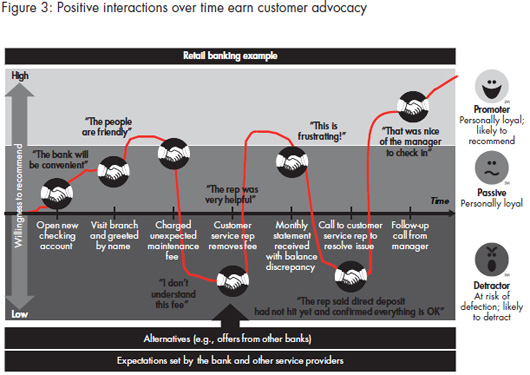
Customer experience evolves. Customers evaluate each interaction in the context of the ones that came before and compare it with their expectations and alternatives (see Figure 3). A series of positive interactions builds towards higher willingness to recommend, creating a promoter. One negative interaction at a “moment of truth” can turn an advocate into an antagonist if it isn’t quickly recognized and addressed. That’s why consistency is so important. Customers become promoters when all key interactions leave them with a positive impression relative to what they have experienced elsewhere.
3. Design differentiation into your experience, deliver consistently and develop your company’s DNA
Any company can create the kind of customer experience that sets it apart from the competition. Though it involves a serious commitment, it is mostly a matter of getting just three things right. They are the “three Ds”: design, delivery and DNA.
Design a better experience for your target customers than your competitors offer. The starting point is identifying and studying your most profitable customer segments, then determining the economics of promoters and detractors within those segments. That allows you to propose and evaluate potential investments in improving their experience.
Here’s how the Dutch airline KLM did it. Researching its customers, the airline saw that it could realize some €100 million in new contribution margin by converting about 20 percent of its highest-value customers into new promoters. But what would really turn them into passionate fans? Executives identified several possible themes and began to implement the most promising ones. Because KLM knew that its most profitable travelers valued their time highly, one theme was “Make It Speedy.” The Make It Speedy initiative brought some quick, visible wins, such as establishing priority security lines for elite flyers, relocating gates to reduce walking times and launching a mobile check-in application. Over time, it would include everything from faster booking to a prearranged car waiting for the traveler upon arrival. The result was a dramatic change in how time-pressed target customers felt about their trip—and about the airline that was providing it.
Deliver a great experience consistently, with seamless integration across all touch points. The next step is to implement the changes—to put systems in place so that things work right every time and customers get the feeling, “Wow, they’re really taking good care of me.” American Express, for example, found that customers who lost a charge or credit card encountered several obstacles when they tried to replace it. Some couldn’t find the right number to call. Others had trouble with the automated menu system and abandoned the call, or else reached a rep who couldn’t handle the task of replacing a card. Executives defined and implemented defect-free processes for all such calls—and along the way realized they could delight their best customers by overnighting them their new cards. An expensive move? Not really. It reduced the number of calls about each lost card, and customers could begin making purchases again with their cards much sooner. Overnight delivery was a “wow,” but a relatively frugal one.
Build a customer orientation into your company’s DNA. Customer experience leaders focus on the customer twenty-four hours a day, seven days a week. Their goals, values and operations all reflect that focus. Their employees know that creating a great experience is part of their mission, and they are empowered to do so. When Charles Schwab began its turnaround, it developed a state-of-the-art Net Promoter system that provided regular, timely feedback from customers. Based on that system, the company’s leaders developed a customer-focused culture based on using that feedback for learning and improvement. Senior executives talked about the customer experience regularly, and made it a part of all ongoing business reviews and strategy discussions. Branch managers began talking to customers every day and learned to take quick action to address many of the issues that arose. The company built the customer experience into its employee training programs and reinforced the importance of a great experience through the internal website and other communications. The upshot: Schwab’s program to transform its customer experience became an integral part of the company’s way of working. “Senior leadership really grasped this concept,” explained one vice president. “It really resonated with how they thought about the business.”
In this short video, Frédéric Debruyne, a partner in Bain's Customer Strategy & Marketing practice, discusses what it takes for companies to improve the customer experience.
Mapping the process of change
These elements—design, deliver and DNA—frame the process of change (see Figure 4). Of course, every company’s journey is different, because each one starts from a different place and has its own unique strengths and weaknesses. But the essential elements of each journey are usually similar.
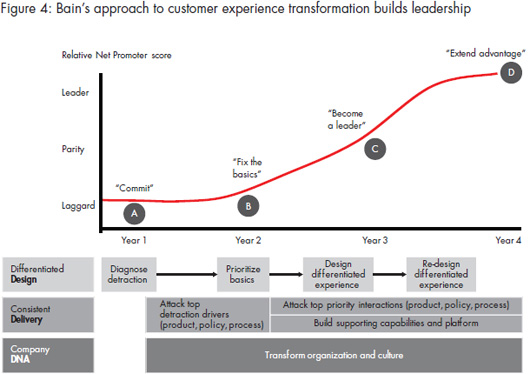
Actually doing it, of course, can feel like climbing a steep mountain. Companies typically find that they have to modify or overhaul many aspects of their business, seemingly all at once. They need rigorous, thorough customer analytics and a system of feedback. They need to develop products and offers tailored precisely to the needs of their target customers. They need IT systems that can offer consistent customer contact, efficient billing and provisioning, and robust customer intelligence. Over the longer term, they need metrics and benchmarks of the sort created at Schwab, so that everyone in the organization knows how they are doing. The people must be on board as well. Leaders need to create an explicit vision of the customer experience and then walk the walk, backing up their commitment with action and investment. The front line must learn how to take responsibility for the customer experience.
Putting it all together is a challenge, but many companies are doing just that. One major telecommunications firm, for example, has transformed itself in the last few years from a bureaucratic, government-owned utility to a world-class competitor. The company’s managers lowered costs, reduced complexity and increased operational efficiency. A vital element of the transformation involved reshaping the entire organization around the customer experience. The company’s field service, for instance—the units that install and repair equipment in homes and businesses—improved its service quality index by nearly 40 points over a two-year period while increasing productivity 70 percent and raising levels of employee engagement.
The keys to this remarkable improvement? The company provided its field-service technicians with better tools, better training, new portals and a help desk for thorny problems, and better scheduling and routing. It also measured their performance every day and provided what it called high-velocity learning loops. Techs learned every morning how they had done the day before, based on customer feedback, and how they could fix whatever issues might have arisen. As it turned out, this fast feedback was mostly positive, so the field techs could feel good about the job they were doing, and they could learn how to do it even better. And indeed, their managers challenged them to get a little bit better every month and every quarter. Before, the company had measured field-service performance on dozens of different metrics, and nobody knew which ones were important. Now there were just three or four to focus on—and performance improved steadily.
No business stands still. It is either gaining on its competitors or it is falling behind. Companies that deliver the best customer experience advance against the competition because they begin with their target customers’ wants and expectations. They adapt themselves to those customers’ needs, and they provide an experience that customers simply can’t get anywhere else.
The result, over time, is more promoters and fewer detractors. That combination is a powerful engine of sustainable, profitable organic growth. Customer-experience leaders never stop learning how to do this, and they continue to distance themselves from competitors. Other companies on the way up are learning these lessons as well—and they are now on their own paths to greatness.
Promoters, detractors and NPS
How do you know if a customer is a passionate fan—a promoter? The easiest way is to survey your customers on a regular basis right after key interactions. Using a zero-to-ten scale, ask them how likely they would be to recommend your company (or a particular product) to a friend or colleague. Scores of nine or ten, we have found, represent promoters. These customers stay longer, buy more and recommend you to their friends. That’s why creating more of them leads to profitable growth. Scores of seven and eight indicate passively satisfied customers, and scores of zero through six indicate unhappy customers—detractors. Your Net Promoter® score (NPS®) is simply the percentage of promoters minus the percentage of detractors.
The winners’ circle: One out of nine
How many companies capitalize fully on the well-documented connections between customer experience, customer advocacy and economic performance? Only a handful. Our latest study of 140 US consumer products and consumer services companies measured relative growth and profitability along with brand equity, Net Promoter scores and other gauges of customer satisfaction. We turned up just 15, or about one out of nine, that were leaders on all these measures. Little surprise that the list includes so many household names:
- American Express
- Apple
- AT&T
- Chick-fil-A
- Costco
- JetBlue
- Kohl’s
- LG Electronics
- USA MetroPCS
- New York Life
- Nordstrom
- TD Bank
- Trader Joe’s
- USAA
- Verizon
First published in 7월 2011