
Skip to Content
  • 오피스

    오피스

    미주
    • Atlanta
    • Austin
    • Bogota
    • Boston
    • Buenos Aires
    • Chicago
    • Dallas
    • Denver
    • Houston
    • Los Angeles
    • Mexico City
    • Minneapolis
    • Monterrey
    • Montreal
    • New York
    • Rio de Janeiro
    • San Francisco
    • Santiago
    • São Paulo
    • Seattle
    • Silicon Valley
    • Toronto
    • Washington, DC
    유럽, 중동, 아프리카
    • Amsterdam
    • Athens
    • Berlin
    • Brussels
    • Copenhagen
    • Doha
    • Dubai
    • Dusseldorf
    • Frankfurt
    • Helsinki
    • Istanbul
    • Johannesburg
    • Kyiv
    • Lisbon
    • London
    • Madrid
    • Milan
    • Munich
    • Oslo
    • Paris
    • Riyadh
    • Rome
    • Stockholm
    • Vienna
    • Warsaw
    • Zurich
    아시아, 호주
    • Bangkok
    • Beijing
    • Bengaluru
    • Brisbane
    • Ho Chi Minh City
    • Hong Kong
    • Jakarta
    • Kuala Lumpur
    • Manila
    • Melbourne
    • Mumbai
    • New Delhi
    • Perth
    • Seoul
    • Shanghai
    • Singapore
    • Sydney
    • Tokyo
    오피스 전체보기
  • 얼럼나이
  • 미디어 센터
  • 구독
  • 연락처
  • Korea | 한국어

    지역 및 언어 선택

    글로벌
    • Global (English)
    미주
    • Brazil (Português)
    • Argentina (Español)
    • Canada (Français)
    • Chile (Español)
    • Colombia (Español)
    유럽, 중동, 아프리카
    • France (Français)
    • DACH Region (Deutsch)
    • Italy (Italiano)
    • Spain (Español)
    • Greece (Elliniká)
    아시아, 호주
    • China (中文版)
    • Korea (한국어)
    • Japan (日本語)
  • Saved items (0)
    Saved items (0)

    You have no saved items.

    관심 있는 내용을 북마크하여 Red 폴더에 저장할 수 있습니다. Red 폴더 에서 저장된 내용을 읽거나 공유해보세요.

    Explore Bain Insights
  • 산업
    메인 메뉴

    산업

    • 우주항공, 방산 및 정부 서비스
    • 농업 관련 산업
    • 화학
    • 인프라, 건설 및 건축 자재
    • 소비재
    • 금융 서비스
    • 헬스케어
    • 산업용 기계 및 장비
    • 미디어 및 엔터테인먼트
    • 금속
    • 광업
    • 석유 및 가스
    • 제지 및 패키징 산업
    • 사모펀드
    • 사회 및 공공 부문
    • 유통
    • 기술
    • 텔레콤
    • 운송
    • 여행·여가
    • 유틸리티 및 재생가능 에너지
  • 컨설팅 서비스
    메인 메뉴

    컨설팅 서비스

    • Customer Experience
    • ESG
    • Innovation
    • M&A
    • 운영
    • 조직
    • 사모펀드
    • 고객 전략 및 마케팅
    • 전략
    • AI, 인사이트 및 솔루션
    • Technology
    • 변화 혁신
  • Digital
  • 인사이트
  • 베인 소개
    메인 메뉴

    베인 소개

    • 업무 소개
    • 베인의 신념
    • 구성원 및 리더십 소개
    • 고객 성과
    • 주요 수상 경력
    • 글로벌 파트너사
    Further: Our global responsibility
    • 다양성과 포용
    • 사회 공헌 활동
    • Sustainability
    • World Economic Forum
    Learn more about Further
  • Careers
    메인 메뉴

    Careers

    • Work with Us
      Careers
      Work with Us
      • Find Your Place
      • Our Work Areas
      • Integrated Teams
      • Students
      • Internships & Programs
      • Recruiting Events
    • Life at Bain
      Careers
      Life at Bain
      • Blog: Inside Bain
      • Career Stories
      • Our People
      • Where We Work
      • Supporting Your Growth
      • Affinity Groups
      • Benefits
    • Impact Stories
    • Hiring Process
      Careers
      Hiring Process
      • What to Expect
      • Interviewing
    FIND JOBS
  • 오피스
    메인 메뉴

    오피스

    • 미주
      오피스
      미주
      • Atlanta
      • Austin
      • Bogota
      • Boston
      • Buenos Aires
      • Chicago
      • Dallas
      • Denver
      • Houston
      • Los Angeles
      • Mexico City
      • Minneapolis
      • Monterrey
      • Montreal
      • New York
      • Rio de Janeiro
      • San Francisco
      • Santiago
      • São Paulo
      • Seattle
      • Silicon Valley
      • Toronto
      • Washington, DC
    • 유럽, 중동, 아프리카
      오피스
      유럽, 중동, 아프리카
      • Amsterdam
      • Athens
      • Berlin
      • Brussels
      • Copenhagen
      • Doha
      • Dubai
      • Dusseldorf
      • Frankfurt
      • Helsinki
      • Istanbul
      • Johannesburg
      • Kyiv
      • Lisbon
      • London
      • Madrid
      • Milan
      • Munich
      • Oslo
      • Paris
      • Riyadh
      • Rome
      • Stockholm
      • Vienna
      • Warsaw
      • Zurich
    • 아시아, 호주
      오피스
      아시아, 호주
      • Bangkok
      • Beijing
      • Bengaluru
      • Brisbane
      • Ho Chi Minh City
      • Hong Kong
      • Jakarta
      • Kuala Lumpur
      • Manila
      • Melbourne
      • Mumbai
      • New Delhi
      • Perth
      • Seoul
      • Shanghai
      • Singapore
      • Sydney
      • Tokyo
    오피스 전체보기
  • 얼럼나이
  • 미디어 센터
  • 구독
  • 연락처
  • Korea | 한국어
    메인 메뉴

    지역 및 언어 선택

    • 글로벌
      지역 및 언어 선택
      글로벌
      • Global (English)
    • 미주
      지역 및 언어 선택
      미주
      • Brazil (Português)
      • Argentina (Español)
      • Canada (Français)
      • Chile (Español)
      • Colombia (Español)
    • 유럽, 중동, 아프리카
      지역 및 언어 선택
      유럽, 중동, 아프리카
      • France (Français)
      • DACH Region (Deutsch)
      • Italy (Italiano)
      • Spain (Español)
      • Greece (Elliniká)
    • 아시아, 호주
      지역 및 언어 선택
      아시아, 호주
      • China (中文版)
      • Korea (한국어)
      • Japan (日本語)
  • Saved items  (0)
    메인 메뉴
    Saved items (0)

    You have no saved items.

    관심 있는 내용을 북마크하여 Red 폴더에 저장할 수 있습니다. Red 폴더 에서 저장된 내용을 읽거나 공유해보세요.

    Explore Bain Insights
  • 산업
    • 산업

      • 우주항공, 방산 및 정부 서비스
      • 농업 관련 산업
      • 화학
      • 인프라, 건설 및 건축 자재
      • 소비재
      • 금융 서비스
      • 헬스케어
      • 산업용 기계 및 장비
      • 미디어 및 엔터테인먼트
      • 금속
      • 광업
      • 석유 및 가스
      • 제지 및 패키징 산업
      • 사모펀드
      • 사회 및 공공 부문
      • 유통
      • 기술
      • 텔레콤
      • 운송
      • 여행·여가
      • 유틸리티 및 재생가능 에너지
  • 컨설팅 서비스
    • 컨설팅 서비스

      • Customer Experience
      • ESG
      • Innovation
      • M&A
      • 운영
      • 조직
      • 사모펀드
      • 고객 전략 및 마케팅
      • 전략
      • AI, 인사이트 및 솔루션
      • Technology
      • 변화 혁신
  • Digital
  • 인사이트
  • 베인 소개
    • 베인 소개

      • 업무 소개
      • 베인의 신념
      • 구성원 및 리더십 소개
      • 고객 성과
      • 주요 수상 경력
      • 글로벌 파트너사
      Further: Our global responsibility
      • 다양성과 포용
      • 사회 공헌 활동
      • Sustainability
      • World Economic Forum
      Learn more about Further
  • Careers
    최근 검색어
      최근 방문 페이지

      Content added to saved items

      Saved items (0)

      Removed from saved items

      Saved items (0)

      Brief

      Why Customer Experience Matters More Than Ever for Enterprise IT

      Why Customer Experience Matters More Than Ever for Enterprise IT

      End users have a growing voice in technology buying decisions.

      글 Chris Brahm, James Dixon, Amir Nahai and Sarah O'Brien

      • 읽기 소요시간

      Brief

      Why Customer Experience Matters More Than Ever for Enterprise IT
      en

      It’s not exactly a trade secret: Enterprise IT companies are not typically known for delivering breakthrough customer experiences. Their customer experience scores (using the Net Promoter ScoreSM, or NPS®, as the metric) are low, down in a range with the health insurance industry—not terribly aspirational.

      Until recently, many tech companies have been able to get by and thrive without emphasizing customer experience. Often they could lock in long-term contracts with buyers who didn’t share the negative opinions end users in the buyers’ organization had of them. And, as in the health insurance industry, buyers often had relatively poor visibility into pricing and competitive options.

      But the industry is changing rapidly, and end-to-end customer experience—which includes how easy it is for customers to learn the product, how the product performs and how the vendor responds to customers’ issues— matters more than ever in enterprise IT. The shift toward cloud computing, changes in the customer buying process and the maturation of the tech industry are all giving customers more leverage in technology purchasing decisions.

      To better understand the evolving role of customer experience in enterprise IT, Bain, in collaboration with market research firm Research Now, surveyed decision makers and end users of eight different hardware and software categories in the US, gathering about 700 respondents for each category.1 As in all NPS surveys, one central question we wanted to understand was, “How likely are you to recommend your enterprise IT vendor to a friend or colleague?”

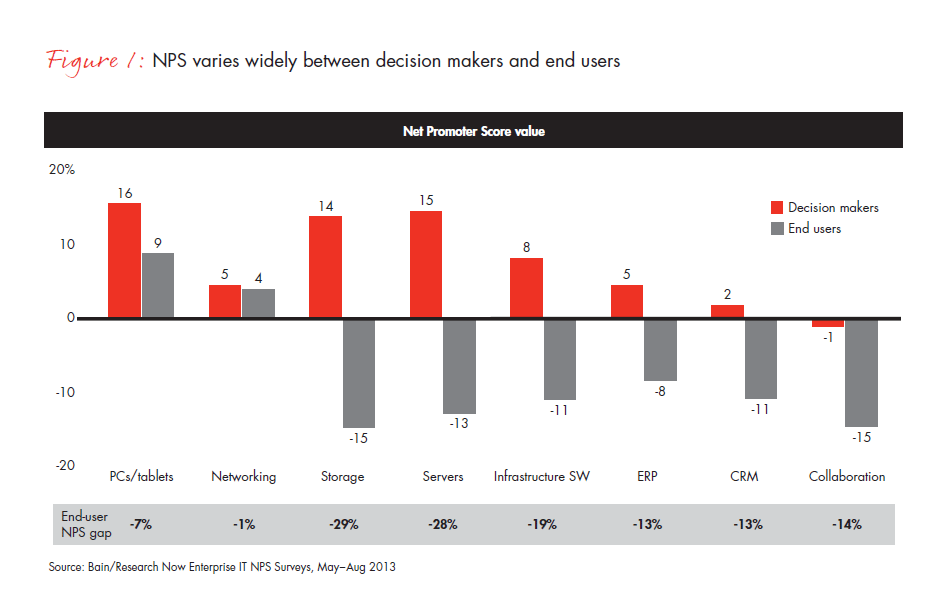
      We found not only low scores for end users, but also a massive gap between their perceptions and those of decision makers. In six of the eight categories, end users gave a negative NPS—that is, they were more likely to be detractors than promoters of their tech vendor. Meanwhile, the scores for decision makers were negative for only one category (see Figure 1).

      why-customer-experience-matters-fig-01_embed

      Why the discrepancy? Often tech vendors have overpromised to decision makers to win the sale and then under-delivered. In our survey, end users cited frustrations with the availability and competence of customer support for hardware; for software, users cited long and complex installations, poor integration and generally clunky functionality and interfaces.

      How the enterprise IT model is changing

      In general, enterprise tech vendors have focused heavily on sales and marketing and product development over the actual customer experience. The old model for enterprise software and hardware depended on a higher-cost direct sales effort that focused relentlessly on key customer decision makers rather than on end users. Vendors often sold a vision of the product’s future possibilities rather than the reality of the day-one experience, and they charged a substantial amount upfront for the product. Once a buyer had decided on a vendor, it was difficult to switch, even if the actual customer experience after installation was poor.

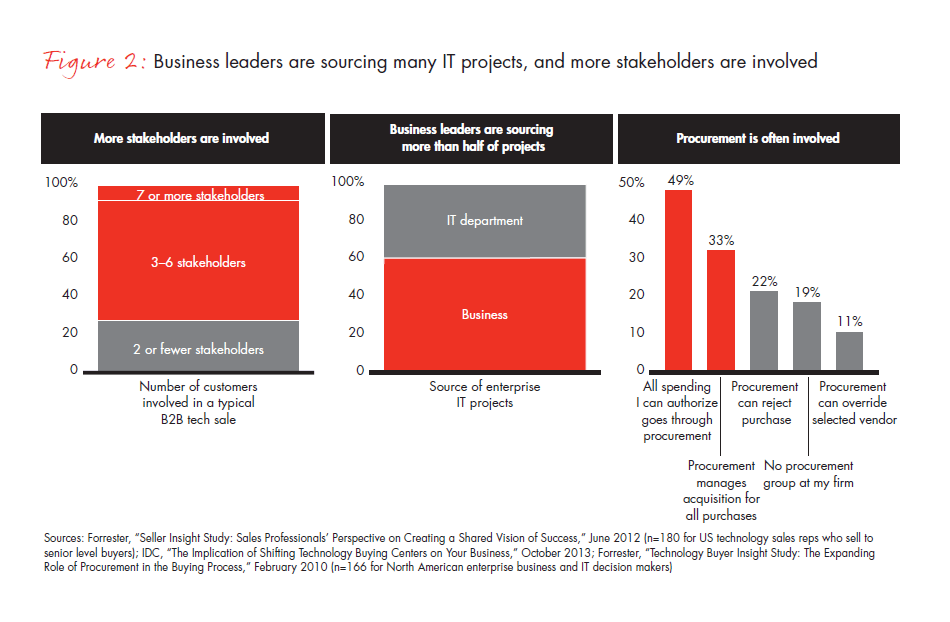
      But as most executives know, the environment in which that sales-and-marketing-driven model developed is changing. Until recently, vendors could focus their sales efforts on a limited set of buyers—in most cases, the CIO and senior IT executives. Now executives in the non-technical functions and in procurement are much more heavily involved in the purchasing process. Armed with increasingly transparent information about pricing, experience and value, buyers across the board are more sophisticated. This has led to more rigorous procurement processes and the decline of “golf course” deal closure (see Figure 2).

      why-customer-experience-matters-fig-02_embed

      Moreover, as the tech market matures, the pathway to profitable growth shifts from attracting new customers to retaining, upselling and cross-selling existing customers. This requires attention to customer touch points after the initial sale, where end users have a stronger voice. Lastly, as pricing models and tech margins shift from products to services, it’s increasingly difficult to sustain poor customer experience when much of the value of the contract has yet to be paid. As an executive at one software-as- a-service (SaaS) provider told us, “We are no longer in an upfront license business, we are now in a renewals business. This software business model can no longer afford poor customer experience.” This is true not only for SaaS. In hardware, too, support and maintenance contracts, along with renewals, are critical elements of the customer lifetime value.

      James Dixon, a partner in Bain's Technology, Media and Telecom practices, explains how companies need to make customer experience a priority as more products and services move to the cloud. 

      Customer experience matters in enterprise IT

      Our research shows that customer experience influences growth for tech companies. Promoters are two to three times more likely than detractors to renew with their vendor. Renewal rates of products with low NPS can run 10 or more points below similar products with higher NPS values— differences that amount to hundreds of millions of dollars.

      At many enterprise software companies, it’s not unusual for renewals on older versions of products to run lower than newer versions, sometimes by as much as 50%. Savvy competitors often target those customers to gain share. Incumbents need to respond very aggressively with upgrade programs to stem attrition.

      Our surveys also found that promoters are about twice as likely as detractors to consider using other products from the same vendor. We have seen this play out in our client experience as well. Efforts to overhaul the customer experience for an enterprise IT client’s core product not only spurred sales for the core product but also reignited growth for adjacent products.

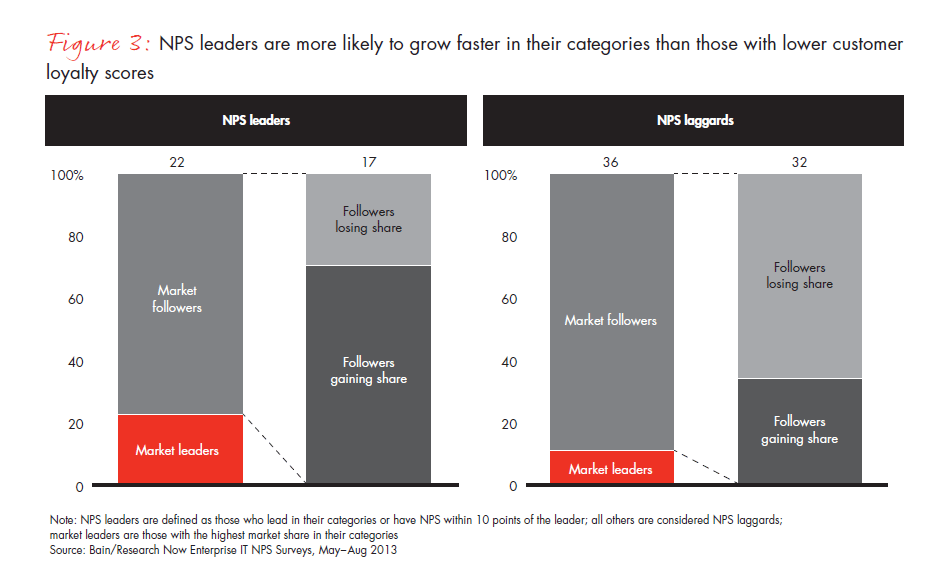
      Finally, we found a relationship between customer advocacy and industry leadership. We segmented each category’s vendors into NPS leaders and laggards, and compared the financial performance of vendors in each group. Vendors with a higher NPS were twice as likely as laggards to be market leaders. And among those who are not market leaders, about 70% of NPS leaders are gaining share, while only about one-third of laggards are gaining share (see Figure 3). Of course, there are always outliers: In some categories, legacy leadership and customer lock-in allow some companies with poor customer loyalty scores to sustain market leadership. However, the structural changes under way, such as shifts to services and greater transparency, suggest these advantages may not last.

      why-customer-experience-matters-fig-03_embed

      How to build better customer experience capabilities

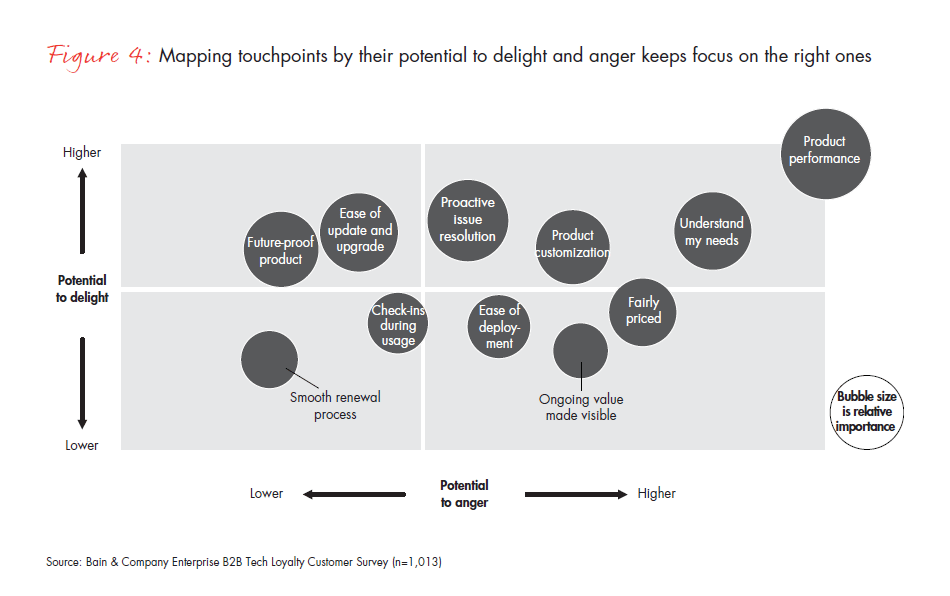
      • Know your customers. Find out which touchpoints matter most in driving delight and frustration among your customers (see Figure 4). Benchmark yourself against direct competitors and loyalty leaders in your sector, and invest in addressing the most critical elements of customer experience for customers at greatest risk of leaving.
      • Put it in context. Set goals for customer experience that align with your competitive situation and your critical strategic issues. A customer experience transformation for a company looking to boost renewal rates may look quite different from one for a company looking to extend its reach to an adjacent product category.
      • Create an “insights to action” engine. Leaders make programmatic investments to track and continuously improve customer loyalty. A well-designed customer experience system has a closed feedback loop installed in each priority touchpoint—one that engages customers, fixes their issues and filters lessons learned back to the organization.
      • Change the mindset. Instill a business culture and create systems based on customer experience. IT companies that have given lip service to customer experience will find it difficult to meaningfully improve with an “initiative of the month” approach. A cultural reset around the customer is needed— both top-down and bottom-up. Installing a chief customer officer helps but is not enough.
      • Be patient: Recognize that it’s a long journey. Commit to bringing your customer experience in line with your promises.
      why-customer-experience-matters-fig-04_embed

      Where are you in your customer experience journey?

      Three questions can help executives begin to turn a critical eye toward their company’s approach to customer loyalty.

      1. Who owns customer experience?
        • Are there specific organizational investments at senior levels?
        • Is customer experience a central part of the operating model across the organization— not just in customer-facing roles?
      2. Do you know which elements of your customers’ experience have the greatest impact on their advocacy?
      3. What are you doing to continually improve customer experience?
        • How do you measure your progress?
        • What is the feedback loop to your strategic plans and day-to-day management?

      Chris Brahm is a partner in Bain & Company’s San Francisco office. James Dixon is a partner in Bain’s Silicon Valley office, where Sarah O’Brien is a manager. Amir Nahai is a partner working in Bain’s Paris and Los Angeles offices. All four work with Bain’s Global Technology practice.


      why-customer-experience-matters-fig-01_full

      why-customer-experience-matters-fig-02_full

      why-customer-experience-matters-fig-03_full

      why-customer-experience-matters-fig-04_full
      저자
      • Headshot of Chris Brahm
        Chris Brahm
        Alumni, San Francisco
      • Headshot of James Dixon
        James Dixon
        Alumni, Silicon Valley
      문의하기
      관련 산업
      • 기술
      고객 전략 및 마케팅
      Do Your B2B Customers Promote Your Business?

      More than great engineering or product features, competitive advantage flows from the strong loyalty of customers.

      자세히 보기
      The cloud reshapes the business of software

      Scale, platform power and stickiness will still be necessary, but speed and deep customer insights will become essential, too.

      자세히 보기
      고객 전략 및 마케팅
      Mastering the New Reality of Sales

      As customers seize power and sales migrate online, B2B sales need a radical new approach.

      자세히 보기
      기술
      Software M&A

      The good news: Most deal best practices still apply to AI acquisitions.

      자세히 보기
      기술
      Exploring AI for Packaging Circularity

      AI is already creating value across the packaging lifecycle, from optimising design and reducing material use to improving sorting and traceability.

      자세히 보기
      First published in 5월 2014
      태그
      • 기술

      프로젝트 사례

      지속 가능성 및 기업의 사회적 책임 Can Microchips Turbocharge Sustainability Improvement?

      See more related case studies

      고객 전략 및 마케팅 Increased sales productivity frees selling time and saves millions

      See more related case studies

      성과 개선 Aggressively growing an IT service provider with a high-performance culture

      See more related case studies

      베인에 궁금하신 점이 있으신가요?

      베인은 주저 없이 변화를 마주할 줄 아는 용감한 리더들과 함께합니다. 그리고, 이들의 담대한 용기는 고객사의 성공으로 이어집니다.

      급변하는 비즈니스 환경에서 살아남기 위한 선도자의 시각. 월간 Bain Insights에서 글로벌 비즈니스의 핵심 이슈를 확인하십시오.

      *개인정보 정책을 읽었으며 그 내용에 동의합니다.

      Privacy Policy를 읽고 동의해주십시오.
      Bain & Company
      문의하기 환경정책 Accessibility 이용약관 개인정보 보호 쿠키 사용 정책 Sitemap Log In

      © 1996-2026 Bain & Company, Inc.

      문의하기

      무엇을 도와드릴까요?

      • 프로젝트 문의
      • 채용 정보
      • 언론
      • 제휴 문의
      • 연사 초청
      오피스 전체보기