

Brief

Today’s grocery business will be virtually unrecognizable a decade from now. As Amazon brings its power and proven approach to deliver the market’s omnichannel potential, now boldly setting a new frontier with its Amazon Go store of the future, and as food delivery services and specialized start-ups continue to enter the competition in unexpected ways, grocery retailing is evolving at record speed—and it is easy to feel daunted by the changes. Indeed, many grocers in the US have cautiously watched events unfold and, amid tough industry economics, shied away from making the required big moves that will help them get out ahead. They’ve struggled to invest sufficiently in a battle they fear they cannot afford to win. However, with the strong new competition and rapid changes, retailers can no longer avoid the tsunami coming at them.
In fact, those who do not invent the future run the risk of being overwhelmed by it. They also have more power than they think.
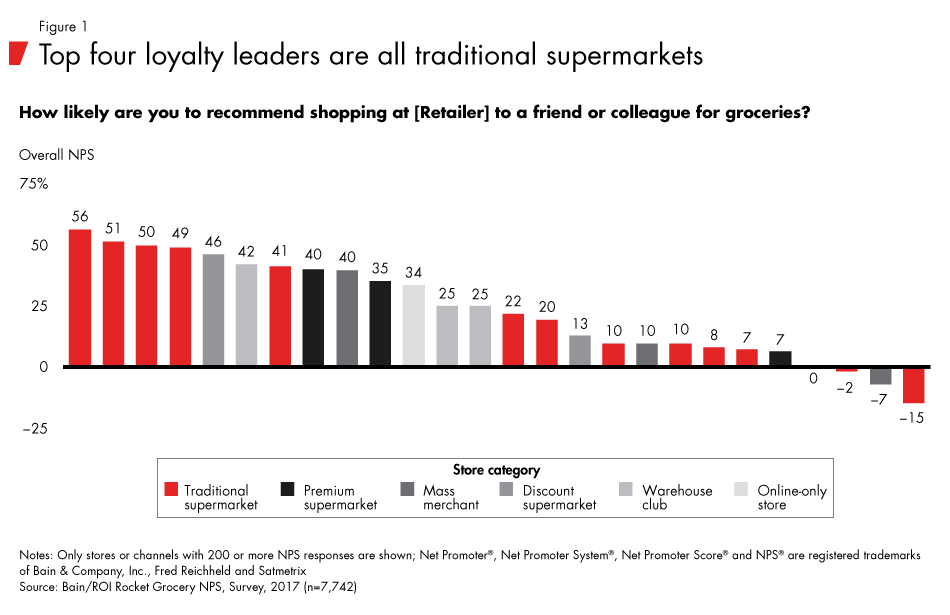
The reality is that as omnichannel becomes widespread in the industry, many traditional incumbent grocers are in a solid position to outpace the competition, both old and new, with a model that is sustainably profitable. Over the decades, these players have steadily gained market share and many have built industry-leading levels of customer loyalty (see Figure 1). Ceding ground to newcomers now means losing not only customers’ hearts, but also the scale and cost gains that have bolstered years of success. So the road ahead starts by investing to protect those hard-earned loyalty and market-share advantages and build on those strengths, thoughtfully expanding digital capabilities while finding new ways to reimagine physical stores to serve evolving customer needs.
Grocers can learn from markets that are further along on the learning curve. While online now represents only 3% of all grocery sales in the US, it accounts for 9% in the UK, about 5.5% in France and is approaching 20% in South Korea, where the urban density (and digitally savvy population) makes the economics work well. Traditional grocers in those markets have taken early, aggressive moves to preempt competition from online pure plays. Some have maintained market share even as the business has made its big online shift.
Consider the strategic steps taken by South Korea’s E-Mart to eliminate customer pain points and attract shoppers to stores, while increasing the degree to which retailing becomes seamlessly omnichannel. For example, to serve different grocery buying needs, the retailer built a proprietary digital platform combining all of its grocery formats as well as a “marketplace.” It offers numerous in-store services tied to its mobile application. Customers can scan the barcode of bulkier products using the E-Mart mobile app and, after paying at the register, have the products delivered to their home. Shoppers can retrieve product information such as reviews and discounts by scanning the product’s QR code. E-Mart invested significantly in back-end operations to offer five different same-day delivery options. To create synergy with its online business, it assigned new roles for stores—they now serve as pickup centers and shipping centers for orders placed online. It also improved its product line with high-profit offerings such as ready-made meals.
Another example of a move toward the future: The acquisition of Argos by Sainsbury’s, which allowed the large UK grocer to further build its scale in nonfood categories, access new fulfillment capabilities and add Argos shops within its supermarkets.

Cultivating Grocery Customers
Grocers eyeing an uncertain future should not forget why their current customers love them.
Retail economics have been challenging, and in hindsight some grocers have made some steps that aren’t worth replicating, but they’ve also created new customer propositions while striving to manage pricing and face some big questions, such as what you can charge for and what you need to give away. For example, in the battle for market share, some European grocers have neglected to charge for the extra effort required for delivery, exposing themselves to financial trouble. Now, consumers have been educated that picking, packing and delivery come at no cost to them. That’s difficult to reverse. The lesson to retailers making those new decisions is clear; educate the market from the start on the price and value of the service you are providing.
Winning also means redefining your investment model. Doing nothing comes at a big cost. By not investing to maintain your leadership position, you will watch your business erode. Even in the changing landscape, scale still matters, and investing to maintain your leadership position is more critical than ever before. However, it is important to acknowledge that investments in both online and offline will remain dilutive in the near term, and that there is an imperative to manage costs to fund the moves that will be necessary to survive and flourish.
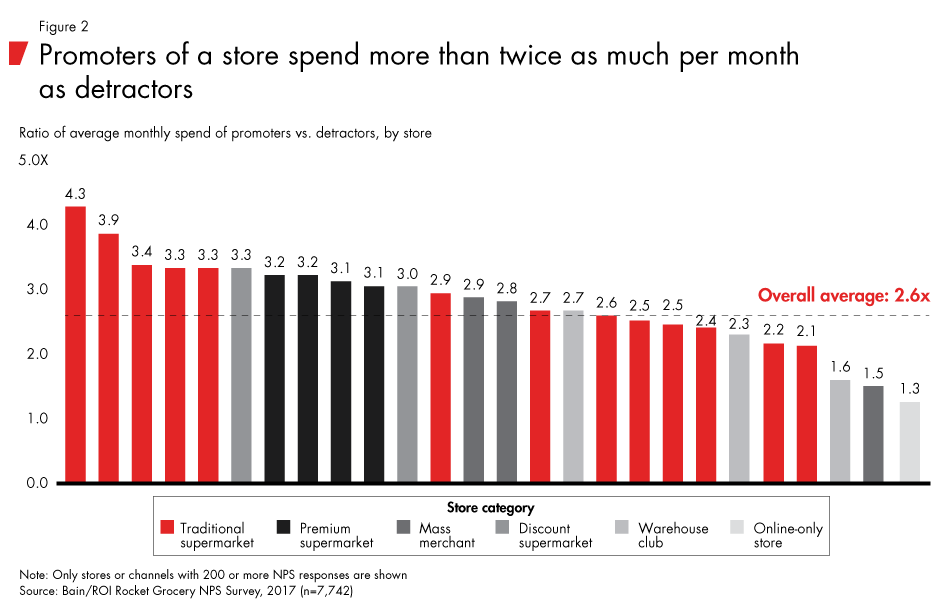
Over the years, leading US grocers have shown how to take the initiative required to gain an edge over rivals. Grocers like H-E-B invested to emphasize localized store formats and product assortments, companies like Walmart and Aldi created a value proposition on pricing, Publix made high-touch customer service a priority, and Wegmans built a reputation for retail theater and prepared foods. Now, these differentiating strategies can give traditional grocers a leg up on newcomers in multiple ways. For example, when customers like your brand, they already spend more with you and may be more likely to stick with you over a newcomer if you have a strong e-commerce offering (see Figure 2).
The omnichannel imperative has brought with it an opportunity to reevaluate how you differentiate and how you can bring that same philosophy to online offerings while evolving your physical stores to meet changing shopper behavior. If anything, omnichannel is a tricky balance. While shoppers undoubtedly will go online for more and more of their routine purchases, they will always look to physical shopping as a part of their total shopping experience. It provides inspiration, variety, entertainment, personal contact and advice, and the ability to confirm freshness and make impulse purchases, among many other things.
A huge part of the challenge has been figuring out how to nail the online offering without losing sight of the critical role that stores will play in the customer experience. That requires boldly experimenting with stores to enhance the shopper experience—to learn what shoppers like in a local trade area while testing your own capabilities. For example, you could install cafes where shoppers can dine on prepared foods provided by third-party vendors, or devote aisles to fresh seafood. You might design an attractive space devoted to picking up items bought online, or erect kiosks for placing online orders that will be delivered to a shopper’s home within an hour, seamlessly combining the best of both physical and digital retailing (what Bain calls Digical®).
The most successful grocers will be those that invest to offer an omnichannel experience without losing sight of their unique value proposition and what they stand for in the customer’s mind.
Bain Partner Lisa Koetter discusses five things traditional grocers can do to stay competitive.
How to find your future
We find that leading grocers get five things right.
Really understand what it is that customers love about you. A fundamental rule for physical stores still applies in an omnichannel world: You cannot be all things to all people. You need to clearly define your value proposition. What do you stand for that is truly distinct? Where do you focus? What can you deliver better than anyone else? Is it convenience? Price? Fresh food? Understand what your customers want and why you have earned their loyalty, and do not abandon that as you define your e-commerce model. In fact, double down on it.
Take your current differentiation and use it online. Omnichannel is an opportunity to recommit yourself to the value proposition that made you successful in the first place. If you put something out there that is too different, it will just confuse your customers. The objective is to reimagine your current value proposition and take that online. For example, if fresh is your differentiation, offer five degrees of ripeness for bananas ordered online. Grocers can look across industries to see how companies are successfully translating their brand positioning into an online environment. Sephora’s value proposition includes an in-store experience in which shoppers sample various types of cosmetics before buying. Online, it relies on augmented reality to offer its “Sephora Virtual Artist,” an interactive virtual makeup mirror that allows shoppers to experiment with different products, shades and styles. Likewise, Best Buy is known for its store-within-a-store concept and the availability of Geek Squad technicians. The electronics retailer’s site offers a similar store-within-a-store experience online as well as the chance to chat live with a Geek Squad agent.
Online brings with it a host of critical business model decisions, such as choosing delivery offerings—same day, next day and pickup—and the choice between what you build yourself and where you partner. Start small and experiment, working with different models and partners to test both physical and online options narrowly by geography. For example, geotargeting may mean offering free online delivery in an urban center, where it is not cost prohibitive and where customers may be more willing to pay, but charging for delivery in outlying areas. It may mean piloting new ministore formats in city centers but larger stores in suburbs. Be careful not to overdeliver or overcommit in ways that are unprofitable and difficult to reverse in the race for market share.
Understand that investing in digital capabilities (tools and people) and operations is table stakes. To succeed in omnichannel you will need to invest in a range of new capabilities, such as generating, collecting and analyzing customer data for personalized marketing and services. These investments should be designed to improve the efficiency of your overall operation in addition to boosting basket size and margins. You cannot invest in everything all at once. You will need to be disciplined, focusing all investments to serve your chosen strategy. The best companies have a portfolio mindset (e.g., 70% of investment is to support the current business, 20% is for near-term changes and 10% is for farther-out innovations). Take a careful, honest look at the capabilities you have, what you need to execute on your strategy and the gaps to fill. For many incumbents, the answer will involve redesigning the operating model for an omnichannel world.
Reimagine the role of the physical store. Again, as omnichannel takes hold, the physical store experience will need to change. Stores will look vastly different 10 years from now—with an expansive pickup area, a convenience section for topping up purchases made online and other big changes that we cannot yet imagine. Ask yourself what you want the physical store to look like for your customers and begin moving in that direction now. For example, create a customer-friendly pickup experience that is operationally efficient. Walmart is experimenting with an offering in which customers can text an associate while in the parking lot to get a head start on picking up items purchased online. Important: Your vision of the future physical store needs to be tailored locally. This is what H-E-B achieves by operating its food hall–inspired Central Market concept in some upscale locales and its Mi Tienda stores in areas that serve primarily Hispanic/Latino customers. In addition, it is critical to understand how new parts of the store that may seem auxiliary to the shopping experience, like tables for ready-to-eat meals, will gain importance by boosting foot traffic. Another big consideration: getting the right-sized store for the location.
Revise how you think about your investment model. Do not make the mistake of evaluating investments in omnichannel on a standalone basis. If you do, it will always look dilutive. You need to consider investments in a broader context of total trade areas and catchment areas. It is critical to understand customer profitability across channels. And remember that there is a cost of doing nothing in your analysis.
The same applies to measuring performance. You no longer can segregate profitability within the four walls of a physical store from online profitability. You need to combine them, considering the total cost to serve. Among the questions to ask: What is your charge-back philosophy? What is the customer willing to pay for? What do you give away for free to earn loyalty? What will you charge for? For example, your customers may be willing to pay for same-day delivery but not for instore pickup—but how will that vary by location? Without appropriate attention to charging tactics and pricing, online will continue to offer less attractive returns than traditional store retailing on a standalone basis.
There is no avoiding the need to reimagine grocery for an omnichannel world. For the leading incumbent grocers—who have built impressive customer loyalty over the years—the opportunity is yours to lose.
Stephen Caine and Lisa Koetter are members of Bain & Company’s Retail practice. Stephen is based in Chicago, Lisa in Boston.
Digical® is a registered trademark of Bain & Company, Inc.
Net Promoter System®, Net Promoter Score®, Net Promoter® and NPS® are registered trademarks of Bain & Company, Inc., Fred Reichheld and Satmetrix Systems, Inc.
First published in fevereiro 2018