

M&A Report

Executive Summary
- A broad-based rebound boosted deal value by 40%, led by resurgent tech M&A.
- Megadeals greater than $5 billion represented more than 73% of incremental deal value as infrequent acquirers came off the sidelines.
- Despite the rebound in activity, the relative share of capital allocated to M&A is at a low of 7%.
- Scope deals accounted for 60% of big deals, making it the biggest year on record for deals driven by revenue growth.
Este artigo faz parte do Relatório de Fusões e Aquisições de 2023 da Bain.
In a year marked by artificial intelligence’s rampant advancement, shifting trade policies, and tepid global volume growth, companies across industries saw the urgent need to reboot strategy. And for many, that meant a return to M&A. The year 2025 is on track to become the second-highest in deal activity: up 40% in value, to an estimated $4.9 trillion, and 7% in volume (see Figure 1), with similar gains across strategic, private equity (PE), and venture capital (VC) acquirers.
Figure 1
Notes: Strategic M&A includes corporate M&A deals and private equity portfolio add-ons; some deals show as $0T due to rounding; bar totals may not equal sum of segments due to rounding
Source: DealogicWhen we unpacked the rebound of 2025, we found two trends with particularly broad implications. First, it was a year of many big bets made by companies that traditionally make few deals. Will that lack of experience impede value creation? In addition, despite the overall robust market, M&A actually took a back seat to other investments in 2025. Companies devoted substantially less of their capital to M&A than they invested in other avenues for growth, namely capex and R&D. How do companies gain confidence in the value creation of any individual deal against an ever-rising bar and competing demands for capital?
What’s behind the rebound?
The rebound of 2025 is notably broad-based across industries and geographies. All regions and industries grew by double digits. Tech M&A is back, up by 77%, propelled by deals for AI-related assets such as Alphabet’s $32 billion purchase of Wiz and Palo Alto Networks’ $25 billion acquisition of CyberArk, not to mention a variety of large-ticket minority investments such as Softbank’s $40 billion investment in OpenAI or Meta’s $14.3 billion investment in Scale AI. Almost half of strategic technology deal value for deals greater than $500 million came from AI natives or deals that cited AI benefits in 2025.
The advanced manufacturing and services sector was also a major contributor to strategic M&A growth in 2025, with headline merger deals such as Union Pacific and Norfolk Southern’s $88 billion tie-up or Airbus, Leonardo, and Thales’ three-way arrangement to create a scale player from the Europe, Middle East, and Africa region in the growing space sector (see Figure 2).
Figure 2
Note: Strategic M&A includes corporate M&A and private equity portfolio add-ons, excludes conglomerates and services
Source: DealogicThe rebound is global. Deals for US targets powered global growth and accounted for nearly half of total strategic deal value. Greater China, the second-largest market, led in deal count, driven by a robust domestic market that accounted for more than 80% of Greater China deal value. Meanwhile, Japan’s M&A market doubled in value to become the third-largest globally while also increasing its number of deals by double digits. Europe, the Middle East, and Africa also experienced strong M&A value growth aided by megadeal activity, but the region’s overall deal count remained flat (see Figure 3).
Figure 3
Notes: Deals classified by target region and country; strategic M&A includes corporate M&A and private equity portfolio add-ons
Source: DealogicA host of factors influenced the decision to buy to grow and respond to changes in profit pools in 2025. Many of the headwinds of the post-pandemic years calmed down. Regulations are easing. The cost of capital is easing. The buyer-seller gap is easing, with valuations rising slightly and sellers perhaps less tied to 2021 peak valuations (see Figure 4). More executives realized that it no longer made sense to wait it out. For many, it was a decision made easier amid the key lesson of AI’s disruption: You need to reinvent yourself or react to what’s happening.
Figure 4
Notes: Median deal multiples for announced strategic deals in which valuation data was available; strategic M&A includes corporate M&A and private equity portfolio add-ons
Source: DealogicIndeed, AI’s role in dealmaking is everywhere. According to our recent survey of more than 300 M&A executives, AI adoption for M&A more than doubled, to 45% of practitioners, and its usage is more widespread across company types and within the M&A value chain. While sourcing and screening still are AI’s main uses, more dealmakers have begun relying on the technology for other functions—planning and executing integration, for example. And many more acquirers now view due diligence as an opportunity to scrutinize AI’s potential risks and opportunities in a target. Indeed, one in five strategic dealmakers tell us that they have walked away from a deal because of the anticipated impact of AI on the target’s business.
M&A executives cited the central role of strategy as the No. 1 reason for sustaining or increasing their deal activity in 2025, and more than 85% said that they refreshed their M&A pipeline, pointing to shifts in technology and strategy. As an indication of the rapidly growing reliance on M&A for strategic shifts, 40% of megadeals valued at more than $5 billion during the first 10 months of 2025 are categorized as transformative, meaning that they represent more than 50% of the acquirer’s market cap.
That’s not to say that there aren’t competing forces at play. For example, PE and VC firms still have a lot of investments in their portfolios that they’ve yet to bring to market. Unrealized value in PE portfolios is at record highs. And lingering above everything, there remains the shadow of macroeconomic uncertainty.
What’s not substantially influencing deal activity?
Early in the year, uncertainty in the wake of US tariff announcements in April slowed deal-making activity, but the pullback was short-lived. Momentum among both corporate and PE buyers and sellers steadily gained over the course of the year.
Likewise, there was concern that uncertainty on trade policies would encourage acquirers to adopt a domestic focus. But that, too, hasn’t happened. The rate of cross-border deals hasn’t substantially changed in 2025. When we polled M&A executives on the issue, less than half said that trade restrictions impacted their overall M&A plans, and 70% said that the policies would not affect their divestiture plans.
While post-globalization didn’t have a big impact on M&A in 2025, we still think it will over time. We’re already seeing the first hints. On balance, non-US companies now have lower appetite for US-based assets, according to our research, while US buyers are more likely to pursue a domestic deal because of tariffs.
M&A provides optionality and access to markets as global trade patterns fragment along regional lines. We’re now seeing more arm’s-length moves between the two biggest deal markets: US and China. For example, in 2025, Starbucks announced it would sell a controlling stake in its China retail operations to Boyu Capital, a Chinese investment firm, to create a joint venture better positioned to compete in the China market. At the same time, Western companies seeking to benefit from China’s world-class pipeline of pharmaceutical therapies are pursuing creative partnership structures that enable access and learning if not control. China’s share of global pharma licensing deals has doubled since 2020.
Meanwhile, there is the capital allocation issue. Over the past decade, M&A has lost share to other forms of cash expenditures by S&P World Index companies, reaching a low of 7% in 2025 (see Figure 5). As a percentage of gross domestic product, M&A has regained ground, but it still lags previous peaks. Our analysis of capital allocations made by nearly 700 companies shows that while there generally is ample cash on hand, more is being spent on capex or R&D than M&A as companies invest in everything from factories to robots to energy farms. Among the biggest non-M&A capital allocation: In the first three quarters, the Mag 7 combined to invest almost $500 billion in capex and R&D through the third quarter of 2025.
Figure 5
Note: Data is a subset of S&P World Index Companies (n=685)
Source: S&P World Index data from S&P Capital IQWe predict that instead of fueling deals and influencing the types of deals getting done, the rise of protectionist measures will continue to have a greater impact on capital allocation. Building back resiliency into supply chains will be expensive as companies take on the incremental cost of not only moving but adding plants. More important, companies across sectors will need to invest in AI capabilities, physical automation, and modernizing their tech stack. What this means for M&A executives is even more scrutiny on regular capital allocations to M&A as well as a higher bar for the ROI of any potential deal. More boards will ask if they’re getting the intended value out of deals. Companies will need robust diligence to build conviction in a deal and the confidence to execute.
Big bets
Megadeals valued at greater than $5 billion are fueling the resurgence in M&A, representing more than 73% of the increase in deal value in 2025. But it gets more interesting when you dig down to see who is making them. Infrequent acquirers accounted for about 59% of megadeals. And many of those are big bets to transform the business, as evidenced by the deal value comprising 50% or more of the acquirer’s market cap (see Figure 6). This gives us pause.
Figure 6
Notes: Megadeals include strategic acquisitions greater than $5 billion in deal value announced between January 1, 2025, and November 15, 2025, exclude spin-offs (n=78); market capitalization determined 20 days prior to deal announcement; private acquirers include privately held and government-owned entities; frequent acquirers made 10 or more acquisitions over the past 10 years; strategic M&A includes corporate M&A and private equity portfolio add-ons
Sources: Dealogic; S&P Capital IQOften, big-bet deals turn out to become make-or-break moves. The last time global M&A deal value exceeded $4 trillion, some of the biggest deals were outsized successes while others were massive failures, according to our analysis of top deals from 2021. We’ve had a front-row seat for enough megadeals to know that big bets grounded in sound strategy can transform the business and set a new growth trajectory. On the other hand, deals made for less-strategic reasons can become a recipe for value destruction.
Large-ticket deals are always risky. Absorbing a $5 billion, $10 billion, or $50 billion business can be a challenge when it comes to preserving and amplifying value, even for mega-cap companies. And it can be even more difficult when the deal approaches being a merger of equals or any situation that can change the acquirer as much as the target. It’s impossible to overstate the importance of getting the organization in order as a first giant step.
While diligence can help identify the risks as well as the value creation potential, ultimately, big bets are bold strategy moves by the CEO and board that require clear and early answers to fundamental questions that too often fail to get asked. What is our shared vision? What is our operating model? How will decisions get made? What kind of culture do we want? Can our enterprise technology infrastructure support the combined company? Are we truly prepared for the daunting change management at both companies? How do we execute?
Sure, frequent acquirers will have some edge in execution. But no experience curve will protect a company from bad outcomes if the strategic bet isn’t right and these big, basic questions aren’t asked and answered thoroughly and with urgency.
A swing toward scope deals
Another big theme of 2025 is the swing toward scope deals. In the first nine months of the year, 60% of the deals valued at greater than $1 billion were scope, putting the year on track for the highest rate of scope dealmaking. Last year’s swing to scale reflected a focus on near-term cost synergies by companies with high fixed costs amid high macroeconomic uncertainty. The dramatic shift toward scope deals, as evidenced by the rebound in tech deal volume as well as the strategic shifts experienced within industries, reflects more confidence in top-line–driven dealmaking (see Figure 7).
Figure 7
Notes: Analysis includes strategic deals with value greater than $1 billion, excludes real estate and services; strategic M&A includes corporate M&A and private equity portfolio add-ons
Source: Bain & CompanyFinancial services and the advanced manufacturing and services sectors, both traditionally scale-focused, have each revealed a growing appetite for new markets and customer segments through M&A (see Figure 8). For example, homeownership firm Rocket Companies pursued a vertical integration strategy through its acquisitions of mortgage servicer Mr. Cooper Group and home search platform Redfin. Active scope dealmaking in the building products sector also represents this use of M&A to access new categories, customers, and channels. James Hardie’s acquisition of Azek opened up access to higher-margin segments in exterior and decking products, and Lowe’s purchase of Foundation Building Materials expanded its access to professional customers and specialty distribution areas.
Figure 8
Notes: Analysis includes strategic deals with value greater than $1 billion, excludes real estate and services; strategic M&A includes corporate M&A and private equity portfolio add-ons
Source: Bain & CompanyAs we’ve seen from tracking M&A for more than two decades, each year brings with it different ways in which industries use deals to deliver on strategy and create value. In pharma, executives started turning to M&A to define their future less by size alone and more by identifying the parts of the value chain that they truly needed to own to stay ahead. For their part, oil and gas companies consolidated in record numbers, aiming to capture scale, cut unit costs, and further integrate value chains to get out ahead of everything from declining oil prices to all-time high demand for natural gas. In banking, companies are increasingly looking for deals with elements of both scale and scope—namely, deals with efficiencies and cost synergies as well as the benefits of complementary capabilities. And in consumer products, large players are taking a hard look at their portfolios and divesting assets that don’t fit their desired strategy and growth profile.
In our full report, we take an industry-by-industry look at how companies are changing their approaches to dealmaking and report on the key trends that M&A practitioners are likely to experience.
-
Methodology (click to expand)
State of the market M&A data
Deal details and aggregate statistics (such as value, volume, multiples) were sourced primarily from Dealogic’s M&A database for this annual report. Q1–Q3 data in most figures includes the time period from January 1 to September 30. Year-to-date 2025 data in most figures includes the time period from January 1 to November 15.
This report’s focus is on strategic M&A, which includes deals inked by corporate buyers (including via sponsor exits) or private equity add-on acquisitions, because both M&A types have fundamentally strategic objectives. All other types, including financial sponsors and venture capital, are classified as nonstrategic. Together, these two categories equal Dealogic’s total M&A market. The region and industry of each deal is classified according to the target’s region and industry unless an exception is noted.
Scale vs. scope
The M&A report signifies scale and scope deals in our chapters’ analyses to discern trends. Assessing deals through these lenses offers crucial insights into M&A market theses and themes.
To understand the nature of M&A activity, we first identified the top 250–300 strategic deals for each year. From the initial list of deals with values greater than $1 billion, as reported by Dealogic, we excluded nonstrategic deals. These include asset or property acquisitions, financial investments, internal reorganizations, and minority stake acquisitions. This resulted in a total of 2,870 deals for the period between first quarter 2015 and third quarter 2025.
We then classified the strategic deals into scale or scope deals based on our proprietary database criteria applied consistently across the years. The proprietary criteria use the stated strategic rationale by the acquirer at the time of announcement to identify the key elements of the deal thesis. Based on these elements, the deals were categorized as scale or scope deals.
Scale deals are intended to strengthen market leadership and lower cost position through benefits of scale, such as cost synergies. Scope deals are intended to accelerate top-line growth by entering or expanding into faster-growing segments, or by bringing in new capabilities (see Exhibit A).
Exhibit AAbout the methodology 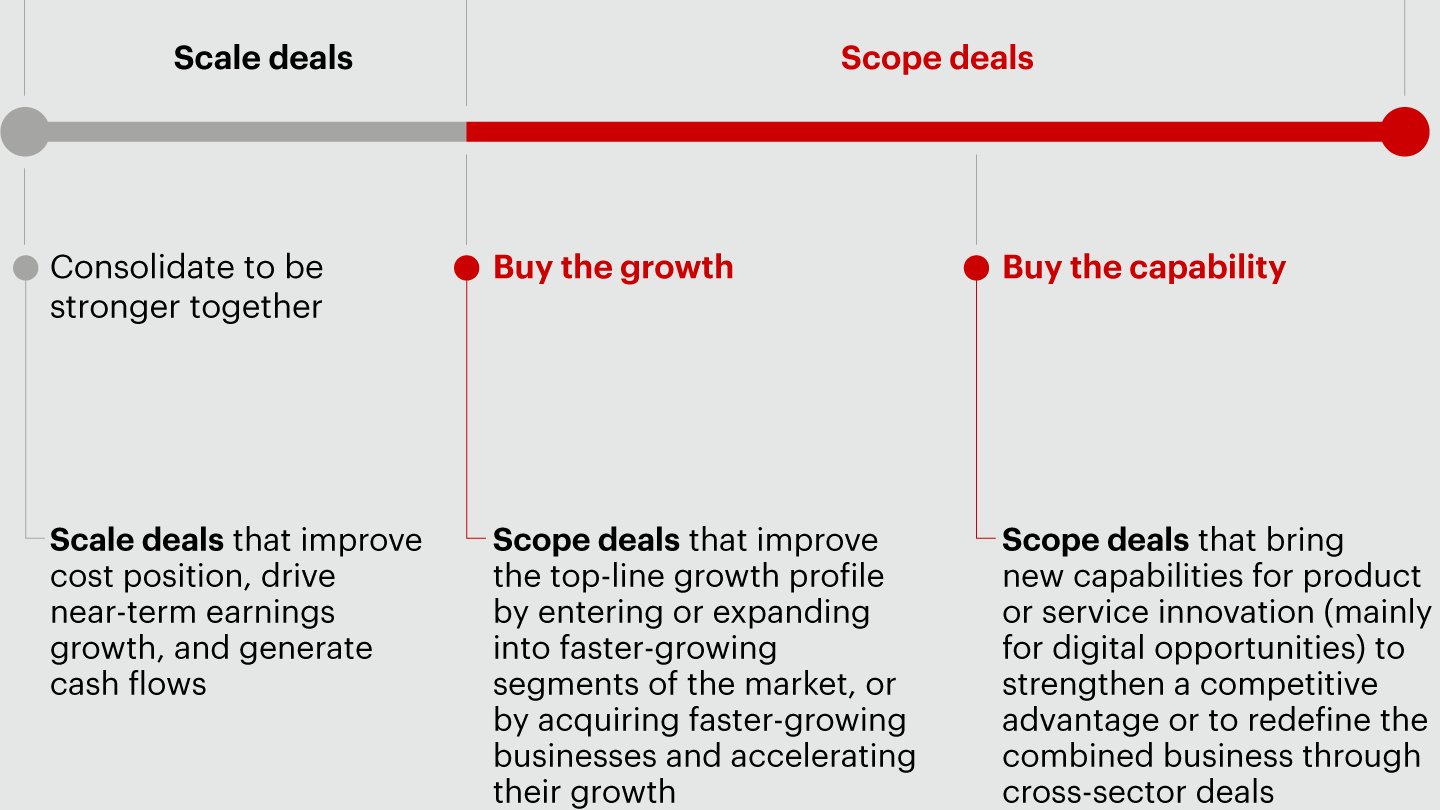

Source: Bain & Company The Practitioners’ 2026 Outlook Survey
The Bain M&A Practitioners 2026 Outlook Survey (n=303) was conducted online by IncQuery in November 2025. The survey ran in Australia, Brazil, Canada, France, Germany, India, Italy, Japan, Singapore, Spain, the UK, and the US. Survey participants held senior executive roles with titles such as vice president, senior vice president/executive vice president, director, C-suite, or owner at companies with greater than $100 million in annual revenue that closed at least one M&A deal per year over the past three years—and they were responsible for M&A decision-making processes at their company.
Leia nosso Relatório de Fusões e Aquisições 2026