

Brief

Executive Summary
- Amid rising consumer demands and digital advances, five retailer models are poised to thrive: “ecosystem players,” “scale fighters,” “value champions,” “hitchhikers” and “regional gems.”
- Retailers that don’t fit these models are at risk of failure or takeover. They typically fall into two groups: “legacy laggards” and “exciting but unsustainable innovators.”
- These vulnerable companies can aim to move to a winning model by addressing shortcomings in scale, innovation and data-led consumer understanding.
The rules of retail have fundamentally changed. Success in the industry often used to hinge on being bigger than your immediate competitors. Skillful operators that were No. 1 or 2 locally tended to enjoy higher profit margins. In US grocery, for instance, retailers with powerful local relative market share historically achieved operating margins of 4% or more, while rivals in weaker positions earned a fraction of that.
In this era of rising consumer demands and digital advances, however, local leadership is only part of a winning formula. For a start, to create the distinctive products, seamless service levels and meaningful brands needed to sustain a winning streak these days, retailers also have to excel at rapid innovation.
Furthermore, it is clear they must master data analytics to understand and delight customers who have become more demanding and harder to pigeonhole. The industry leaders are finding that the same data skills have become key to cost-reduction programs in areas such as labor-cost management, supplier negotiations and reduction of inventory shrinkage. Analytics is also core to their attempts to win and retain traffic, both online and in-store.
Bain's Marc-André Kamel and Suzanne Tager discuss how the rapidly shifting retail environment is changing the rules of the game.
Above all, retailers need a different type of scale to thrive in the future. The regional No. 1 or 2 will still have a solid base for competition, for sure. But for most retailers, local heft will have to go hand in hand with a more absolute type of scale—one that can fund the unprecedented investments required to stay competitive with the likes of Amazon and Alibaba as the industry digitalizes.
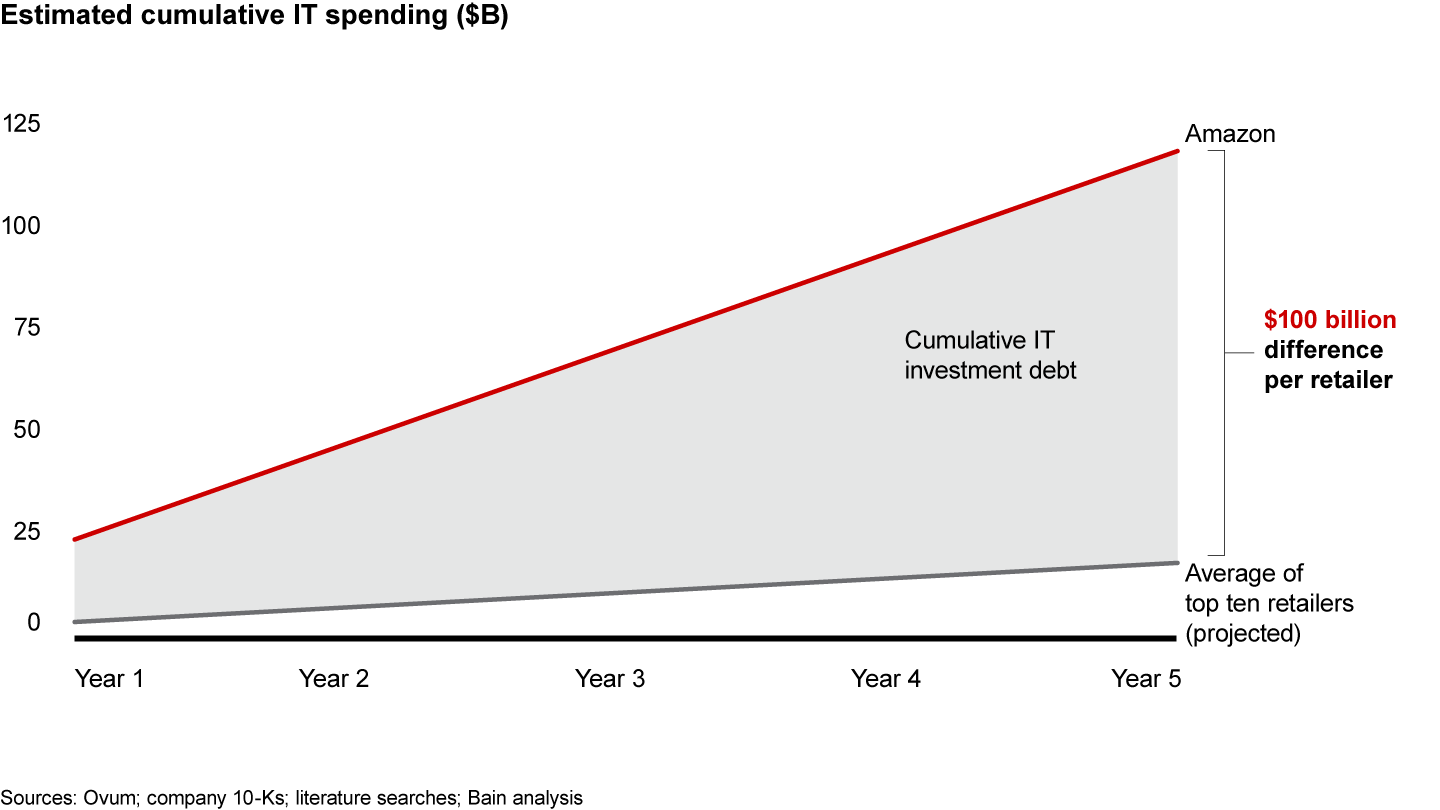
That’s no small challenge. For instance, the world’s 10 largest traditional retailers are spending a much smaller proportion of their revenues on IT than Amazon, which views digital tools, data analytics and other technology as core to its mission to get ever closer to customers. The cumulative impact of this underspending—call it their “IT investment debt”—is likely to be striking. On average, each of those top 10 retailers will be putting an estimated $100 billion less into IT than Amazon over the next five years at current spending rates, according to Bain & Company research (see Figure 1).
Figure 1

Investors recognize that existential issues are at play. While many stock markets climbed in recent years, valuations of retail stalwarts have been heading in the opposite direction; the enterprise value-to-revenue ratio for most retailers has dropped 4% annually since 2015.
Many retailers have plenty of work left to do to secure their future. Analyzing the evolving marketplace, Bain has found five retailer models that are likely to thrive in the future. Those that don’t fit these models are in serious danger.
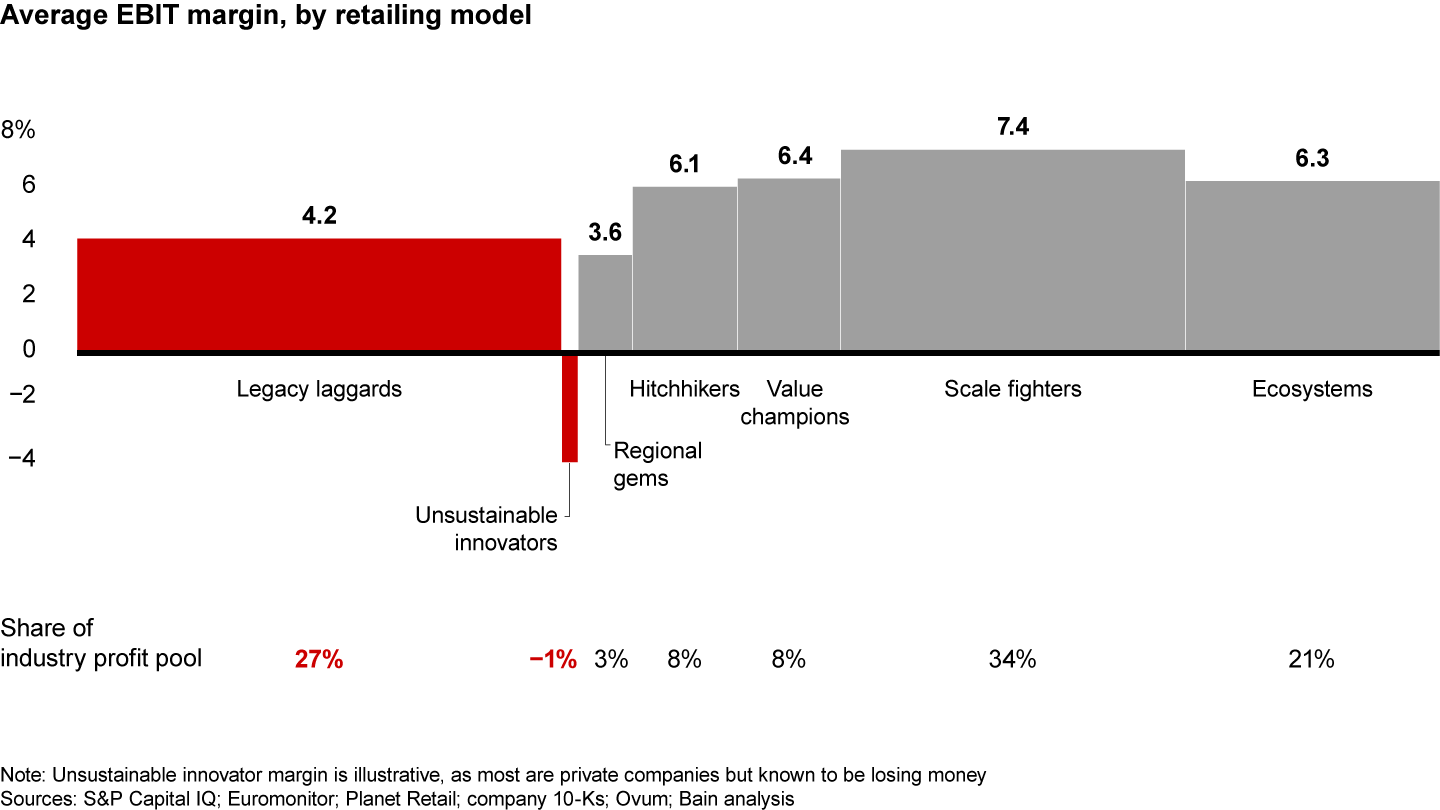
As many retail executives know all too well, the threat to the industry is wide-ranging. In the US, for instance, we calculate that retailers accounting for nearly 30% of the sector’s entire profit pool are currently at risk (see Figure 2).
Figure 2

However, if they can address shortcomings in scale, innovation and data-led consumer understanding, many threatened retailers should still have time to develop a winning model. By the same token, those already in a strong position will have to move even faster to maintain their advantages.

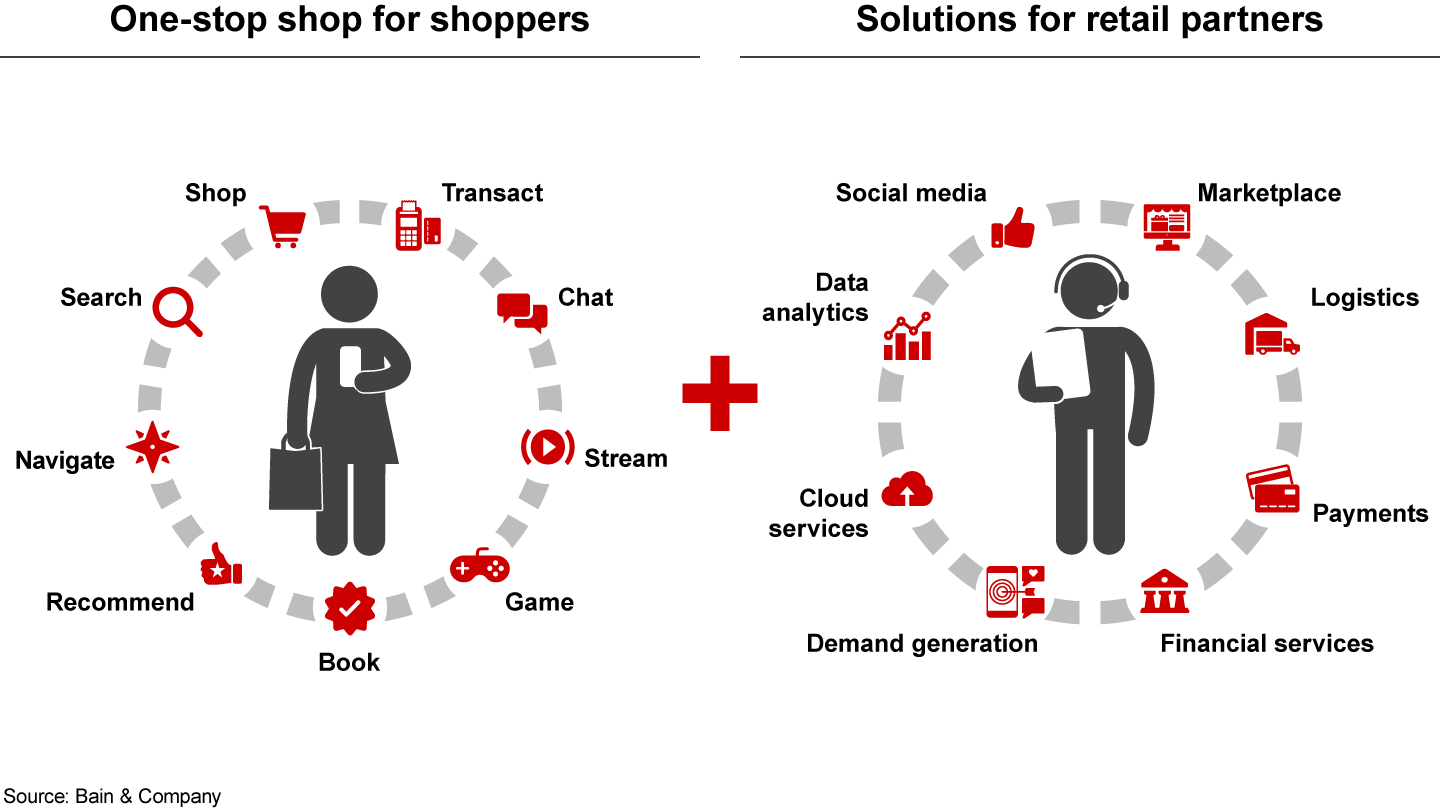
One of the strongest retailing models of the future belongs to the far-reaching “ecosystem players.” These are the companies building one-stop shops for consumers—places to browse, buy, read, chat, play and more. Their ecosystems also offer all-in-one solutions to other vendors, supplying access to both customers and services, such as logistics, advertising, analytics and payments.
Amazon, a pioneer in this field, has spent a quarter of a century extending its ecosystem from retailing to entertainment (e-books, streaming of music, video and games), logistics, cloud computing, marketplaces, payments and other areas. The outer reaches now include an ocean freight shipping arm, digital educational content-sharing for teachers (Amazon Inspire), government supplies and more.
The rise of this archetype has massive implications for retail. The annual gross value of merchandise passing through Amazon’s ecosystem is estimated to exceed $400 billion. But this pales in comparison with the more than $800 billion for Alibaba’s ecosystem, which has helped to make Asia the spiritual home of the phenomenon.

Into the Future of Retail
Scale, innovation and analytics will prove pivotal for tomorrow’s leading retailers.
Alibaba’s ecosystem now sprawls across consumer-to-consumer and business-to-consumer marketplaces (Taobao, Tmall and AliExpress); financial services and payments (through its relationship with Ant Financial); logistics (Cainiao); a travel agency platform (Fliggy); and brick-and-mortar stores (for example, Hema).
For all ecosystems, success stems from “sticky” customer experiences. For Alibaba, electronic payments and single customer IDs across the full platform are the glue. In Amazon’s case, it is the Prime loyalty program and its rapid free delivery. “We believe we are not competing with Amazon—we are competing with Prime,” the CEO of one well-funded retail start-up said recently. For others, the sticky service is chat or even gaming (see Figure 3).
Figure 3

Ecosystem players account for about a fifth of the industry profit pool in the US. Heavier spending on IT and rapid innovation should enable them to expand their market share by siphoning off more traffic from rival retailers and adjacent markets, while continuing to extend across the business-to-consumer, business-to-business and even consumer-to-consumer worlds effectively.
But being an ecosystem won’t guarantee growth and profitability. There is a risk of being displaced by another ecosystem. This has been happening to eBay, for instance, at the hands of Alibaba in China, and Amazon in the US and Western Europe.

If they cannot become ecosystem players (and few can), today’s big retailers aspire to being “scale fighters.” Retailers following this model have access to absolute scale as well as local relative market share leadership. A big chunk of industry profit flows through their checkouts as a consequence: Bain research suggests they account for roughly one-third of the sector’s US profit pool.
The threshold for becoming a scale fighter will vary across the retail landscape, but broadly speaking, they are already big enough to bankroll their own omnichannel and data-analytics capabilities. Some will use M&A or partnerships to develop that bulk, such as international grocers Ahold and Delhaize, which merged in 2016. The combined group, Ahold Delhaize, tallied pro forma sales of €62 billion for its first year and was able to cut prices thanks to enhanced buying power across multiple brands, including US chains Food Lion, Stop & Shop and Giant. The UK’s Tesco and France’s Carrefour have pursued virtual scale with their 2018 strategic purchasing alliance, meanwhile. Across the industry, further deals could be in the cards.
Scale fighters have the potential to get even bigger in the future through organic growth as well as M&A. Yet size is not their only defining characteristic. They also move fast despite their mass and are deft at innovation, aided by a larger-than-average investment in IT. To maintain their strong position, they will need to sustain this creative edge, while managing traffic carefully—both online and in physical stores—and diversifying into new profit pools.

Another model that should have a secure future: “value champions.” These are low-cost chains that are evangelical about passing on savings to their customers. But low prices are not enough. True value champions like Aldi, Lidl, Costco, T.J. Maxx and Primark manage to offer a good-enough experience, often one that is less spartan than the pricing would suggest. Products do not sit on the shelves for long, keeping these companies' inventory investments down; they tend not to invest in digital bells and whistles, either.
Value champions will grow, largely through new store openings, although in mature markets, they need to manage the risk of eroding profitability through overexpansion and beware of price wars on comparable SKUs. To thrive in the future, they will need to broaden points of distribution in markets with lower penetration, reduce their supply costs and innovate to make their product range and value proposition even more appealing.

“Hitchhikers” are a relatively small band of retailers that have distinctive capabilities in areas such as design and product development. However, they lack the absolute scale now required to keep pace with must-have investments in logistics, IT systems, advanced analytics and other capabilities. To resolve this strategic challenge, they borrow scale by partnering with other companies—effectively “hitchhiking” with them.
Retail ecosystems are already full of product-led hitchhikers gaining access to an expanded pool of customers and shared services, which would have been uneconomical to nurture independently. Examples include Levi Strauss & Co. and Adidas selling directly through Amazon.com, as well as smaller retailers using Amazon’s logistics service or creating “miniprograms” that allow users to shop with them without leaving the popular WeChat or Alipay apps.
But there are other options, too. Running concessions within other retailers is a hitchhiking strategy from the predigital age; it remains a tempting route, as shown by “shop-in-shop” experiments featuring companies like French electronics and household goods retailer Darty (inside Carrefour hypermarkets).
In the US, hitchhikers currently account for nearly 10% of the profit pool. In the long run, they will do well if they can stand out from the crowd. That means being great at product development and marketing, especially staying at the cutting edge of search-engine optimization.

Like hitchhikers, “regional gems” also lack the absolute scale that is increasingly vital in the industry. However, their strong local leadership position has given them an advantage in the past, and may continue to grant some of them a defensible niche.
Supply chain costs, for instance, have always been more about the “last 100 miles” than the “first 1,000 miles.” For this reason, regional gems tend to have cost advantages over players with a less concentrated local presence. Regional gems often have deep customer connections and an assortment that is better attuned to local variations. They frequently gain an edge through their grassroots knowledge of the labor pool, ubiquitous local advertising and embrace of community causes.
These advantages are all under threat, though. Online players, with their far broader assortment, are eroding the benefits of locally tailored product ranges, for example, while data analytics is yielding the sort of granular insights into customer preferences that used to be the preserve of “feet on the street” local operators.
The best defense for regional gems may be to invest even more in frontline staff and the digital tools that support them, while also strengthening their customer relationship management. But some might be better off shifting toward a hitchhiker model, or even a value champion approach, although the latter would be a harder road to follow.

So what of the retailers that, as things stand, don’t fit one of these five winning models? These companies will face a tough challenge meeting the strategic demands of the future and can be broadly sorted into two groups.
One of these groups consists of “legacy laggards”: once-mighty businesses fallen on harder times as they struggle to adapt to market changes. These retailers are finding it difficult to increase revenue or profit. They may still hit short-term profit targets, but often by closing stores, selling real estate and aggressively cutting costs.
Executives at legacy laggards tend to focus on operating the business, as opposed to innovating. They come up with incremental improvements that don’t keep pace with customer expectations. They are not investing much in data analytics, partly because they know that their teams lack the expertise to exploit it.
Some of the highest-profile victims in the sector so far—such as Sears, Toys “R” Us, RadioShack and Debenhams—fit the legacy laggard description. After alienating customers by repeatedly cutting service levels, these big names ended up in bankruptcy or insolvency proceedings.
Companies within the legacy laggards group may not survive the next 10 years. Some, however, still have a chance to transform their businesses and find a pathway to one of the viable models.
They might achieve this by increasing scale through M&A or striking a partnership with a larger rival that could provide functions they were struggling to fund on their own—allowing executives to focus on making the company’s offering more distinctive. Alternatively, owners of legacy laggards can also realize value by exiting the sector through a sale or running the business for cash until the competitive pressures become too much.

The other threatened group of retailers is, paradoxically, often generating positive headlines today. These “exciting but unsustainable innovators” catch the eye because of their pioneering—and often digitally powered—business models. Yet easy access to capital can mask the fact that they are subscale and lack a proper profit engine to support their ongoing investments.
Many of the companies within this small group will be acquired before they can reach sustained profitability. Some have already been purchased, such as online marketplace Jet.com, acquired by Walmart in 2016 for $3.3 billion, and Chewy, the online pet product retailer bought by PetSmart in 2017. For others, the financial backing will eventually dry up.
Still, exciting but unsustainable innovators could stay in the game by outlining a clear path to profitability. The UK’s Ocado did just this. It could not build adequate scale as an online grocery operator. So it pivoted to focus on selling the underlying software to other grocers—essentially turning itself into a B2B company that had enough heft to thrive. Its warehouses became de facto test-and-learn labs to feed this sustainable model.
Imperatives for all retailers
The models for future retail success—ecosystem players, scale fighters, value champions, hitchhikers and regional gems—capture the new strategic priorities of a sector in flux. They can help executives gain a candid understanding of where their company might be headed, and alternative paths that they could yet take.
No retailer can afford to sit still. Many have to figure out how to escape an unsustainable position. Others need to get even better at their current value propositions. While executives will face different strategic choices depending on their company’s starting point, five imperatives are likely to apply to all.
- Strengthen your differentiation today and prepare for a more innovative future. Me-too strategy? Ditch it, and nurture your individuality instead. Think strategically beyond the next quarter and anticipate future disruption.
- Obsess over customers and their experiences. Use distinctive marketing to boost traffic (maybe teaming up with others). Worry about the most important episodes in the customer’s journey, not the inward-facing details of your sales channel.
- Find the fuel for technology investments. Cut costs without hurting shoppers’ experience. Buy or borrow scale through M&A or partnerships. Join an ecosystem—or, for the select few, build one yourself.
- Use data to automate more decisions. Build the capabilities needed to master data analytics. Change culture to be more hands-off on decisions such as basic assortment, replenishment and pricing. Concentrate your finest minds on more complex challenges.
- Speed up innovation. Embrace Agile principles such as cross-functional teams and rapid prototyping. Take a more dynamic approach to capital expenditure by copying venture capital techniques.
Marc-André Kamel is a Bain & Company partner based in Paris. He leads the firm's global Retail practice. Suzanne Tager is the global practice senior director for the firm’s Retail practice; she is based in New York. Jonathon Ringer, a Bain partner based in London, leads the firm’s Retail practice in Europe, the Middle East and Africa. Aaron Cheris is a Bain partner in San Francisco and leads the Retail practice in the Americas. Charles Ormiston, a Bain partner in Singapore, leads the Retail practice in Asia-Pacific.
First published in junho 2019