

Brief

Executive Summary
- The store is back at the center of retail strategies with 75% of executives planning a large-scale store transformation in the next two years.
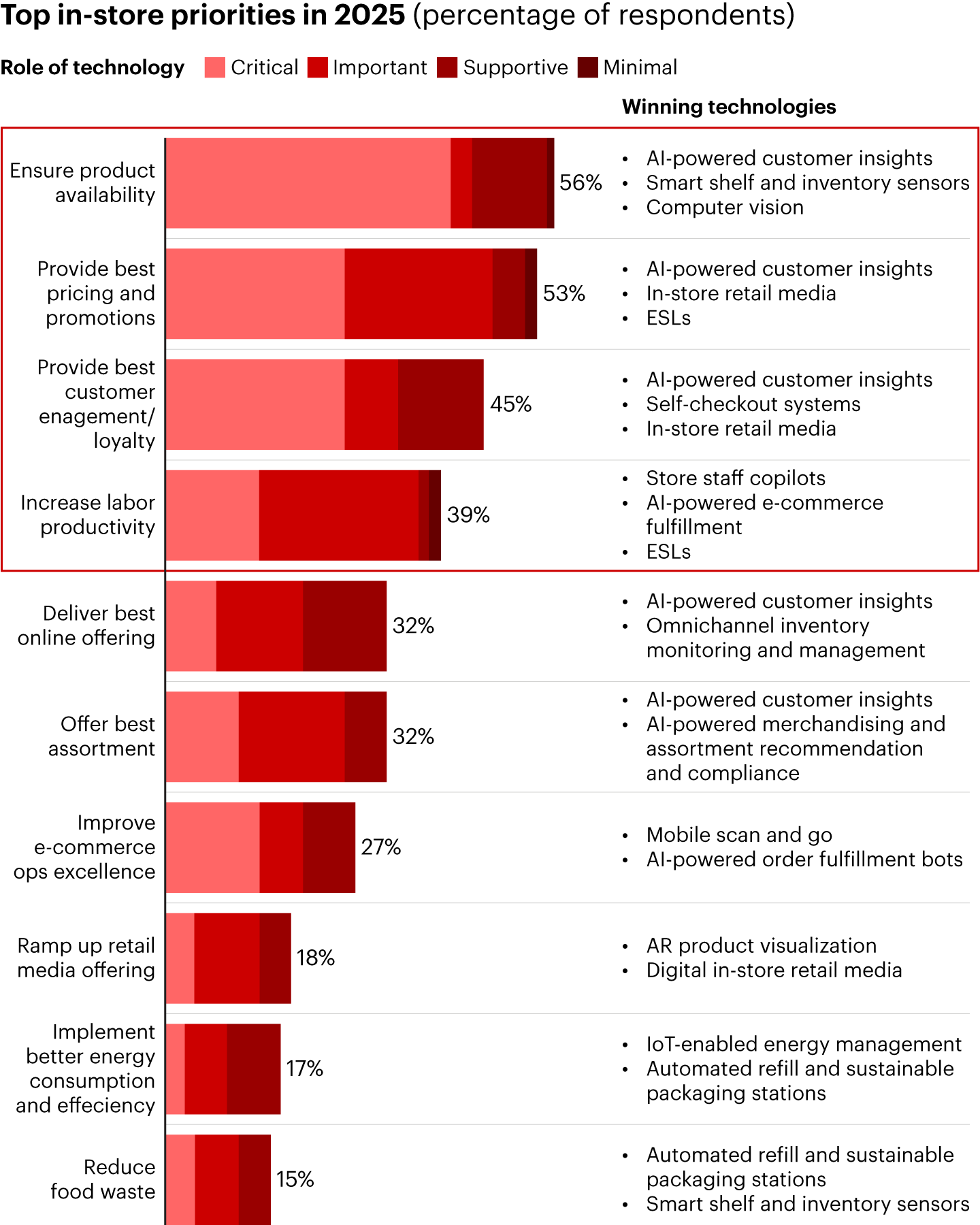
- Retailers’ top three customer-centric priorities are product availability (56%), price integrity (53%), and better customer engagement (45%).
- About half (44%) of retailers expect their store technology investments to improve their bottom line by 1.5+ percentage points.
- Retail is moving toward a new hybrid model in which physical stores generate new data assets and combine commerce with media, entertainment, and personalization.
According to a global survey of 66 leaders from top-250 retailers conducted by Bain in partnership with VusionGroup, a global leader in digitalization solutions for commerce, in-store technology is becoming a retail standard rather than a novelty in both store operations and customer experience.
Written in collaboration with
Written in collaboration with

Though these advancements were previously considered only experimental, our survey indicates that a large share of retailers reported having at least tested or begun rolling out smart shelf, inventory sensor, and artificial intelligence (AI)-powered customer insight technologies in their stores. More established tech has also moved further down the maturity curve. For example, nearly 60% say they’ve implemented electronic shelf labels, either fully or partially; 55% have rolled out self-checkout systems at scale; almost half (44%) use some level of radio frequency identification (RFID); and about a third (33%) noted that scan-and-go options were operational in at least part of their footprint.
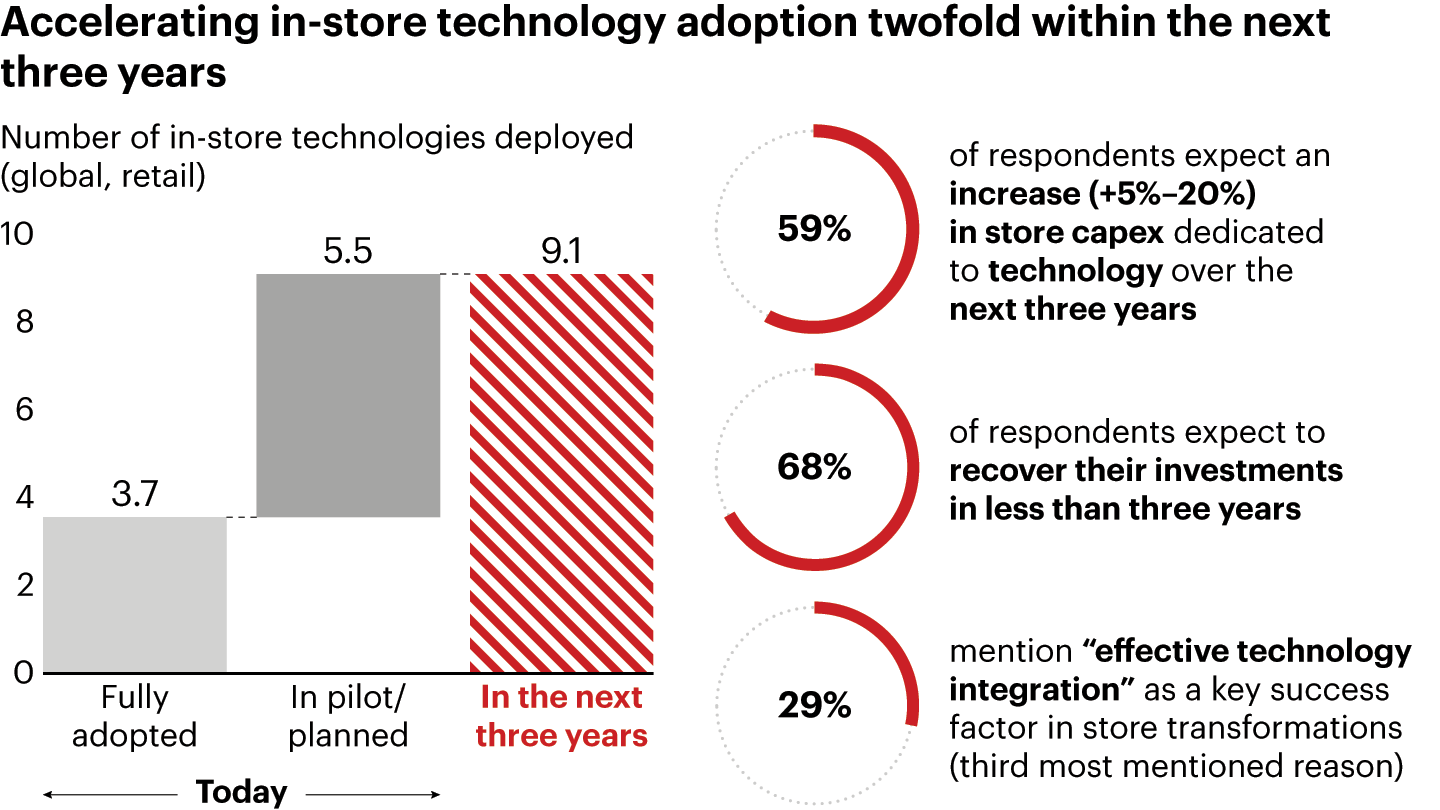
To fund these initiatives, over the next five years, 60% of retail executives plan to increase their capex for store refurbishments by 5% to 20%.
Retail executives are betting on store technology, and they think they’ll win big.
Forty-four percent of retailers expect their store technology investments to improve their bottom line by 1.5+ percentage points, benefiting from improved customer experiences, operational efficiencies, and new monetization opportunities. Specifically with regard to new monetization opportunities, when physical stores operate as hybrid media and e-commerce platforms, retailers can create new revenue streams from in-store experiences and retail media networks, transforming in-store analog signage and static displays into dynamic data-generating assets.
With most retail segments already operating on thin margins, that level of bottom-line impact can fund bold pricing strategies, customer experience upgrades, and other initiatives that competitors will struggle to match.
The technology momentum is accelerating, as the average retailer now tests five new store technologies at once, aiming to double their current toolkit from 3.7 tools today (see Figure 1). The innovation push comes even though 86% of previous store transformations failed to fully meet expectations.
What’s changed? Retailers plan to recoup their investments much sooner; nearly 70% expect to recover their investments in less than three years.
Past experiments generate useful insights for the next rounds of testing. For example, smart shelves, electronic shelf labels, and AI-driven analytics are finally working together to unlock additional customer experiences and operational use cases that weren’t possible with each technology separately, such as personalized offers at the shelf, in-store navigation, planogram compliance, or out-of-stock detection.
Figure 1

What’s driving the rush to digitize?
Postponing investments in in-store technology is no longer a neutral choice—it carries the real risk of falling behind. Industry leaders can reinvest their tech-driven savings into sharper pricing and enhanced customer experiences, steadily reshaping the competitive playing field. This makes it critical to focus on the key areas where digitization can unlock better in-store economics.
Enhanced, more relevant customer experiences solve major pain points, such as accurate on-shelf pricing with electronic shelf labels; out-of-stocks with computer vision; smart carts to circumvent long checkout lines; or difficult store navigation with geolocation and wayfinding. Retailers can turn shopping into a frustration-free journey. Real-time personalization and entertainment can elevate the experience and help build even more engagement.
Operational efficiency demands are pushing automation and AI into front- and back-of-store operations, including e-commerce fulfillment, shelf restocking, and shelf price updates. In the meantime, price volatility has gone up, retailers face increasing staff turnover and labor shortages, and more e-commerce orders are being prepared and shipped from stores. Manual processes are being transformed to take less time and be conducted exactly when needed.
Omnichannel flexibility requires stores to function seamlessly as fulfillment hubs, returns stations, and digital showrooms. Customer journeys now span multiple touchpoints, and stores need to adapt their operations to support whatever role the customer needs at any moment. Forty-four percent of retailers plan to add new omnichannel roles and workflows to meet shoppers’ needs in-store and at home.
Walmart offers a glimpse of what this future can look like: Its stores now serve as both shopping destinations and e-commerce fulfillment centers, enabled by technologies such as computer vision and RFID to improve inventory accuracy, digital shelf labels that support both customers and online-order-selecting associates, and AI tools that streamline stocking and workflow management. With innovations from pick-to-light systems to electronic price tags for e-commerce fulfillment and even drone delivery, Walmart shows how a connected-store platform can unlock ROI while laying the groundwork for future innovation.
New revenue streams come from store digitization. Targeted and dynamic in-store content and digital retail media can trigger personalized campaigns, including closed-loop attribution, transforming stores into digital media centers. Over time, digitization can also enable next-generation collaboration between retailers and consumer goods brands based on monetization of in-store insights. For example, AI-enabled analysis of sales generated with leveraged digital media, in-store merchandising, and personalized offers enable better data-driven decisions, turning stores into both sales channels and monetization engines.
Big investments, rapid paybacks
Almost 60% of retailers plan to increase store technology spending over the next three years. Rapid payback periods are driven by increasing technology maturity, which delivers results more rapidly, while steadily decreasing technology prices. This means even mid-tier retailers can build momentum, implementing new technology bundles every two to three years. Instead of implementing single tools or point solutions, the retailers leading in-store technology adoption are tackling store-level problems with integrated technology families—combinations of technologies that work together to solve business issues.
For example, Carrefour’s store technology push shows what’s possible when a retailer goes all-in on technology. Integration of pick-to-light on electronic shelf labels with e-commerce improves order fulfillment speed and accuracy. Those same electronic shelf labels also enable reliable on-shelf pricing and near-instant pricing changes. Dynamic computer vision and RFID technology improve inventory tracking and on-shelf availability. All these tools together drive measurable productivity gains while setting the stage for faster fulfillment and better customer experiences.
As technology offerings mature, smaller chains no longer need massive budgets to compete. With such an advantage, retailers can focus on a few key technologies that work together, then use the savings to fund their next round of upgrades—with the flexibility and ability to drive change, eventually increasing competitiveness.
Four technologies are leading the change
Retailers are using technology to solve issues that traditional store operations have historically struggled to deliver effectively and efficiently under ever-growing customer expectations and margin pressures. These align directly with retailers’ top priorities: improve product availability (56%), provide the best price/promotion and ensure price integrity (53%), provide the best possible customer engagement (45%), and improve staff productivity (39%) (see Figure 2).
Figure 2

These priorities explain why four technologies are leading the change:
- Shop floor apps for associates, evolving towards copilots are becoming retailers’ preferred approach to support their workforce. These AI-powered systems help handle routine tasks, such as inventory checks, out-of-stocks, price errors, staff on-the-job training, and equipment troubleshooting. When it comes to the last task, copilots have proven much faster and often more accurate than traditional troubleshooting support methods, such as teleservices. Better technologies that improve productivity typically increase employee morale and free those employees to spend more time helping customers. Almost 50% of retailers are now testing or rolling out staff copilots in stores, showing significant potential in coming years.
- AI-driven customer insights help retailers localize shopping experiences at scale. The technology analyzes customer purchasing behavior and other relevant data, such as traffic paths and patterns for each store. It predicts what the customers will likely want next and helps each store stock the right products on the right shelves at the right time of the day or day of the week. Nearly three-quarters of retailers (73%) are considering using AI-powered customer insights in their stores.
- E-commerce fulfillment lets stores handle walk-in shoppers and online orders from the same location. Automated systems ensure inventory availability through integrated store demand forecasting, on-shelf availability is monitored through computer vision, and effective order fulfillment is enabled by pick-to-light integration with geolocation, digital shelf systems, and electronic shelf labels. What’s more, these offerings don’t compromise the in-store shopping experience. Thirty percent of retailers say in-store fulfillment is already deployed at scale in their stores.
- Digital in-store retail media creates new revenue streams for retailers. Digital displays and smart shelf tags let brands advertise directly to shoppers on the spot as they browse and make their purchasing decisions, blending seamlessly into aisles and turning store visits into advertising opportunities. Nearly a third of retailers (29%) say their store operations or layouts will evolve in the next five years to accommodate retail media and experiential retail.
Building future-proof platforms for connected stores
Retailers are now having to choose between multiple technology options to address their business issues. For example, retail executives cite up to eight different options for each challenge when asked about which technologies they would implement to support labor productivity or customer engagement. Every RFP now requires a comprehensive investigation process designed to outline use cases and set clear priorities.
This also raises questions regarding future tech compatibility and risks of creating multiple layers of protocols in stores. It also highlights that tech choices today could potentially create significant roadblocks in three to five years by limiting options and preventing future investments. Without a consistent store tech strategy, retailers may be exposed to issues related to scalability, (cyber)security, and cost redundancy. Retailers need to build store platforms that anticipate where their business needs will be in the mid-term, based on a strategic vision for store tech investments.
Retailers reveal lessons learned
Retailers have learned valuable lessons from previous technology experiments and have tested integrated technology upgrades that work better than subscale experiments.
However, when trying to adopt new technologies, retailers continue to run into the same, often internal, pain points. Slow internal decision-making processes tops the list at 43%, followed by security and compliance concerns (40%), high costs beyond the already planned capex (32%), and resistance to change (29%) (see Figure 3).
Figure 3


Not surprisingly, only 21% of retailers identified “effective technology integration” as a barrier to success, a sign that many may still be struggling to move past other major internal barriers earlier on the maturity curve before finally integrating or evolving their tech stack.
Realizing the full potential of technology also introduces a major challenge of engaging, mobilizing, and evolving the retailer’s in-store and headquarters teams. A successful in-store technology transformation requires a two-pronged strategy. First, manage change by empowering the in-store team with AI-driven tools and precision training to improve their productivity and overall on-the-job experience. Second, evolve in-store team roles, upgrade current team member capabilities, and selectively strengthen the team by hiring for new capabilities and updating compensation incentives.
How to win with store technology
These five principles can help retailers succeed with store technology:
1. Start with customer and staff pain points. The best technology-enabled solutions address real issues faced by customers and staff—out-of-stocks, long lines, incorrect prices, or shrink—while looking upstream to sourcing, warehousing, and operations for the root causes. Focus on innovations that ease today’s frustrations and strengthen the end-to-end systems for lasting impact.
2. Build endorsement at all levels. Transformations don’t fail because the technology doesn’t work—they falter because the organization isn’t committed to driving change or ready to use it effectively. Retailers need to appropriately support technology implementation, from the right operating and governance models to change management, executive sponsorship, training, and communication throughout the process.
3. Think platform first, then technologies. In general, retailers are finding the biggest returns on their tech investments by rolling out capabilities that reinforce each other. Pairing electronic shelf labels with AI-driven insights and computer vision can solve inventory accuracy problems more effectively than any single technology. Retailers need to build long-term strategic visions for their store digitization, anticipating future business needs, such as scalability, security, or future compatibility requirements. Consistent technology investment roadmaps will allow retailers to plan technology families that address complete business challenges and strengthen the ROI of each investment.
4. Solve the talent puzzle. Retailers can invest more in productivity tools and operational efficiencies at the same time they upskill, retrain, and partially change their in-store teams. Reinvent the store’s employee value proposition to retain in-store talent and upskill them on technology and customer-centric expertise.
5. Run the transformation with an omnichannel angle. The lines between online and offline will continue to be blurry for shoppers and operations. Evaluating investments and financial performance in silos is outdated. Shoppers now move fluidly across channels, meaning retailers need to have a more integrated and holistic approach to capturing and recording revenue and allocating costs.
After years of digital channels dominating the investment agenda, the store is finally striking back—powered by technology. Retailers are putting real money behind transforming their in-store operations, seeing a clear path where smarter systems drive down costs, enable sharper prices, and attract more customers. Each transaction, in turn, generates richer data to fuel even smarter decisions, setting a powerful flywheel into motion. Those who move early will not just catch up—they will redefine the rules of competition, creating a durable advantage that laggards will struggle to close.

About VusionGroup
VusionGroup is the global leader in digitalization solutions for commerce, serving over 350 large retailer groups in Europe, Asia, and North America. Its IoT, cloud, and AI technologies empower retailers to reimagine their physical stores as efficient, intelligent, connected, and data-driven assets. Committed to enabling sustainable and human-centered commerce, VusionGroup supports the United Nations Global Compact initiative and received the Platinum sustainability rating from EcoVadis in 2023. Learn more at www.vusion.com.
First published in setembro 2025