

Brief
Ben Hogan, one of the greatest golfers in the history of the sport, believed that any golfer with average coordination could shoot below 80—if he applied himself patiently and intelligently. Hogan’s 1957 thesis, Five Lessons: The Modern Fundamentals of Golf, delivered on this promise of simplicity by offering a short guide that helped even the best professionals concentrate on the things that really mattered in order to save strokes and deliver their strongest performances on the fairway and the green.
For the oil and gas industry, the biggest planning lesson of recent years has also been one of simplicity: Focus planning on the fundamentals to deliver strong results. A short list of criteria can help executives frame the thinking that goes into the strategic plan, drawn from projections and budgets and from tracking to headline performance. In recent years, while the oil and gas industry has been targeting growth, Bain & Company has been recommending a set of 10 planning criteria to help oil and gas executives establish priorities (see below on 2014 priorities). For 2015, because we believe getting the right focus is more important than heroic ambition—and inspired by Mr. Hogan’s example—we have simplified the list to only five:
- Actionable oil price assumptions;
- Realistic cost targets;
- Operational predictability;
- Capital project delivery; and
- Investment in people and capabilities.
1. Actionable oil price assumptions. Oil and gas price cycles have shortened—on the order of days and months rather than years—and many executives are reacting in real time or after the fact. They would be better served by adopting through-cycle planning, which was popular in the past. Setting price boundaries could help establish scenarios that provide clear signals for action or intervention. For example, a Brent crude price band of $80 to $100 per barrel could be considered an affordable range for some companies. Any dip below that price could set in motion predefined steps to slow or delay activities like longer-term, high capital-exposure projects. Fluctuations above $100 could release funding for expansion projects. Realistic central bands in gas for planning could be in the range of $3 to $5 per million BTUs in North America and $7 to $10 for the rest of the world. The market is not likely to provide stability, so executives must find ways to develop stable plans on their own.
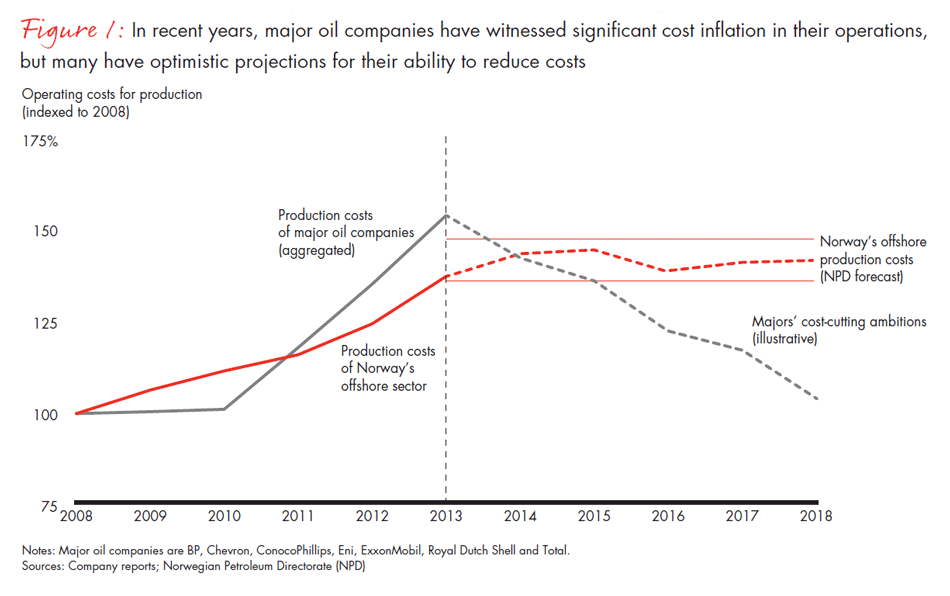
2. Realistic cost targets. It’s certainly good news that oil and gas companies are making serious efforts to reduce upstream operating and capital costs; unfortunately, their cost improvement projections may be too optimistic. Given that the past four years have seen operating cost increases of around 15% annually for the major oil companies (see Figure 1), it’s hard to imagine reversing the trend and reducing costs by 10% or more in 2015—although that’s what many are hoping for. More realistic plans will estimate flat production costs in 2015, with sustainable reductions arriving in 2016.
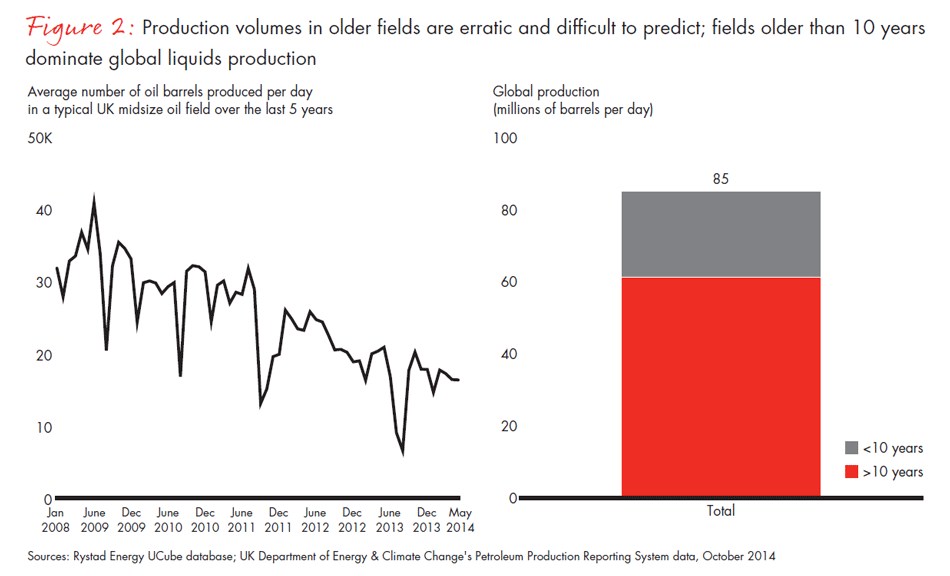
3. Operational predictability. In recent years, oil and gas companies have found it difficult to deliver on estimates for upstream production, especially those predicting growth. Many factors affect performance, and one of the most important is the maturity of the field and its facilities.
With more than 70% of the world’s oil production coming from fields that are older than 10 years (see Figure 2), asset reliability and output predictability are key. Almost all of these oil fields have reached or passed their peak and will see declining production. Many are well into their enhanced oil recovery (EOR) and are more expensive to operate, more variable in productivity and more prone to interventions and breakdowns. It’s important to provide realistic expectations on the volumes that can be derived from these types of assets rather than to predict theoretical maximums. The P50 estimate comes with a wider variation in these older fields.
4. Capital project delivery. The stakes remain extremely high for many project teams. Some very large projects have not gone well in recent years, with cost overruns more than double their budgets and missed start-up deadlines—by months or even years. Yet when we look at the next few years, a very large amount of capital (60%) is targeted at mega projects, including more than $10 billion for large LNG projects (see Figure 3).
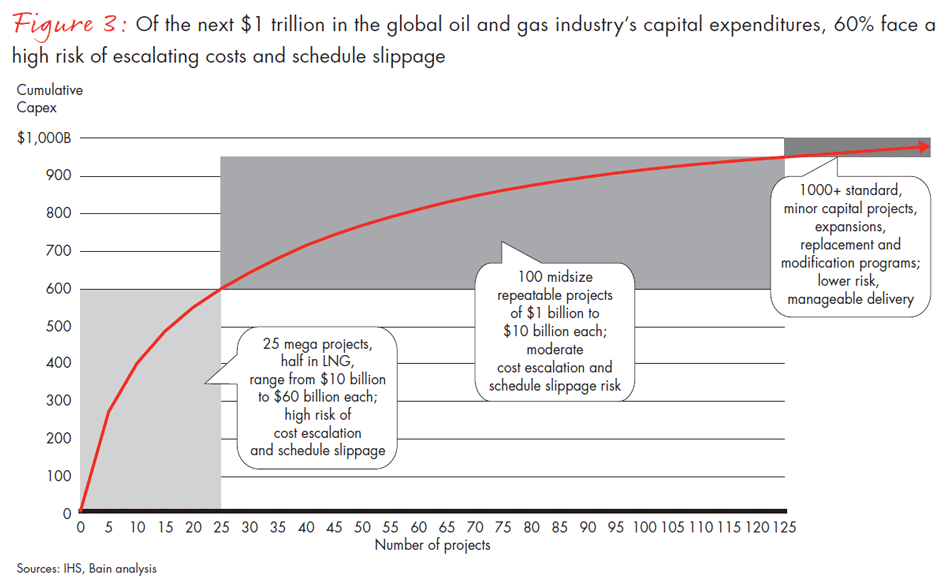
Given the challenging history of these large projects, planners would do well to assign unique probabilities to them. We suggest separating projects into several categories, including routine upgrades and small projects, repeatable projects and very large or new step-put technology projects. Categorizing would enable oil and gas companies to begin establishing realistic Capex baselines and would provide greater visibility for their most challenging large projects.
5. Investment in people and capabilities. The industry has moved into another round of serious reductions in head count, including some widely reported cost-cutting programs at several oil majors. Some national oil companies (NOCs) are looking to quickly trim corporate centers and staff functions, and independents are making changes to their business models—consider Hess’s focus on unconventionals, Occidental’s California spinoff and Chesapeake’s portfolio rationalization. Given that personnel costs and local requirements represent about one-quarter of budgets, there’s always a tendency to look there first when reducing costs.
Executives would do well to remember the lessons from the 1990s, when the last major round of personnel cuts occurred. They should consider the longer-term impact of cuts on capability—which is often not addressed until after the capabilities have walked out the door. At some point, the planning process should link people costs with the productivity of assets. We would suggest taking 20% of the cost savings and using it to invest in skills, capabilities and strong centers of excellence. Otherwise, we will again regret the loss of talent to other industries, and oil and gas companies will feel the impact on their midterm performance.
Getting a strong grip on these five fundamental planning criteria will help executives steer their companies along a positive course in 2015 and beyond. Once performance delivery is under stronger control, the planning agenda can again become more diverse and strategic in nature. But even as companies aim to deliver a return on capital of more than 12%, and strive for 20%, keeping things clear and simple, as Ben Hogan advised long ago, is the best course for 2015.
What happened to the 2014 planning criteria?
The oil and gas industry’s priorities and performance in 2014 suggest the planning agenda has been taken apart piece by piece, with only a few players (Canadian Natural Resources, Woodside and Anadarko) staying ahead of the curve. Most are now racing to catch up with the realities of thinner upstream margins, limited availability of capital and pressure to reduce costs and head count.
The indicators we saw in September 2014 have played out in interesting ways, with some organizations better prepared than others to respond.
1. Low real interest rates. What will a period of sustained low-cost capital enable us to do?
Low-cost capital seems to have bypassed the oil and gas industry, due largely to conservative debt positions for the majors and higher-cost leverage for independents. Many NOCs now also struggle with longer-term funding. The US Energy Information Administration reported that for the year ending March 31, 2014, the 126 oil and gas companies it had reviewed had added $106 billion to debt and divested $73 billion in assets.
2. The new normal of political risk. How can we plan better for short-term disruptive political risk?
Overall, the industry remains in a reactive mode, relying on its historical capability of riding out disruptions. The past year’s events in Iraq, Russia and Scotland have longer-term consequences and should have led to a decrease or halt of investments.
3. Capabilities and capacities. How can we strengthen our talent pool and organize more effectively?
Most oil and gas companies have headed in reverse, reducing head count with a vengeance. They may see short-term productivity gains, but building capabilities is essential to long-term success.
4. Inflation. How should we account for sector inflation?
It’s difficult to imagine moving from double-digit inflation to double-digit cost reduction in one jump. Lower rig rates will help, but managing the cost of ownership has to become a core capability.
5. Oil and gas price volatility. How can we plan effectively, given the volatility in prices?
The weaker oil prices of the past few months have taken many by surprise. We will see $80 per barrel as the new threshold for a positive business case on new projects, $4 per million BTU for North American gas and $8 for gas in the rest of the world.
6. Longer-term project pipeline quality. What plans should we make to extend growth beyond the completion of major projects after 2017?
The short-term focus of 2014 has made this difficult. Major LNG commitments are being made, but meanwhile the focus on midsize oil developments could be improved.
7. Exploration focus. Where will we focus, and how will we ensure adequate reserves?
We have entered a world of high and low performers in exploration. On the high side, Statoil, Eni, Noble and many of the US shale independents show strong contingent resource and reserve growth. Others, including the majors, are finding it hard to replace 60% of production from exploration additions. For explorers, 2015 will be a vital year given that the discretionary cost cuts put exploration budgets at risk.
8. Gas. What role will gas play?
Producers continue to place big bets on gas in unconventionals, LNG and exploration programs. Limited effectiveness and progress around carbon pricing keeps gas undervalued relative to oil, but holding half the portfolio in gas assets has been a good planning rule to follow.
The last two areas—major projects start-up and realistic operational delivery—remain challenging and feature in this year’s fundamentals.
Peter J. Parry is a partner with Bain & Company in London. He leads the firm’s Global Oil & Gas practice.
First published in 12월 2014