

Brief

As chemical companies look to gain a competitive edge from digital technology, executives can become overwhelmed by the vast array of options. Distracted by “1,000 points of digital light,” they may overlook the few initiatives that could scale and make a significant difference. Executives need to find ways to filter out the noise and channel their efforts to the most promising digital initiatives.
The strongest and most enduring digital strategies balance the visions of the dreamers in the organization (those who focus on long-term, disruptive possibilities) with the aims of the more pragmatic doers (those who want to cut through the hype and focus on implementing practical initiatives). Companies need a bold, inspiring vision, but they also need to define where and how they can make progress now. The Bain Radar 360SM approach offers a practical way to strike that balance (see Figure 1). It relies on three key principles: zeroing in on the most beneficial set of initiatives, making progress through a series of smaller initiatives, and channeling the initiatives along several pathways—such as customer experience, products and services, and operations. (For more on this, see the Bain Brief “Digital Strategy for a B2B World.”)
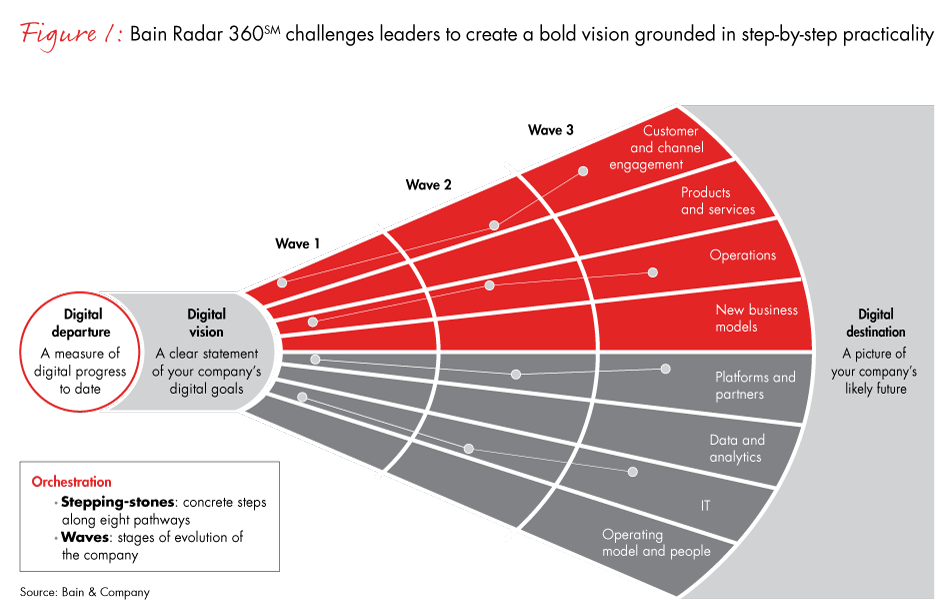
Of course, before executives can map out their most promising digital initiatives, they need a clear understanding of their point of departure, their position in the industry, and their unique advantages and capabilities. Here are five questions chemicals leaders should ask themselves to help focus the journey.
1. How will digital shift the profit pools in your business?
Digital innovation is rearranging the game board, changing the rules that determine who makes money and how. In fertilizers, for example, the rapidly evolving market space around precision agriculture creates new opportunities and threats for chemical producers. New players could easily capture the potential revenue streams from platform solutions, and, more generally, volumes could come under pressure from more efficient fertilizer use.
Other markets are less likely to see disruptive shifts. For example, companies that supply polymers to a few big customers in a small market face less of a threat from potential intermediaries.
Chemical producers—especially those with diversified portfolios—need a clear understanding of where they make their money, what generates profitability and how the advent of digital technology could change the equation.
2. What’s your true competitive advantage?
Perhaps even more important than understanding where you make money is understanding why you make money. Strengthening those areas through digital, and determining where digital can provide new sources of differentiation, can help companies make the most of their investments. Frequently, senior executives are so focused on the range of digital opportunities in front of them that they lose sight of what really matters: the competitive advantages that set the company apart from the pack.
Chemical companies are often amalgams produced by multiple rounds of M&A, so the problem may be even more intractable here than in other industries. Business units may have different strategic goals and advantages. A business focused on selling at the lowest cost in its sector might prioritize investments in data science to improve predictive maintenance and optimize its transportation and supply chain costs, whereas one that differentiates through exceptional service might invest in end-to-end sourcing visibility and track-and-trace capabilities.
One chemical producer was investing heavily to enhance the customer experience, even though it had a captive base that valued low prices. By focusing on improving its commercial capabilities, the company was actually diluting its true competitive advantage and creating an opening for other companies to move in.
3. Are you a digital leader or fast follower?
Both strategies offer advantages, but the decision implies vastly different levels of investment, risk and return. Investing in disruptive change will cost more and take longer, but assuming more risk can deliver greater rewards and a competitive edge in the market. Adopting a more cautious tack—embracing innovations rapidly as others demonstrate their value—may take less time and stave off competition, but it’s unlikely to move a company ahead of the curve. In fact, in an industry like chemicals, where years-long lead times for investments are common, a fast-follower strategy can still be expensive and risky. Either way, standing still is not an option.
Leaders follow trends closely, choosing strategies that are most relevant to the company and promise to be most disruptive. These executives are already building the stepping-stones to success: developing digital capabilities, investing in assets and hiring the right talent. Innovators will probably hire more creative technology talent, while fast followers will need more systems engineers.
4. Is your digital starting point clear?
Within every chemical company, various functions and business units will be at different stages in the digital journey. To develop and articulate a digital vision and strategy, CEOs need a clear, integrated view of digital initiatives across sites, functions and the entire company. In particular, senior executives should be able to delineate between digital initiatives that create new capabilities and rearguard measures designed to upgrade legacy IT operations.
Once the starting point is clear, executives will have a more complete picture of what the company is doing right and where it needs to redouble its efforts. That will help in setting priorities that support the company’s long-term digital destination—which may not be as daunting as it sounds. We know the general direction of disruption; the critical task lies in applying that knowledge to bring discipline to the company’s digital investments, focusing on those that will have the most impact at scale.
5. Do you have a compelling case for change that connects the vision of the dreamers with the day-to-day reality of the doers?
Most leadership teams have both doers and dreamers, and both perspectives are valid—indeed, critical—for success. Yet if left in opposition, the tension between these groups can paralyze initiatives.
Successful CEOs tap the energies of both types, striking a balance between the doer and dreamer perspectives. This balance should blend a practical set of near-term, high-impact initiatives with a bold vision for how the company will keep pace as digital innovation reshapes the industry over time.
Nate Anderson, a partner with Bain's Chemicals practice, explains that as executives plan their strategy for optimizing the digital potential, they should ask themselves these three questions in order to succeed.
Where to apply pressure
Answering these questions will help executives articulate a clear digital strategy and direct resources to a prioritized set of digital opportunities. To follow through on those expectations, they should focus on three key areas.
-
Align your operating model. Even as companies begin to define their digital strategies, they may struggle to execute against them. By taking a wide view of the entire organization, they can expose any elements of the operating model that are not supporting their digital vision. Since operating models serve as the blueprint for organizing and distributing resources to get work done, adapting the model is the most effective way to shape the direction of the business, to determine how people work together within and across boundaries, and to define how the corporate center adds value to the business units.
In a digital transformation, these adjustments to the operating model are likely to focus on building up new digital capabilities, finding and retaining talent, and forging partnerships where necessary, particularly with firms that offer analytics services.
-
Define an integrated roadmap for your digital initiatives. Digital leaders set bold ambitions and build the capabilities necessary to achieve them. They learn where gaps exist and then hire or partner with others to fill them. They invest in analytics capabilities and IT architecture that enable them to develop rapidly and draw meaningful insights from data.
Be clear on what you want to do, and empower the right people to carry it through. Start by aggregating a complete list of digital initiatives, and then find ways to shatter the silos that can hinder digital success. Digital initiatives typically cross horizontal and vertical boundaries in an organization—spanning processes, functions and business units. Successful efforts require integrated decision making.
-
Accelerate outcomes. When digital initiatives stall, one way to restart is to narrow the vision to one or two initiatives that can be achieved rapidly. Quick wins generate momentum and serve as models for future initiatives. They also demonstrate that the team is building the capabilities to deliver accelerated results.
Among those capabilities, teams should develop the ability to work in a series of Agile sprints, breaking complex problems into smaller modules in order to make progress and demonstrate success. Sprints typically bring together cross-functional teams of five to nine members, who have the autonomy to determine the scope and timing of their work. Activities are time-boxed in sprints of one to four weeks, with deliverables presented to the customer (internal or external) at the end of each sprint. These deliverables are ready for feedback, which contributes to the next, iterative stage of the broader process. Team members collect input at each stage, which helps them adapt and prioritize using test-and-learn principles.
As recently as a year ago, we knew many chemicals executives who were still deciding whether and how to advance on digital initiatives within their companies. This is much less true today: Nearly everyone we speak with now recognizes the opportunity and potential value at stake in the broad digital transformation underway in the chemical industry. The most urgent tasks for senior executives today are understanding their point of departure, setting ambitious but realistic targets, and moving quickly to capture advantage.
Nathan Anderson and Peter Guarraia are partners with Bain & Company in Chicago. Joachim Breidenthal and Thomas Kwasniok are Bain partners based in Johannesburg and London, respectively. All four work with Bain’s Global Chemicals practice.
Bain Radar 360SM is a service mark of Bain & Company, Inc.
First published in 8월 2017