

Brief
The notion that customer experience matters in pharma is old news. Every mission statement alludes to it. Every pharma executive we know wants more focus on it. Yet pharma was rated among the least customer-friendly industries in a 2011 Harris poll, down 43% from a similar poll conducted in 1997.
The challenge starts with the very definition of “customer.” Patients are clearly the end customers, but pharma companies often deal more directly with prescribing physicians, regulators and payers. All three stakeholders shape the patient experience significantly because they influence decisions about whether and how to market individual pharma products. More challenging still, this complex customer landscape continues to evolve as new payment structures emerge, patients request more involvement in treatment decisions and pharma companies engage in more direct-to-consumer marketing.
The current model of interaction between physicians and pharma sales reps is poised for significant change. Sales reps have increasingly limited access to physicians. According to a recent survey by ZS Associates, 51% of physicians were considered accessible in 2014, down from 55% in 2013 and 65% in 2012. Clinical and product information is increasingly ubiquitous, diminishing the value of nonindividualized information from sales reps. Most pharma companies don’t have formal feedback mechanisms to address customer concerns. And there is limited understanding of nonclinical factors that encourage loyalty or result in detraction. These trends have led pharma companies to adopt a smorgasbord of salesforce effectiveness initiatives, which arguably focus more on efficiency than on creating true value for customers.
Why has there been so little progress? Simply put, it’s much easier to talk about great customer relationships than to build them. The executives we talk to all understand the importance of providing customer experiences that create advocates for their products and brands. The challenge is how to create organizational capabilities that delight customers on a repeat basis, simultaneously encouraging advocacy and boosting the bottom line.
Three key elements must be in place for pharma companies that want to improve the customer experience.
As the old axiom goes, if you can’t measure it, you can’t manage it. The first element is implementing an effective tracking mechanism for measuring customer experience. This tracking creates transparency on where you stand with your most important stakeholders relative to competitors and over time. The second element is harvesting feedback from customer-facing staff and using that feedback to create superior experiences for customers and a repeatable learning loop for the organization. Finally, fostering a customer-centric mindset is necessary at every level of the organization, from frontline employees to the C-suite.
Pharmaceutical executives understand the benefits of having loyal customers, but they struggle to engender that feeling among the people they serve. In response, more pharma companies are starting to use the Net Promoter SystemSM so they can meet their customers' needs better, says David Michels, a partner in Bain's Customer Strategy & Marketing practice.
1. Measurement is relative
Business leaders have long understood the relationship between scale and profitability. As relative market share increases, so generally does return on sales. But how do you build relative market share in the first place, and what role does customer advocacy play? There is no question that pharma companies ultimately succeed or fail based on the clinical efficacy of their medications. Increasingly, however, the customer experience is also a significant factor in sorting pharma leaders from followers.
Happy customers are good for business because they tend to promote your products and brand. Conversely, unhappy customers are bad for business because they tend to spread negative stories about your brand. In an era when any customer can reach a global audience in seconds with a single tweet, all companies must reckon with the growing power of consumer advocacy.
Bain’s Net Promoter SystemSM involves asking customers a single question—“How likely is it you would recommend us to a friend?”—and calculating the customer’s Net Promoter ScoreSM. This score is used to classify customers as promoters, passives or detractors.1 The Net Promoter System also collects verbatim responses that capture many factors in the customer experience, ranging from price and product features to the customer’s perception of how the company responds to his or her needs. Based on extensive research and years of experience in many industries, the Net Promoter System provides a simple yet rigorous way to measure customer advocacy on an ongoing basis.
Perhaps the best-known type of Net Promoter Score is the “experience” score, earned when a company asks its customers for feedback immediately after selected experiences or transactions. But equally valuable and often overlooked is the company’s score relative to the scores of direct competitors. A company’s competitive benchmark Net Promoter Score is simply its Net Promoter Score minus the score of its most relevant competitor. Competitive benchmark Net Promoter Score measures the competitive position of a company, business or product relative to the loyalty leader in a particular market, which in the case of pharma is usually a given therapeutic area within a given national market.
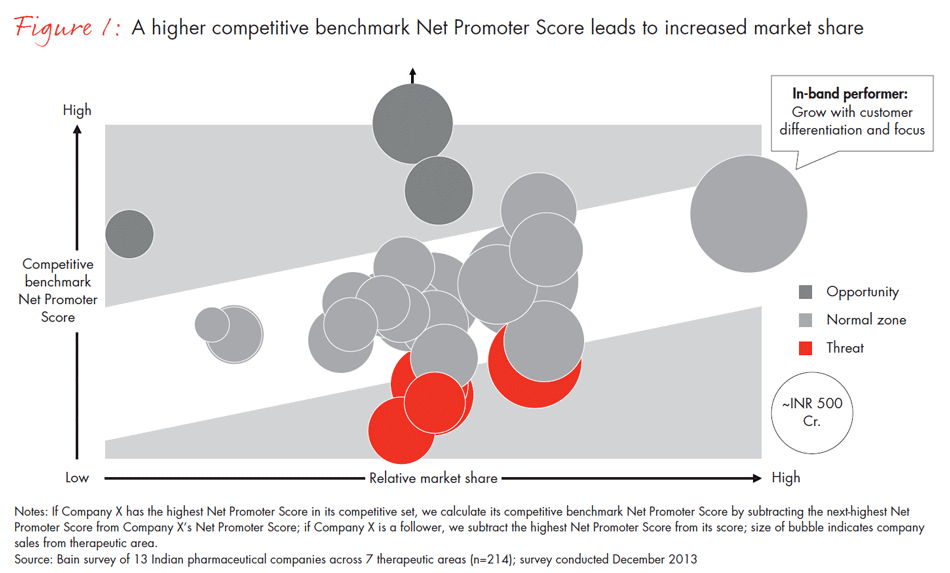
Bain research has shown that in most industries, including pharma, a competitive benchmark Net Promoter Score contributes significantly to growth in relative market share. The relationship between this score and relative market share holds in both developing and developed pharma markets, and for specialty products and branded generics alike. High Net Promoter Scores correlate with greater share of wallet. Pharma sales reps who generate high Net Promoter Scores tend to be more productive. One major European pharma company has found that, on average, promoters treat between 2.5 and 2.8 times more patients with its products than detractors do. And a recent Bain survey of 13 Indian pharma companies found that Net Promoter System leaders grow faster than the market or have higher relative market share compared with Net Promoter System followers. The survey found that high Net Promoter Scores correlate well—more than 80% likelihood—with current or growing leadership in a given therapeutic area.
Focusing on your portfolio of brands relative to the norm can yield important strategic insight (see Figure 1). For example, if one of your brands has high relative market share but a low competitive benchmark Net Promoter Score, that’s a significant warning sign and call to action. The high relative market share is often a positive legacy of the past, while the low competitive benchmark Net Promoter Score can indicate competitive activity aimed at weaning your customers. By contrast, if you have low relative market share but a high competitive benchmark Net Promoter Score, you probably have potential to harness your customer franchise. In our India research, we saw this most clearly in instances where a business led in a narrowly defined market niche, but failed to capitalize on its success by expanding into adjacent markets where it could share customers, costs and capabilities.
2. Repeatability rules
Pharma executives often tell us they spend a lot of money on customer research, only to harvest reams of data that yield few insights. Part of the problem is that this research is usually one time and one way. You can only accomplish so much by polling a random sample of customers once a year, then failing to close the loop with these customers by not responding to their concerns. Ultimately, you can only move the needle on customer advocacy by developing repeatable capabilities within the organization.
Imagine two closed learning loops: an “inner,” or individual, loop and an “outer,” or structural, loop. Within the inner loop, frontline employees harvest input from customers and use it to continuously improve the customer experience. The outer, institutional learning loop complements these individual loops, collecting feedback from customer-facing staff and using it to create repeatable practices company-wide.
At the individual level, a useful example from the provider world is Cancer Treatment Centers of America (CTCA), which has achieved industry-leading customer advocacy scores by using the Net Promoter System to track advocacy levels among patients and caregivers. CTCA conducts weekly patient focus groups and surveys all patients when they leave a facility. CTCA consistently achieves Net Promoter Scores above 90, the highest we have seen in healthcare. CTCA’s loyal customers helped it score five consecutive years of double-digit revenue growth, compared with average industry growth in the low single digits.
At the institutional level, one European-headquartered pharma company has built a network of more than 700 physicians who engage in regular, detailed feedback calls with senior management, including the CEO. This provides a constant flow of tactical and strategic insights on which the organization can act. The physician network serves as a giant sounding board that the company can also use to test specific ideas or initiatives.
3. Engage the organization
A customer-centric mindset is critical at every level of a pharma organization, not just at the front line. Everyone has a role to play. Senior leaders must advocate the importance of customer centricity and connect directly with high-value customers. They should also visibly incorporate the customers’ voices in day-to-day management and resource allocation decisions.
Functional managers need to participate in regular feedback cycles and connect directly with customers. They must engage in processing insights internally and across functions, and in developing solutions. For example, one biopharma company created cross-functional “customer tables” to respond to feedback that ranged from tactical (“I am interested in the latest product brochure”) to strategic (“You should extend the product’s indication range”). Managers’ objectives can often be accomplished by expanding regular business review dialogues to include potential actions arising from customer insights.
Finally, frontline employees need to participate actively in truly engaging customers—arguably the biggest behavior change necessary. Line employees lead on collecting customer feedback, closing feedback loops and acting on insights. Leading requires honesty and courage on the part of individual employees and steady support from supervisors, who need to communicate often and clearly that the goal is continuous learning and steady improvement in providing a valuable customer experience.
Conclusion
In the pharma industry, the product hand you are dealt heavily influences success in a given national market or therapeutic area. As the pharma market continues to fragment into specialized categories, companies that achieve leadership within categories have an inherent advantage over companies that seek to build scale across the industry as a whole (see the Bain Brief “New paths to value creation in pharma”).
Pharma companies that deliver outstanding customer experiences are more likely to achieve such category leadership. The customer experience can be an especially important factor in competitive markets where no product stands out primarily on its clinical merits. Many companies believe they offer superior customer experience, but few achieve it and outperform. As the customer landscape continues to evolve, pharma companies need to translate insights to action, creating Repeatable Models® from customer feedback. The Net Promoter System can help.
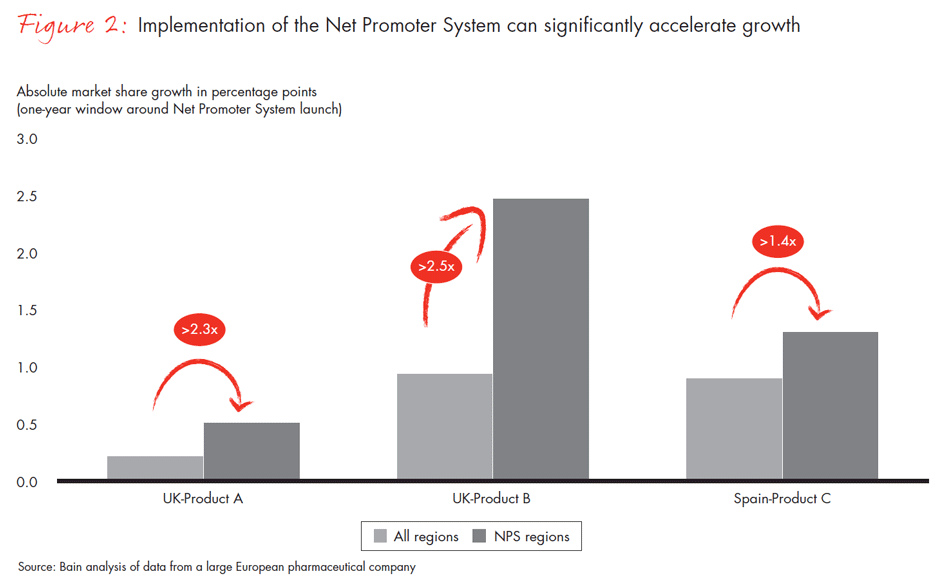
If properly implemented, a customer experience system based on measurement over time, closed-loop feedback and organizational focus on the customer can create impressive business results. For example, monthly revenue growth more than doubled after one global pharma company implemented the Net Promoter System in an initial wave of countries and therapeutic areas. Revenue and market share both rose significantly in territories where the Net Promoter System had been implemented, compared with those territories where it was not yet in use (see Figure 2).
You can’t create a customer-centric culture and operating model within your organization simply by tracking what your customers like and dislike. This is where the Net Promoter System is particularly helpful, because it is far more than a metric—it’s a way of doing business. The Net Promoter System can help pharma companies identify and ingrain practices that attract promoters, while shedding practices that breed detractors. It gives pharma companies a new way to stand out, to create a better customer experience and to deliver greater value to all stakeholders.
1In the Net Promoter System, answers to the core question are ranked on a zero-to-10 scale. Scores from zero to 6 indicate that the customer is a detractor. Scores of 7–8 indicate that the customer is neutral about your company, or “passive” in Net Promoter terms. A score of 9 or 10 indicates that the customer is a promoter. A company’s Net Promoter Score is simply its percentage of promoters minus its percentage of detractors.
Dave Michels is a partner in Bain & Company’s Zurich office and a leader in the firm’s Global Healthcare and Customer Strategy & Marketing practices. Christian Rebhan is a principal in Bain’s Zurich office and a member of the Global Healthcare practice. Parijat Ghosh is a partner in Bain’s Mumbai office, where he leads the Healthcare practice in India.
First published in 12월 2014