

Brief


|
|
Gritty, intoxicating Naples—renowned for pizza margherita, football magician Diego Maradona and … connected insurance? Indeed, Napoli has become a proving ground for one of the most promising technology-related opportunities in insurance: the use of sensors for collecting, transmitting and analyzing data on the status of an insured risk. Connected insurance is starting to pay off for carriers, and they have made the greatest progress in Italy. Consider the following estimates by Bain & Company’s Observatory on Telematics, Connected Insurance & Innovation, a collaboration with the Italian National Association of Insurance Companies (ANIA). About 16% of auto insurance contracts sold and renewed in Italy by the fourth quarter of 2015 featured in-vehicle telematics, with growth outpacing even online insurance sales. Drivers have outfitted their Fiats and Alfa Romeos with 4.8 million black boxes. One insurance group, UnipolSai, has more than one-third of its auto insurance portfolio connected to telematics, and many carriers have been incorporating telematics into their home and health insurance products as well. Penetration has been greatest in places with high premiums, such as Naples, where customers are especially motivated to contain costs. Italy’s experience with connected insurance holds lessons for carriers in such countries as the UK and US, which have rolled out their own connected systems in the past few years, according to an analysis by the Observatory. With black boxes connecting to an ecosystem that includes smartphone applications and third-party providers, carriers now have opportunities to substantially improve their economics and customer loyalty. In auto, home, health and industrial sectors, telematics is starting to generate real gains along the insurance value chain. The richest offerings to date are in auto coverage, through both pay-as-you-drive and pay-how-you-drive usage. These offerings are influencing the sector’s fundamentals in several dimensions:
Beyond coverage itself, an array of related services that use telematics has emerged for drivers (see Figure 1). These include street-sweeping alerts, antitheft alerts if the black box registers an unusual driving style, stolen-vehicle recovery, simplified claims notification with automatic form fill-in based on telematics data, and short-term coverage for theft when parking the car in a high-crime location. Such services enable carriers to differentiate themselves in the marketplace and to increase interactions with customers, which is one proven way to earn greater loyalty.
Similar opportunities are emerging in other lines of business. In health coverage, for example, carriers are exploring arrangements with preferred networks to implement telemedicine solutions that reduce the average cost of claims, thanks to earlier exits from hospital and remote monitoring of patient health data. Ping An, a large Chinese carrier, has built a connected health platform that now has 77 million registered users and more than 50,000 doctors. In home insurance, AXA Germany has teamed up with RWE’s SmartHome system to minimize flood damage and provide fast support. In commercial insurance, connectivity will change the nature of underwriting and claims handling. And in the workplace, AIG has invested in Human Condition Safety, a tech start-up developing wearable devices, analytics, and systems to prevent injuries in manufacturing and construction. Senior managers who want to expand their options in connected insurance can start by answering a set of key questions:
While a degree of hype surrounds the potential of the Internet of Things, connected devices clearly are proliferating in cars, homes, medical settings and workplaces. Answering the questions above will help managers devise appropriate strategies and invest wisely in connected insurance, so that they can deliver services that customers truly value, and improve the overall economics of the business. 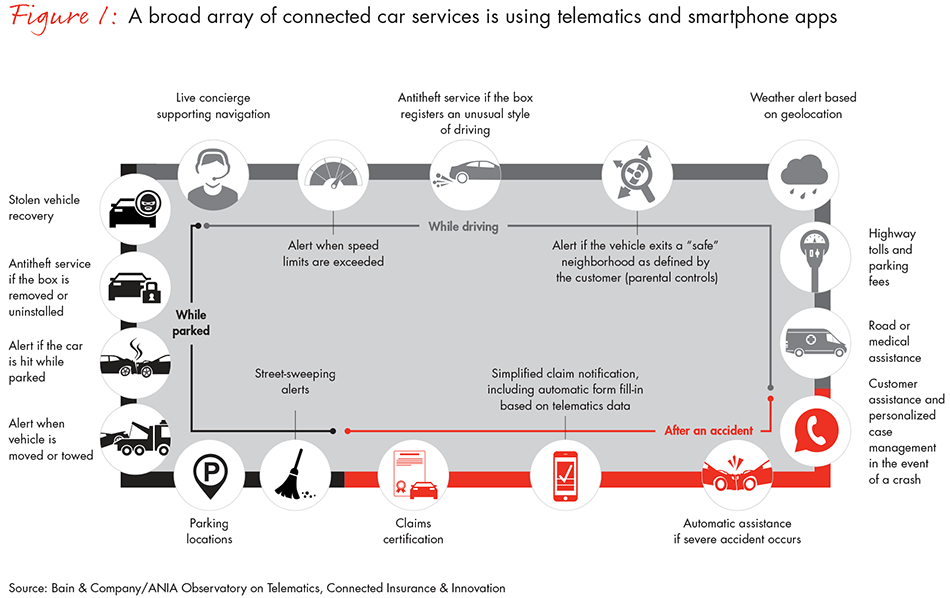 |