

Brief

“Our customers have gotten way ahead of our sales efforts. Too often, in fact, we’re not even getting invited to the dance!” It’s a common lament among CMOs and heads of sales for business-to-business (B2B) firms.
These executives face two major challenges. First, the wealth of information available from online sources has given customers more power. Buyers perform more than two-thirds of their decision-making research online before they even contact a vendor. A company’s digital footprint now serves as its showroom and helps determine whether it makes the short list of vendors long before it even knows a customer is in the market. Yet while the websites of traditional B2B companies often overflow with product features, they offer few perspectives about how the products actually solve customers’ problems, and therefore do little to define a compelling value in prospects’ minds. Meanwhile, insurgent online competitors are making inroads with target customer segments.
The second challenge is that the portfolio of products and services for many larger B2B firms has expanded to the point that frontline sales representatives cannot understand and credibly sell it. One response is to hire product specialists, but these valuable resources often get pulled into early-stage opportunities that have not been fully qualified.
Mark Kovac, the global head of the Commercial Excellence Group within Bain's Customer Strategy & Marketing practice, recommends that B2B sellers upgrade their digital presence and redefine the role of the sales representative.
In short, the traditional marketing and sales model has run its course. Digital disruption is picking up steam across B2B markets, and we expect to see the following changes:
- Marketing and sales functions that operate in silos will fall behind those that integrate. We will see more sales and marketing organizations led by a single chief commercial officer.
- The role of the generalist continues to diminish as companies employ far fewer sales reps overall and emphasize those with far greater domain expertise and higher productivity (and cost).
- Business marketers will operate similar to consumer marketers, with continuous, near-real-time management of the pipeline.
- Traditional customer segmentation will be replaced by highly personalized “segments of one” enabled by advanced data analytics.
Are B2B companies ready for this sea change? Nearly half of the 370 marketing and sales executives in technology and industrial companies globally that Bain & Company surveyed earlier this year said that digital capabilities have significantly changed their customers’ behavior. Only 12%, however, feel well prepared for the new realities brought about by digitally enabled customers.
The action moves upstream
To accommodate these changes in buying behavior, marketers and sellers must fundamentally reorient upstream. They can no longer rely on simple sales collateral or traditional lead generation methods, which typically have a low return on investment (ROI). First impressions have always mattered, but now they involve building out a relevant and deep digital footprint to reach a potential customer early in the buying process, staying on the prospect’s short list, and engaging the customer with the right experts in the right channel to close a deal.
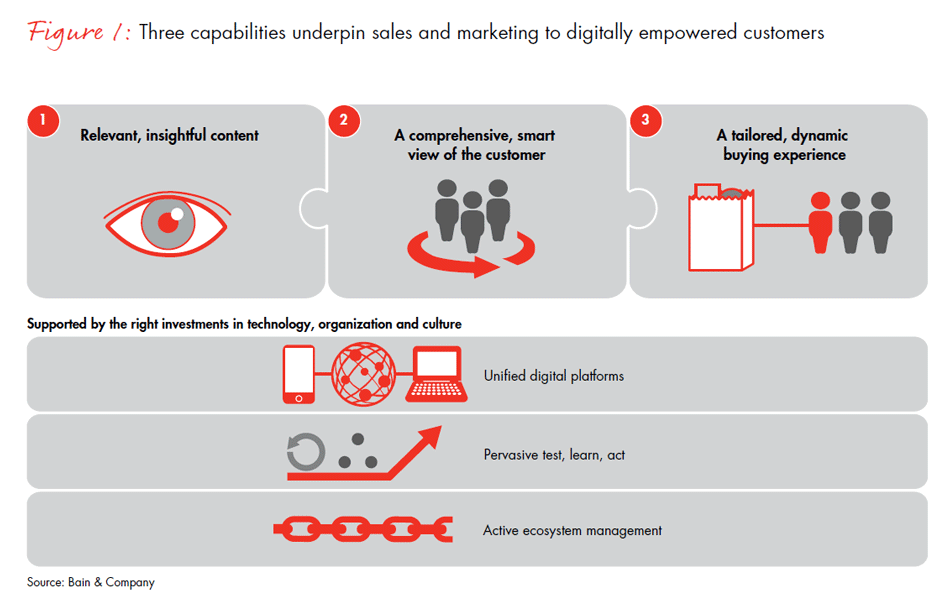
Some B2B companies have already made strides in responding to the shifts in customer behavior. Among the leaders, three capabilities underpin their ability to thrive in the digital environment (see Figure 1):
- They create and deliver relevant, insightful content that brings to life how their offerings address customers’ business priorities.
- They build a comprehensive, smart view of customers’ behavior and capitalize on it.
- They provide customers with a tailored, dynamic experience throughout the buying process.
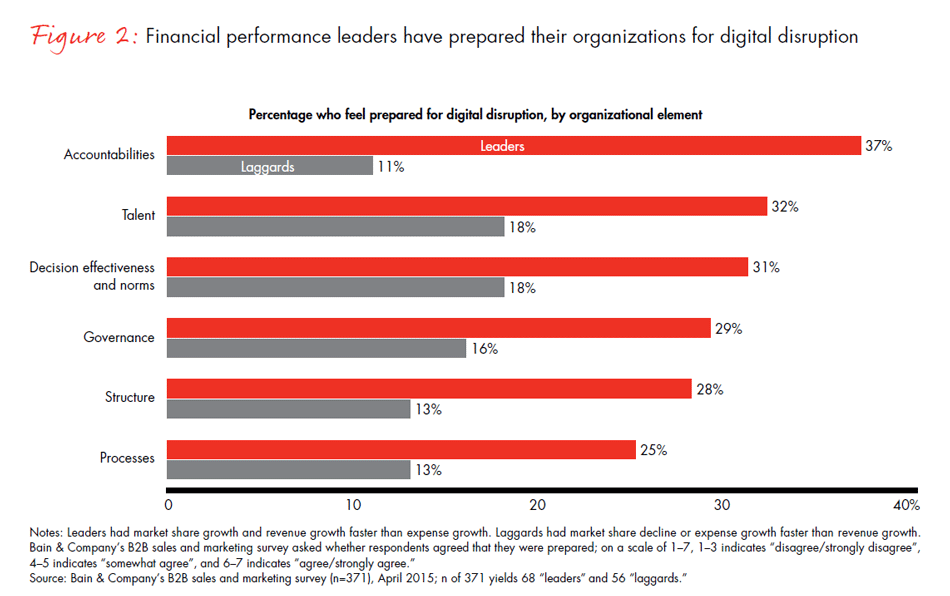
Based on our analysis of the 370 executives surveyed, these capabilities correlate with financial outcomes. The market share and revenue growth leaders in that group indicate that they have a much higher degree of readiness in these capabilities than do companies that qualify as financial laggards. Newly hired sales reps at the leaders ramp up to full sales productivity faster than laggards. The leaders also report more readiness to deal with digital disruption along every element of their organization (see Figure 2). Let’s look at what the leaders do differently.
Relevant, insightful content
Creating a brand presence has become more complicated as buyers can access expert reviews, user ratings and detailed data that companies offer. Leaders take control of their positioning to ensure that their products, services and the company don’t get defined, for example, by social media or an expert’s blog.
Companies in a range of industries have grounded their marketing in original content that speaks directly to customers’ pressing needs and priorities. Moreover, skillful marketers syndicate their content across the relevant digital channels where prospective buyers are likely to engage. When a utility publishes a point of view on the implications of deregulation on customers or a software firm publishes on how the evolution of the cloud will affect healthcare delivery, they stake out a position as thoughtful, empathetic partners who understand the context in which their customers operate. Such content goes beyond feature-laden sales brochures to help customers make smarter decisions.
Adobe Systems, for example, made deft use of its website CMO.com to help reposition itself from the core desktop publishing market and expand into digital marketing analytics, which has different buyers and a different sales process. Adobe got the nascent website when it acquired Omniture and gradually turned it into a powerhouse of original and curated content relevant to heads of marketing. While Adobe didn’t explicitly set up CMO.com as a demand-generation site, it does have advertising for offers, white papers and other demand-generation content on the site and in the weekly newsletters. CMO editors also draft executive summaries of Adobe research, with links to the full reports.
Even some traditional industrial companies are harnessing new digital channels to keep customers and the broader public engaged with their activities. Maersk Line, the world’s largest container shipping company, started experimenting with social media several years ago, and now has 1.1 million likes on Facebook and large audiences on other channels, including Twitter and Instagram. Maersk has learned to publish captains’ blogs and stories about people, environmental issues, and other topics at a fraction of what advertising would cost.
Maersk took a novel approach to publishing after the Baltic Sea froze over, making it difficult for ships to arrive on time in the port of St. Petersburg. A campaign called #wintermaersk showed how Maersk navigated the icy waters to keep the cargo flowing, with dramatic photos that captivated social media users. The campaign resulted in 150 unique sales leads, which is significant in the shipping industry. More broadly, Maersk’s surveys show that its social media efforts have improved customers’ perceptions of the company.
A comprehensive, smart view of the customer
Many B2B companies sit on a trove of customer data, yet it often resides piecemeal in unlinked databases. Marketers and sellers don’t know all the data linkages that exist, so they rarely tap into them. When companies assemble the right data focused on specific insights, they can understand customers’ needs and preferences, inform the next cross-selling campaign, profile high-value prospects, and create more productive interactions when they actually engage.
Leading companies have achieved an integrated view of each customer by learning what the customer has purchased in the past, looking at what similar customers have purchased and tracking in real time what the customer searches for on their website. This intelligence allows them to predict with greater accuracy what else the customer would likely buy based on the individual profile and interactions. Some companies have improved their analytics and marketing skills to the point at which they have realized “segments of one” in which the company can treat the customer uniquely rather than as part of a group.
One equipment manufacturer collects data on its product usage, customer satisfaction with products and dealer service, and dealer financial data. The company analyzes the data and, with guidance from sales and marketing staff, makes recommendations on how to improve sales visit timing, product development and dealer training. The equipment manufacturer has aligned sales visit frequency closely with customers’ needs for maintenance and upgrades. The company’s ability to incorporate customer feedback into new products and services has improved, and it continues to view using customer data and insights as a big opportunity to tailor its offerings.
A tailored, dynamic buying experience
Consumer retail shopping has become more efficient through digital exploration, ordering and engaging, using the physical store mainly to try on an item for size or speak with a specialist for a more complex purchase. Business customers, too, want faster, more effective ways to engage with their suppliers. Deeper engagement with decision makers within target customer firms, we have found, improves the quality of opportunities, from lead generation through higher closing rates.
Rewiring for digital, mobile and in-person channels to provide a dynamic experience is not easy to organize, but it’s essential to attract and retain B2B customers.
The experience of an enterprise software provider illustrates the point. Through many years of acquisitions, the company used essentially the same high-touch sales coverage model for its corporate customers and prospects, regardless of size or industry. The model was too expensive and complex for mid-market and smaller customers, so the software provider largely ignored those groups. Moreover, it focused sales efforts on existing customers rather than going after companies with large IT spending but no current relationship.
Unwanted salesforce attrition and revenue declines for bookings generated from new customer sales caused the software provider to design a more tailored model. For a few hundred of its biggest clients, the largest IT spenders, it began assigning a dedicated account manager plus product line specialists who could work with key decision makers and knowledgeably discuss their business issues. To pursue new target prospects, it adjusted salesforce compensation to accommodate the long sales cycle involved. For midsize and smaller firms, the company built a “see, try, buy” model allowing prospects to download a product for a free trial in their own IT setting. A new inside sales team could focus on these high-potential leads.
Customers embraced the new engagement model as better suited to their needs and expectations, and this more dynamic approach has yielded impressive early results. The salesforce adjustments, in conjunction with product-focused actions, helped the company return to growth and reduce sales attrition in the quarters following this transition.
Questions for executives
Building the three capabilities described here clearly has implications for how B2B companies reorient their marketing and sales focus, make their next wave of investments and deploy resources. Executives committed to evolving their sales and marketing approach for the new digital customer behaviors can ask a set of high-gain questions:
- Are your marketing and sales teams aligned and focused on your sweet spot in the marketplace?
- Do you know which marketing activities have the highest ROI?
- Does your digital footprint allow you to reach and influence target customers who conduct their own decision-making research online?
- Have you assembled predictive customer data so that your marketing and sales teams can anticipate customer needs and raise the odds of being considered?
- Have you reimagined how customers will engage with your company throughout the buying process in a way that they prefer and that creates a memorable experience?
As traditional models expire, companies that wait on building a new model will likely see declining sales productivity and won’t recognize which opportunities they missed. Those that move quickly to address these questions will be able to capitalize on the opportunities inherent in the new digital buying behaviors.
Mark Kovac leads the Sales & Channel Effectiveness group globally in Bain & Company’s Customer Strategy & Marketing practice. Mark Chong and Tobias Umbeck are partners with the practice. Dianne Ledingham leads the group in the Americas. They are based, respectively, in Dallas, Chicago, Munich and Boston.
First published in 10월 2015