

Bain Classic | Brief

Many management teams these days find themselves in intense debates over a pressing question. There’s a lot of cash on the company’s balance sheet right now. Should we buy back some of our shares—or should we invest in growth?
Share buybacks have an obvious appeal and an obvious limitation. They give a quick shot in the arm to earnings per share and (usually) the stock price. They pacify activist investors clamoring for the company to return cash to shareholders. But while buybacks may be viewed as a sign of a company’s confidence in its future, they are pure financial engineering. They do nothing to stimulate growth.
Growth investments encounter obstacles of their own. Presented with investment proposals, chief financial officers (CFOs) often report back that the proposals don’t make economic sense—the anticipated return doesn’t exceed the company’s hurdle rate for the assumed level of risk. Mergers and acquisitions are particularly prone to this type of reasoning. Given the unusually high prices in today’s M&A environment, how can available deals possibly pass a company’s hurdle rates?
The result can be a kind of no-growth trap: Cautious companies wind up holding on to their cash, returning it to shareholders or trying to boost margins through cost reductions. Procter & Gamble is a case in point. P&G has spent heavily on dividends and share buybacks over the past five years, but both its revenues and earnings (in real terms) have been essentially flat. Overall, companies on the S&P 500 increased their revenue an average of 7% a year from 2003 to 2008, but only 1.7% a year from 2008 through 2013. While EBITDA margins grew faster in the latter period, most of the increase came from margin expansion rather than from top-line growth.
But there is a path out of this trap—a path based on a different way of analyzing and assessing growth opportunities. It has five key steps.
1. Set your TSR ambitions—and understand the achievement gap
Total shareholder return (TSR) is the ultimate measure of a company’s financial performance, as every business school student learns. In general, it depends on two broad elements. One is the value of the enterprise, which ultimately varies with the level of operating profit and the multiple the stock market gives to a company’s earnings. The other is the company’s capital structure, including net debt levels, numbers of shares outstanding and dividend yields. On average, changes in the multiple and dividend yield are the most important variables determining TSR in the short run (see Figure 1). In the longer term—5 to 10 years—operating profit is far and away the most important determinant. Share buybacks have relatively little effect on TSR even in the short run, and the effect decreases rapidly with time.
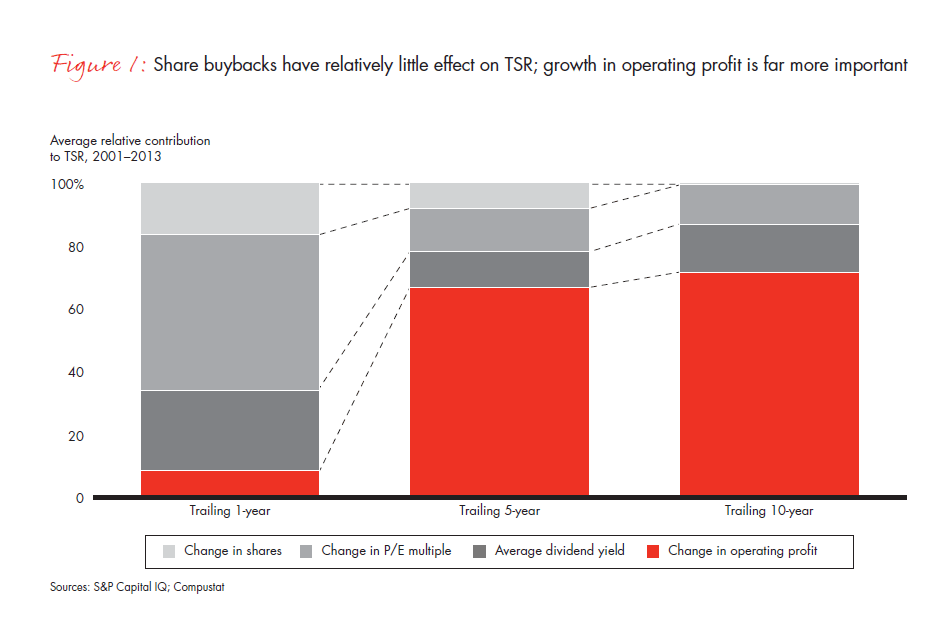
Assessing your own company’s TSR relative to expectations and breaking it down into its constituent factors can be revealing. Looking at it historically shows you how you are performing relative to peers and which factors are responsible for your relative under- or over-performance. It also brings into sharp focus how investors view the company. An industrial company, for instance, found that its TSR was twice that of one key competitor, but well below the TSR of two others. Analysis revealed that this company’s operating margin explained the difference between its performance and that of its top peers. That encouraged the senior team to tackle overhead costs and focus its business mix and R&D on higher-margin areas.
In our experience, the best-performing firms typically set explicit goals (to be in the top quartile in their industry, say) and then identify the gaps between those goals and current earnings expectations. The exercise allows the senior team to make strategic choices on how best to deploy capital and other resources.
2. Analyze your investor base
Many public companies find that a discrete number of large traders, usually between 25 and 100, move their stock in any given quarter. Companies need to know who these investors are—how many are short-term momentum traders, how many are long-term investors and so on. Investors in each segment have their own biases and are likely to focus on specific metrics based on their view of how companies create competitive advantage.
Over time, growth-oriented companies need to create an investor base that is consistent with their plans. That requires both laying out a compelling vision of where the company is going and consistently reinforcing the vision through action. Many companies, for example, view themselves as growth oriented. But the decisions they make—buying back shares, increasing dividends, announcing modest growth expectations—belie that ambition. Not surprisingly, their investor base migrates toward the value-oriented segment rather than the growth-oriented one. To get back on the growth path, the companies have to change investor expectations and gradually transform the base.
3. Look for balanced growth opportunities—including M&A
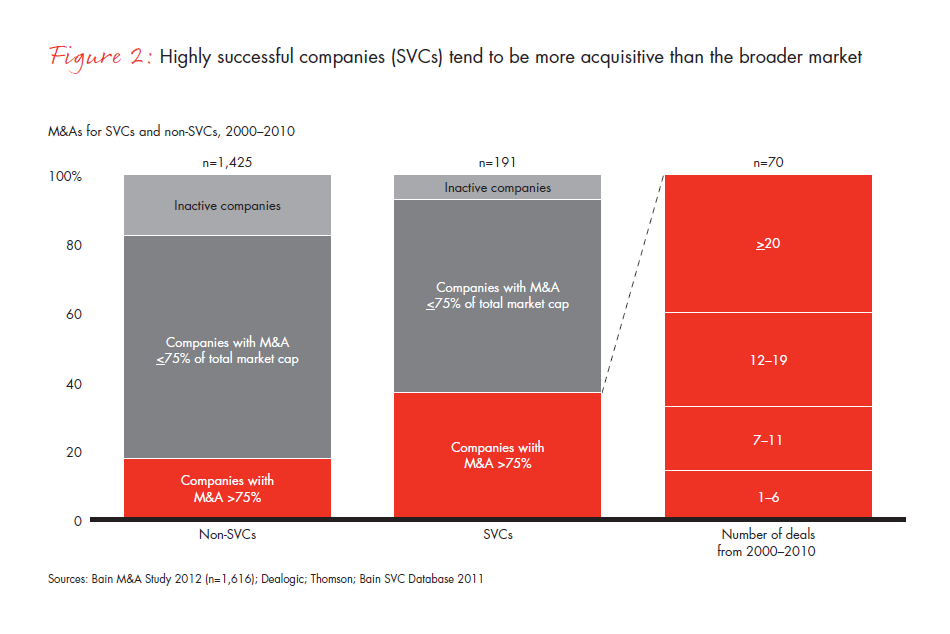
It’s hard to achieve sustained profitable growth. On average, only one out of every nine large companies exceeds a 5.5% annual increase in revenue and profit over 10 years while earning its cost of capital. These “sustained value creators” (SVCs), as we call them, deliberately pursue both top-line and bottom-line growth, avoiding investments that would tip them too far in one direction or the other.
How do they get such great results? Most SVCs rely on a mix of organic growth and mergers and acquisitions. But the data shows that they tilt toward M&A (see Figure 2). This shouldn’t be surprising. In a study of more than 1,600 companies around the world, we found that “inactive” companies—those with no M&A—turned in an average annual TSR of 3.3% from 2000 through 2010. Companies that did engage in M&A, by contrast, averaged 4.8%. In a classic example from a few years ago, two electronics equipment companies were each spending roughly $2 billion a year on research and development, capital expenditures and acquisitions. But one put most of its money into organic growth (R&D and Capex), while the other bought a string of adjacent competitors. In this case the company with the M&A strategy turned in double the TSR of its competitor. That won’t always be true, of course, but executives need to know the value of different growth options.
One advantage of M&A is that it allows companies to make bets on long-term developments even while they are investing in short-term growth. Blockbuster had a chance to acquire Netflix for only $50 million in the early 2000s. But it missed the opportunity because it was focused on the short term and couldn’t see a payback on the investment.
4. Pressure-test your hurdle rates
Almost all corporate investors rely on a couple of basic financial calculations—internal rate of return (IRR) and net present value (NPV)—to evaluate prospective mergers or acquisitions. These are useful tools, but they are only as good as the assumptions that go into the deal model. Suppose that a company’s hurdle rate for low-risk new investments is its weighted average cost of capital (WACC), which we can estimate at 8% (roughly the average for the S&P 500). Conservative CFOs probably add an M&A risk premium of four or more percentage points on top of that, so their effective hurdle rate for deals is 12% or more.
This calculation presents three issues:
- Today’s cost of debt is at a historic low. Previous Bain studies have shown that today’s world is awash in capital: About $300 trillion in global financial holdings is available for investment. The law of supply and demand means that the cost of capital will likely remain low. Moreover, central banks are committed to keeping interest rates down for the foreseeable future. Talent and innovative ideas may still be scarce, but capital is not.
- Risk premiums are often too high. The superabundance of capital not only affects current and future WACC calculations; it also means that conventional risk premiums may in fact be too high. A decade ago, a 4% premium on a 12% WACC may have made sense. But 4% on top of a 6% to 8% WACC represents a much higher relative premium.
- Risk premiums vary with experience. Companies too often use standard risk premiums, neglecting to tailor the premiums to their own experience. A company contemplating entering an unstable developing market for the first time, for example, is wise to set a high risk premium for the venture. But a company with deep experience in that country can afford to be more sophisticated about its premium— the standard rate wouldn’t apply.
5. Build your investment capabilities, thus lowering your risk
Bain’s study of mergers and acquisitions reveals a compelling truth: The more deals a company does and the more material those deals are to the company’s overall market capitalization, the better the returns. During the 11-year period from 2000 through 2010, companies averaging more than one deal per year—and where the deals added up to more than 75% of the buyer’s market cap—turned in an average TSR well above that of companies in other categories. M&A, in short, is an arena where experience and expertise matter a great deal.
Companies that are most experienced at M&A build up their capabilities over time. They search hard for merger or acquisition candidates that will add to their operating profit, fueling balanced growth. They pursue nearly as many “scope” deals as “scale” deals, moving into adjacent markets as well as expanding their share of existing markets. Most important, they create Repeatable Models® for identifying, evaluating and then closing good deals. What they find, typically, is that there are plenty of good prospects to be pursued, and that the risk involved decreases over time. Remarkably, 24% of these companies are sustained value creators, as compared with only 11% of companies in general.
Escaping the no-growth trap isn’t a matter of leaping into the abyss. Rather, it’s a matter of carefully evaluating your company’s TSR and investor base, reexamining growth opportunities and hurdle rates in light of your TSR objectives, and then strengthening your investment muscles. The companies that take such steps have started to grow again, leaving their competitors behind.
Michael Robbins is a Bain partner based in Washington, DC and leader of the firm’s Corporate Finance practice in the Americas. Henrik Poppe, a partner based in Oslo, leads the Corporate Finance practice in Europe, the Middle East and Africa. David Harding, based in Boston, is a Bain partner and co-leader in Bain’s Global M&A practice.
First published in 12월 2014