
Skip to Content
  • 오피스

    오피스

    미주
    • Atlanta
    • Austin
    • Bogota
    • Boston
    • Buenos Aires
    • Chicago
    • Dallas
    • Denver
    • Houston
    • Los Angeles
    • Mexico City
    • Minneapolis
    • Monterrey
    • Montreal
    • New York
    • Rio de Janeiro
    • San Francisco
    • Santiago
    • São Paulo
    • Seattle
    • Silicon Valley
    • Toronto
    • Washington, DC
    유럽, 중동, 아프리카
    • Amsterdam
    • Athens
    • Berlin
    • Brussels
    • Copenhagen
    • Doha
    • Dubai
    • Dusseldorf
    • Frankfurt
    • Helsinki
    • Istanbul
    • Johannesburg
    • Kyiv
    • Lisbon
    • London
    • Madrid
    • Milan
    • Munich
    • Oslo
    • Paris
    • Riyadh
    • Rome
    • Stockholm
    • Vienna
    • Warsaw
    • Zurich
    아시아, 호주
    • Bangkok
    • Beijing
    • Bengaluru
    • Brisbane
    • Ho Chi Minh City
    • Hong Kong
    • Jakarta
    • Kuala Lumpur
    • Manila
    • Melbourne
    • Mumbai
    • New Delhi
    • Perth
    • Seoul
    • Shanghai
    • Singapore
    • Sydney
    • Tokyo
    오피스 전체보기
  • 얼럼나이
  • 미디어 센터
  • 구독
  • 연락처
  • Korea | 한국어

    지역 및 언어 선택

    글로벌
    • Global (English)
    미주
    • Brazil (Português)
    • Argentina (Español)
    • Canada (Français)
    • Chile (Español)
    • Colombia (Español)
    유럽, 중동, 아프리카
    • France (Français)
    • DACH Region (Deutsch)
    • Italy (Italiano)
    • Spain (Español)
    • Greece (Elliniká)
    아시아, 호주
    • China (中文版)
    • Korea (한국어)
    • Japan (日本語)
  • Saved items (0)
    Saved items (0)

    You have no saved items.

    관심 있는 내용을 북마크하여 Red 폴더에 저장할 수 있습니다. Red 폴더 에서 저장된 내용을 읽거나 공유해보세요.

    Explore Bain Insights
  • 산업
    메인 메뉴

    산업

    • 우주항공, 방산 및 정부 서비스
    • 농업 관련 산업
    • 화학
    • 인프라, 건설 및 건축 자재
    • 소비재
    • 금융 서비스
    • 헬스케어
    • 산업용 기계 및 장비
    • 미디어 및 엔터테인먼트
    • 금속
    • 광업
    • 석유 및 가스
    • 제지 및 패키징 산업
    • 사모펀드
    • 사회 및 공공 부문
    • 유통
    • 기술
    • 텔레콤
    • 운송
    • 여행·여가
    • 유틸리티 및 재생가능 에너지
  • 컨설팅 서비스
    메인 메뉴

    컨설팅 서비스

    • Customer Experience
    • ESG
    • Innovation
    • M&A
    • 운영
    • 조직
    • 사모펀드
    • 고객 전략 및 마케팅
    • 전략
    • AI, 인사이트 및 솔루션
    • Technology
    • 변화 혁신
  • Digital
  • 인사이트
  • 베인 소개
    메인 메뉴

    베인 소개

    • 업무 소개
    • 베인의 신념
    • 구성원 및 리더십 소개
    • 고객 성과
    • 주요 수상 경력
    • 글로벌 파트너사
    Further: Our global responsibility
    • 다양성과 포용
    • 사회 공헌 활동
    • Sustainability
    • World Economic Forum
    Learn more about Further
  • Careers
    메인 메뉴

    Careers

    • Work with Us
      Careers
      Work with Us
      • Find Your Place
      • Our Work Areas
      • Integrated Teams
      • Students
      • Internships & Programs
      • Recruiting Events
    • Life at Bain
      Careers
      Life at Bain
      • Blog: Inside Bain
      • Career Stories
      • Our People
      • Where We Work
      • Supporting Your Growth
      • Affinity Groups
      • Benefits
    • Impact Stories
    • Hiring Process
      Careers
      Hiring Process
      • What to Expect
      • Interviewing
    FIND JOBS
  • 오피스
    메인 메뉴

    오피스

    • 미주
      오피스
      미주
      • Atlanta
      • Austin
      • Bogota
      • Boston
      • Buenos Aires
      • Chicago
      • Dallas
      • Denver
      • Houston
      • Los Angeles
      • Mexico City
      • Minneapolis
      • Monterrey
      • Montreal
      • New York
      • Rio de Janeiro
      • San Francisco
      • Santiago
      • São Paulo
      • Seattle
      • Silicon Valley
      • Toronto
      • Washington, DC
    • 유럽, 중동, 아프리카
      오피스
      유럽, 중동, 아프리카
      • Amsterdam
      • Athens
      • Berlin
      • Brussels
      • Copenhagen
      • Doha
      • Dubai
      • Dusseldorf
      • Frankfurt
      • Helsinki
      • Istanbul
      • Johannesburg
      • Kyiv
      • Lisbon
      • London
      • Madrid
      • Milan
      • Munich
      • Oslo
      • Paris
      • Riyadh
      • Rome
      • Stockholm
      • Vienna
      • Warsaw
      • Zurich
    • 아시아, 호주
      오피스
      아시아, 호주
      • Bangkok
      • Beijing
      • Bengaluru
      • Brisbane
      • Ho Chi Minh City
      • Hong Kong
      • Jakarta
      • Kuala Lumpur
      • Manila
      • Melbourne
      • Mumbai
      • New Delhi
      • Perth
      • Seoul
      • Shanghai
      • Singapore
      • Sydney
      • Tokyo
    오피스 전체보기
  • 얼럼나이
  • 미디어 센터
  • 구독
  • 연락처
  • Korea | 한국어
    메인 메뉴

    지역 및 언어 선택

    • 글로벌
      지역 및 언어 선택
      글로벌
      • Global (English)
    • 미주
      지역 및 언어 선택
      미주
      • Brazil (Português)
      • Argentina (Español)
      • Canada (Français)
      • Chile (Español)
      • Colombia (Español)
    • 유럽, 중동, 아프리카
      지역 및 언어 선택
      유럽, 중동, 아프리카
      • France (Français)
      • DACH Region (Deutsch)
      • Italy (Italiano)
      • Spain (Español)
      • Greece (Elliniká)
    • 아시아, 호주
      지역 및 언어 선택
      아시아, 호주
      • China (中文版)
      • Korea (한국어)
      • Japan (日本語)
  • Saved items  (0)
    메인 메뉴
    Saved items (0)

    You have no saved items.

    관심 있는 내용을 북마크하여 Red 폴더에 저장할 수 있습니다. Red 폴더 에서 저장된 내용을 읽거나 공유해보세요.

    Explore Bain Insights
  • 산업
    • 산업

      • 우주항공, 방산 및 정부 서비스
      • 농업 관련 산업
      • 화학
      • 인프라, 건설 및 건축 자재
      • 소비재
      • 금융 서비스
      • 헬스케어
      • 산업용 기계 및 장비
      • 미디어 및 엔터테인먼트
      • 금속
      • 광업
      • 석유 및 가스
      • 제지 및 패키징 산업
      • 사모펀드
      • 사회 및 공공 부문
      • 유통
      • 기술
      • 텔레콤
      • 운송
      • 여행·여가
      • 유틸리티 및 재생가능 에너지
  • 컨설팅 서비스
    • 컨설팅 서비스

      • Customer Experience
      • ESG
      • Innovation
      • M&A
      • 운영
      • 조직
      • 사모펀드
      • 고객 전략 및 마케팅
      • 전략
      • AI, 인사이트 및 솔루션
      • Technology
      • 변화 혁신
  • Digital
  • 인사이트
  • 베인 소개
    • 베인 소개

      • 업무 소개
      • 베인의 신념
      • 구성원 및 리더십 소개
      • 고객 성과
      • 주요 수상 경력
      • 글로벌 파트너사
      Further: Our global responsibility
      • 다양성과 포용
      • 사회 공헌 활동
      • Sustainability
      • World Economic Forum
      Learn more about Further
  • Careers
    최근 검색어
      최근 방문 페이지

      Content added to saved items

      Saved items (0)

      Removed from saved items

      Saved items (0)

      Brief

      China’s Businesses Start Down the Path of Recovery from Covid-19

      China’s Businesses Start Down the Path of Recovery from Covid-19

      Reducing costs and optimizing supply chains can help restart growth after the coronavirus pandemic.

      글 Kelly Liu and Kevin Ye

      • 읽기 소요시간
      }

      Brief

      China’s Businesses Start Down the Path of Recovery from Covid-19
      en
      한눈에 보기
      • All industries in China will face significant short-term obstacles as they strive to get their businesses up and running.
      • The key medium- to long-term challenges are deterioration of market demand, supply chain disruptions and rising operating costs.
      • Bain research shows 60% of senior executives in China are skeptical about their ability to overcome the medium- to long-term effects of the coronavirus.

      Companies in China are gradually resuming production, but the challenges imposed by the coronavirus pandemic are far from over. Cash-flow problems and parts shortages may slow efforts to get plants up and running. And the spread of the disease, creating a humanitarian crisis around the world, is likely to weaken demand. Senior executives in China expect Covid-19 to pummel their businesses in the short term, followed by a gradual recovery, according to Bain research.

      But uncertainties abound. Few leadership teams and boards have managed through a disruption of this magnitude. As they consider actions to reduce the medium- to long-term effects of the crisis, many remain worried about the path ahead. Nearly 60% of the senior executives we surveyed were skeptical that these actions would be successful. The findings are drawn from interviews with 89 senior executives in China at multinationals, private companies, state-owned enterprises and joint ventures in multiple industries.

      For Our Clients

      Macro Surveillance Platform

      For more detail on the business implications of coronavirus from Bain’s Macro Trends Group, log on to the Macro Surveillance Platform. Learn more about the platform >

      Short-term headwinds

      In the next 3 to 6 months, all industries will encounter obstacles restarting a smooth collaboration with suppliers, distributors and customers. The nationwide lockdown on production and consumption disrupted supply chains and logistics, hitting some industries harder than others. The advanced manufacturing, consumer products, retail and healthcare industries face the biggest challenges, given the complexity of their supply chains and surging demand for their products during the outbreak (see Figure 1).

      Figure 1
      Companies are most worried about Covid-19’s effect on supply chains and damage to business partners
      Companies are most worried about Covid-19’s effect on supply chains and damage to business partners
      Companies are most worried about Covid-19’s effect on supply chains and damage to business partners

      Over the next 6 to 18 months, fallout from the epidemic will include mounting operating costs (labor and raw materials, for example), supply chain disruptions, and possible deterioration in market demand. The challenges will differ from industry to industry. Retail, advanced manufacturing and financial services, for example, are tied more closely to the macroeconomic cycle and as a result, are more vulnerable to a downturn in demand (see Figure 2).

      Figure 2
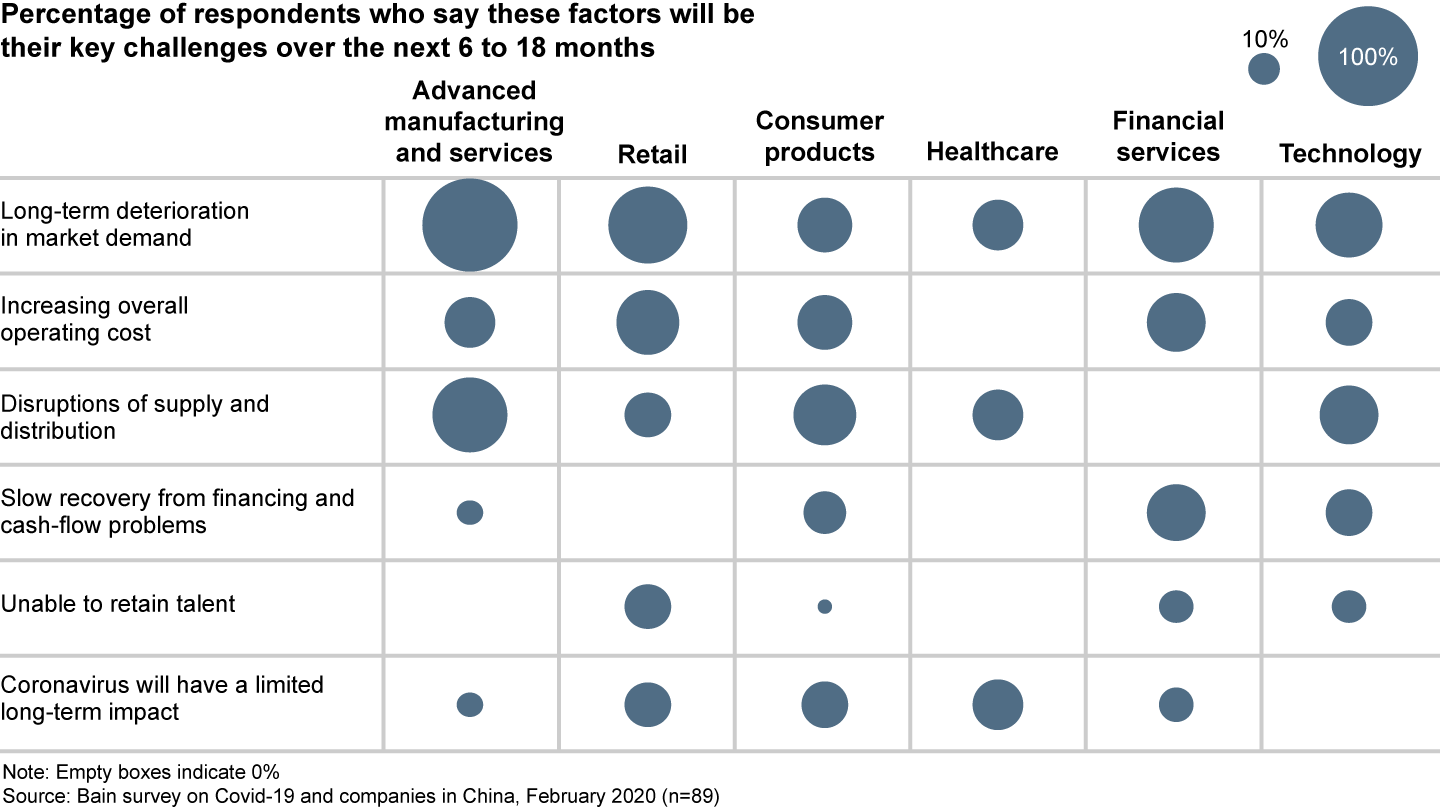
      Manufacturing, financial and retail companies expect a long-term deterioration of market demand
      Manufacturing, financial and retail companies expect a long-term deterioration of market demand
      Manufacturing, financial and retail companies expect a long-term deterioration of market demand

      The most effective medium- to long-term responses to Covid-19 also vary from industry to industry. Advanced manufacturing, retail, financial services and technology, media and telecom typically put more emphasis on cost reduction and operational efficiency to bolster performance. Retailers, with their extensive supplier networks, tend to focus on optimizing their long-term supply chains, vendor management and inventory (see Figure 3).

      Figure 3
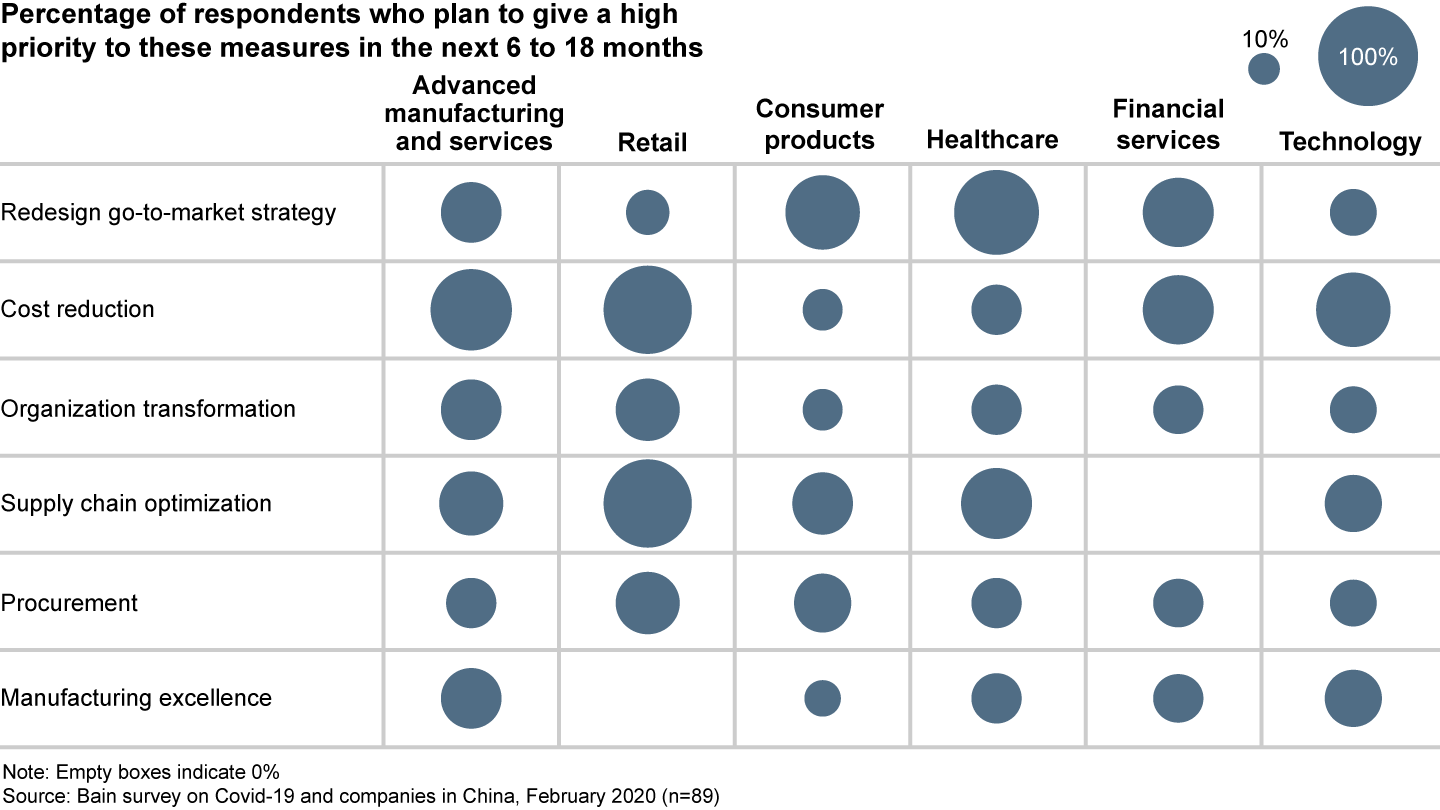
      Retailers’ Covid-19 recovery plan: reduce costs and improve supply chains
      Retailers’ Covid-19 recovery plan: reduce costs and improve supply chains
      Retailers’ Covid-19 recovery plan: reduce costs and improve supply chains

      To minimize the impact of the coronavirus in the medium to long term, leading companies are starting to reduce costs and optimize their supply chains. More than 60% of the executives we interviewed pointed to labor and nonlabor costs as a top priority. Companies that focused on supply chains said sales and operations and production planning, inventory management and digitalization are critical. Leaders will also diversify their supply chains to avoid excessive reliance on a single supplier or single region

      Two priorities to grow out of the crisis

      The coronavirus epidemic has accelerated the pace of structural change and innovation. Leaders are taking two important steps to kick-start sustainable growth: cost reduction and supply chain optimization.

      Cost reduction

      For many companies, cost-cutting is a one-time reset that delivers short-term results at the expense of employees and customer experience. Our experience shows that costs eliminated by radical cuts often creep back over time. Cost productivity leaders take a more programmatic approach, following five key principles:

      Define clear targets using a today-forward, future-back perspective. Cost-reduction plans with clear targets and specific measures are more likely to deliver the expected results. Leaders formulate a plan to improve current operations while developing future productivity targets and long-term strategy.

      Focus on best in class vs. best in cost. Instead of cutting costs indiscriminately, successful companies adapt the cuts to their strategy. They invest in low-cost capabilities, but also build a competitive advantage to fuel sustainable growth.

      Adopt a zero-based budget approach. Applying cost-reduction tools to an existing business model is likely to produce disappointing results. Leaders start from scratch to rethink processes and unearth new efficiencies. They use zero-based redesign and zero-based budgeting to align spending and investment with the firm’s stage of development.

      Improve organizational capabilities. Top-down cost-reduction plans typically are difficult to implement, lack frontline commitment and produce less satisfactory results. Effective leaders give the front line a sense of ownership in change programs. They cultivate an open culture focused on productivity, streamline decision making and offer incentives that sustain results.

      Harness digital solutions. Digital tools can significantly improve operations efficiency and strengthen supplier and inventory management. Leading companies deploy digital technologies to create outstanding cost and operating models.

      Companies that follow these principles are likely to recover faster and emerge from the crisis stronger. One international fast-food chain in Greater China embarked on a series of cost-reduction efforts, including zero-based redesign and zero-based budgeting. The leadership team built a transparent cost baseline to reevalute its savings priorities. Using digital tools, it generated a more accurate sales forecast. That, in turn, helped optimize the costs of labor, packaging and raw material, and supported vendor evaluations and negotiations. The company met its profit goal, cut baseline costs 5% to 25%, and invested the savings in projects tied to future priorities.

      Supply chain optimization

      The coronavirus epidemic has dramatically changed companies’ external environment, upending the competitive landscape and collaboration along the value chain. Leading companies now are reconfiguring their supply chains for the future by focusing on three vital steps.

      Align supply chain objectives with business strategy. Supply chain managers typically balance three competing priorities: improving efficiency (cost, lead time and inventory turnover, for example); reducing supply risk; and enhancing customer satisfaction. To make the right trade-offs, leaders review their medium- to long-term business strategies and focus on the factors that sharpen their competitive edge, such as speed to market, supply security, pricing or innovation. Setting strategic priorities guides future supply chain objectives and the overall supply network’s design, as well as daily supply chain operations.

      Adopt a global perspective. A global supply network—including suppliers, manufacturing sites, logistics and warehousing—helps lower costs and spread risks across regions. Companies can reconfigure their manufacturing footprint by moving production to lower-cost regions such as inland China or parts of Southeast Asia. To improve supply security for core components, leaders are developing alternative suppliers and sites in other countries. They also are cultivating strategic suppliers for key technologies to avoid potential disruption from international trade disputes.

      Embrace digitalization. Digital tools give managers a comprehensive view of their internal and external supply chain and provide real-time performance feedback. In addition, leaders make sure the digital platform is linked to the operating model and includes a mechanism that can rapidly engage senior executives for decisions on critical issues at the right moment.

      The coronavirus outbreak has provoked unprecedented economic disruption around the world. As leadership teams in China emerge from the most acute phase of the crisis and restart operations, they are rightly focused on the long-term health of their businesses, employees and customers. Those that optimize their costs and supply chain structure will be best positioned to meet the challenges ahead and succeed in the long run.

      Kelly Liu is a partner with Bain & Company and leads the firm’s Performance Improvement practice in Greater China. She is based in Bain’s Beijing office. Kevin Ye is an expert principal in Bain’s Performance Improvement practice and is based in the firm’s Shanghai office.

      The authors would like to give special thanks to Peter Guarraia, the leader of Bain’s Global Supply Chain and Cost Management practices; and Raymond Tsang and Vinit Bhatia, the coleaders of Bain’s Asia-Pacific Performance Improvement practice, for their guidance. The authors also thank case team leader Zoe Cai and associate consultant Joyce Li for their contributions.

      Related Insights

      Coronavirus

      The global Covid-19 pandemic has extracted a terrible human toll and spurred sweeping changes in the world economy. Across industries, executives have begun reassessing their strategies and repositioning their companies to thrive now and in the world beyond coronavirus.

      저자
      • Headshot of Kelly Liu
        Kelly Liu
        Alumni, Shanghai
      • Headshot of Kevin Ye
        Kevin Ye
        파트너, Shanghai
      문의하기
      관련 컨설팅 서비스
      • 성과 개선
      • 어드밴스드 애널리틱스
      • Digital
      • Supply Chain
      Coronavirus
      Supply Chain Lessons from Covid-19: Time to Refocus on Resilience

      Amid crisis and disruption, supply networks designed for low-cost and minimal inventory pose a major risk.

      자세히 보기
      Coronavirus
      Cash Management Practices to Weather a Downturn

      Take an honest look at the business, and decide where to improve.

      자세히 보기
      성과 개선
      It's Time to Build Resilience into Retail and Consumer Goods Supply Chains

      Reeling from Covid-19 disruptions, leaders are investing to improve speed and agility.

      자세히 보기
      Coronavirus
      Ramping Up Online Grocery without Breaking the Bank

      Bain’s Marc-André Kamel discusses the challenges that online grocery presents for retailers and CPGs and how they can pair up to find a winning solution.

      자세히 보기
      Coronavirus
      Online Grocery: A Joint Challenge for Retailers and CPG Suppliers

      While online grocery has continued to surge, grocers and consumer packaged-goods groups must work together to fix the dilutive economics of the channel.

      자세히 보기
      First published in 3월 2020
      태그
      • 성과 개선
      • 어드밴스드 애널리틱스
      • Coronavirus
      • Digital
      • Supply Chain

      프로젝트 사례

      어드밴스드 애널리틱스 Blockchain-enabled Payment Flows: A Payments Company Reviews its Strategy

      See more related case studies

      성과 개선 Turning bottlenecks into growth opportunities

      See more related case studies

      성과 개선 Carmaker shifts its production model

      See more related case studies

      베인에 궁금하신 점이 있으신가요?

      베인은 주저 없이 변화를 마주할 줄 아는 용감한 리더들과 함께합니다. 그리고, 이들의 담대한 용기는 고객사의 성공으로 이어집니다.

      급변하는 비즈니스 환경에서 살아남기 위한 선도자의 시각. 월간 Bain Insights에서 글로벌 비즈니스의 핵심 이슈를 확인하십시오.

      *개인정보 정책을 읽었으며 그 내용에 동의합니다.

      Privacy Policy를 읽고 동의해주십시오.
      Bain & Company
      문의하기 환경정책 Accessibility 이용약관 개인정보 보호 쿠키 사용 정책 Sitemap Log In

      © 1996-2026 Bain & Company, Inc.

      문의하기

      무엇을 도와드릴까요?

      • 프로젝트 문의
      • 채용 정보
      • 언론
      • 제휴 문의
      • 연사 초청
      오피스 전체보기