
Skip to Content
  • 오피스

    오피스

    미주
    • Atlanta
    • Austin
    • Bogota
    • Boston
    • Buenos Aires
    • Chicago
    • Dallas
    • Denver
    • Houston
    • Los Angeles
    • Mexico City
    • Minneapolis
    • Monterrey
    • Montreal
    • New York
    • Rio de Janeiro
    • San Francisco
    • Santiago
    • São Paulo
    • Seattle
    • Silicon Valley
    • Toronto
    • Washington, DC
    유럽, 중동, 아프리카
    • Amsterdam
    • Athens
    • Berlin
    • Brussels
    • Copenhagen
    • Doha
    • Dubai
    • Dusseldorf
    • Frankfurt
    • Helsinki
    • Istanbul
    • Johannesburg
    • Kyiv
    • Lisbon
    • London
    • Madrid
    • Milan
    • Munich
    • Oslo
    • Paris
    • Riyadh
    • Rome
    • Stockholm
    • Vienna
    • Warsaw
    • Zurich
    아시아, 호주
    • Bangkok
    • Beijing
    • Bengaluru
    • Brisbane
    • Ho Chi Minh City
    • Hong Kong
    • Jakarta
    • Kuala Lumpur
    • Manila
    • Melbourne
    • Mumbai
    • New Delhi
    • Perth
    • Seoul
    • Shanghai
    • Singapore
    • Sydney
    • Tokyo
    오피스 전체보기
  • 얼럼나이
  • 미디어 센터
  • 구독
  • 연락처
  • Korea | 한국어

    지역 및 언어 선택

    글로벌
    • Global (English)
    미주
    • Brazil (Português)
    • Argentina (Español)
    • Canada (Français)
    • Chile (Español)
    • Colombia (Español)
    유럽, 중동, 아프리카
    • France (Français)
    • DACH Region (Deutsch)
    • Italy (Italiano)
    • Spain (Español)
    • Greece (Elliniká)
    아시아, 호주
    • China (中文版)
    • Korea (한국어)
    • Japan (日本語)
  • Saved items (0)
    Saved items (0)

    You have no saved items.

    관심 있는 내용을 북마크하여 Red 폴더에 저장할 수 있습니다. Red 폴더 에서 저장된 내용을 읽거나 공유해보세요.

    Explore Bain Insights
  • 산업
    메인 메뉴

    산업

    • 우주항공, 방산 및 정부 서비스
    • 농업 관련 산업
    • 화학
    • 인프라, 건설 및 건축 자재
    • 소비재
    • 금융 서비스
    • 헬스케어
    • 산업용 기계 및 장비
    • 미디어 및 엔터테인먼트
    • 금속
    • 광업
    • 석유 및 가스
    • 제지 및 패키징 산업
    • 사모펀드
    • 사회 및 공공 부문
    • 유통
    • 기술
    • 텔레콤
    • 운송
    • 여행·여가
    • 유틸리티 및 재생가능 에너지
  • 컨설팅 서비스
    메인 메뉴

    컨설팅 서비스

    • Customer Experience
    • ESG
    • Innovation
    • M&A
    • 운영
    • 조직
    • 사모펀드
    • 고객 전략 및 마케팅
    • 전략
    • AI, 인사이트 및 솔루션
    • Technology
    • 변화 혁신
  • Digital
  • 인사이트
  • 베인 소개
    메인 메뉴

    베인 소개

    • 업무 소개
    • 베인의 신념
    • 구성원 및 리더십 소개
    • 고객 성과
    • 주요 수상 경력
    • 글로벌 파트너사
    Further: Our global responsibility
    • 다양성과 포용
    • 사회 공헌 활동
    • Sustainability
    • World Economic Forum
    Learn more about Further
  • Careers
    메인 메뉴

    Careers

    • Work with Us
      Careers
      Work with Us
      • Find Your Place
      • Our Work Areas
      • Integrated Teams
      • Students
      • Internships & Programs
      • Recruiting Events
    • Life at Bain
      Careers
      Life at Bain
      • Blog: Inside Bain
      • Career Stories
      • Our People
      • Where We Work
      • Supporting Your Growth
      • Affinity Groups
      • Benefits
    • Impact Stories
    • Hiring Process
      Careers
      Hiring Process
      • What to Expect
      • Interviewing
    FIND JOBS
  • 오피스
    메인 메뉴

    오피스

    • 미주
      오피스
      미주
      • Atlanta
      • Austin
      • Bogota
      • Boston
      • Buenos Aires
      • Chicago
      • Dallas
      • Denver
      • Houston
      • Los Angeles
      • Mexico City
      • Minneapolis
      • Monterrey
      • Montreal
      • New York
      • Rio de Janeiro
      • San Francisco
      • Santiago
      • São Paulo
      • Seattle
      • Silicon Valley
      • Toronto
      • Washington, DC
    • 유럽, 중동, 아프리카
      오피스
      유럽, 중동, 아프리카
      • Amsterdam
      • Athens
      • Berlin
      • Brussels
      • Copenhagen
      • Doha
      • Dubai
      • Dusseldorf
      • Frankfurt
      • Helsinki
      • Istanbul
      • Johannesburg
      • Kyiv
      • Lisbon
      • London
      • Madrid
      • Milan
      • Munich
      • Oslo
      • Paris
      • Riyadh
      • Rome
      • Stockholm
      • Vienna
      • Warsaw
      • Zurich
    • 아시아, 호주
      오피스
      아시아, 호주
      • Bangkok
      • Beijing
      • Bengaluru
      • Brisbane
      • Ho Chi Minh City
      • Hong Kong
      • Jakarta
      • Kuala Lumpur
      • Manila
      • Melbourne
      • Mumbai
      • New Delhi
      • Perth
      • Seoul
      • Shanghai
      • Singapore
      • Sydney
      • Tokyo
    오피스 전체보기
  • 얼럼나이
  • 미디어 센터
  • 구독
  • 연락처
  • Korea | 한국어
    메인 메뉴

    지역 및 언어 선택

    • 글로벌
      지역 및 언어 선택
      글로벌
      • Global (English)
    • 미주
      지역 및 언어 선택
      미주
      • Brazil (Português)
      • Argentina (Español)
      • Canada (Français)
      • Chile (Español)
      • Colombia (Español)
    • 유럽, 중동, 아프리카
      지역 및 언어 선택
      유럽, 중동, 아프리카
      • France (Français)
      • DACH Region (Deutsch)
      • Italy (Italiano)
      • Spain (Español)
      • Greece (Elliniká)
    • 아시아, 호주
      지역 및 언어 선택
      아시아, 호주
      • China (中文版)
      • Korea (한국어)
      • Japan (日本語)
  • Saved items  (0)
    메인 메뉴
    Saved items (0)

    You have no saved items.

    관심 있는 내용을 북마크하여 Red 폴더에 저장할 수 있습니다. Red 폴더 에서 저장된 내용을 읽거나 공유해보세요.

    Explore Bain Insights
  • 산업
    • 산업

      • 우주항공, 방산 및 정부 서비스
      • 농업 관련 산업
      • 화학
      • 인프라, 건설 및 건축 자재
      • 소비재
      • 금융 서비스
      • 헬스케어
      • 산업용 기계 및 장비
      • 미디어 및 엔터테인먼트
      • 금속
      • 광업
      • 석유 및 가스
      • 제지 및 패키징 산업
      • 사모펀드
      • 사회 및 공공 부문
      • 유통
      • 기술
      • 텔레콤
      • 운송
      • 여행·여가
      • 유틸리티 및 재생가능 에너지
  • 컨설팅 서비스
    • 컨설팅 서비스

      • Customer Experience
      • ESG
      • Innovation
      • M&A
      • 운영
      • 조직
      • 사모펀드
      • 고객 전략 및 마케팅
      • 전략
      • AI, 인사이트 및 솔루션
      • Technology
      • 변화 혁신
  • Digital
  • 인사이트
  • 베인 소개
    • 베인 소개

      • 업무 소개
      • 베인의 신념
      • 구성원 및 리더십 소개
      • 고객 성과
      • 주요 수상 경력
      • 글로벌 파트너사
      Further: Our global responsibility
      • 다양성과 포용
      • 사회 공헌 활동
      • Sustainability
      • World Economic Forum
      Learn more about Further
  • Careers
    최근 검색어
      최근 방문 페이지

      Content added to saved items

      Saved items (0)

      Removed from saved items

      Saved items (0)

      Brief

      Creating a Dynamic Management System Built for Speed

      Creating a Dynamic Management System Built for Speed

      In these turbulent times, flexibly prioritizing and allocating resources helps companies make good decisions and focus on what matters most.

      글 Sarah Elk, Joost Spits, and Michelle Carroll

      • 읽기 소요시간
      }

      Brief

      Creating a Dynamic Management System Built for Speed
      en
      한눈에 보기
      • An integrated corporate management system helps establish priorities, allocate resources, review outcomes, and dynamically learn and adapt.
      • Companies with strong management systems have five-year profit growth that is more than three times that of other companies.

      Tom Cruise fans will remember the line he made famous in the 1986 blockbuster Top Gun: “I feel the need … the need for speed.” In today’s shifting marketplace, CEOs often echo this sentiment. They, too, want to move faster.

      In the movie, Cruise flew an F-14 Tomcat fighter, a plane that can reach speeds of up to 1,500 miles per hour. Newer fighter planes remain just as fast but have other upgrades. They are difficult to detect and much more nimble, capable of sharing airspace with automated drones. 

      Executives yearn for such a combination of speed and flexibility. For corporations, that starts with a management system. A collection of processes that help an organization achieve results, the management system determines how a company establishes its priorities, allocates resources, reviews and learns from the outcomes of its efforts, and then adapts based on those lessons (see Figure 1).   

      Figure 1
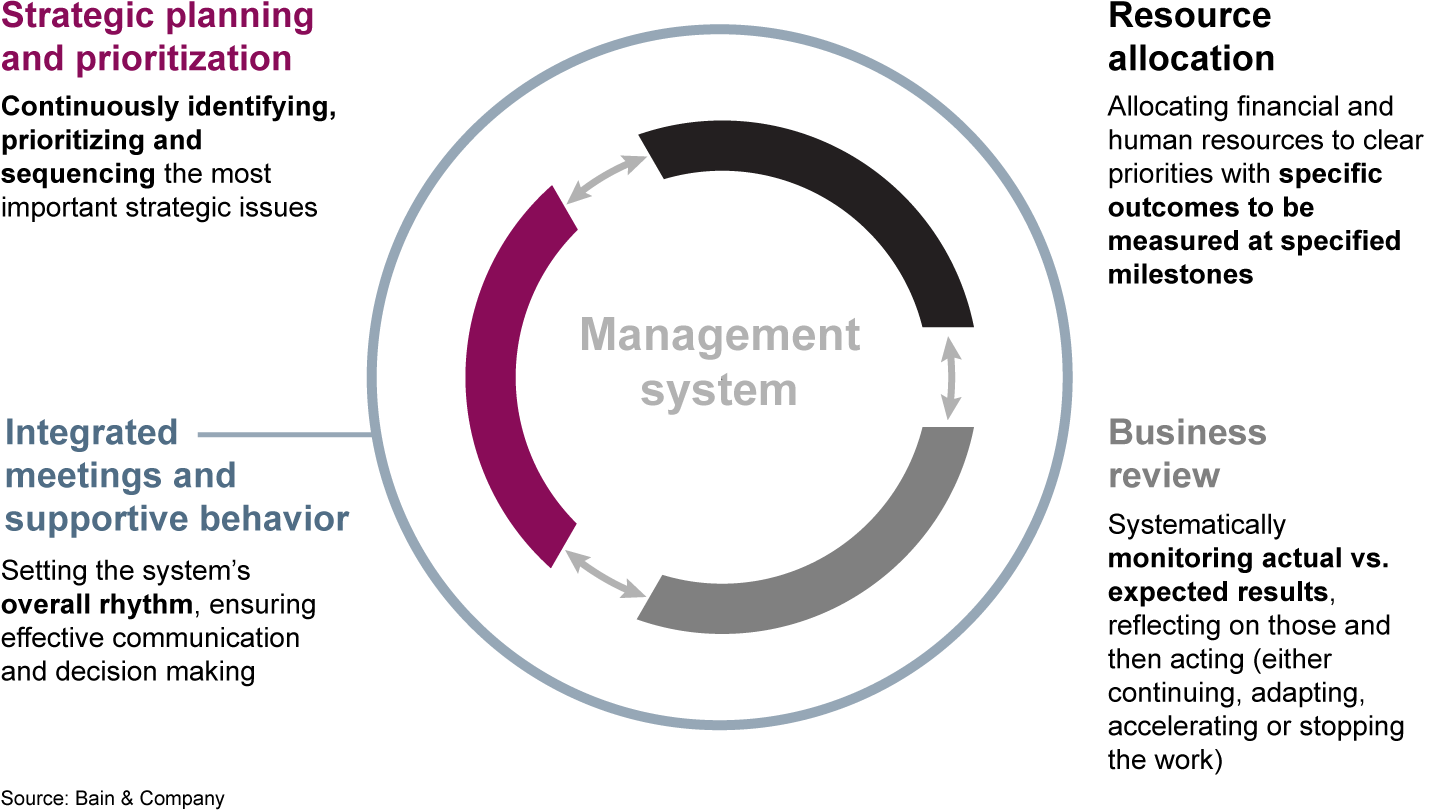
      A dynamic management system consists of four elements
      A dynamic management system consists of four elements
      A dynamic management system consists of four elements

      Our research suggests that companies with the strongest management systems achieve 3.4 times greater five-year profit growth than other companies—27% growth vs. 8%.

      Compared with other factors that contribute to organizational outcomes—such as talent systems, data and technology, business processes, leadership, and others—the management system is consistently one of the top influences on performance. A company’s management system has the greatest impact on its adaptability and efficiency.

      A well-designed management system can help executives simultaneously run the existing business efficiently and change it, moving toward long-term strategic goals with speed and innovation. Doing both requires companies to take a few steps.

      • Shift from a set, cyclical strategic planning process to one built on a managed backlog of issues, revisited and updated frequently. This makes it possible to continuously address issues using disciplined decision-making methodologies.

        Dell Technologies has made this transition. Several years ago, the company decided to implement a new model for strategic planning, budgeting and reviewing. Chairman and chief executive officer Michael Dell first develops a clear ambition for the company’s future value. Company leaders compare this target to a projection of its value on its current trajectory, and they identify the high-level actions required to close the gap between the two. This process produces a multiyear outlook of revenue and profit and a backlog of initiatives. The leaders then develop a detailed one-year operating plan. While this process happens annually, the team challenges the prioritization and resourcing of initiatives periodically during the year, ensuring that Dell can react quickly to changing customer needs, competitor moves and information about the results of past actions.

      • Allocate financial and human resources dynamically, often in smaller increments tied to specific goals, rather than in a single annual distribution. Frequent assessment makes it possible to reallocate based on results and evolving strategic priorities.

        When a US airline took a broad look at all the projects it had underway, managers realized their cycle of annual resource allocation was slowing them down and leading to overinvestment in unsuccessful experiments. So they shifted to frequent reviews of projects and their dedicated resources. During these reviews, successful projects that fit with the business’s priorities and strategy can earn more resources. For those that aren’t working, it’s a chance to be recognized as a learning experience and discontinued before the company invests too much.

      • Design forward-looking business reviews as two-way dialogues focused on the most critical issues. The review structures and content that work for projects focused on efficiently running the current business will differ from those designed for projects focused on growing it.

      • Match meeting cadence to the rapid pace of decision making and execution, and customize the meeting design and agenda to cultivate the right mindset and conversations. Though it’s one of their most valuable resources, companies squander an amazing amount of leadership time in poorly conceived meetings. By clarifying the intent of these forums, who should attend and what is discussed, companies can greatly improve their effectiveness and, in turn, their teams’ impact.

        Poor business reviews focus excessively on the things that are going exactly as expected. They should focus on the things that are not going as expected. However, in a recent Bain & Company survey conducted with Dynata, only 31% of respondents strongly agreed that their company’s business reviews focus on critical areas in which performance is deviating from expectation.

        Seeking to make its meetings more productive, a consumer products company split its “run-the-business” and “grow-the-business” topics into different meetings. Focused on predictable functions, the run-the-business meetings are frequent, short and standardized. Participants get materials to read ahead of the meeting and focus their in-person time on solving the issues that have come up. The grow-the-business meetings are dedicated to innovation and involve a lot of management coaching, ensuring that lessons are being captured and shared, and structuring ways to quickly scale what’s working. The style and substance of the meetings differ, as do the people who attend.

        More companies could follow this lead. According to our survey, only 20% of respondents’ organizations are clearly separating reviews into these two categories.

      The power of an integrated management system

      Individually important, these steps work best as part of an integrated system connected by frequent feedback. For example, business reviews help those maintaining the strategic backlog decide what should stop, continue and accelerate.

      An integrated system helps ensure that advances in individual functions benefit the whole organization. For example, implementing a more dynamic strategic planning process will only succeed if there is also a way to fund new ideas mid–business cycle. Similarly, allocating resources more dynamically won’t help for long if there is no effective review process to track the results of those investments. You can surface strategic issues during a strong business review, but they still won’t get the attention they need if the right feedback mechanisms aren’t in place.

      Though integration is critical, designing a holistic system can be difficult. Most companies already have some form of management system in place, and while it may be ill suited to what the business needs, it can also be hard to change (see Figure 2).

      Figure 2
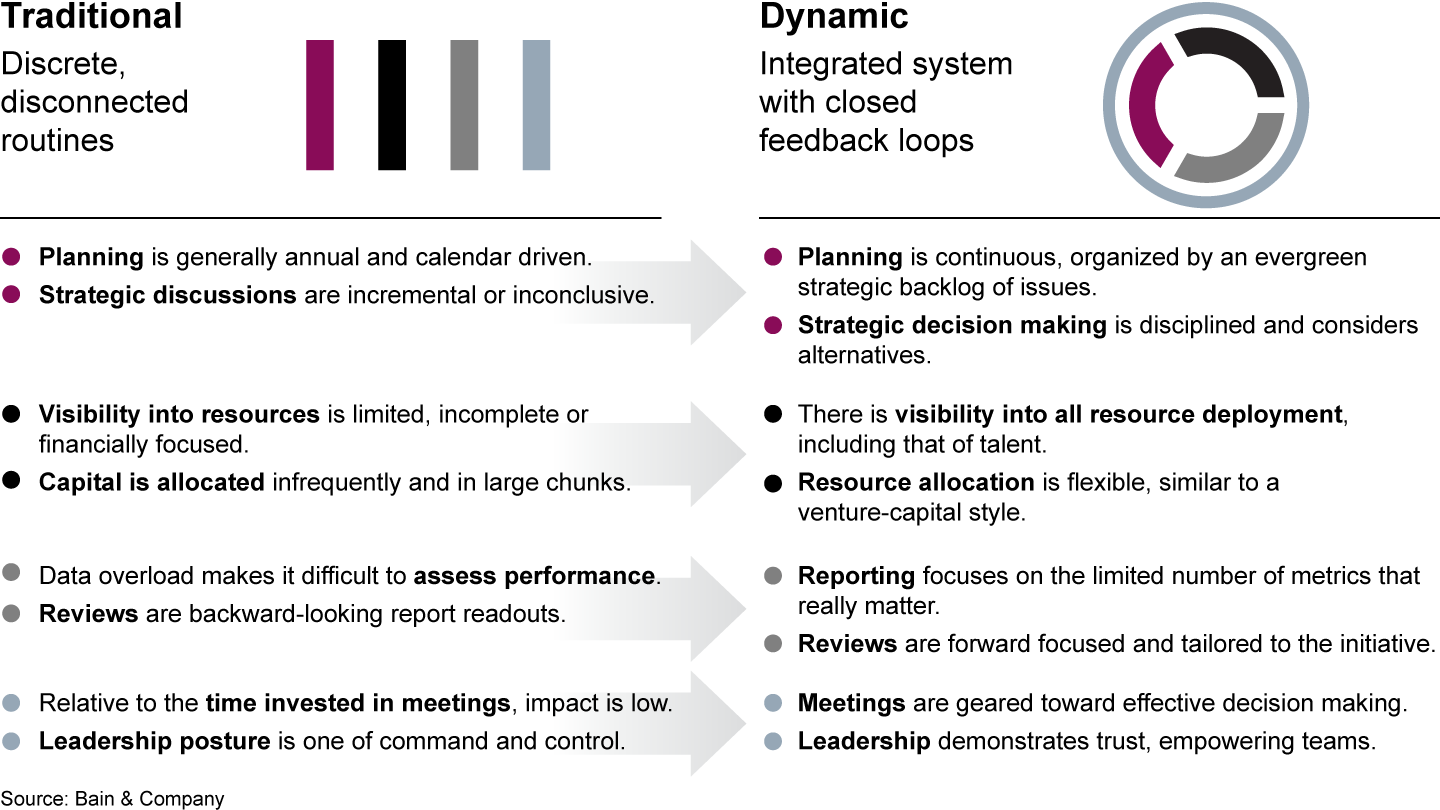
      Creating a dynamic management system
      Creating a dynamic management system
      Creating a dynamic management system

      In thinking this through, executives can take a page from Tesla’s design book. After the electric car pioneer designed its initial battery technology, executives didn’t want to build a vehicle to use it entirely from scratch. So they looked at the Lotus Elise platform. It had already been tested for US safety regulations, and sharing parts could save money. But as they began to consider all the particulars, Tesla executives realized how different an electric vehicle’s design needed to be. Even things like fans, headlights and air conditioning were fundamentally different. Most cars use air warmed by the engine to generate cabin heat, for example, but electric car engines aren’t hot. In the end, only 7% of the parts in the Lotus worked. Tesla had to create the other 93% itself. A fully integrated electric vehicle required a custom design.   

      Similarly, reinventing a management system for today’s world will require building something fundamentally different, and hopefully better, than the old one. To get there, organizations may have to fight inertia that has been building over decades. Top Gun and its dogfighting Tomcats might get away with “classic” status, but organizations with antiquated management systems won’t. The risk is too great that faster competitors will permanently outmaneuver them.

      About the Research

      Data powered by Dynata, a leading global first-party data and insights platform.

      저자
      • Headshot of Sarah Elk
        Sarah Elk
        Partner, Houston
      • Headshot of Joost Spits
        Joost Spits
        파트너, Boston
      • Michelle Carroll
        Practice Director, Dallas
      문의하기
      관련 컨설팅 서비스
      • 조직
      • Operating Model & Org Design
      최적의 솔루션 찾기
      • Dynamic Management System
      Dynamic Management System
      Dynamic Strategic Planning and Budgeting

      Dynamic Strategic Planning and Budgeting is a method to help companies plan and invest during times of great uncertainty.

      자세히 보기
      조직
      Linking Organizational Effectiveness and Employee Engagement

      A Bain analysis shows that efforts to make an organization more effective also improve employee engagement.

      자세히 보기
      Dynamic Management System
      Objectives and Key Results (OKRs)

      Objectives and Key Results (OKRs) are a goal-setting framework used by organizations to clarify what to work on and how to measure progress.

      자세히 보기
      조직
      Consumer Products Companies, Your Strategy Evolves, So Why Doesn’t Your Organization?

      What’s needed now is an organization that can meet the unexpected.

      자세히 보기
      Dynamic Management System
      Scenario Analysis and Contingency Planning

      Scenario Analysis and Contingency Planning is a process that allows executives to explore and prepare for several alternative futures.

      자세히 보기
      First published in 12월 2020
      태그
      • 조직
      • Dynamic Management System
      • Operating Model & Org Design

      프로젝트 사례

      조직 Moving Beyond an Operating Model Redesign to Live the Model

      See more related case studies

      조직 Building a winning media salesforce

      See more related case studies

      조직 A Regional Operating Model Lifts European Sales for a Medical Device Maker

      See more related case studies

      베인에 궁금하신 점이 있으신가요?

      베인은 주저 없이 변화를 마주할 줄 아는 용감한 리더들과 함께합니다. 그리고, 이들의 담대한 용기는 고객사의 성공으로 이어집니다.

      급변하는 비즈니스 환경에서 살아남기 위한 선도자의 시각. 월간 Bain Insights에서 글로벌 비즈니스의 핵심 이슈를 확인하십시오.

      *개인정보 정책을 읽었으며 그 내용에 동의합니다.

      Privacy Policy를 읽고 동의해주십시오.
      Bain & Company
      문의하기 환경정책 Accessibility 이용약관 개인정보 보호 쿠키 사용 정책 Sitemap Log In

      © 1996-2026 Bain & Company, Inc.

      문의하기

      무엇을 도와드릴까요?

      • 프로젝트 문의
      • 채용 정보
      • 언론
      • 제휴 문의
      • 연사 초청
      오피스 전체보기