

Brief
In our conversations with telecom executives, analysts and investors, we often hear a resigned acceptance that the wireless industry is marching toward commoditization. The consumer market in North America is nearly saturated—more than 9 out of 10 adults in the US own a mobile phone and 7 of those are smartphones—so 95% of “new” subscribers are just switching among carriers. Like other mature consumer markets, the battle in wireless telecom has become a “fight for inches.”
As wireless carriers compete for market share, some of the traditional sources of differentiation (such as network quality or phone selection) have been losing efficacy, making it harder for carriers to sustain advantages against competitors. In some European markets, telcos have already lost these sources of differentiation, as the market has commoditized almost completely. North American carriers are not as far down that path, but we see signs that they are headed in that direction. For example, Bain & Company’s recent benchmarking of consumer behavior and customer loyalty in the wireless industry, which we measure with the Net Promoter ScoreSM (NPS®), found that among the top three primary reasons customers choose their carrier, price is beating out network quality and brand as the most important factor. What’s more, customer loyalty scores of those choosing their carrier based on the brand or network have been converging among the major carriers.1 Whether in the form of lower rates, handset subsidies or early termination buyouts, price is becoming the main source of competition. But even so, we don’t think the march to commoditization is a foregone conclusion in North America.
Despite the signs pointing toward commoditization, Bain research finds that wireless consumers still have unmet needs—and, more important, they will pay more for value propositions addressing these needs. Our nationwide consumer survey of 2,000 wireless users and direct conversations with more than 100 customers in focus groups revealed some of those opportunities: We believe carriers that can improve their abilities to segment customers and also deliver innovations closely targeted to customers’ unmet needs will set themselves apart from competitors. The products and services they deliver could help raise average revenue per user (ARPU) while improving NPS, increasing new subscribers, reducing churn and bolstering their reputations beyond mere connectivity providers.
Identifying new sources of value in wireless
Telecom executives can take lessons from other mature consumer industries where successful companies have reversed the march toward commoditization by innovating around customers’ unmet needs to increase revenue. In 2005, Gillette injected new energy in the stagnant razor category by identifying an unmet need for higher-quality shaving, leading to the successful five-blade Fusion ProGlide razors while sustaining a substantial price premium over private-label substitutes. In the 2000s, airlines in the US responded to rising costs and price competition by gaining a clearer picture of the needs of their customer segments and unbundling services that were important to each. This allowed them to begin charging for valued features, such as extra legroom and priority boarding. Today these offers represent a significant portion of the industry’s profits in the US, offsetting losses in the core business of short- and long-haul air travel. In both cases, refocusing on specific customer needs counteracted trends toward commoditization.
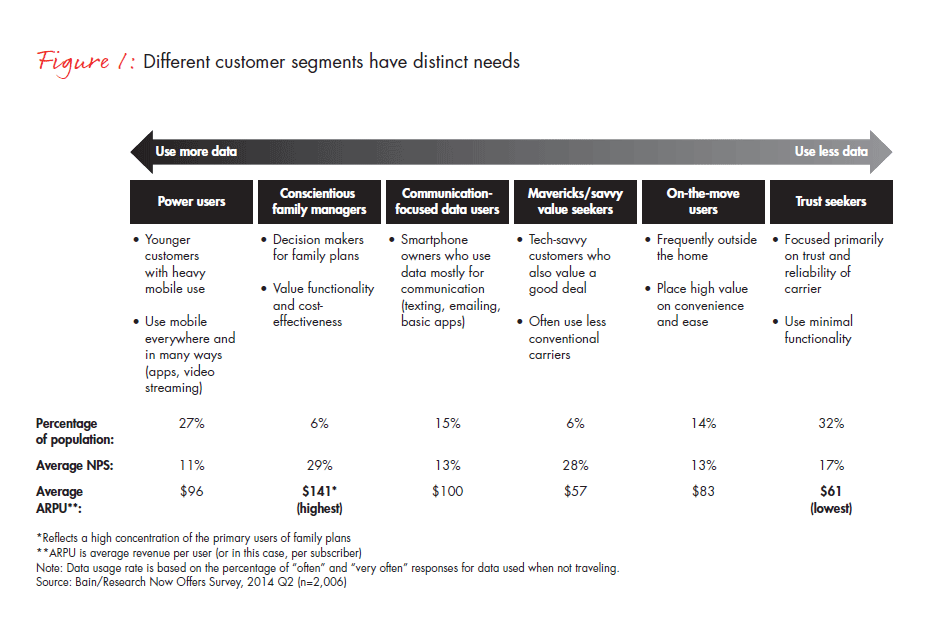
Similar opportunities are emerging in wireless. In our conversations with customers, they say they are overcharged and underserved, but these same people acknowledge they still have unmet needs that they’re willing to pay more to have addressed. To learn more about these needs and the revenue opportunities underlying them, we applied top-down and bottom-up research approaches. Our top-down segmentation revealed six distinct segments of wireless customers, each with various levels of engagement, suggesting opportunities for innovation (see Figure 1).2
Once we had identified distinct segments and needs, our bottom-up approach sought to validate that users would pay more for innovative offers addressing those needs. We began by using Bain’s BothBrain® Innovation methodology3 to identify 800 promising ideas for new wireless propositions, based on our work with clients and our customer research. We then distilled that list down to four value propositions that we deemed broadly representative of customers’ unmet needs: ubiquitous connectivity, priority access, mobile video and predictive assistance (see Figure 2). A series of focus groups and interviews helped us define and refine hypothetical test offers, which we then used to build a nationwide survey to evaluate customers’ interest and willingness to pay.
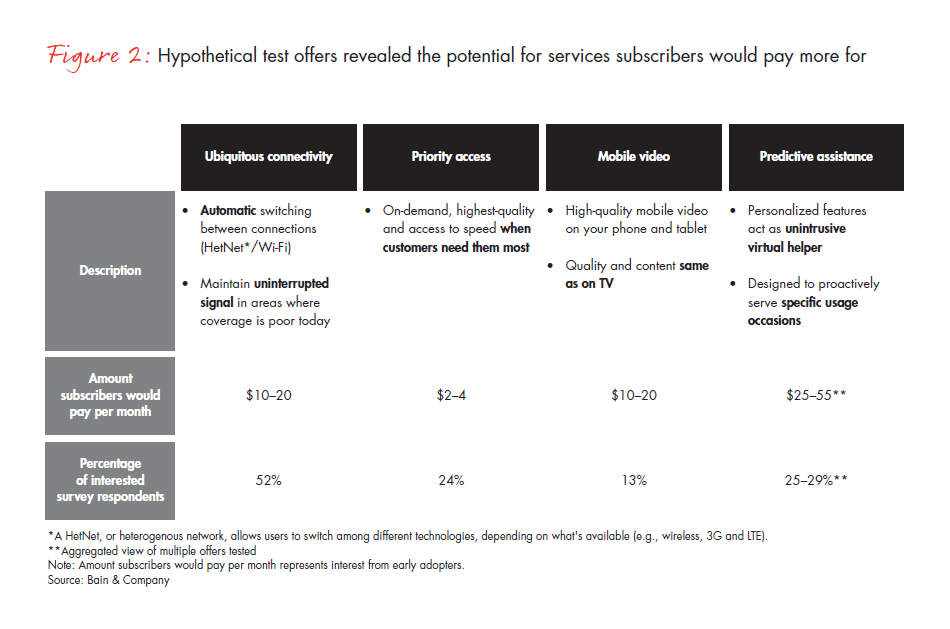
In that survey, 45% of respondents said they would be willing to pay $10 to $20 more per month for at least one of those features. More consumers were willing to pay for tangible features. For example, half of survey respondents expressed interest in ubiquitous connectivity and mobile video offers, and in focus groups, some customers expressed excitement about “knowing your connection won’t drop” and “being part of the conversation with my friends” if a live sports stream is as instantaneous as on TV. Even for less tangible and more theoretical offers (for example, predictive assistance) as many as 29% of survey respondents expressed interest.
Surprisingly, when we introduced these offers in our consumer focus groups, some of the same people who had said they would not consider spending more with their carrier showed interest in the new offers.
Of course, there are limits to the ability of consumer research to accurately forecast future demand for new offers. Steve Jobs famously eschewed consumer research as a predictor of the iPhone’s viability, believing consumers don’t know what they want until it is built.
Unlocking new value through customer-centric innovation
New services that address customers’ unmet needs not only increase revenue, but can also boost customer loyalty, reduce churn, draw in new subscribers and improve a carrier’s reputation. Until recently, carriers in the US didn’t need to invest heavily in understanding these needs, because they were riding two waves of growth: the first in the early 2000s as mobiles became mainstream and the second after 2007 as subscribers upgraded to smartphones and increased their data usage. As that second wave levels off, carriers must begin to think more like any good consumer products company and shift their focus to segment-specific innovation and delivering products and services that exceed customer expectations.
Based on our experience with the world’s leading carriers and the most innovative consumer goods companies, we see five capabilities or enablers that carriers will need to build into their operating models to deploy customer-centric innovation effectively.
Advanced segmentation. Traditional “one size fits all” marketing, which often promotes speed and bandwidth, may have helped grow the pool during the past decade’s expansion. But now wireless carriers will need to develop their capabilities to distinguish user segments with distinct needs. Sophisticated analytical tools can help telcos derive insights from these segments and track customer needs as these needs evolve. As a start, carriers should get a clear understanding of how fresh the data on their segmentation is and assess their ability to segment, compared with their competitors and leading consumer products companies that are best in class at deriving customer insights.
Agile product development. As with other mature consumer industries that are focused on capturing market share, rapid innovation is critical. Technology and competitors move quickly, and customer needs are a moving target. Innovation must be a continual exercise, and carriers will need to develop the muscles to cycle through as often as every 6 to 12 months these key exercises: developing a value proposition, offer prototyping, iterative testing and learning cycles, and product launches. Carriers should evaluate their time to market for new offers to specific customer segments and work to reduce it.
Cross-functional decision making. Effective product development will require the best joint perspective of marketing, product development, engineering and IT. Seamless collaboration by these groups requires clear roles and accountability for decision making and execution. A decision-making framework, such as Bain’s RAPID®, can help guide this process.4 Those involved in a decision should be able to describe their roles accurately and consistently.
Balanced growth strategy. Carriers need to design a strategy that reflects a balanced approach to growth— generating more revenue from existing customers as well as acquiring new subscribers, all while controlling costs. This requires everyone in the organization, including engineering, marketing and the front line, to share a common set of metrics that considers ARPU, profits, volumes and costs.
Cultural shift beyond price and cost. At many telcos, strategic and tactical discussions focus almost exclusively on cost and price, which translate into an intense focus of resources and attention on these priorities. But if carriers are to avoid a race to the bottom, they must make deliberate and explicit attempts to change that culture and broaden their focus to initiatives that can restore value—such as more-detailed segmentation, keener insights into customers’ unmet needs and targeted innovation that delivers on those opportunities. Of course, all of this must happen in an environment that keeps cost and price pressures at bay while aligning efforts against the most promising customer groups.
Customer-centric innovation is not a cure-all for the current challenges of the wireless industry, nor does it eliminate the need for price competitiveness or technological parity. But it does represent a path away from increasing commoditization and value erosion while giving customers new reasons to love their carriers and stay with them. As in other mature consumer industries, we expect that customer-centric innovation will become an indispensable element of the playbook for wireless competitiveness.
Dan Kuzmic is a partner with Bain & Company in Dallas. Peter Bowen is a Bain partner in Chicago. Both work with Bain’s Global Telecommunications practice. The authors would like to acknowledge the contributions of Jason Park, a manager in Bain’s Chicago office.
1 Companies measure their Net Promoter Score (NPS) by asking customers a single question: “How likely are you to recommend [this company or product] to a friend or colleague?” Respondents giving marks of 9 or 10 are promoters, the company’s most devoted customers. Those scoring their experience at 7 or 8 are passives, and those scoring it from zero to 6 are detractors. NPS represents the percentage of promoters minus the percentage of detractors. Across industries, this single metric ties directly to customer retention, share of wallet and referral rates. Each quarter, Bain benchmarks wireless consumers (n=15,000) on certain measures, including carrier NPS, device NPS and consumer preferences. For wireless carriers, Bain research shows that detractors are up to six times more likely to churn than promoters.
2 In addition to Bain’s quarterly benchmarking survey of approximately 15,000 US wireless customers, we conducted a separate nationwide consumer survey, which segmented wireless customers based on their needs and carrier preferences, and evaluated interest in specific, representative wireless test offers.
3 Bain’s BothBrain Innovation is an idea generation and commercialization methodology that utilizes creative and analytic talents within organizations to build effective new product and strategy development processes, and to ensure efficient allocation of R&D. Bain research shows that a leadership strategy that successfully couples right-brain creative talents to left-brain management skills is the most effective approach for repeatable innovation in any economic climate.
4 High-quality decision making and strong performance go hand in hand. Yet in many companies, even clear, well-framed decisions can be derailed by uncertainty over roles and responsibilities. The RAPID framework clarifies decision accountability. A loose acronym for Input, Recommend, Agree, Decide and Perform, RAPID assigns owners to the five key roles in any decision.
NPS® is a registered trademark of Bain & Company, Inc., Fred Reichheld and Satmetrix Systems, Inc.
Net Promoter ScoreSM is a trademark of Bain & Company, Inc., Fred Reichheld and Satmetrix Systems, Inc.
RAPID® and BothBrain® are registered trademarks of Bain & Company, Inc.
First published in 9월 2014