

Brief

For ambitious entrepreneurs and companies in developing markets, creating the next wave of growth will be harder than at any point in recent memory. Evolving their organizations to ensure that they function as effectively as in the early days and synchronize with any changes in strategy may be the best investment these companies can make.
Beyond a certain size, growth for developing-market firms likely involves some combination of making acquisitions, expanding overseas, entering new businesses, layering in professional management, taking on new investors and investing in transformative technology—all complicated, risky moves.
The macro environment poses its own challenges. China’s economy is growing at the slowest rate in three decades. Excitement about the prospects for reform and growth in countries such as India and Indonesia ebbs and flows.
Customer behavior has changed as well, notably in the recent embrace of online purchasing. In China, even as overall retail sales growth slows, online sales in the world’s largest digital marketplace are growing at an annual rate of 25%, Bain & Company analysis shows. Customers’ expectations rise as they sample a broader array of sophisticated goods and services.
At the same time, organization-related challenges have surfaced, especially when a founder or small group has planned and managed growth to date. The most discussed challenge is the scarcity of high-caliber talent—for instance, according to ManpowerGroup’s 2015 Talent Shortage Survey, 48% of employers in Asia-Pacific have cited difficulty filling jobs; that’s 10 points higher than the global average.
Less visible but just as pressing for developing-market companies are issues of decision making, governance and ways of working that start to hold back the company. Decision making often remains highly centralized. Certain capabilities, particularly in corporate support functions, remain underdeveloped or nonexistent. As founders push the limits of their ability or will to manage daily operations, they have to professionalize the management team and confront the challenge of preserving their unique culture while continuing to grow. Taking on new investors, meanwhile, has implications for more rigorous and transparent governance, but there’s a risk of new governance adding extra reviews that slow decision making.
Scrutinizing the experience of multinational corporations for guidance can be useful, but has its limits, given their different starting points, cultures and shareholder expectations. Moreover, Bain surveys show that only 20% of executives believe that their current operating model helps them outperform competitors.
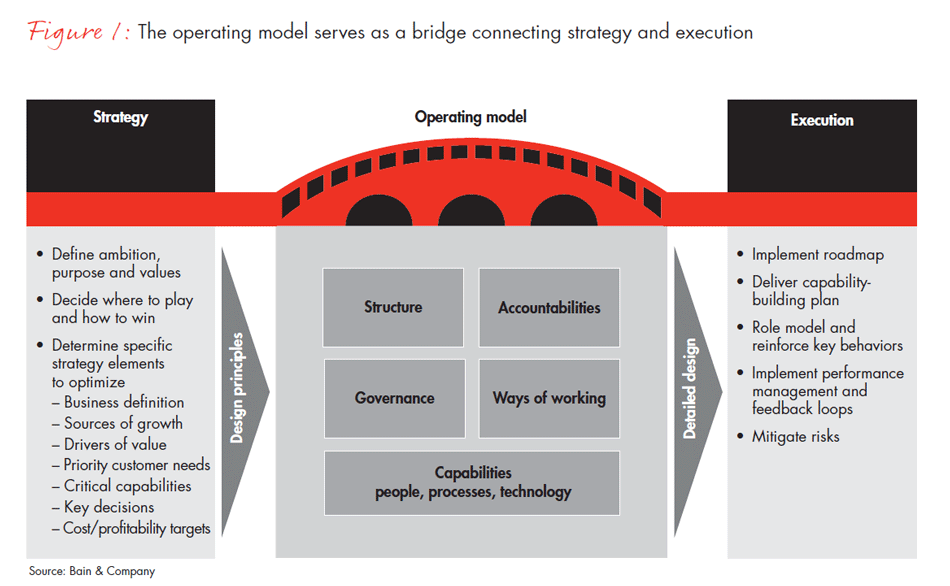
Developing-market champions that effectively manage these challenges put in place integrated organizational solutions that go well beyond a new set of key performance indicators or a new structure with new job descriptions. They align all the elements of the operating model with their strategy.
The operating model provides a bridge between the strategy and the detailed organizational design required to execute. It serves as a blueprint for how resources are implemented to get critical work done (see Figure 1).
While there is no single best way to organize a company, we have seen several common principles among leading developing-market firms as they design operating models that suit the strategy yet allow them to adapt to the rapid changes of their businesses:
- Stitch the organizational seams to match exactly how the company creates value.
- Professionalize without piling up bureaucracies.
- Explicitly link the talent plan to the strategy.
- Develop and deliver the capabilities that matter most.
Stitch the organizational seams to match exactly how the company creates value
An operating model should closely fit the company’s strategy, like a tailor-made suit with seams drawn and stitched to accommodate movement and comfort for a given body type. Every organizational structure creates boundaries between departments, geographic units or lines of business, and people must learn to collaborate across them. What’s important is to define the seams in a way that naturally reflects how the company creates value.
Aravind Eye Care System, a chain of hospitals whose founder set out to eradicate blindness in India, went from an 11-bed hospital in 1976 to more than 4,000 beds in seven cities today. Aravind recognized early that the nexus of value was a highly efficient hospital operating room. To optimize operating-room activities, Aravind set up a hub-and-spoke model, leveraging a well-trained population of nurses in local villages, known as “sisters,” who perform an initial screening of patients. Once patients arrive at the hospitals, the operating room setup makes the most of the doctors’ availability by eliminating any unproductive time. Hospital nurses take flawless care of transitions, preparation and administrative work so that surgeons can focus on performing a high number of surgeries per day, at success rates higher than hospitals in the UK.
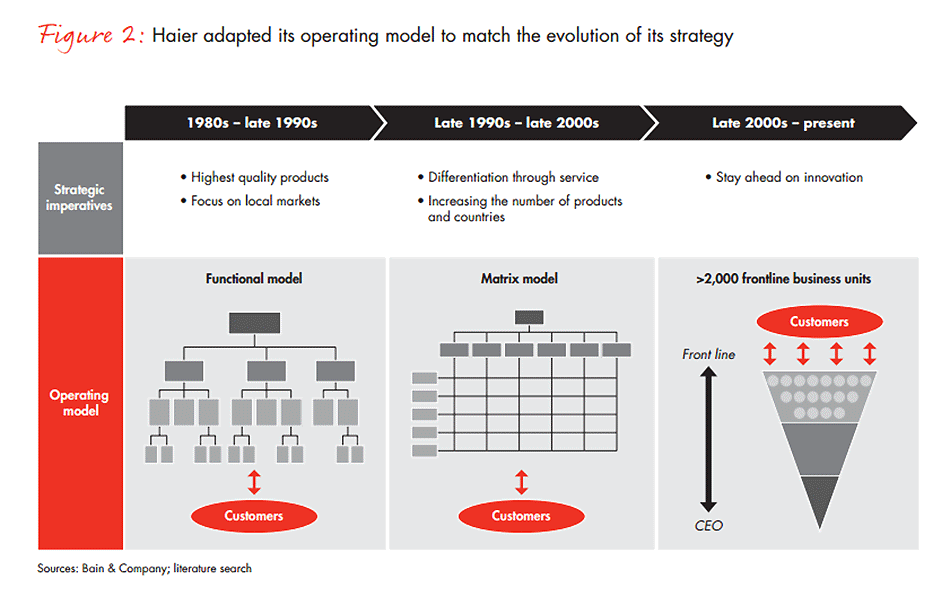
When companies grow quickly, they may have to adjust their operating models during each phase of their growth. Haier, the Chinese white goods manufacturer, has sustained an impressive average revenue growth rate of 24% per year over the past two decades in part by evolving its organization to match the priorities of each phase of growth. In the 1980s and 1990s, when the company focused on achieving and sustaining the highest-quality product, a functional structure helped it achieve excellent standards. In the late 1990s and 2000s, a matrix structure made it easier to expand into numerous product lines and countries.
Since the late 2000s, Haier has dealt with creeping complexity and the desire to out-innovate competitors by shifting decision making to thousands of frontline units, each empowered to directly understand and serve customer needs and collaborate with suppliers (see Figure 2). These multifunctional teams of 10 to 20 people have their own revenue and P&L objectives. They self-manage budgets, expenses, hiring and firing, but they use common component modules to minimize costs, even as they customize products for target segments.
Professionalize without piling up bureaucracies
One often hears developing-market leaders worry, “I’m dependent on one or two people; I need to hire more like them.” They might feel frustrated when early organizational changes don’t go well: “I moved procurement back under me because it just wasn’t working reporting into the CFO.”
We understand the frustration, but these are temporary fixes, not long-term solutions. As companies grow and diversify, professionalizing starts by recruiting people from outside who fit the culture but bring their own strengths and perspective so that they can take on more of the decision making.
Yonghui Superstores, one of China’s largest supermarkets for fresh produce, publicly acknowledged the need to inject expertise from the outside. After its IPO in late 2010, it hired several senior executives from world-class firms and middle managers from competitors. The executives developed a more data-driven approach to making decisions and pushed accountability for decisions lower in the organization. Regional heads, for instance, became responsible for ordering, pricing, promotion and, ultimately, the P&L of each region as well as for identifying and grooming the next cadre of leaders. These practices have helped Yonghui scale up more quickly.
Professionalizing involves more than bringing in managers from the outside; it means changing governance—and in family-controlled firms, that often means creating a family council with an agenda that is separate from the board of directors’ business agenda. Harsh Mariwala, the founder of Marico, a food company in India, deliberately planned the transition to a professional CEO and made it clear that family members would not automatically be in line for succession. Professionalizing also requires creating processes to replace ad hoc efforts, setting a regular rhythm of meetings, writing down values and philosophies, and installing technology systems.
Successful developing-market companies are able to adapt their operating models to their strategies as their organizations evolve. James Root, a partner with Bain's Organization practice, outlines four ways that these companies are riding the next wave of growth.
Explicitly link the talent plan to the strategy
Talent may be tight in many developing markets, but responding by throwing up your hands and saying “I can’t get enough good people” won’t solve the problem. Even in the tightest markets, smart companies have devised creative talent plans to advance growth.
Wipro of India had to innovate its talent strategy to meet its accelerating growth. It bolstered collaboration with leading Indian universities by launching Mission 10X, a program that increases students’ employability by training Indian engineering faculty to enhance the quality of education and the skill readiness of Indian talent. Today, Wipro works with more than 25,000 recruits on average every year and makes them project ready within weeks; in the 1990s the recruits numbered a few thousand or less.
Aravind has developed a talent strategy that appeals to different employee groups and addresses a key concern of potential customers. Many rural Indians with cataracts do not know what causes their blindness. Aravind established storefront centers staffed with “sisters” who have the trust of the local population and want to develop new skills via Aravind’s two-year training. For the scarce, expensive surgeons, Aravind created an attractive proposition, offering continuous learning through rotation to non-cataract treatments and participation in research with leading international academic institutions. Aravind harnesses underused people from its local communities and deploys the highest-trained professionals at their maximum capacity.
Even in tight labor markets, it pays to be selective. Developing-market leaders define what skills and capabilities they need to support the strategy, identify how they cultivate those skills internally or recruit them from outside, and build an attractive value proposition for their people.
Siam Cement Group (SCG), the largest industrial conglomerate in Thailand, has two main strategic priorities: expansion into other Southeast Asian countries, and developing innovative products and services. SCG geared its talent management practices to meet those objectives. For example, SCG dramatically increased hiring from other countries so that 30% of the workforce lives outside Thailand, a share the company aims to increase to 47% in five years, according to statements given to the Nikkei Asian Review. To encourage innovation, SCG trains people at all levels on innovation-related skills, evaluating their eagerness to learn those skills, their on-the-job application of those developed skills and their amenability to risk taking.
Develop and deliver the capabilities that matter most
Successful companies choose which few capabilities they need to excel at while being “good enough” at other capabilities. Once senior leaders have set the strategy and agreed on which capabilities they need to execute effectively, they harness the right people, processes and technology to deliver the capabilities.
Bank Central Asia (BCA), an Indonesian bank, competes on a foundation of customer centricity, and has overinvested in capabilities that promote convenience. To streamline lending, for instance, BCA developed strong central risk management guidelines, sophisticated systems to target loan applicants with whom it already had a relationship and a high-speed approval process. Faster approval makes customers happy and frees up time for branch employees to devote to high-value interactions with customers. As a result, BCA has achieved a very low loan default ratio of less than 1% and the industry’s highest customer loyalty scores in Indonesia.
Leaders of developing-market firms face increasing competition from both sophisticated multinationals determined to leverage their scale and nimble, local start-ups. In response, they may be tempted to address their organizational problems with partial, temporary fixes, but those tactics will slow down an organization and inhibit growth. A more effective way for developing-market firms to thrive amidst the turbulence is to adapt their operating model holistically, integrating the adjustments to structure, ways of working, governance and talent. That is what it will take to ride the next wave of growth.
James Root leads Bain & Company’s Organization practice in the Asia-Pacific region. Dunigan O’Keeffe leads Bain’s Strategy practice in the Asia-Pacific region. Stephen Shih is a partner with Bain’s Organization practice. They are based, respectively, in Hong Kong, Mumbai and Beijing.
First published in 10월 2015