
Skip to Content
  • 오피스

    오피스

    미주
    • Atlanta
    • Austin
    • Bogota
    • Boston
    • Buenos Aires
    • Chicago
    • Dallas
    • Denver
    • Houston
    • Los Angeles
    • Mexico City
    • Minneapolis
    • Monterrey
    • Montreal
    • New York
    • Rio de Janeiro
    • San Francisco
    • Santiago
    • São Paulo
    • Seattle
    • Silicon Valley
    • Toronto
    • Washington, DC
    유럽, 중동, 아프리카
    • Amsterdam
    • Athens
    • Berlin
    • Brussels
    • Copenhagen
    • Doha
    • Dubai
    • Dusseldorf
    • Frankfurt
    • Helsinki
    • Istanbul
    • Johannesburg
    • Kyiv
    • Lisbon
    • London
    • Madrid
    • Milan
    • Munich
    • Oslo
    • Paris
    • Riyadh
    • Rome
    • Stockholm
    • Vienna
    • Warsaw
    • Zurich
    아시아, 호주
    • Bangkok
    • Beijing
    • Bengaluru
    • Brisbane
    • Ho Chi Minh City
    • Hong Kong
    • Jakarta
    • Kuala Lumpur
    • Manila
    • Melbourne
    • Mumbai
    • New Delhi
    • Perth
    • Seoul
    • Shanghai
    • Singapore
    • Sydney
    • Tokyo
    오피스 전체보기
  • 얼럼나이
  • 미디어 센터
  • 구독
  • 연락처
  • Korea | 한국어

    지역 및 언어 선택

    글로벌
    • Global (English)
    미주
    • Brazil (Português)
    • Argentina (Español)
    • Canada (Français)
    • Chile (Español)
    • Colombia (Español)
    유럽, 중동, 아프리카
    • France (Français)
    • DACH Region (Deutsch)
    • Italy (Italiano)
    • Spain (Español)
    • Greece (Elliniká)
    아시아, 호주
    • China (中文版)
    • Korea (한국어)
    • Japan (日本語)
  • Saved items (0)
    Saved items (0)

    You have no saved items.

    관심 있는 내용을 북마크하여 Red 폴더에 저장할 수 있습니다. Red 폴더 에서 저장된 내용을 읽거나 공유해보세요.

    Explore Bain Insights
  • 산업
    메인 메뉴

    산업

    • 우주항공, 방산 및 정부 서비스
    • 농업 관련 산업
    • 화학
    • 인프라, 건설 및 건축 자재
    • 소비재
    • 금융 서비스
    • 헬스케어
    • 산업용 기계 및 장비
    • 미디어 및 엔터테인먼트
    • 금속
    • 광업
    • 석유 및 가스
    • 제지 및 패키징 산업
    • 사모펀드
    • 사회 및 공공 부문
    • 유통
    • 기술
    • 텔레콤
    • 운송
    • 여행·여가
    • 유틸리티 및 재생가능 에너지
  • 컨설팅 서비스
    메인 메뉴

    컨설팅 서비스

    • Customer Experience
    • ESG
    • Innovation
    • M&A
    • 운영
    • 조직
    • 사모펀드
    • 고객 전략 및 마케팅
    • 전략
    • AI, 인사이트 및 솔루션
    • Technology
    • 변화 혁신
  • Digital
  • 인사이트
  • 베인 소개
    메인 메뉴

    베인 소개

    • 업무 소개
    • 베인의 신념
    • 구성원 및 리더십 소개
    • 고객 성과
    • 주요 수상 경력
    • 글로벌 파트너사
    Further: Our global responsibility
    • 다양성과 포용
    • 사회 공헌 활동
    • Sustainability
    • World Economic Forum
    Learn more about Further
  • Careers
    메인 메뉴

    Careers

    • Work with Us
      Careers
      Work with Us
      • Find Your Place
      • Our Work Areas
      • Integrated Teams
      • Students
      • Internships & Programs
      • Recruiting Events
    • Life at Bain
      Careers
      Life at Bain
      • Blog: Inside Bain
      • Career Stories
      • Our People
      • Where We Work
      • Supporting Your Growth
      • Affinity Groups
      • Benefits
    • Impact Stories
    • Hiring Process
      Careers
      Hiring Process
      • What to Expect
      • Interviewing
    FIND JOBS
  • 오피스
    메인 메뉴

    오피스

    • 미주
      오피스
      미주
      • Atlanta
      • Austin
      • Bogota
      • Boston
      • Buenos Aires
      • Chicago
      • Dallas
      • Denver
      • Houston
      • Los Angeles
      • Mexico City
      • Minneapolis
      • Monterrey
      • Montreal
      • New York
      • Rio de Janeiro
      • San Francisco
      • Santiago
      • São Paulo
      • Seattle
      • Silicon Valley
      • Toronto
      • Washington, DC
    • 유럽, 중동, 아프리카
      오피스
      유럽, 중동, 아프리카
      • Amsterdam
      • Athens
      • Berlin
      • Brussels
      • Copenhagen
      • Doha
      • Dubai
      • Dusseldorf
      • Frankfurt
      • Helsinki
      • Istanbul
      • Johannesburg
      • Kyiv
      • Lisbon
      • London
      • Madrid
      • Milan
      • Munich
      • Oslo
      • Paris
      • Riyadh
      • Rome
      • Stockholm
      • Vienna
      • Warsaw
      • Zurich
    • 아시아, 호주
      오피스
      아시아, 호주
      • Bangkok
      • Beijing
      • Bengaluru
      • Brisbane
      • Ho Chi Minh City
      • Hong Kong
      • Jakarta
      • Kuala Lumpur
      • Manila
      • Melbourne
      • Mumbai
      • New Delhi
      • Perth
      • Seoul
      • Shanghai
      • Singapore
      • Sydney
      • Tokyo
    오피스 전체보기
  • 얼럼나이
  • 미디어 센터
  • 구독
  • 연락처
  • Korea | 한국어
    메인 메뉴

    지역 및 언어 선택

    • 글로벌
      지역 및 언어 선택
      글로벌
      • Global (English)
    • 미주
      지역 및 언어 선택
      미주
      • Brazil (Português)
      • Argentina (Español)
      • Canada (Français)
      • Chile (Español)
      • Colombia (Español)
    • 유럽, 중동, 아프리카
      지역 및 언어 선택
      유럽, 중동, 아프리카
      • France (Français)
      • DACH Region (Deutsch)
      • Italy (Italiano)
      • Spain (Español)
      • Greece (Elliniká)
    • 아시아, 호주
      지역 및 언어 선택
      아시아, 호주
      • China (中文版)
      • Korea (한국어)
      • Japan (日本語)
  • Saved items  (0)
    메인 메뉴
    Saved items (0)

    You have no saved items.

    관심 있는 내용을 북마크하여 Red 폴더에 저장할 수 있습니다. Red 폴더 에서 저장된 내용을 읽거나 공유해보세요.

    Explore Bain Insights
  • 산업
    • 산업

      • 우주항공, 방산 및 정부 서비스
      • 농업 관련 산업
      • 화학
      • 인프라, 건설 및 건축 자재
      • 소비재
      • 금융 서비스
      • 헬스케어
      • 산업용 기계 및 장비
      • 미디어 및 엔터테인먼트
      • 금속
      • 광업
      • 석유 및 가스
      • 제지 및 패키징 산업
      • 사모펀드
      • 사회 및 공공 부문
      • 유통
      • 기술
      • 텔레콤
      • 운송
      • 여행·여가
      • 유틸리티 및 재생가능 에너지
  • 컨설팅 서비스
    • 컨설팅 서비스

      • Customer Experience
      • ESG
      • Innovation
      • M&A
      • 운영
      • 조직
      • 사모펀드
      • 고객 전략 및 마케팅
      • 전략
      • AI, 인사이트 및 솔루션
      • Technology
      • 변화 혁신
  • Digital
  • 인사이트
  • 베인 소개
    • 베인 소개

      • 업무 소개
      • 베인의 신념
      • 구성원 및 리더십 소개
      • 고객 성과
      • 주요 수상 경력
      • 글로벌 파트너사
      Further: Our global responsibility
      • 다양성과 포용
      • 사회 공헌 활동
      • Sustainability
      • World Economic Forum
      Learn more about Further
  • Careers
    최근 검색어
      최근 방문 페이지

      Content added to saved items

      Saved items (0)

      Removed from saved items

      Saved items (0)

      Brief

      Digital Attacker Banks’ Time Has Come

      Digital Attacker Banks’ Time Has Come

      Digital attackers are lower cost, faster to innovate and can transform their traditional parents.

      글 Fabrice Franzen, Vitor D'Agnoluzzo, and Bernardo Sebastião

      • 읽기 소요시간
      }

      Brief

      Digital Attacker Banks’ Time Has Come
      en
      한눈에 보기
      • Digital attacker banks have demonstrated that they can delight customers, scale up quickly and expand into new products, geographies and customer segments.
      • Attackers’ cloud-native, cutting-edge technology platforms allow them to have much lower operating costs than most traditional incumbent banks.
      • As an alternative to embarking on a multiyear, hugely expensive systems transformation, some incumbent banks have launched attackers with the aim of transforming the core business.

      Digital attackers—that is, digital-only banks using a cloud-native, low-cost platform—historically were secondary banks for consumers. Many attackers garnered smaller deposits and more limited lending than traditional banks.

      Yet digital attackers have gained ground among consumers, and they hold more promise than initially meets the eye. Traditional banks risk losing market share if they don’t respond to these new models. An inflection point in adoption is near, as some attackers have shown that they can please customers and achieve a large scale. They are expanding from retail to small business accounts, from deposits and basic transactions to lending. As a result, venture capitalists and other investors have heavily funded digital attacker banks in recent years (see Figure 1).

      Figure 1
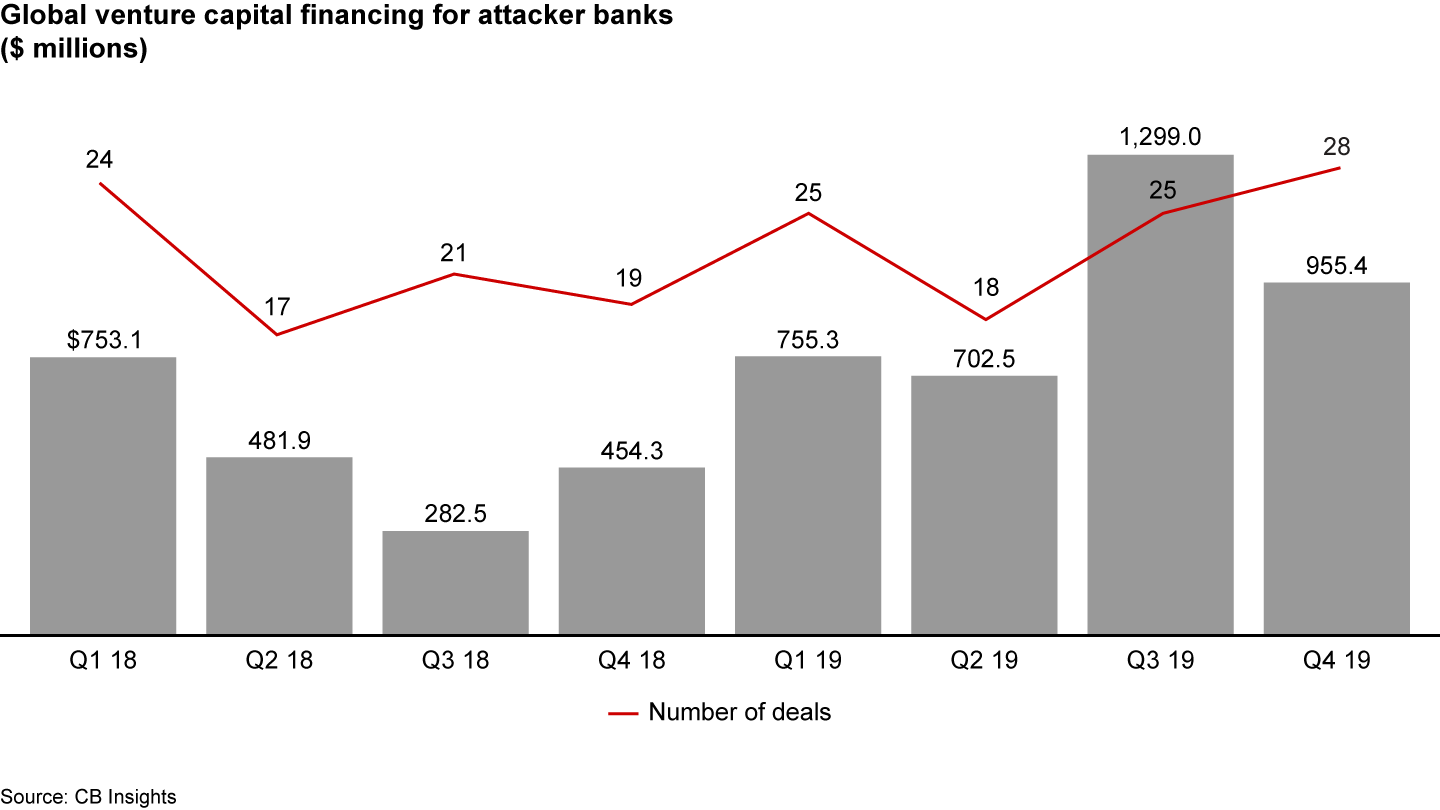
      Digital attacker banks are attracting heavy funding

      For instance, Nubank in Brazil has more than 25 million customers, making it one of the world’s largest digital banks. Nubank has put the smartphone at the heart of its strategy, and it has earned the region’s highest NPS Prism® score (a key metric of loyalty) for banks. Similarly, Kakao Bank attracted 10 million customers in just two years, and in 2019, it also had a customer loyalty score far above traditional banks in Korea, largely on the strength of its customer experience.

      In parallel, the ranks of traditional banks launching their own digital attackers has grown. Mettle, launched by NatWest, targets small UK businesses. Bradesco’s digital offering, Next, started by targeting underserved millennials in Brazil, and it has broadened its appeal to other underserved segments.

      Incumbent banks have realized the compelling logic of having a separate digital bank. Regulatory changes (such as open banking initiatives and the Revised Payment Services Directive, or PSD2, in the European Union) that are designed to promote innovation, better prices and a better experience have primed the field for more competition. Customer expectations have been redefined by technology firms offering personalized, easy, convenient services. To open a current checking account, for instance, takes an average of 81 clicks for 11 major incumbents analyzed in Europe, but it only takes 36 clicks on average for 5 attacker banks in Europe, according to the Centre for Finance, Technology and Entrepreneurship.

      Digital’s cost advantage

      On the revenue side, incumbents strategically can use an attacker bank to enter a new country or to improve their position within a customer segment such as millennials.

      Moreover, lower operating costs flow from having a modern, cloud-native technology platform. Analysis by Bain and Thought Machine finds that a digital attacker launched on such a platform could have a cost base that is 60% to 70% lower than a mid-tier legacy bank (see Figure 2). Bain’s comparison of four attackers with four major incumbents shows that attackers serve two to three times as many customers per employee.

      Figure 2
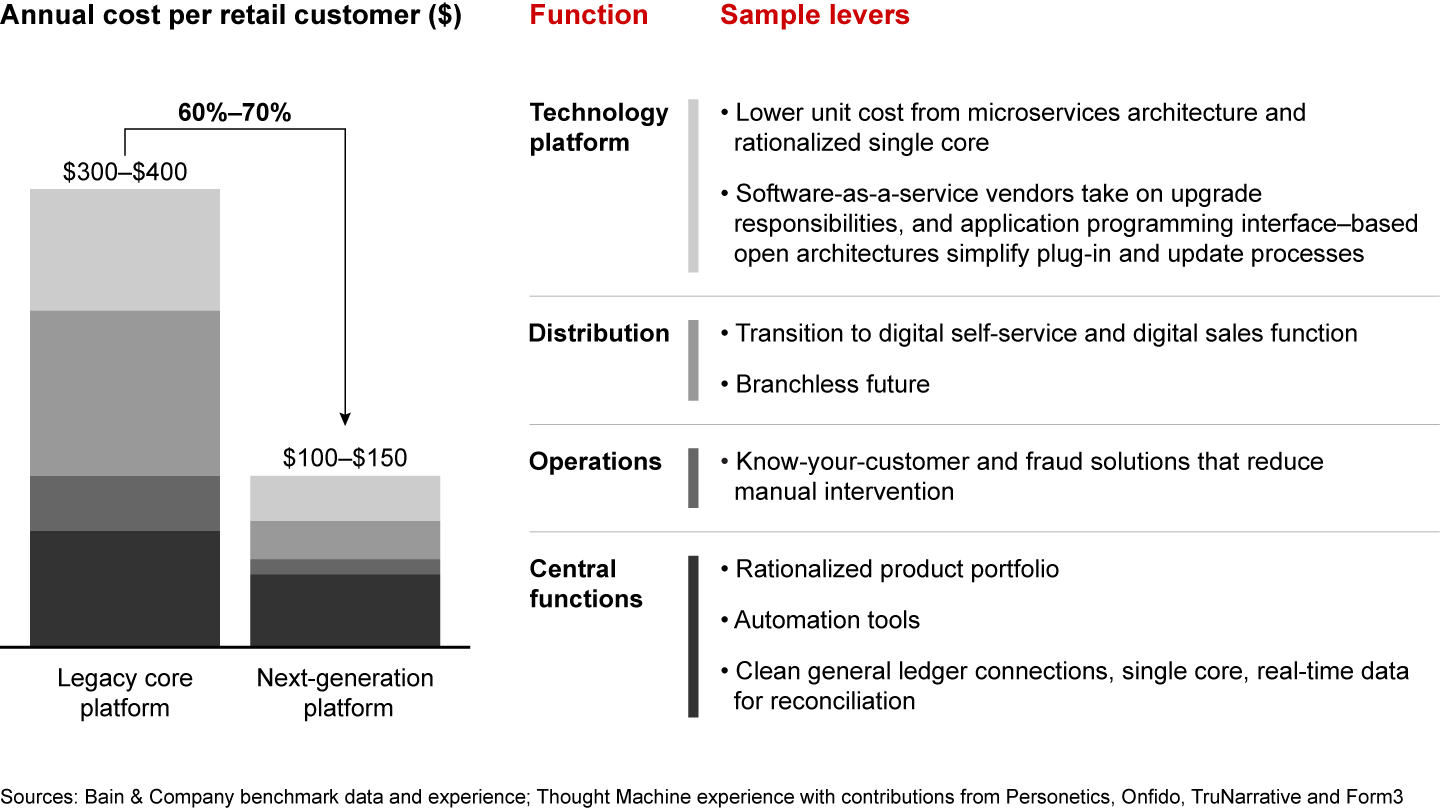
      A digital attacker bank on a cutting-edge technology platform could have a cost base 60%–70% lower than a mid-tier traditional bank

      Digital banks launched by incumbents have varying levels of integration with the parent company. Some incumbents treat their digital attacker as a separate entity with which to energize revenue growth by reaching underserved customer segments and quickly launching new products. They may also enjoy synergies with the existing business—for instance, by sharing fast, low-cost innovation.

      The child could transform the parent

      Other incumbents take a longer view, aiming to use the new bank to transform the core business by building very low-cost operations and more resilient technology. For example, Swedish bank SEB set up SEBx, a cloud-native technology platform, creating an in-house fintech to break with the traditional bank’s own legacy that will serve the broader SEB Group over time. This option holds perhaps the greatest promise as an alternative to embarking on a five-year, hugely expensive core banking transformation that risks causing a big-bang, all-at-once migration of customers.

      Whatever the motivation, success with an attacker bank hinges on several dimensions.

      • Monetization: From the outset, there should be a clear and realistic path to monetizing the strategy. Digital attackers have demonstrated that they can monetize by focusing on a specific customer segment with a narrow value proposition that addresses that segment’s needs.
      • A customer-centered proposition: The offering must align with customers’ needs and expectations. That’s why Marcus from Goldman Sachs has made inroads with affluent US millennials with its high-yield-interest savings product.
      • Speed of scaling: The ability to scale up quickly allows insurgents to penetrate their target segment. Bradesco’s Next reached 3.2 million customers in three years. By contrast, Chase shut down finn, its digital-only mobile banking platform, after only 47,000 customers had joined in a year.
      • Lean operations: The best bank platforms run low-cost operations by leveraging next-generation technology, as Revolut has demonstrated with its cloud-based core systems.
      • An ecosystem of partners: Many customers have begun to see value in obtaining related services through a single platform using open architecture for better integration. Starling’s third-party marketplace is one example, offering insurance, wealth management and tax tools.

      As with any new business, not all attackers will survive, much less thrive. Yet many have resonated with customers; digital attacker banks typically earn higher loyalty scores than regional and national incumbents. Digital attackers might start with less profitable parts of a market, but as they become the primary bank for more customers, they will grow and continue to take share from traditional banks. Younger customers are particularly open to using digital attackers, meaning that the pool of potential customers is bound to grow.

      So incumbents that embrace the scale insurgent mentality stand a better chance of defending their current business while also targeting new customer segments and new markets. It pays to act soon, however, as the window of time to build a strong attacker brand that will attract high-value customers is closing.


      NPS Prism® is a registered trademark of Bain & Company, Inc.

      저자
      • Headshot of Fabrice Franzen
        Fabrice Franzen
        파트너, Middle East
      • Headshot of Vitor D'Agnoluzzo
        Vitor D'Agnoluzzo
        파트너, London
      • Headshot of Bernardo Sebastião
        Bernardo Sebastião
        Alumni, São Paulo
      문의하기
      관련 산업
      • 금융 서비스
      • 뱅킹
      • 뱅킹(2)
      관련 컨설팅 서비스
      • 정보기술(IT)
      • Digital
      금융 서비스
      What Makes Digital Attacker Banks So Efficient?

      Digital-only banks have gained ground with consumers, and have lower operating costs than incumbent banks. Here’s why.

      자세히 보기
      금융 서비스
      Can US Banks Protect Their Card-Issuing Business?

      Consumer payments have been gravitating to neobanks and technology firms.

      자세히 보기
      정보기술(IT)
      Reimagining Merchandising in the Era of Agentic AI

      The future of merchandising is not better analysis, but faster, smarter execution—and agentic AI is what makes that possible.

      자세히 보기
      금융 서비스
      The Fragmentation of Wholesale Payments Calls for Banks to Remake Their Approach

      Banks have a dominant position, but competitors look set to take market share.

      자세히 보기
      정보기술(IT)
      Beyond AI Efficiency: A Conversation with Intuit’s Ivan Lazarov

      “Ultimately, we must be audacious enough to envision the impossible and bold enough to build it.”

      자세히 보기
      First published in 12월 2020
      태그
      • 금융 서비스
      • 뱅킹
      • 뱅킹(2)
      • 정보기술(IT)
      • Digital

      프로젝트 사례

      Digital A European Banking Giant Rises to the Fintech Challenge

      See more related case studies

      어드밴스드 애널리틱스 Blockchain-enabled Payment Flows: A Payments Company Reviews its Strategy

      See more related case studies

      어드밴스드 애널리틱스 A Digital-First Bank Finds a Customer-Driven Path to Profitability

      See more related case studies

      베인에 궁금하신 점이 있으신가요?

      베인은 주저 없이 변화를 마주할 줄 아는 용감한 리더들과 함께합니다. 그리고, 이들의 담대한 용기는 고객사의 성공으로 이어집니다.

      급변하는 비즈니스 환경에서 살아남기 위한 선도자의 시각. 월간 Bain Insights에서 글로벌 비즈니스의 핵심 이슈를 확인하십시오.

      *개인정보 정책을 읽었으며 그 내용에 동의합니다.

      Privacy Policy를 읽고 동의해주십시오.
      Bain & Company
      문의하기 환경정책 Accessibility 이용약관 개인정보 보호 쿠키 사용 정책 Sitemap Log In

      © 1996-2026 Bain & Company, Inc.

      문의하기

      무엇을 도와드릴까요?

      • 프로젝트 문의
      • 채용 정보
      • 언론
      • 제휴 문의
      • 연사 초청
      오피스 전체보기