

Brief

한눈에 보기
- Bain forecasts the electric vehicle market will start rapidly scaling around 2024, escalating original equipment manufacturers’ race to keep up with tech competitors.
- At the same time, the pandemic is chipping away at automakers’ financial cushion and threatening to hamper progress in autonomous vehicle development—a market that we expect to reach a turning point around 2028.
- Automakers can seize opportunities and manage threats for the impending EV- and AV-driven future by making strategic investment trade-offs and forging critical partnerships.
Tech companies have secured their place in the fast lane of an electrified, autonomous world—and original equipment manufacturers (OEMs) are hurrying to keep up. Consider one leading indicator: German regulators have granted Mobileye, Intel’s autonomous vehicle (AV) division, a permit to test its driverless cars on public roads, in real-world traffic. Mobileye is one of the first nontraditional manufacturers to receive the go-ahead for testing, giving the firm an opportunity to surpass traditional manufacturers, despite their early start.
As they race to keep up with digitally minded and cash-flush tech companies, the Covid-19 pandemic also threatens to hamper progress for some OEMs. Conserving cash and containing costs are now urgent priorities, requiring careful calibration of research and development (R&D) and capex investments. Inevitably, this involves tough choices. Daimler and BMW, for instance, have put their AV collaboration on hold in light of high costs. At the same time, Daimler has teamed up with Nvidia to develop a software-based vehicle architecture for autonomous driving. In addition, the automaker recently announced a partnership with Waymo to build a Level 4 autonomous truck—one that can drive itself without human interaction under certain circumstances. Reducing investments in in-house development for AV technologies allows OEMs to shift limited resources to more timely opportunities, such as their push for electrification.
Daimler and BMW wouldn’t be alone in their thinking; the global crisis could serve as a catalyst for the adoption of electric vehicles (EV). European governments are using economic stimulus to push for a more sustainable postpandemic world. France, Italy and Germany are boosting EV subsidies as part of their recovery plans. The Chinese government, which previously planned to roll back EV subsidies by the end of the year, has decided instead to extend some modified incentives until 2022, hoping to ease automakers’ pain. In addition, major ride-hailing companies, such as Lyft and Uber, have recently committed to shift to 100% electric vehicle fleets by 2030.
Decisions that automotive leadership teams make in the coming months will be critical to determining their future competitiveness. And with a number of routes to choose from, no single company can afford to win every battleground alone. But there are a few practical things that OEMs can do now to reorient themselves for the reality of the impending EV- and AV-driven future. It starts with assessing the opportunities, determining where to play, and making the right investment trade-offs and partnerships to stay competitive in their chosen space.
Ramping up the EV timeline
It’s a rare executive or board that hasn’t struggled with the questions of betting on new technologies: Will the new technology fully catch on? When will it be scalable and profitable?
Leadership teams that have identified the turning point for EVs—the threshold at which a niche market begins scaling rapidly until it reaches saturation—know that the time to invest is now. According to Bain analysis, global EV adoption will rapidly increase as prices decrease over the next two to eight years, reaching a turning point in 2024 (see Figure 1).
Figure 1
There are several influential factors at play here. One is the need for a more robust charging infrastructure. For German drivers, the days of anxiously planning trips around the location of charging stations will soon be gone. However, there are still hurdles to be tackled in terms of everyday charging convenience, such as the lack of availability in rural areas and a transparent, comprehensive payment method. And China has quickly become a front-runner in infrastructure, with more than 1.5 times as many stations than Europe and the US combined.
But customer acceptance will be one of the largest determining factors. Over the past few years, government incentives have powered the growth in EV popularity. In Norway—where EV drivers enjoy tax incentives, the ability to drive in bus lanes and exemptions from ferry fares—EVs already make up almost half of newly registered vehicles. US car buyers, who qualify for tax breaks at the federal, and sometimes state or local level, boosted the Tesla Model 3 into the ranks of the top 10 best-selling passenger cars in 2019. And much of the world is poised for dramatic change. In a Bain survey of consumers from the US, Germany and China, almost 50% said they are considering purchasing plug-in hybrid electric vehicles (PHEVs) or battery electric vehicles (BEVs) as their next car.
Even with those kinds of promising numbers, manufacturers know they are still losing money. With a small pool of customers primarily purchasing BEVs via government subsidies, on average, OEMs are currently seeing a negative 15% margin, compared with the 5% margin of conventional powertrain vehicles.
Nevertheless, they can’t afford not to play, given current government mandates. As of 2020, carmakers who want to participate in China’s market must earn credits equivalent to 12% of their annual output—forcing them to meet the EV production quota or purchase credits from eco-friendly industry leaders. In California, the state legislature recently announced a bold regulation—a ban on the sale of new gasoline-powered cars by 2035—that could prompt more climate-conscious governing bodies to follow suit. To keep up with these edicts, OEMs are planning to expand their battery electric vehicle portfolios extensively. Led by ambitious players like Volkswagen, manufacturers aim to launch more than 100 new models by 2023.
Powerful legislation, such as bans, could certainly contribute to EV-dominated roads in the future. But for now, in much of the world, if EV adoption is to continue accelerating and OEMs are to turn a sufficient profit, car buyers will need more than tax incentives. To expand the market based on consumer demand, shoppers will need to feel assured that owning an EV can cost the same as, if not less than, a gasoline-powered vehicle. This will depend on the total cost of ownership (TCO).
On average, in Germany’s compact car segment, the total cost of ownership—the purchase price and operating costs—of battery-powered cars is on par with comparable gasoline vehicles. For different regions around the world, the exact point in time will depend on the vehicle class, battery size and gasoline and electricity prices. It also will depend on the driver and how the vehicle is used. For a model calculation of a low-mileage driver of a compact car in Germany (without incentives introduced in light of Covid-19), internal combustion engine vehicles (ICEVs) currently cost about 8% less. But for frequent drivers, or those who travel about 15,500 miles or more per year, BEVs have an estimated 9% cost advantage, because of consumption savings. Consider recent commitments from Amazon, UPS and FedEx to electrify their delivery trucks. Commercial fleets are achieving TCO parity due partly to their extensive mileage.
Falling battery costs will help. The purchase price of compact class EVs is still significantly higher than ICEVs—and the battery accounts for around 30% of the manufacturing costs. However, Bain forecasts battery pack costs will drop from $124 per kilowatt-hour to $100 per kilowatt-hour by 2025 (see Figure 2). Technology improvements and optimized production at scale will enable this step change.
Figure 2
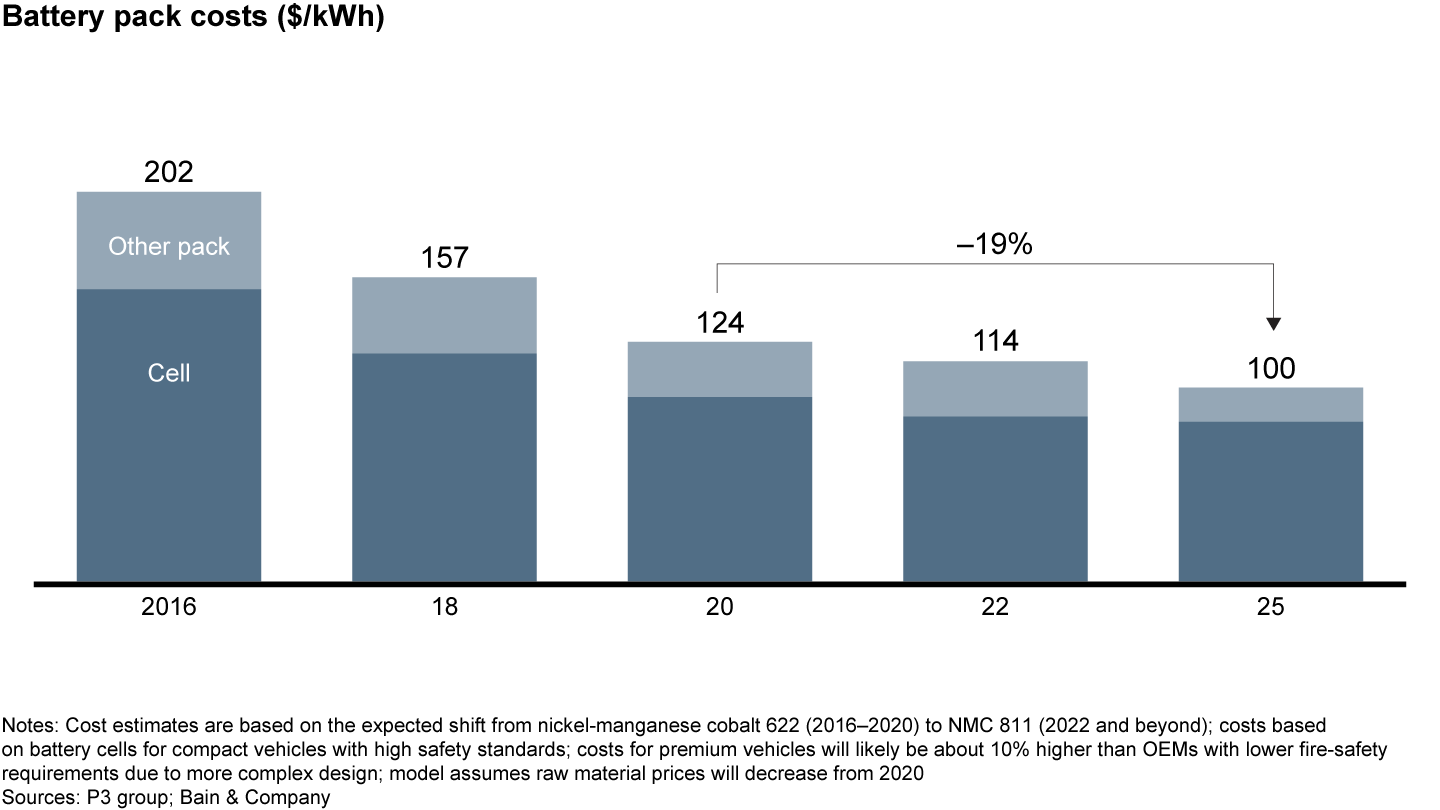

Over the next five years, as TCO reaches parity across vehicle segments and driving profiles in different regions, customer demand will pick up. But on average, OEMs’ margins for BEVs will remain negligible until 2025. For electric mobility to truly reach its turning point, electric cars need to be cheaper to buy than gasoline and diesel models—without government support.
The twin forces of technological advancement and new consumer demand will give the final push. Beyond declining battery costs, technical optimization and the benefits of scale will pull down costs for other BEV-specific components. Leading OEMs can eventually introduce high-volume automated production. Their development expenses will also drop, with less R&D investment needed for subsequent electric models.
The first firms to achieve the ultimate goal—an affordable, unsubsidized electric vehicle—will gain a valuable competitive advantage. Over time, EVs will turn the same, or even higher, profit as ICEVs. By 2025, about 12% of all new cars sold worldwide will be fully electric. By 2040, that figure will be more than 50%. This enticing prospect has led to the foundation of a handful of start-ups, further emboldened by the successes of Tesla—and established manufacturers need to stake their claim.
Finding the right track to autonomous vehicles
For some manufacturers, the transition from gasoline-powered to electric-powered vehicles will give way to another natural transition: autonomous vehicles. While many assumed that early AVs would be gasoline hybrids, recent research by Carnegie Mellon University suggests that energy-efficient software and aerodynamic hardware will make for more eco-friendly self-driving cars. Working on these technologies in tandem could give some EV leaders a leg up in the industry’s next hot battleground, where Silicon Valley start-ups and subsidiaries are already making steady progress.
Exactly when will it become normal to see driverless cars zipping down highways and through city streets? We anticipate autonomous vehicles will start to gain momentum by 2028 (see Figure 3).
Figure 3
Over the next eight years, two major uses will emerge: autonomous highway driving for private vehicles, and robo-taxi fleets for urban areas. Regulations will play a substantial role in the time lines for both of these applications. It’s no surprise that Alphabet’s Waymo decided to pilot and launch its autonomous driving (AD) taxi service in Arizona, which offered an AV-friendly regulatory environment. Much of the US, Europe and China will require further legislation for widespread commercial use.
What’s more, customers need to feel safe. Customers are currently skeptical about driving a fully autonomous car in all situations and weather conditions, without the need to intervene. Their hesitancy will decrease only when more people have the opportunity to test the technology.
While consumers may feel that going to work or running errands in a fully autonomous car sounds more like a scene from a sci-fi movie than a possibility for this decade, the technology is rapidly progressing. Waymo has completed 13,219 miles on average in autonomous driving mode without needing manual intervention—the most of any manufacturer, according to the California Department of Motor Vehicles. However, there’s still a ways to go: According to an analysis by Allstate, the average US motorist is involved in one accident every 10 ½ years, or 140,000 miles.
It’s also important to recognize that in Phoenix, Arizona, Waymo benefits from favorable conditions beyond the regulatory environment: a dry climate year-round, well-marked lines on roads and low population density. In order to expand to key markets, automakers will need to address adverse weather conditions, nonstandard road infrastructure and better technological capabilities to ensure safety. For AD pilots to outperform the average human driver, OEMs also must invest in intelligent technologies that provide better decision making, detection and response to unexpected third-party behavior.
Current models display significant progress in these areas. However, they haven’t hit every requirement for Level 3 automation. Level 3 vehicles can perform most driving tasks within limited conditions, but a human driver must be ready to take over the wheel when the vehicle prompts it. For example, Tesla vehicles with Full Self-Driving Capability will automatically steer a vehicle toward highway interchanges and exits, but active driver supervision is required at all times.
For the market to reach its turning point, vehicles will need to exhibit Level 4 automation, or self-driving without human interaction under certain conditions. Many traditional manufacturers are expanding their advanced driver assistance systems and planning to launch Level 4 features by 2025.
AVs will eventually reach the market as private vehicles, in the luxury and premium segment. Offering a hands-free commute or trip, with the invaluable prospect of more time spent working or sleeping, these vehicles could make a high price worthwhile for many consumers. By 2030, in some regions, we expect 4% to 9% of new cars sold will be equipped with Level 4 automation—the majority of which will be private vehicles offering highway assistance.
Cost, of course, will be a significant hurdle for AVs. But they won’t offer benefits only to individual, time-strapped consumers. Robo taxis, which can eliminate drivers and the associated costs, will prove a valuable complement for public transportation in cities around the world.
According to Bain research, AV ride-hailing services could be a profitable solution for urban mobility by 2030 (see Figure 4). Innovative cities will use robo-taxi fleets to complement their existing public transportation systems, utilizing AVs to cover less frequented routes, helping to relieve traffic in congested areas.
Figure 4
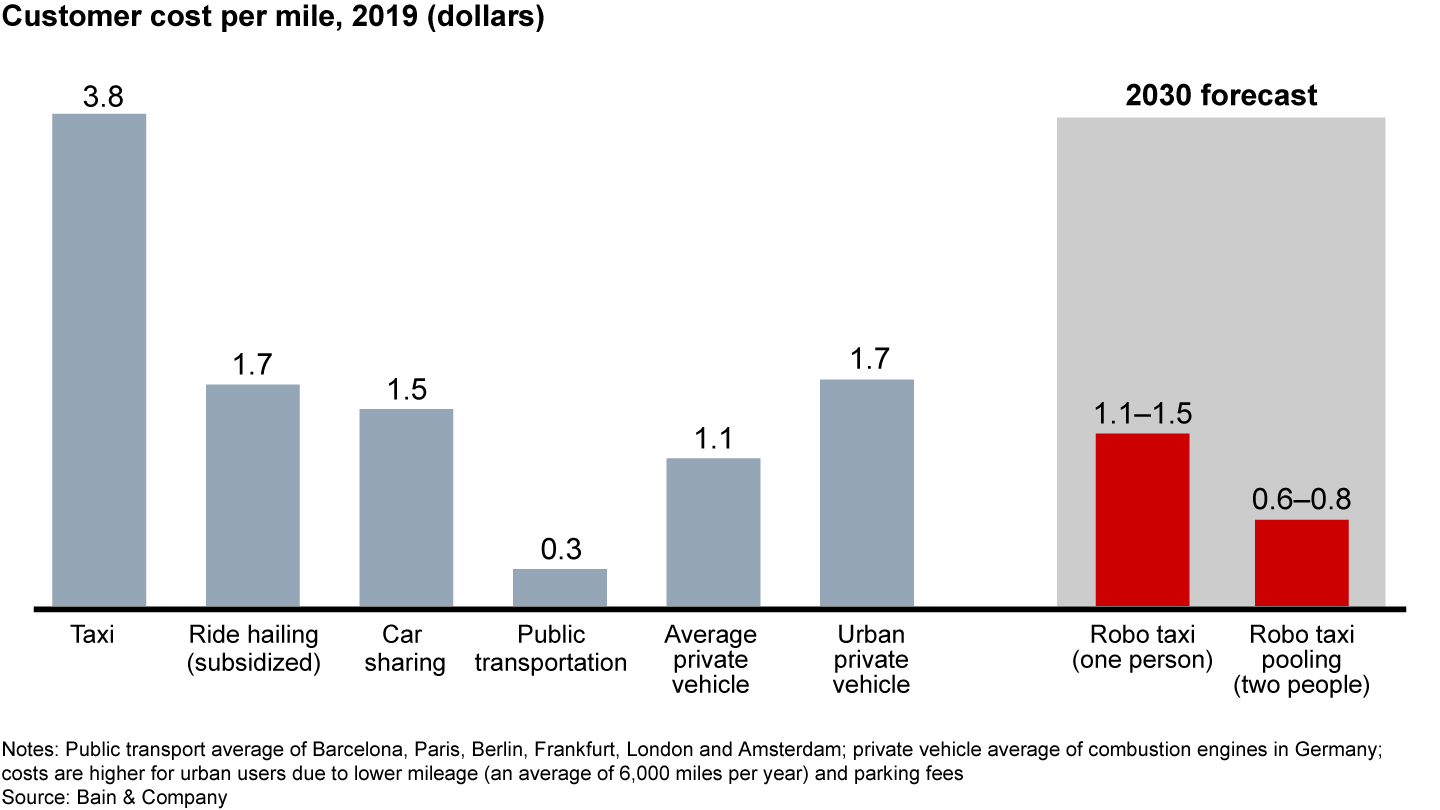

High-level autonomous driving kits currently cost more than $70,000. But over time, standardization, simplification and mass production will significantly reduce the costs. The cost of an autonomous system could fall by more than 85%, to around $10,000, by 2030.
With Waymo offering app-based ride sharing in Phoenix, and Uber and Lyft benefitting from a wealth of consumer data and brand recognition, tech firms are already in a position to win this space. But OEMs don’t have to reinvent the wheel. Instead, they can form critical partnerships with tech firms and cities alike, to secure access to new technology and establish a relationship with end users.
How OEMs can stay in the race
OEMs have reached a critical juncture, heightened by the pandemic. Leadership teams recognize they have little or no financial cushion, and the decisions they make in the months ahead will likely determine the future of the business. They also know that few if any companies currently have the resources to invest in the wealth of opportunities created by the advancement of both EVs and AVs, requiring tough choices. Even those with the scale and capabilities to break into both segments will need to concentrate on areas of brand differentiation, if they’re to outperform formidable tech competitors. The road ahead calls for strategic trade-offs.
To keep up with the pace of the market and avoid regulatory penalties, OEMs can take a few immediate actions for electric vehicle investments.
- Reduce complexity and costs to manage higher costs of EVs. Leading automakers will reduce their product lineup and shift investments to capabilities that differentiate the brand in consumers’ eyes.
- Win new customer segments. OEMs can make direct connections with consumers through innovative new business models, such as subscription services. They can use other programs, like flexible leasing, to compensate for higher EV prices and reach new audiences.
- Forge partnerships. Strong partnerships can help manufacturers plan for next-gen batteries, and secure expertise in cell technology and manufacturing.
Leading OEMs can simultaneously prepare to seize opportunities and manage threats in an autonomous future.
- Define a position in the new mobility value chain. Leading OEMs will evaluate current capabilities and determine where they can create real value—whether private highway vehicles, urban ride-hailing services or EV-meets-AV technology.
- Establish points of contact to the end user. With tech firms already dominating mobility services, top manufacturers will land partnerships to gain access, shape the customer experience and reach users.
- Secure access to Level 4 technology. Depending on their uses, OEMs will engage in partnerships early to shape the technology and minimize costs.
The future of mobility is getting closer, faster than many expected in light of the pandemic. While the time frame is narrow, OEMs can still catch up to their competitors—by creating a bold strategy and quickly executing it.
The authors would like to thank Ingo Stein and Jens Meurer for their contributions to this brief.
First published in 10월 2020