

Brief

The first generation of blockbuster cancer drugs generated a decade of high returns for the field’s pioneers—Roche, Novartis and Celgene—and ample cash flow to invest in next-generation products. Those days are over. Nearly every major pharma company today aims to lead in oncology. Pipelines are bulging with competing products, and earning superior returns in a crowded market is increasingly difficult.
No question, oncology is one of the industry’s largest and most attractive sectors, with more than $100 billion in sales, double-digit growth rates and strong margins. But the goalposts for success are shifting. Drug development is becoming more complex, more data dependent and more costly. In established markets, new entrants have to prove their products are not only effective, but superior to existing treatments. As new players crowd in, the period of market exclusivity for first-time entrants will shrink and the cost of commercialization will grow.
Oncology is entering an era of rapid evolution. The rise of combination therapies that outperform single drugs will transform markets swiftly over the next decade, posing a significant challenge to leadership teams. Those companies that fail to make the tough choices required to pursue a clear path to leadership will have difficulty competing with more focused rivals.
Which strategies will be successful in that difficult and fast-changing terrain—and which are likely to fail? The top 20 biopharma companies have bet more than 30% of their pipelines on oncology products, and many are investing broadly across the entire spectrum of cancer targets. That approach risks spreading R&D and clinical investments too thin in a rapidly evolving market.
Todd Sangster, an expert principal with Bain's Healthcare practice, discusses three strategies for building category leadership and achieving success in one of biopharma's largest sectors.
The most successful companies use a category leadership strategy: They seek to lead in one or two segments—rather than broadly across the oncology landscape. The key to understanding category leadership, as we wrote recently in In Vivo, is to view categories through the eyes of the customer: patients, prescribing physicians and payers. Category leaders develop products that are bought using a common purchasing process by a defined set of end users.
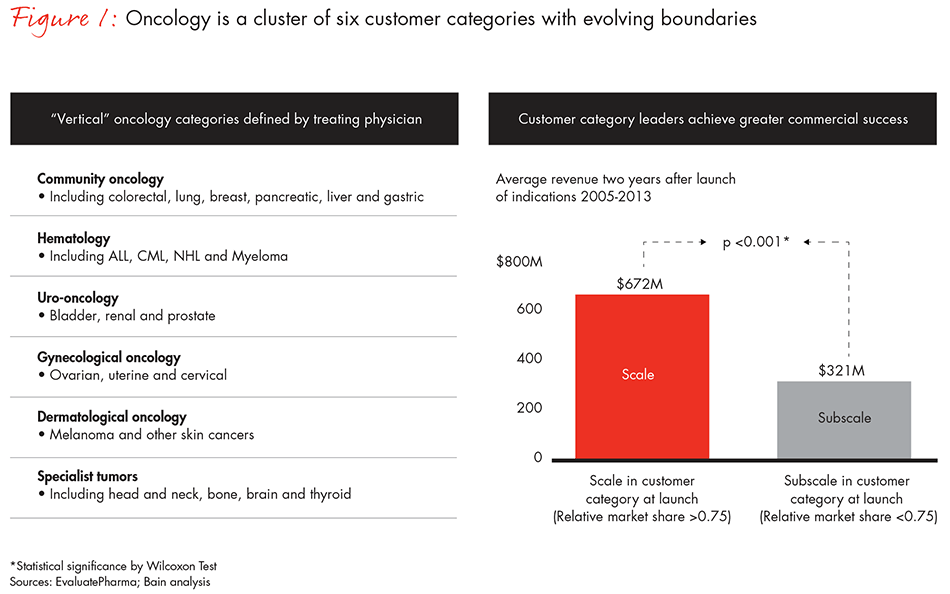
In fact, companies that look at oncology through a shared-customer lens quickly understand that it is not a single category. It is a cluster of six or more distinct, vertical customer categories whose boundaries are still evolving, many at a rapid clip (see Figure 1, left side). Some distinctions are obvious. Hematology, for example, is a recognized oncology subspecialty. Others, such as gynecological oncology, are newly emerging. A strategy targeting these vertical categories allows companies to leverage customer insights, commercial strategies and go-to-market models across multiple therapies in the same category.
Bain research shows companies that seek to lead in specific vertical categories, such as dermatological oncology or community oncology, outperform rivals. In a recent study of 73 oncology-indication launches from 2005 to 2013, the revenues of vertical category leaders two years after indication launch were more than double the revenues of subscale rivals (see Figure 1, right side). They also had a 31% higher approval rate for indications moved into phase III trials.
Vertical category leaders in oncology, like those in other pharma categories, benefit from a virtuous circle across the value chain that increases their odds of innovating and winning. Thanks to privileged access to top physicians and patient groups, these companies have better insights on customer needs, greater expertise and improved understanding of the dynamics of the category. Knowledge of cutting-edge clinical development leads to more and higher-quality asset sourcing opportunities, and increases a company’s ability to maximize value through better clinical design and product launch capabilities.
Unlike more mature pharmaceutical categories such as cardiology or gynecology, most oncology categories are composed of markets—individual tumor types—at different stages of clinical maturity. That difference has important strategic implications in charting a path to leadership, particularly for new entrants. In the community oncology category, for instance, the treatments for HER2+ breast cancer are well established and effective, creating a high innovation hurdle for newcomers. By contrast, the treatments for pancreatic cancer are less effective, lowering the barrier to entry and opening a potentially easier path to leadership.
Build deep knowledge
Companies that build a strategy around one or two vertical categories in oncology are more successful for several reasons. Not only are oncology markets becoming intensely competitive, they are also highly complex. Focusing on a narrower set of customers helps pharma companies identify the greatest unmet need and understand what physicians are looking for in next-generation drugs. This strategy also builds deep knowledge in fast-moving markets where potential treatments continue to multiply and therapy outcomes are evolving. The greater the knowledge about a particular tumor, the sharper the insights a company will have to identify targets, guide clinical program design and pursue optimal combination therapies.
Becoming a leader in patient outcomes in a vertical category is an evolutionary process. The path in immature markets typically starts with a scientific breakthrough leading to a new product. Companies advance by expanding the use of a breakthrough drug for additional indications in that vertical category and in new combinations with other treatments to create better outcomes and greater commercial scale. Over time, successful companies develop additional products in the category, firmly anchoring their leadership position.
Celgene became category leader in hematology, for example, by building a suite of hematology therapies. It started with a breakthrough use of thalidomide, then improved treatment options with thalidomide derivatives such as Revlimid and Pomalyst before adding hematology therapies, including Vidaza and Istodax, around that core. Recently, Celgene executed a new type of indication-specific partnership with AstraZeneca to add checkpoint inhibitors to its pipeline and open the path to combination approaches.
As oncology markets mature and combination therapies become the treatment of choice, companies with larger portfolios in vertical categories gain a clear advantage. Ultimately, category leaders are best positioned to offer complete disease solutions for a particular tumor, from drugs and diagnostics to long-term patient support, further consolidating their leadership profile.
In addition to the vertical path to leadership, challengers may compete on a second, science-based, horizontal axis (see Figure 2). With this approach, challengers focus on developing a breakthrough technology with broad applicability. In the past, Roche applied the VEGF pathway and its Avastin franchise across multiple tumor types; more recently, Bristol-Myers Squibb is building on its initial breakthroughs in checkpoint inhibitors with development programs across the full spectrum of vertical categories.
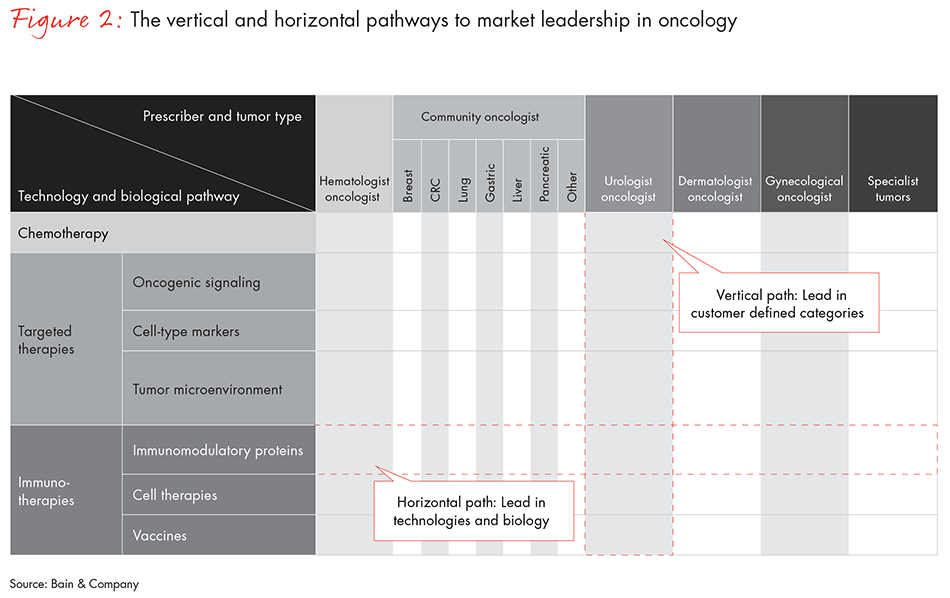
In the future, specific technologies such as CAR T-cell (chimeric antigen receptor T-cell therapies), with their steep experience curve and specialized equipment, may be particularly attractive for such a horizontal strategy—an approach that companies like Juno and Kite are actively pursuing. The risk: While expertise in horizontal technologies may be a path to breakthrough therapy, it may not be sufficient over the long run to build defendable market leadership.
Ultimately, there is no single “right” answer. The most effective leadership strategy for a company depends on its starting point. The challenge for companies with deep expertise in a horizontal scientific platform is to figure out how they can best translate that into sustainable vertical category leadership. Conversely, companies pursuing leadership in a vertical category must remain vigilant to ensure they have access to scientific platforms with scale potential in that category.
Three paths to category leadership
Companies have some options for building or maintaining category leadership, based on three different starting positions.
-
Vertical leaders: Double down in categories where you lead or are pursuing leadership. Apply a category leadership lens to your R&D and BD portfolio decisions, deliberately valuing the synergies that result from additional depth in a category—and applying higher hurdles for off-strategy investments. At the same time, invest or partner to ensure access to platform technologies that could disrupt your targeted category vertical.
Capitalize on your leadership position by deepening your offering in the category through biomarkers, combination therapies and best-in-class care protocols; developing innovative pricing to mitigate costs and uncertainty of outcomes; and investing in patient care solutions to better manage the specific challenges of the disease and the chosen course of therapy.
-
Horizontal leaders: Invest in technology leadership through an active clinical program in next generation therapies and technology-specific biomarkers. Keep an eye out for opportunities to shape the market by redefining medical practice (for example, CAR-T or vaccine clinics), across tumor vertical categories.
Identify vertical categories where your technology platform has the greatest potential to disrupt current treatment paradigms and build a portfolio of additional assets that support the move toward sustainable vertical category leadership. Even the strongest horizontal players should limit their focus to one or two vertical categories where they can credibly lead the market.
In vertical categories where you have little or no opportunity to disrupt, pursue partnerships and licensing deals for specific indications with vertical category leaders, to enhance horizontal leadership while remaining focused on priority verticals. AstraZeneca, for example, is building a strong scientific platform in immuno-oncology, especially in checkpoint inhibitors. Since the company had little experience in the hematology category, it licensed its assets in that category to the hematology leader, Celgene. The deal gives AstraZeneca immediate financial benefits while retaining some of the potential upside return. Importantly, the lifetime value of the platform in hematology will likely be higher since Celgene, as category leader, is best-positioned to maximize the potential of the combined portfolio.
-
Start-ups and insurgents: Assess where your high-quality assets have the best opportunity to deliver superior patient outcomes over the current standard of care, and build your category leadership plan around that core. Natural targets are tumor types with the greatest unmet need, since the innovation hurdle is lower and a successful asset can establish a beachhead into the broader category.
For a new horizontal player, a similar logic applies: Avoid technologies like the PD-1 pathway where established players have insurmountable leads and prioritize other, less established pathways or newer approaches like cell therapy and vaccines.
Once you establish a beachhead, you can chart out a strategy for horizontal and vertical expansion, always keeping an eye on how the category is likely to evolve from a customer perspective as well as the potential for further technological disruption. This is the toughest route to the top, given the large number of mechanisms required in many categories to build a leadership portfolio, but with a high-quality core asset, thoughtful planning and judicious dealmaking, you can maximize the probability of success. If no obvious path to leadership exists, consider joining forces with other players to ensure you don’t end up being stranded as a subscale player.
Tough choices
Many pharma companies are still investing broadly across a wide range of oncology categories—a position that will become increasingly difficult to defend as the market matures and becomes more competitive. Bain analysis shows that the median number of years that an oncology drug with a novel mechanism enjoys mechanism of action (MOA) exclusivity has halved from eight in the 2000-to-2004 period, to four a decade later. The value of individual assets is likely to continue to decline in the future as competition further intensifies and combination therapies become the norm.
A category leadership approach can help pharmaceutical companies sharpen their strategic focus when considering tough choices between different oncology assets. Those that build strength in one or two vertical oncology categories and invest judiciously in complementary scientific platforms will have a powerful edge as markets evolve toward disease solutions.
Nils Behnke is a partner in Bain & Company’s San Francisco office and is part of its Global Healthcare and Strategy practices. Michael Retterath is a partner in Bain’s New York office and a member in the Global Healthcare practice. Todd Sangster is a principal in Bain’s San Francisco office and part of the Global Healthcare practice.
First published in 9월 2016