

Brief
How much value can a company gain by streamlining its portfolio of products or services? It’s a question that could have been posed to the chief executive of a European supermarket chain.
The chain was facing fierce competition and was struggling. It had added more and more products to its shelves. It carpet bombed shoppers with promotions. But the strategy wasn’t working, and the CEO knew it. Finally, the company reversed course. It initiated everyday low prices. It simplified and redesigned its stores so that shoppers could find products more easily. In a bold move, it eliminated many brands and increased the proportion of private-label products while cutting the overall number of stock-keeping units (SKUs) by a whopping 40%.
The result? Overhead costs plummeted. Inventory days dropped by 60%. And revenues rose 25%.
Simplifying your product portfolio in this way can seem like magic: Every number suddenly begins to move in the right direction. And it works as well with manufacturers and service companies as it does with retailers. But it isn’t magic, only a practical answer to a common problem.
Avoid creeping product proliferation
Companies often add one product or service after another in hopes of attracting and keeping customers, boosting market share and increasing profitability. Many different functions—engineering, R&D, marketing, sales, customer service—push for new offerings or features.
At some point, however, product proliferation and the resulting complexity overwhelm the company’s systems. Costs rise. Quality declines. Salespeople get confused. Stock outs multiply. Meanwhile, many customers can’t find what they’re looking for or don’t know what to choose, and some depart for simpler pastures. (Researchers have dubbed this phenomenon the paradox of choice: People often prefer fewer choices to more.) Because of the complexity, companies become confused about which products customers really want and which they are settling for, usually because the one they want is out of stock. The companies fail to understand what we call native demand, because they don’t have a sufficiently intimate understanding of their customers.
In short, many companies need far fewer products in their portfolios than they currently offer (see Figure 1). We have seen some businesses cut their SKUs by 50% or more—99.9% in one case we’ll discuss in this article— with no negative effects on profitability or competitive position. We have also studied the effects of product complexity in a wide range of industries, and our findings underscore the power of radical simplification. Companies with the least complex product and service offerings typically have a far better understanding of customers and what they want than companies with more complex offerings. Not surprisingly, the low-complexity companies typically grow almost three times as fast as high-complexity companies and are more profitable as well.
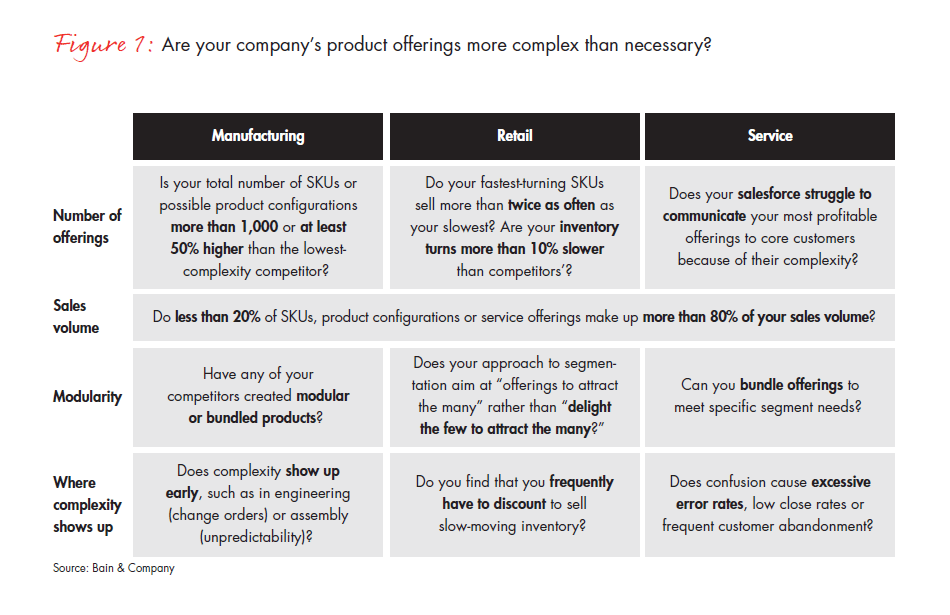
Of course, no large enterprise can eliminate product-portfolio complexity completely. Customers want some choices. But they don’t want so many that they feel overwhelmed. The challenge is to locate the balance point— the point at which you are delivering what your core customers most value at the lowest possible cost, with no superfluous products.
That can be a daunting task, so let’s consider the five essential steps.
1. Create a “complexity P&L”
The typical company’s profit and loss (P&L) statement does a great job of capturing revenues and (usually) gross margin. But it doesn’t accurately capture the cost of prolif-erating SKUs. Even activity-based costing methods rarely gauge the full cost of product-portfolio complexity. In most companies, proposals for an additional feature, size or product are hard to say no to, because the data on the true cost of those additions aren’t easily available.
A complexity P&L is a tool for measuring those true costs. It begins by identifying the factors that spawn complexity—unique parts, platforms, brands, sizes, feature options and so on. Starting from a perspective where there is no complexity at all, teams of analysts then move systematically from one cost bucket to the next, modeling cost curves to understand how the curves change as complexity increases. That is a time-consuming task. But the zero-based approach allows the company to envision how things might be done completely differently without complexity, and the cost modeling provides executives with the precise data they need to make appropriate trade-offs between economic value and complexity.
An industrial distributor, for example, learned from this kind of analysis that many of its products were sold at negative margins. The analysis also revealed significant regional and industry variations in pricing and margins. As part of the solution, the company developed new sales protocols, a system that tracked profitability each month across the entire business, and new pricing and discounting rules to account for order sizes and lead times. These moves enabled it to improve EBITDA by some 20%.
2. Deepen your customer analysis
If a company was clairvoyant, it would carry little inventory and require no discounting. It would deliver the product via the cheapest possible supply chain to the right customer at the exact moment that customer wanted it. In the real world, companies must rely on customer research for that kind of insight. Yet many don’t conduct enough research to know what their customers truly value.
Companies with focused product portfolios begin solving this problem with a proprietary, needs-based segmentation of their customers. They learn exactly what customers in each segment want from the product in question—the “job to be done,” as Harvard professor Clayton Christensen puts it—and only then design the specifications that will deliver value and create competitive differentiation. Over time, they refine their offerings using Net Promoter® scores and responses, sales feedback, observational research, focus groups and statistical tools such as discrete choice analysis. They have a similarly detailed view of competitors’ product offerings, road maps and strategic intent.
All the data then inform product-portfolio decisions. A tool manufacturer, for instance, knew that 20% of its SKUs accounted for 80% of its revenues, so it saw a great streamlining opportunity. But rather than simply eliminate unpopular products—“whacking the tail,” as it’s often called—the company assessed the value of each SKU to its target customers. Some SKUs were both unprofitable and unimportant to major customers, so eliminating them was easy. Another group included items that major customers wanted, but which produced insufficient margins. The tool company was able to reprice some of those products and reengineer others to reduce design complexity. Thanks to such measures, the company substantially reduced product complexity, which contributed to an increase in operating margins of up to 70%.
3. Look across functions
Many companies try to optimize their product portfolio by asking one function to lead the charge. But the results are predictable. Marketing-led exercises miss costs and promote buzz-enhancing features. R&D organizations include the newest technologies whether customers want them or not. Procurement-led efforts optimize costs but may remove products or features that matter to customers.
Complexity is a problem that crosses organizational boundaries, which is why it is so often owned by everyone and no one. To eliminate it, companies need empowered, cross-functional teams that can strike the right balance between customer needs and the costs of complexity and then make decisions about the product portfolio. A company must then commit significant resources to executing the teams’ decisions. Sales and marketing, for instance, has to guide customers to the new, leaner range of offerings; R&D must redeploy its resources; and so on. The tool company just mentioned restructured production, sequestering some of its more complex products in separate facilities, so that their complexity wouldn’t infect other products.
4. Take the costs out
Streamlining a product or service portfolio does not automatically eliminate costs or improve business performance. Indeed, some companies reduce their product portfolio and see little or no performance improvement, leading them to question the whole idea of simplification.
More experienced companies know the truth: Once product decisions have been made, it takes real work to bring about better performance. Line owners must adopt cost targets. Managers need to reset budgets. Dedicated teams have to redesign processes and procedures to capitalize on the newly simplified portfolio. And that’s just for starters. Over time, companies can take many other actions across the entire business:
- Reallocating R&D funds to reflect the new product strategy
- Reducing product-development and time-to-market cycles
- Consolidating vendors and renegotiating contracts by helping vendors understand the costs of complexity in their own systems and how they can lower those costs
- Simplifying manufacturing schedules to increase stability and reduce changeovers and retooling
- Redesigning sales processes to allow focus on higher-value activities and services
- Reducing spare-part inventories and customer-support expenditures
- Simplifying financial reporting and IT systems
Dell, for instance, found that reducing the number of computer configurations brought potential benefits to many elements of the business. It mobilized dedicated teams for nearly two years to capture these benefits (see below, “"Dell’s simplification saga").
5. Keep complexity out
Like weeds, complexity tends to spread throughout an organization and strangle growth. And it keeps coming back unless prevented from doing so. Focused companies have learned this lesson and keep their profit gardens weed-free. They may set absolute targets for new products and services, removing one for every one they add. They may increase hurdle rates. Nearly all periodically review their product portfolios to keep complexity in check. A medical device and specialty pharmaceuticals manufacturer adopted several such techniques: It developed new stage gate processes and used hurdle rates and other tools to inform decisions about new SKUs. It also specified who could recommend a decision to approve an SKU, who would make the decision, and what data and metrics around costs and customers were required. Those innovations led to a reduction in product complexity and a 15% gain in annual margin—an improvement likely to last.
Streamlining the product portfolio is an indispensable step in creating a focused company. It increases efficiency and boosts margins. It often leads to revenue growth. Still, it is only one step. A company that fails to focus its strategy, its customer base, its organization and its processes is likely to find that product complexity creeps back into the business despite efforts to keep it out.
But when product simplification is the first step, it’s a powerful one. When Steve Jobs returned to Apple in 1997, he eliminated the vast majority of the company’s products and told his team to focus on just four computer models: a desktop and a laptop for each of two target segments, consumers and professionals. They did. Today, Apple has just a handful of product families—far fewer SKUs than competitors do—and annual revenues of $108 billion. Jobs famously said, “I’m actually as proud of what we don’t do as of what we do do.”
Those are words to manage by.
Mark Gottfredson is a partner with Bain & Company in Dallas and a senior member of the Global Performance Improvement practice. Chuck Whitten is a Bain partner in Dallas and a member of the firm’s Global Performance Improvement, Strategy and Technology practices.
Dell’s simplification saga
Dell’s meteoric rise from dorm-room start-up to the leading personal computer company of the mid-1990s and early 2000s was really a story of customer focus. Its direct sales model allowed it to deliver products at significantly lower cost. Its customer relationships and innovative supply chain enabled it to understand the innovations that buyers wanted and provide them faster than competitors. Dell’s model also gave sophisticated customers the ability to configure their computers exactly as they wished.
Over time, however, the business changed. The PC market expanded, technological innovation slowed and prices fell. Fewer customers valued configurability. Competitors began selling fixed-configuration machines directly, reducing Dell’s historical advantage. Before long, Dell’s legacy model of allowing vast configurability was dragging down every part of its business. Salespeople had to spend a lot of time on the phone with each customer. Tech support was expensive—the more configurations, the more frequently the computers were likely to fail. Dell’s performance deteriorated: Its market capitalization, once more than $100 billion, sank below $20 billion by mid-2009.
Recognizing clearly the value of recapturing its historic customer focus, Dell attacked the problem, using the five-step process described above. Its first step was customer research. Teams analyzed millions of records, using statistical tools such as cluster analysis to determine which product attributes were most important to each customer segment and which options buyers in each segment tended to choose. The analysis showed the company how many clusters would be required to meet each segment’s needs, and it revealed which components fit best together in a cluster. Thanks to this clustering, Dell eliminated more than 99% of its consumer product configurations—a remarkable feat in any business.
In parallel, Dell X-rayed every cost bucket to understand how each set of costs changed with complexity. It also benchmarked competitors to understand the cost position required. A dedicated cross-functional team then set cost targets, reinvented processes to help the company meet those targets and established the necessary governance procedures to keep complexity out.
The results of all these measures have been remarkable. Dell lowered its manufacturing costs by 30% and improved operating margins. Its revenue growth outpaced the industry. “Exactly what you want faster than anyone,” claimed the company—and the numbers supported the claim. More than 40% of buyers were ordering preconfigured machines in early 2012, up from zero in 2010. Dell was shipping orders out the next day 98% of the time. The PC market, of course, is continuing to evolve, and Dell along with it. But the company’s renewed customer-centered approach should provide both the foundation and the funds for the company’s future growth.
Net Promoter® and NPS® are registered trademarks of Bain & Company, Inc., Fred Reichheld and Satmetrix Systems, Inc.
First published in 8월 2012