

Brief

News sources and public officials often talk about restarting the economy as if it were as simple as flipping a switch: Officials lift the stay-at-home orders, people swarm to their jobs, companies step on the gas and the economy roars back to life.
If only it were that easy.

Macro Surveillance Platform
For more detail on the business implications of coronavirus from Bain’s Macro Trends Group, log on to the Macro Surveillance Platform. Learn more about the platform >
Starting up a complex organization is significantly harder than shutting one down. That is especially true in a period of deep uncertainty across the scientific, policy and economic fronts. As companies plan their return to business, leaders face two immediate high-stakes challenges: How do we unfreeze an operation that’s been slowed or stopped for months? And how do we know how quickly to ramp up activity amid the threat of recession and a bewildering variety of plausible demand scenarios?
At the same time, leaders must grapple with a longer-term question: How should we retool our supply chain to protect against shocks while staying competitive on cost and value? For years, “faster, cheaper and more efficient” has been the supply chain manager’s mantra. Quick delivery, lean operations and a widely distributed footprint have been the top priorities. But in a matter of a few short weeks, the global coronavirus panic demonstrated starkly that many management teams have vastly underestimated the value of supply chain resiliency and visibility.
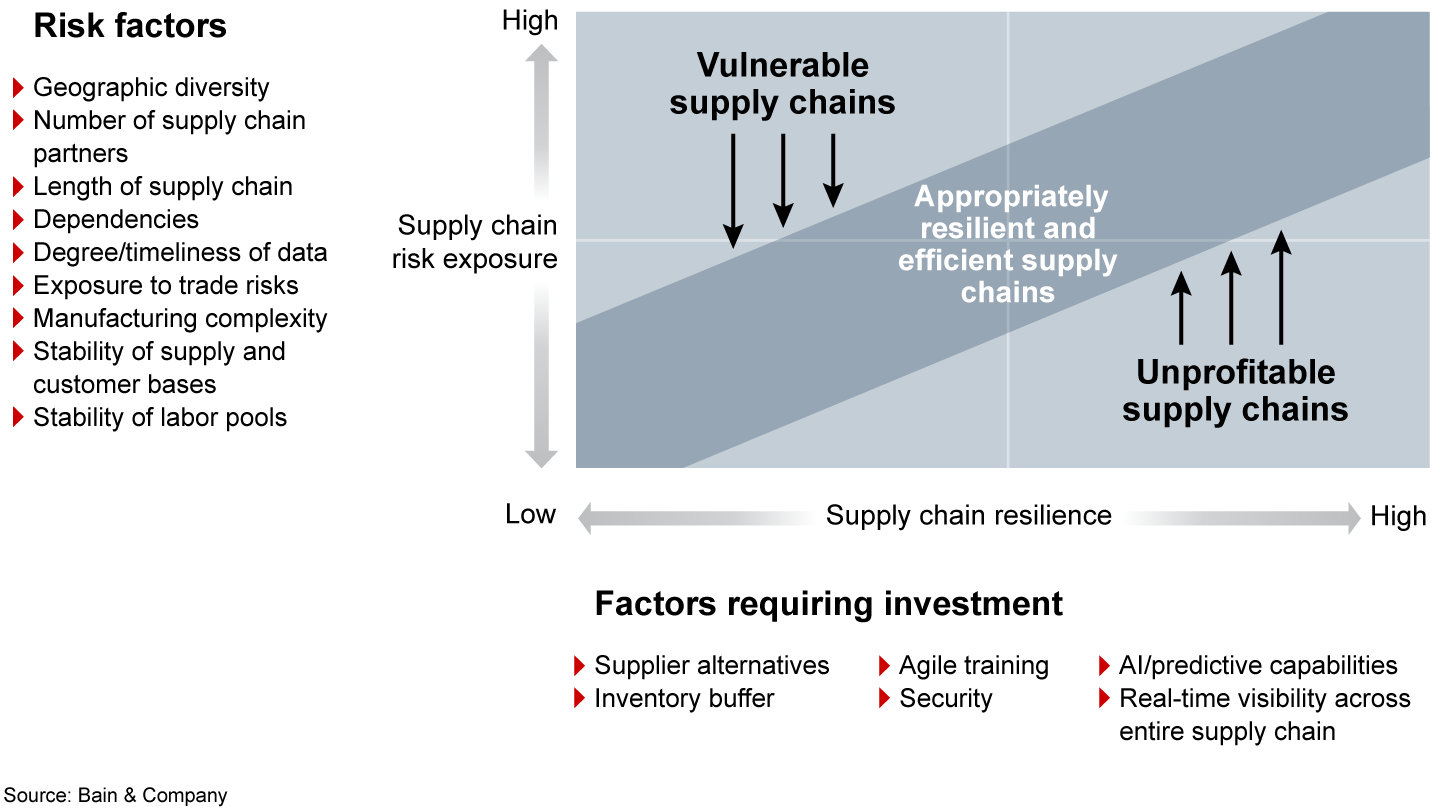
Shoring up their supply chains and shielding them against future shocks will challenge leaders to strike a new equilibrium between efficiency and reliability (see Figure 1). But the challenge also opens up an important opportunity to create value. The best place to start is with your own strategy for winning with customers. That will point to the one or two critical supply chain initiatives that can have an immediate impact during the downturn by reducing cost or boosting resiliency where it matters most.
Figure 1

The start-up challenge
Starting up after a prolonged shutdown involves decisions and rapid execution from one end of the supply chain to the other. Companies need to choose which plants, retail outlets or distribution centers they need to bring online and when. They face key working capital decisions: When do we restock, and how much inventory do we need?
Bringing back furloughed employees can be difficult—some may be afraid to return, others may want to max out their unemployment benefits first. Suppliers, meanwhile, may be out of business or in different geographies that start up on different schedules. It may be necessary to negotiate new terms and credit arrangements to reflect new levels of volume and risk.
Then there are the Covid-specific issues: What rules and regulations will we have to comply with? How will customer behaviors change? Will there be a surge of pent-up demand, and how long until a normal pattern establishes itself? If you’re an apparel company, do you skip the summer season and go right into fall? If you’re a restaurant chain with outlets in a market that demands you scan the temperature of every customer coming in for dinner, do you make the investment in devices and training?
Every industry will experience its own demand curve reflecting its customer base, regulations, level of pent-up spending, and the emergence of alternative products or services. And every management team will have to triage these issues before resuming anything like normal operations. War rooms set up to manage cash, health and shutdowns will have to pivot rapidly to work on demand scenarios and manage the operations restart as signals warrant.
Adjusting to the new normal
What’s also becoming clear is that we may not be returning to normal any time soon. Massive unemployment numbers, turmoil in the oil markets, a steady drone of earnings warnings—all point to a broad and prolonged recession that will likely exert pressure on demand across industries through 2020 and into 2021. Many companies will face quarters, if not years, of significant top-line pressure as customers retrench.
That means leaders can’t afford to wait for resurgent demand to lift their earnings before interest, taxes, depreciation and amortization. They have to make the tough decisions now to bring operations in line with a new normal of lower demand.
Supply chain leaders have already worked hard to reduce costs and have made some initial tough choices. But what seemed impossible a month ago will now be required as businesses restructure to be profitable amid demand that is uncertain and often much lower. Companies will have to comb through the procurement process to both buy more effectively and bring more discipline to spending. Some facilities won’t reopen, and others will need to automate or become more agile. Many aspects of logistics will have to come back in-house. In many cases, back-office operations that are running without select workers in the short term will have to be redesigned or automated to operate at a leaner level for the duration.
Turning challenge into opportunity
The opportunity to create value in this chaotic time lies in finding ways to add balance to your supply chain, focusing efforts on three essential characteristics: resiliency (inventory in the right place at the right time), visibility (a clear, technology-aided view of dependencies from one end of the chain to the other) and simplicity (focused product lines and a culture of ongoing waste reduction) (see Figure 2).
Figure 2
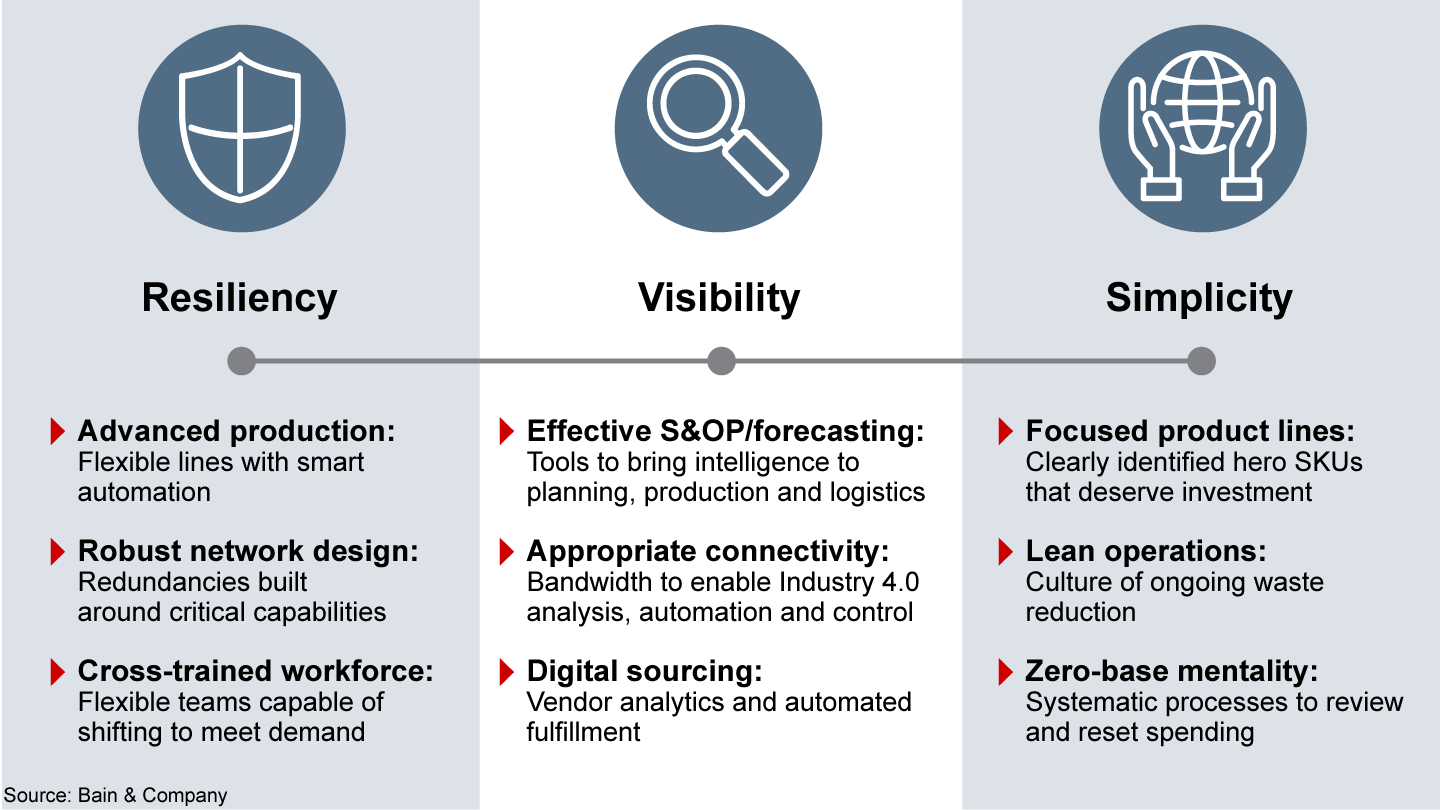

Building a more resilient supply chain means ensuring that inventory and production capacity are available when needed by spending on redundancy. Creating visibility—well past your tier-one suppliers—means using technology to understand where risk lurks in your operation and tracking performance at each tier of the supply chain, all the way back to raw inputs. The Covid-19 crisis has drawn a bright line under the need for redundancy and real-time intelligence in times of disruption. Yet those things are also expensive. Companies need to ask themselves, “What’s the right balance between a more robust and dependable supply chain and one the company can afford?”
The reality is most portfolio companies (and targets, for that matter) have yet to fully optimize their supply chains for cost. Fewer still have optimized them for strategy. By taking a zero-based approach and starting from a question—what do our customers really value, and how can we affordably deliver on those few critical priorities?—companies can find efficiencies that end up paying for essential supply chain improvements to provide visibility, increase reliability and make operations more responsive to shifting levels of demand.
The strategy imperative
Consider the example of a leading food company whose customers valued freshness and seasonal selection above most other considerations. For years, keeping fresh, seasonal product on the shelves meant constantly producing excess inventory so stores would never run out of popular items at times of high demand. But then the company made an initial investment in digital forecasting tools that offered predictive analytics capabilities. It devised systems to get key data into the hands of the customer representatives responsible for keeping shelves stocked. The improved visibility into who was buying what and where allowed the company to be more strategic about product placement and more precise about how much to produce, resulting in significantly less inventory cost. The company plowed the resulting savings into more technology to increase visibility throughout the supply chain.
Too often, companies assume their customers value variety and customization, with little data to back it up. Over time, they’ve added products and services—and built capacity to deliver them―leading to massive complexity that boosts costs more than customer satisfaction.
A good example is the typical industrial supply company, which has added a wealth of free customer services over the years, with little insight into what its best customers really value. Is it most important that their mission-critical parts are always in stock? Or is same-day delivery the key differentiator? Would they shift from a competitor if you offered a customized self-serve online ordering site that makes replenishment easier?
Services like these create supply chain costs that may or may not make sense. But a rigorous process to identify your best customers and ask them what they value most can generate an important conversation around value: If we invest in the capacity or redundancy to provide you with fail-safe supply, is that something you’re willing to pay for? If we stopped offering this service in order to fund something more valuable, would you care?
There’s little doubt that, in the wake of the Covid-19 crisis, companies will scramble to shore up their supply chains in terms of resiliency and visibility. But they will find it doesn’t pay―and probably isn’t possible―to throw money at every potential vulnerability without understanding the true cost of doing so. Viewing the supply chain through a strategic lens allows companies to prioritize the initiatives that will make the most difference. It provides a compass for making intelligent choices about where to invest and where to cut back based on value at stake.
Only by clearly identifying your company’s hero SKUs can you comfortably prioritize investment behind your most valuable products and create resiliency in terms of expanded production capacity or sourcing redundancy. The same could be said for technology investments. A variety of consumer products and technology companies are actively exploring spending on automation to help lower labor costs so they can bring strategic manufacturing capacity back on shore, where they have more control over outcomes. Making it work demands a full understanding of the investment required and the cost trade-offs with offshore production. But that calculation isn’t particularly useful without clearly defining the strategic value of that capacity.
As companies and their investors work through the myriad issues involved with starting up operations again, the supply chain is going to be front and center―presenting both challenge and opportunity. It’s tempting to try to fix everything at once, but the most effective management teams recognize how easy it is to overwhelm an organization with initiative fatigue. A relentless focus on strategy means prioritizing supply chain initiatives that will reduce costly services customers don’t value and increase the kind of resiliency they do.
Management teams face almost unprecedented uncertainty and static. For private equity firms, helping them zero in will be critical to creating value as the Covid-19 crisis runs its course.

Operations Excellence
Companies with best-in-class operations have a strong competitive edge. Bain's insights on operational excellence help leadership teams transform supply chains, procurement strategy, and manufacturing capabilities into strategic weapons.

Coronavirus
The global Covid-19 pandemic has extracted a terrible human toll and spurred sweeping changes in the world economy. Across industries, executives have begun reassessing their strategies and repositioning their companies to thrive now and in the world beyond coronavirus.
Miles Cook is a Bain & Company partner based in Atlanta and a member of the firm’s Private Equity practice. Peter Guarraia leads Bain’s Global Operations practice and is based in Chicago. Jörg Gnamm is a partner with Bain’s Performance Improvement practice and is based in Munich.
First published in 4월 2020