

Brief

한눈에 보기
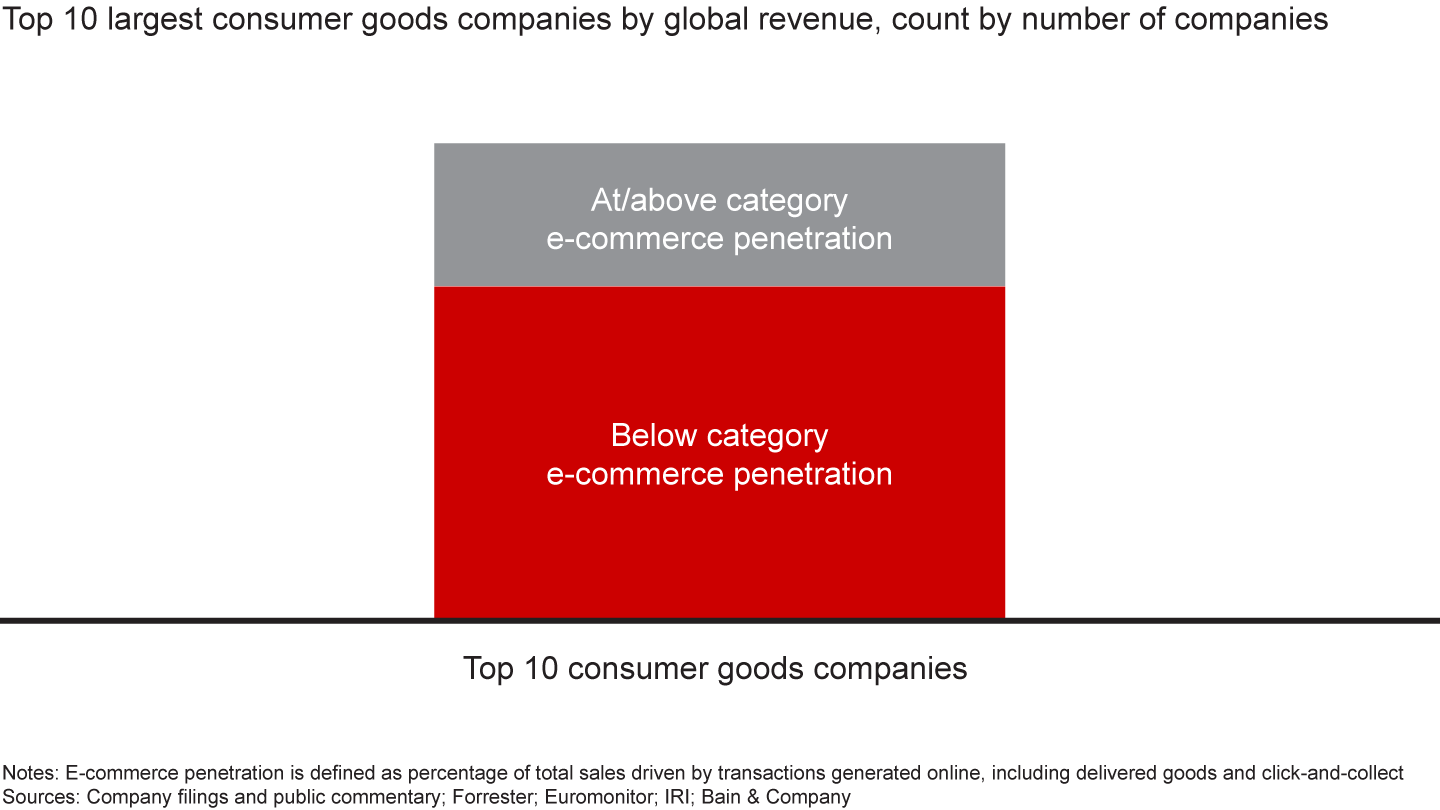
- Large consumer goods companies may feel they are doing well online, but they have a much bigger opportunity. Consider that 7 of the 10 largest consumer goods companies are lagging in e-commerce penetration in their categories, despite delivering online sales growth of 30% or more.
- Fundamental issues are keeping large brands from gaining more traction online. They typically are not set up to make the quick pivots in e-commerce marketing that the channel requires, and they often make a series of predictable missteps, such as not having a holistic view of online performance or putting all e-commerce marketing in the hands of outside agencies.
- Companies can quickly seize the online opportunity by taking critical steps, such as moving e-commerce marketing in-house, shifting control of e-commerce marketing budgets and content from brand teams to shopper-led e-commerce teams, and determining what leads to incremental sales—and doubling down.
Most consumer goods executives smile when they see their e-commerce sales performance. As shoppers began shifting to online channels, these executives resolutely designated resources to tackle the opportunity. Many now are enjoying double-digit growth—in many product categories—and they are more than pleased with the results. However, new Bain & Company analysis shows that most major brands have little to celebrate. They are far from reaching their full potential in the fastest-growing retail channel. Worse, many are unknowingly ceding online growth to competitors. Among the world’s 10 largest consumer products brands, 7 lag in e-commerce penetration in their categories, despite delivering online sales growth of 30% or more (see Figure 1). That group includes names like Procter & Gamble, Unilever, Colgate-Palmolive and Mondelez, companies that still have a significant share of e-commerce to capture an even bigger potential growth opportunity.
Figure 1

Why aren’t leading brands able to extend their offline success into the online world? One fundamental issue is that online’s “endless shelf ” creates massive long-tail assortment and additional competition from smaller brands that leading companies are not accustomed to in the brick-and-mortar world. Also, they must adapt to different shopper behavior. Technology allows shoppers to easily reference prior purchases or search and filter for product attributes instead of scanning planogrammed shelves and product labels. Among the profound implications: Being online doesn’t guarantee benefit to a market leader, and winning marketing capabilities differ from the offline world.
Leading consumer goods companies may know, for example, that online searching is critical and that 70% of Amazon shoppers never click past the first page of search results, giving a huge advantage to companies whose products appear first. They may know that roughly half of all US online shoppers start their product research on Amazon, giving online leaders an enormous advantage. However, whether they are aware or not, they are typically not set up to act on these hugely important insights.
Many large brands make a set of common missteps. They may lack everything from the right talent, to sufficient e-commerce budgets, to the organization capabilities that will deliver dramatic gains in digital sales—or at least enable them to keep up with competitors. We often see companies bundling e-commerce with other “alternative channels” or asking an e-commerce sales lead to manage the matrix in order to align marketing, supply chain and product development priorities. We have seen multiple brand teams within a brand portfolio competing for the same shopper, effectively driving up their own costs of sale. At many companies, nobody has a holistic view of a brand’s true performance online.
Eileen Shy, a partner with Bain’s Consumer Products practice, outlines steps that leading companies are taking to gain control of their digital operations and turn the illusion of online success into reality.
E-commerce requires teams to pivot at a moment’s notice in everything from updating digital content to adjusting digital marketing campaigns to making the swift budget decisions that will allow them aggressively to pursue a new product or packaging opportunity, for example. While the degree of urgency varies across categories and geographies, every consumer goods company needs to develop the new ways of working, forge new partnerships and build new capabilities as quickly as possible. Here are the six most important things to do.
Don’t be lulled by strong performance. It may be time to stop celebrating “incremental” sales growth that underestimates the contribution of channel shifts. The reality is that many companies simply do not know their online market share nor how their growth compares with competitors. This is hard to get right, especially across countries and specialist, generalist and marketplace models. When one company did its research, it learned that it had pegged the size of the market to less than sales on a single retail site. This insight spurred a much more ambitious e-commerce agenda and hastened development of both global capabilities and local market playbooks.
Even companies with solid performance need to be set up to do more with the data that e-commerce creates. E-commerce teams should be viewed as more than a source of sales. They can generate insights from real-time customer data that is shared among teams—alerting store teams if they see a spike in a particular product or new competitors gaining traction online first, for example.
Bring e-commerce marketing capabilities in-house. Advances in data management and analytics allow companies to make marketing decisions more quickly and effectively. Yet, many companies are still following the traditional route of relying on outside agencies to handle their digital marketing. The typical agency model does not provide companies with performance metrics transparency and fails to share valuable consumer and market insights with the brand. Bain has repeatedly seen how a dependence on agencies can lead to a lack of control and a “set it and forget it” mindset rather than the continuous improvement that is so critical in this dynamic channel. Also, agency handoffs tend to slow things down. Smaller, digital-native brands often choose a different path and are successful online. For example, Dollar Shave Club chose to keep most of its marketing activities in-house, even after its $1 billion acquisition by Unilever in 2016.
One iconic brand learned the value of in-house capabilities. The brand realized that it was underperforming on Amazon compared with competitors and embarked on a series of sprints to test various marketing tactics, such as new product page content with photos and product descriptions, and search-term bidding. It saw an uplift in sales within 12 weeks. Based on that quick success, the company then invested in a robust in-house Amazon account team with digital marketing platform capabilities. That team generated better results than its third-party agency had achieved while also saving on agency fees. Ultimately, this company earned a 15% boost in its baseline growth rate on Amazon. Just as important, many of the tactics proved to be scalable to other platforms, including Walmart.com and other US online retailers, as well as in other geographies, achieving 10% to 15% sales growth acceleration in a single quarter.
For some brands, a full internal marketing team is not the right model. For these brands, one solution that we have seen work well is a hybrid model with in-house resources tightly engaging the agency and going deep into its key performance indicators and campaign design. This is a good option in a transition period or for smaller brands in a larger company that do not get the attention they need from central agency teams. One requirement for the agency-hybrid model to work effectively: The client needs to bring the agency into business conversations and push for more transparency on campaign performance and costs—and not just rely on traditional media metric reporting.
Shift control of e-commerce marketing budgets and content from brand teams to shopper-led e-commerce teams. Having in-house marketing capabilities is not enough if e-commerce teams lack the control to make things happen. Leaving decision rights in the hands of a brand team can lead to inadvertent cross-brand competition. For example, we have seen situations in which nine brands from the same company independently bought the same search terms—bidding up the price of those terms. In addition, companies that do not have a team holistically thinking about e-commerce marketing spend find it impossible to plan effectively and adjust those plans based on realtime performance.
Companies need to give e-commerce teams control over marketing content, too. Many brands still make top-down marketing campaign decisions, inflexibly focusing on brand and product priorities rather than on what online shoppers are actually looking for. There is a common disconnect. Brands typically offer content that is either too complex or takes a transactional approach; they may communicate product features only as they were written for product packaging, for example. For e-commerce (and social platforms), brand and product content needs to be optimized for those channels. There are many ways to make product page content improvements that increase the likelihood consumers will choose your brand. Enhance and add more product images, for example. Write shopper-focused bullet points that describe the benefits of the product. Include a robust “from the manufacturer” section to spell out the unique value proposition. Add videos or other rich content. In our experience, these page improvements can boost sales by up to 10% for a given product.
Ensure your team has both bias and ability to take action. Undeniably, companies need the data to inform strategy, the skills to run in-market tests and the power to inflect investments real-time. That means ensuring that teams have both the ability and responsibility to make decisions.
For example, a team should be able to say, “The 8 AM -to-12 PM period on Day 3 of ‘Turkey 5’ [the five days between Thanksgiving and Cyber Monday] was astounding. In the next hour, let’s adjust the plan to extend spending throughout the day.” This is what happened to one company that sells popular gift items, generating the majority of its annual sales in late November and December. It assigned a dedicated team member to monitor online sales and was able to capture the share of impressions (and sales) from competition by proactively adding incremental marketing budget throughout the day as it tracked record traffic. It had depleted its budget by 11 AM but by noon was able to shift more resources to extend campaigns. It was a major success: The incremental investments allowed the company to exceed its e-commerce sales targets twofold. Return on advertising spend (ROAS) was three times higher than the company expected.
Meanwhile, to build competitive advantage, you need to constantly explore the highest return opportunities and innovate. E-commerce players like Amazon change their algorithms and rules all the time—so the traditional static approach taken by consumer goods companies no longer works. The best companies are testing something online most of the time, and the e-commerce team has an ever-growing list of ideas for what to test next. Teams should be cross-functional and empowered to react quickly to test results, serving as the link between marketing and research and development to innovate pack sizes or flavors when consumer data suggests shoppers are looking for offerings that the company does not have in its portfolio.
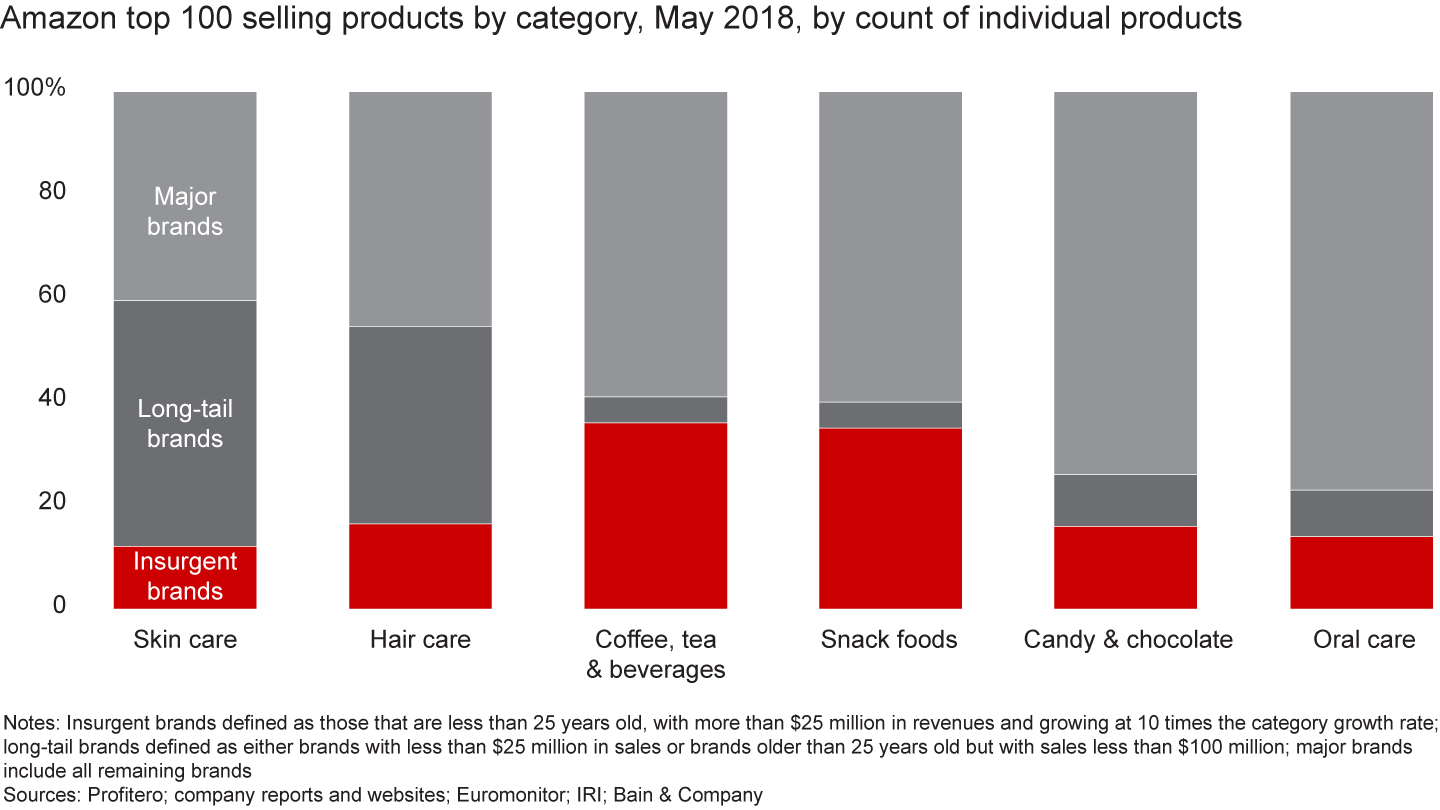
This ability to test and pivot is one reason “insurgent” brands have enjoyed outsized success in e-commerce channels in many categories.[1] (See the Bain Brief “How Insurgent Brands Are Rewriting the Growth Playbook.”) On Amazon, for example, insurgent brands represent as much as a 35% share in some product categories (see Figure 2) . In the bottled water category, Fiji lost 5% of its market share in the second quarter of 2018 to insurgents like Essentia, which gained an additional 4% of the market and now ranks as the category’s top seller on Amazon, according to the e-commerce intelligence firm One Click Retail. Their nimble, entrepreneurial cultures enable insurgents to quickly adapt to changes. Yet while these smaller brands have the early lead in many categories, thanks to their ability to move swiftly, larger brands can battle back, given their strong brand awareness and deeper resources. They often have the advantage in terms of assets they can devote to test and trial. Most insurgents need to make trade-offs, hoping they bet well.
Figure 2

Dissect what truly leads to incremental sales and double down. Too many consumer goods companies are satisfied with superficial views of their e-commerce ROAS—they may look at ROAS in aggregate across campaign types instead of distinguishing between awareness campaigns, which will deliver lower ROAS, and conversion tactics, which will bring in higher ROAS. Also, many companies focus too much on ROAS versus broader shopper acquisition costs.
One common misleading situation occurs when marketing agencies invest the majority of a client’s search budget in “branded” search terms (when a shopper types a product brand name in the search bar on a retailer’s website). The trouble is, because the shopper who was searching for the brand name was more likely to purchase it in the first place, branded searches naturally show higher conversions and returns. The consumer goods company is essentially giving marketing dollars away to acquire a sale that it probably would have won anyway.
To avoid this situation, make sure that you are bidding on the right set of search terms. It is particularly effective to invest in “unbranded search,” nonbrand specific terms that indicate a product (e.g., kids’ snacks vs. pretzels) or occasion (e.g., brunch recipes). Some companies make it a point to think as their consumers do when they create household shopping lists—and then invest in the key words that those consumers would use: tissues, pasta sauce, sponges and so on.
Another common marketing misstep: failing to coordinate promotion strategy across channels and brands, which leads to sales or margin cannibalization. For example, we recently saw a company buying search terms that resulted in its own products being featured when consumers typed in the name of its subsidiary’s brands—it was giving away marketing dollars to compete for a consumer who was looking for one of the company’s own brands. Brands also need to ensure that marketing and other investments tie to broader e-commerce and commercial strategy. It is terrific to optimize Amazon.com or Tmall presence, but not if it is unwittingly at the expense of other important e-commerce channels, particularly a brand’s own site.
Gear offline actions to online impact. Finally, brands should consider other ways that their offline tactics affect online sales. Indeed, it can be counterproductive to be too obsessive about offline sales goals at the expense of online sales. A single example: Marking down items with traditional retailers will lead to price matching online. Amazon dynamically adjusts prices to remain competitive in the marketplace. It is also critical to understand how leakage into your distribution channel can lead to diverted products winding up in the online marketplace—and the policies and procedures you need to enforce with distributors and online retailers to protect your brand.
As shoppers move online—even in low-penetration grocery categories—brands need to view the big shift not as a disruption but as a huge opportunity, one that big brands are well positioned to capture. (See “A note about margins," below.) Consumer goods companies that move far out ahead of competitors in the fastest-growing channel will share common traits. They will not be swayed by “strong” performance. They will create in-house teams with critical capabilities, giving them control of their budgets and content. They will empower their teams to act and double down on what truly contributes to sales, coordinating offline and online actions. In other words, they will win not because of competitors’ errors but because they have learned how to adapt their game amazingly well.
-
Related: A word about margins (click to read)
Soften the bottom-line hit when investing to grow online.
Chasing outsized growth in e-commerce is exciting, but shareholders still expect profits. Unfortunately, the system economics aren’t always attractive. Penny profits online do not always cover shipping costs, for example. Moves like lightweighting products, offering auto-replenishment and developing basket strategies can help, as can a focus on click-and-collect retailers where the system economics are more attractive. Brands that do the best job of maintaining margins as they grow will also look for opportunities to strip out costs. For example, supply chain modifications and agency relationships need to be considered as part of your e-commerce strategy. The most successful companies invest in the requirements for e-commerce early, often well before e-commerce becomes a significant share of their total business. Product development cycles, and the operation and organizational changes needed for e-commerce, too often could take years to get right as companies delay required investment.
Getting started
- Start with understanding the opportunity size relative to broader commercial and e-commerce strategy and earn some quick wins to fund the investment and motivate the team, e.g., your products' search ranking and share of voice vs. competition with large online retailers like Amazon.
- Establish a “test-for-results” team that will run Agile sprints to identify tactical opportunities with attractive return on investment and potential to scale.
- Scale and amplify the benefits and expand results to other channels and regions.
- Build in-house team capabilities and engage the organization to sustain results, with the goal of capturing future penetration growth as consumers continue to migrate online.
- Dedicate yourself to continuous innovation to improve margins.
[1] We define insurgent brands as those that are less than 25 years old, with more than $25 million in revenues and growing at 10 times the category growth rate.
Eileen Shy is a Bain & Company partner based in New York. John Grudnowski is a Bain expert vice president in Minneapolis. Nadya Yankovskaya is a principal and Suzanne Tager is global senior practice director in Bain’s Consumer Products and Retail practices. Both are based in New York.
First published in 9월 2018