
Skip to Content
  • 오피스

    오피스

    미주
    • Atlanta
    • Austin
    • Bogota
    • Boston
    • Buenos Aires
    • Chicago
    • Dallas
    • Denver
    • Houston
    • Los Angeles
    • Mexico City
    • Minneapolis
    • Monterrey
    • Montreal
    • New York
    • Rio de Janeiro
    • San Francisco
    • Santiago
    • São Paulo
    • Seattle
    • Silicon Valley
    • Toronto
    • Washington, DC
    유럽, 중동, 아프리카
    • Amsterdam
    • Athens
    • Berlin
    • Brussels
    • Copenhagen
    • Doha
    • Dubai
    • Dusseldorf
    • Frankfurt
    • Helsinki
    • Istanbul
    • Johannesburg
    • Kyiv
    • Lisbon
    • London
    • Madrid
    • Milan
    • Munich
    • Oslo
    • Paris
    • Riyadh
    • Rome
    • Stockholm
    • Vienna
    • Warsaw
    • Zurich
    아시아, 호주
    • Bangkok
    • Beijing
    • Bengaluru
    • Brisbane
    • Ho Chi Minh City
    • Hong Kong
    • Jakarta
    • Kuala Lumpur
    • Manila
    • Melbourne
    • Mumbai
    • New Delhi
    • Perth
    • Seoul
    • Shanghai
    • Singapore
    • Sydney
    • Tokyo
    오피스 전체보기
  • 얼럼나이
  • 미디어 센터
  • 구독
  • 연락처
  • Korea | 한국어

    지역 및 언어 선택

    글로벌
    • Global (English)
    미주
    • Brazil (Português)
    • Argentina (Español)
    • Canada (Français)
    • Chile (Español)
    • Colombia (Español)
    유럽, 중동, 아프리카
    • France (Français)
    • DACH Region (Deutsch)
    • Italy (Italiano)
    • Spain (Español)
    • Greece (Elliniká)
    아시아, 호주
    • China (中文版)
    • Korea (한국어)
    • Japan (日本語)
  • Saved items (0)
    Saved items (0)

    You have no saved items.

    관심 있는 내용을 북마크하여 Red 폴더에 저장할 수 있습니다. Red 폴더 에서 저장된 내용을 읽거나 공유해보세요.

    Explore Bain Insights
  • 산업
    메인 메뉴

    산업

    • 우주항공, 방산 및 정부 서비스
    • 농업 관련 산업
    • 화학
    • 인프라, 건설 및 건축 자재
    • 소비재
    • 금융 서비스
    • 헬스케어
    • 산업용 기계 및 장비
    • 미디어 및 엔터테인먼트
    • 금속
    • 광업
    • 석유 및 가스
    • 제지 및 패키징 산업
    • 사모펀드
    • 사회 및 공공 부문
    • 유통
    • 기술
    • 텔레콤
    • 운송
    • 여행·여가
    • 유틸리티 및 재생가능 에너지
  • 컨설팅 서비스
    메인 메뉴

    컨설팅 서비스

    • Customer Experience
    • ESG
    • Innovation
    • M&A
    • 운영
    • 조직
    • 사모펀드
    • 고객 전략 및 마케팅
    • 전략
    • AI, 인사이트 및 솔루션
    • Technology
    • 변화 혁신
  • Digital
  • 인사이트
  • 베인 소개
    메인 메뉴

    베인 소개

    • 업무 소개
    • 베인의 신념
    • 구성원 및 리더십 소개
    • 고객 성과
    • 주요 수상 경력
    • 글로벌 파트너사
    Further: Our global responsibility
    • 다양성과 포용
    • 사회 공헌 활동
    • Sustainability
    • World Economic Forum
    Learn more about Further
  • Careers
    메인 메뉴

    Careers

    • Work with Us
      Careers
      Work with Us
      • Find Your Place
      • Our Work Areas
      • Integrated Teams
      • Students
      • Internships & Programs
      • Recruiting Events
    • Life at Bain
      Careers
      Life at Bain
      • Blog: Inside Bain
      • Career Stories
      • Our People
      • Where We Work
      • Supporting Your Growth
      • Affinity Groups
      • Benefits
    • Impact Stories
    • Hiring Process
      Careers
      Hiring Process
      • What to Expect
      • Interviewing
    FIND JOBS
  • 오피스
    메인 메뉴

    오피스

    • 미주
      오피스
      미주
      • Atlanta
      • Austin
      • Bogota
      • Boston
      • Buenos Aires
      • Chicago
      • Dallas
      • Denver
      • Houston
      • Los Angeles
      • Mexico City
      • Minneapolis
      • Monterrey
      • Montreal
      • New York
      • Rio de Janeiro
      • San Francisco
      • Santiago
      • São Paulo
      • Seattle
      • Silicon Valley
      • Toronto
      • Washington, DC
    • 유럽, 중동, 아프리카
      오피스
      유럽, 중동, 아프리카
      • Amsterdam
      • Athens
      • Berlin
      • Brussels
      • Copenhagen
      • Doha
      • Dubai
      • Dusseldorf
      • Frankfurt
      • Helsinki
      • Istanbul
      • Johannesburg
      • Kyiv
      • Lisbon
      • London
      • Madrid
      • Milan
      • Munich
      • Oslo
      • Paris
      • Riyadh
      • Rome
      • Stockholm
      • Vienna
      • Warsaw
      • Zurich
    • 아시아, 호주
      오피스
      아시아, 호주
      • Bangkok
      • Beijing
      • Bengaluru
      • Brisbane
      • Ho Chi Minh City
      • Hong Kong
      • Jakarta
      • Kuala Lumpur
      • Manila
      • Melbourne
      • Mumbai
      • New Delhi
      • Perth
      • Seoul
      • Shanghai
      • Singapore
      • Sydney
      • Tokyo
    오피스 전체보기
  • 얼럼나이
  • 미디어 센터
  • 구독
  • 연락처
  • Korea | 한국어
    메인 메뉴

    지역 및 언어 선택

    • 글로벌
      지역 및 언어 선택
      글로벌
      • Global (English)
    • 미주
      지역 및 언어 선택
      미주
      • Brazil (Português)
      • Argentina (Español)
      • Canada (Français)
      • Chile (Español)
      • Colombia (Español)
    • 유럽, 중동, 아프리카
      지역 및 언어 선택
      유럽, 중동, 아프리카
      • France (Français)
      • DACH Region (Deutsch)
      • Italy (Italiano)
      • Spain (Español)
      • Greece (Elliniká)
    • 아시아, 호주
      지역 및 언어 선택
      아시아, 호주
      • China (中文版)
      • Korea (한국어)
      • Japan (日本語)
  • Saved items  (0)
    메인 메뉴
    Saved items (0)

    You have no saved items.

    관심 있는 내용을 북마크하여 Red 폴더에 저장할 수 있습니다. Red 폴더 에서 저장된 내용을 읽거나 공유해보세요.

    Explore Bain Insights
  • 산업
    • 산업

      • 우주항공, 방산 및 정부 서비스
      • 농업 관련 산업
      • 화학
      • 인프라, 건설 및 건축 자재
      • 소비재
      • 금융 서비스
      • 헬스케어
      • 산업용 기계 및 장비
      • 미디어 및 엔터테인먼트
      • 금속
      • 광업
      • 석유 및 가스
      • 제지 및 패키징 산업
      • 사모펀드
      • 사회 및 공공 부문
      • 유통
      • 기술
      • 텔레콤
      • 운송
      • 여행·여가
      • 유틸리티 및 재생가능 에너지
  • 컨설팅 서비스
    • 컨설팅 서비스

      • Customer Experience
      • ESG
      • Innovation
      • M&A
      • 운영
      • 조직
      • 사모펀드
      • 고객 전략 및 마케팅
      • 전략
      • AI, 인사이트 및 솔루션
      • Technology
      • 변화 혁신
  • Digital
  • 인사이트
  • 베인 소개
    • 베인 소개

      • 업무 소개
      • 베인의 신념
      • 구성원 및 리더십 소개
      • 고객 성과
      • 주요 수상 경력
      • 글로벌 파트너사
      Further: Our global responsibility
      • 다양성과 포용
      • 사회 공헌 활동
      • Sustainability
      • World Economic Forum
      Learn more about Further
  • Careers
    최근 검색어
      최근 방문 페이지

      Content added to saved items

      Saved items (0)

      Removed from saved items

      Saved items (0)

      Brief

      Hacking Software’s Rule of 40

      Hacking Software’s Rule of 40

      Software companies need to balance growth and profitability to create lasting value.

      글 Thierry Depeyrot and Simon Heap

      • 읽기 소요시간
      }

      Brief

      Hacking Software’s Rule of 40
      en
      한눈에 보기
      • Large software companies are, increasingly, measured against the Rule of 40: the idea that growth rate plus profit margin should exceed 40%.
      • Young companies often beat that mark with their rapid growth. But older companies, whose growth has tapered off, need to improve performance and profit margins to hit that metric.
      • Beating the Rule of 40 in a single year is admirable, but the greater challenge is balancing growth and performance year after year.

      The Rule of 40—the principle that a software company’s combined growth rate and profit margin should exceed 40%—has gained momentum as a high-level gauge of performance for software businesses in recent years, especially in the realms of venture capital and growth equity. Increasingly, software industry executives are embracing the Rule of 40 as an important metric to help measure the trade-offs of balancing growth and profitability.

      • Click to expand: About the Rule of 40

        Venture capitalists began to popularize the Rule of 40 in 2015 as a high-level health check for SaaS companies, but it’s broadly applicable to most software companies. The metric neatly captures the fundamental trade-off between investing in growth (including new products and customer acquisition) and short-term profitability. Analysts have differed on which measure of profitability to use—most use EBITDA, but some have proposed free cash flow, EBIT or net income as alternatives. We use EBITDA, a publicly available profitability metric that excludes the effect of taxes and accounting policies.

      Venture capital investors initially came up with the Rule of 40 as a way to quickly assess the performance of small, fast-growing companies. For larger companies, beating the Rule of 40 in a single year is not exceptional. In fact, over such a short period, the top quintile of software businesses approaches a gross profit ratio of 50% (see Figure 1).

      Figure 1
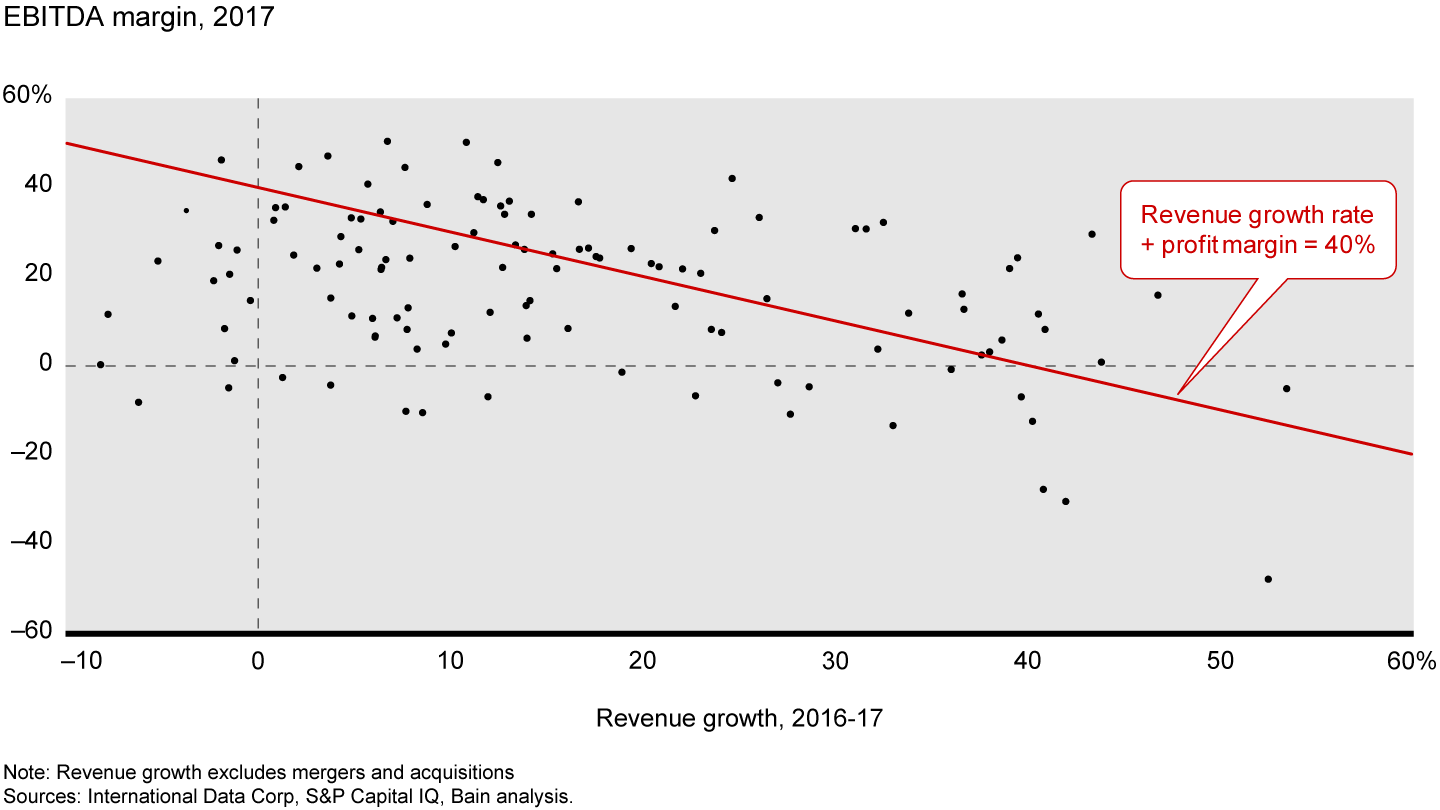
      In 2017, 40% of software companies outperformed the Rule of 40
      In 2017, 40% of software companies outperformed the Rule of 40
      In 2017, 40% of software companies outperformed the Rule of 40

      Consistently strong performance against the Rule of 40, however, is difficult to maintain. Bain & Company researched the performance of 124 publicly traded software companies to identify those that outperformed the Rule of 40 over three years and five years. We found that 40% of them outperformed the Rule of 40 in a single year (2017). But of 86 companies researched from 2013 to 2017, just 25% outperformed the Rule of 40 for three or more years, and only 16% outperformed for all five years, adjusted for mergers and acquisitions (see Figure 2).

      Figure 2
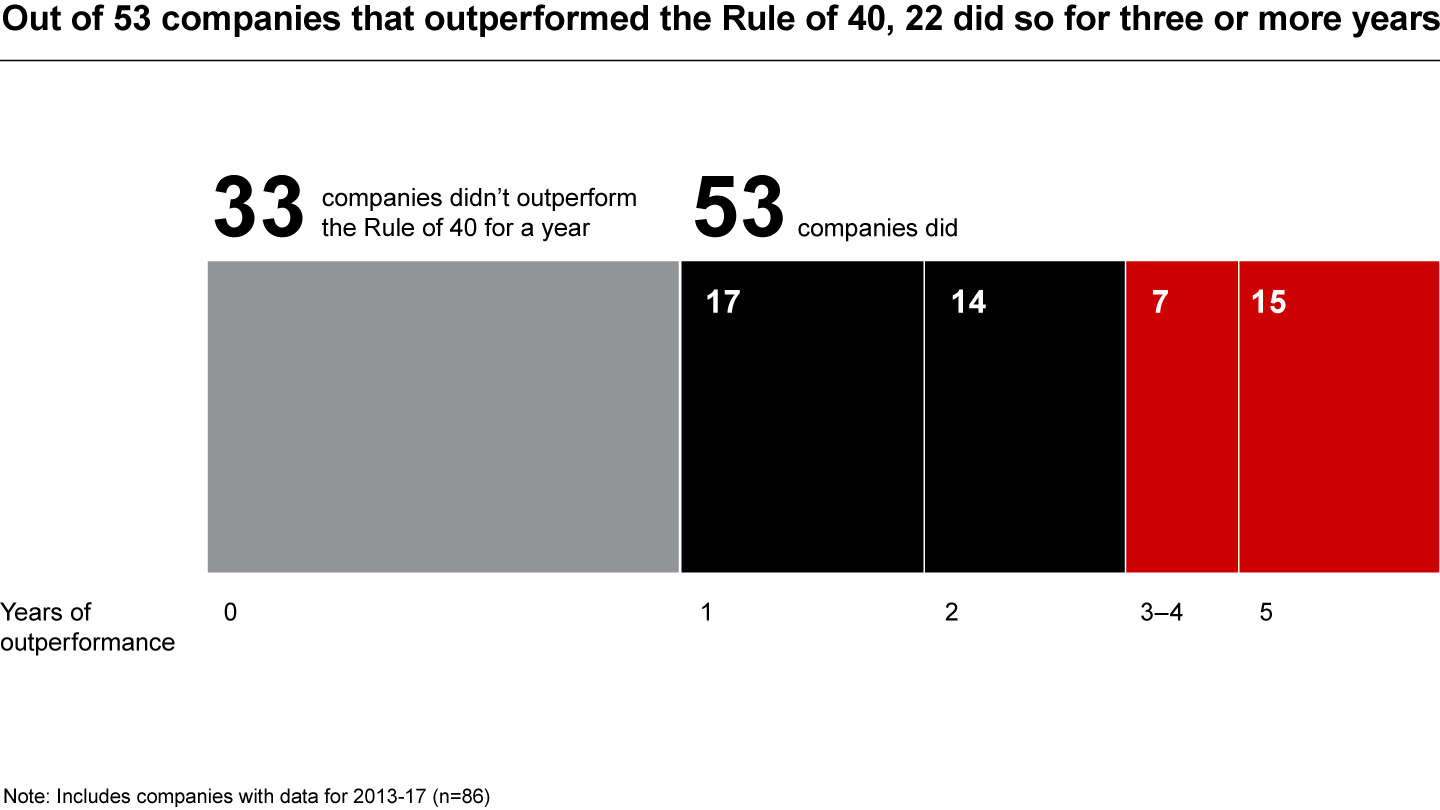
      Consistently outperforming the Rule of 40 is difficult
      Consistently outperforming the Rule of 40 is difficult
      Consistently outperforming the Rule of 40 is difficult

      What’s more, once a business has matured and its growth has slowed, it’s difficult to regain that growth. Among companies with growth rates higher than 10% in 2004–05, average revenue growth sank below 10% over time and has not bounced back (see Figure 3). Continuing growth at scale is also hard; only five software companies have grown to $5 billion from $1 billion in the past 20 years.

      Figure 3
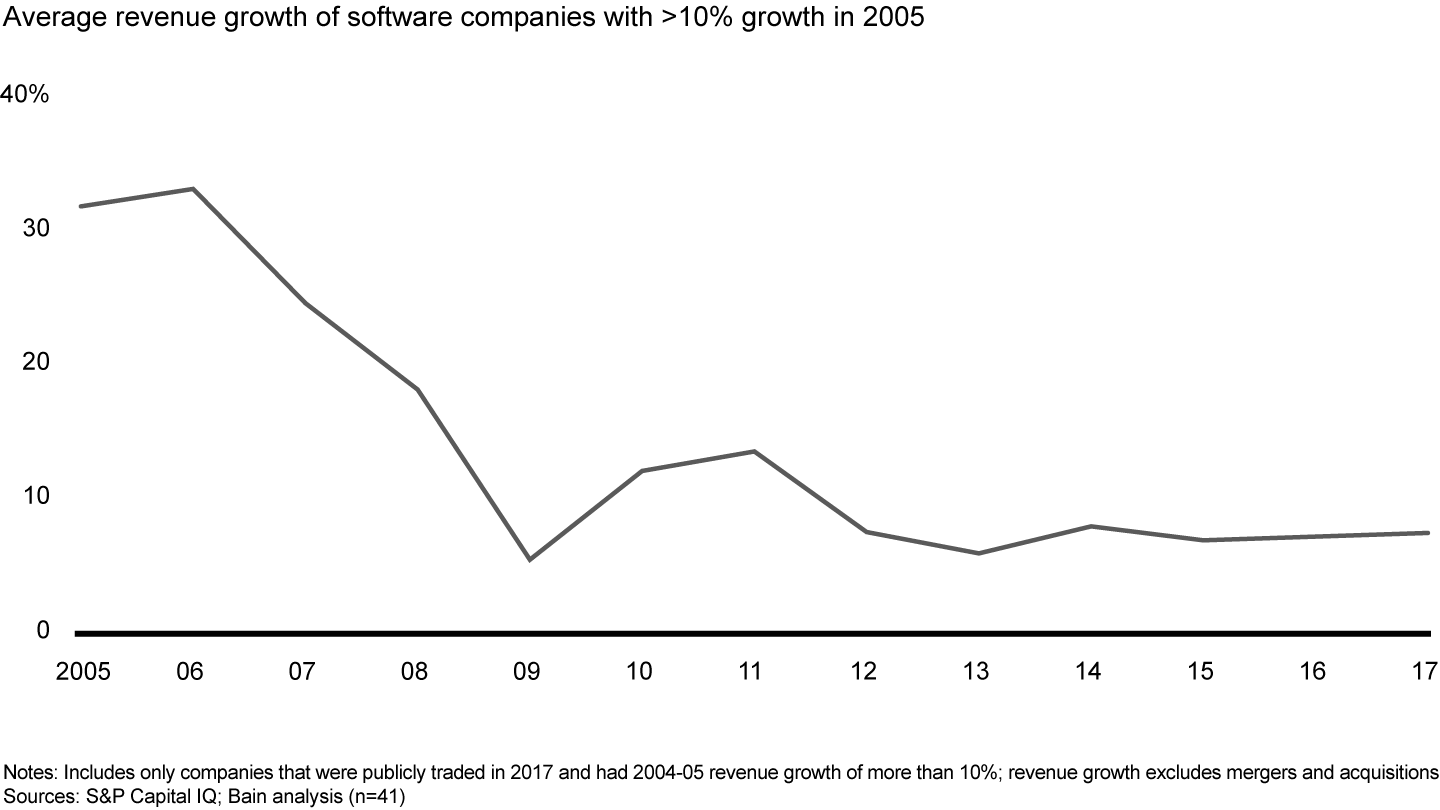
      Growth falls off over time – and is difficult to revive
      Growth falls off over time – and is difficult to revive
      Growth falls off over time – and is difficult to revive

      Software companies that can balance growth and profitability to outperform the Rule of 40 have valuations (measured by the ratio of enterprise value to revenue) double that of companies that fall “below the line,” and they achieve returns as much as 15% higher than the S&P 500. Companies whose growth slows and that fail to improve profitability often find themselves the target of activist investors and private equity acquirers.

      Bain Partner Thierry Depeyrot explains how software companies can achieve sustained, profitable growth.

      Three ways to beat the Rule of 40

      Companies can beat the Rule of 40 at all stages of their life cycle.

      • Strong growth. Of the companies that outperform the Rule of 40 over five years, one-third achieve it with revenue growth above 30%. These companies—such as Splunk, Wix and Workday—are modestly profitable while investing in hypergrowth to build a large installed base, displace legacy vendors and attain the holy grail of becoming a platform. Beyond $1 billion in revenue, software businesses must evolve their operating model and process maturity to handle the complexities of serving multiple customer segments, with multiple products, across many countries. As growth slows, mature software companies look for ways to generate more revenue from existing customers, while becoming more efficient to increase profit margins and maintain performance that beats the Rule of 40.
      • Balanced, profitable growth. Half of the companies consistently exceeding the Rule of 40 do so with revenue growth between 10% and 30%. Such large, established companies as VMWare, Adobe and Salesforce have successfully developed new products for markets adjacent to their core, and navigated technology or business model transitions (for example, to SaaS and subscription models) to keep growing. Having climbed the S-curve, they must reorient their approach to reach the next level. Some companies accustomed to rapid growth struggle to adapt. For example, R&D spending needs to reflect the fact that subsequent waves of innovation might not be as valuable as the earlier breakthroughs, relative to the business size, and that the mix of investment may need to shift to renewing the original architecture. Disciplined and data-driven portfolio management and investment choices become increasingly important.
      • Profitability. We also found that 18% of companies beat the Rule of 40 with annual organic revenue growth below 10%. Established players like Oracle, SAP and Trend Micro have large, profitable flagship businesses. With growth stabilizing below 10%, companies turn to becoming more efficient and profitable—exacting pricing power, leveraging the scale and scope of large salesforces, cross-selling and expanding installed base customers, exploring new business models, increasing renewals, moderating R&D investment.
      Infographic

      How Software Firms Can Outpace the Rule of 40

      Consistently beating this magic number remains elusive for large, established firms. But it’s possible with the right moves.

      Increasing efficiency and effectiveness in a maturing business

      It’s difficult to consistently and sustainably outperform. Each company faces its own unique profitability challenges across products and offerings, engineering efficiency and effectiveness, go-to-market productivity and customer life cycle management. But most successful companies display a few common patterns.

      • Focus on installed base. Customers are the biggest asset of a mature software business. Retaining that base, and expanding the value delivered to it, becomes the top priority. Ensuring customer success, investing in customer-centric innovation, developing broader and deeper solutions strategies, and implementing pricing strategies and discipline are all essential. Customer data can help provide insights on the best ways to deliver, as marketing investments shift to “farming” over “hunting.” They need to establish more efficient ways of selling to established customers, for example, by deploying inside sales rather than expensive field forces, and paying channel partners based on the value they add.
      • Engineering productivity. Engineering groups face new challenges as a business matures. In addition to being directed by smart portfolio investment choices, engineering groups need to balance the demands of delivering new features with those of product maintenance—all while dealing with the technical debt that often slows them down. Getting clarity on priorities and visibility into how sprawling engineering groups are spending time to align with those priorities is paramount. Streamlining roles, supporting critical developers and clarifying site strategy can refocus the best resources on building what is important in the most cost-effective way.
      • Operational efficiency. For mature companies, the enemy of efficiency is often complexity. Processes and systems reflect historical choices as new products, customer and countries are added to the business mix, along with new acquisitions. Continuous streamlining and process automation can help raise efficiency. This can include reducing the number of SKUs and price meters, streamlining the number of legal entities and channel types, clarifying the roles of operational teams and removing duplication, and eliminating layers of management.

      Some of the most successful software businesses gauge their performance against the Rule of 40, and many others increasingly aspire to achieve it across the various stages of their life cycles. What’s more, the rule is helpful not only at the companywide level, but as a way to assess the performance of business units or product families within an organization. Indeed, for some companies, focusing on and achieving the Rule of 40 at the unit level is an ideal way to get started, allowing them to build the goal into their business planning and performance assessments.

      Thierry Depeyrot and Simon Heap are partners with Bain & Company’s Global Technology practice, and both work in the firm’s Silicon Valley office.

      저자
      • Headshot of Thierry Depeyrot
        Thierry Depeyrot
        Executive Vice President, Coro, Silicon Valley
      • Headshot of Simon Heap
        Simon Heap
        어드바이저 파트너, Silicon Valley
      문의하기
      관련 산업
      • 기술
      최적의 솔루션 찾기
      • Software Value Creation
      기술
      In Enterprise Software, Renewals and Retention Have Never Been More Important

      Covid-19 has changed every customer’s finances. Vendors should respond with new segmentations and offers.

      자세히 보기
      기술
      Software M&A

      The good news: Most deal best practices still apply to AI acquisitions.

      자세히 보기
      Software Value Creation
      India SaaS Report 2022

      Remaining steady through turbulence

      자세히 보기
      기술
      Exploring AI for Packaging Circularity

      AI is already creating value across the packaging lifecycle, from optimising design and reducing material use to improving sorting and traceability.

      자세히 보기
      기술
      How Businesses Can Prepare for Post-Quantum Cybersecurity Threats

      Your company will soon face attackers armed with quantum technology. Will you be ready?

      자세히 보기
      First published in 12월 2018
      태그
      • 기술
      • Software Value Creation

      프로젝트 사례

      Helping a Midsize ERP Player Compete against the Giants

      See more related case studies

      성과 개선 Aggressively growing an IT service provider with a high-performance culture

      See more related case studies

      고객 전략 및 마케팅 When the price is right, customers respond

      See more related case studies

      베인에 궁금하신 점이 있으신가요?

      베인은 주저 없이 변화를 마주할 줄 아는 용감한 리더들과 함께합니다. 그리고, 이들의 담대한 용기는 고객사의 성공으로 이어집니다.

      급변하는 비즈니스 환경에서 살아남기 위한 선도자의 시각. 월간 Bain Insights에서 글로벌 비즈니스의 핵심 이슈를 확인하십시오.

      *개인정보 정책을 읽었으며 그 내용에 동의합니다.

      Privacy Policy를 읽고 동의해주십시오.
      Bain & Company
      문의하기 환경정책 Accessibility 이용약관 개인정보 보호 쿠키 사용 정책 Sitemap Log In

      © 1996-2026 Bain & Company, Inc.

      문의하기

      무엇을 도와드릴까요?

      • 프로젝트 문의
      • 채용 정보
      • 언론
      • 제휴 문의
      • 연사 초청
      오피스 전체보기